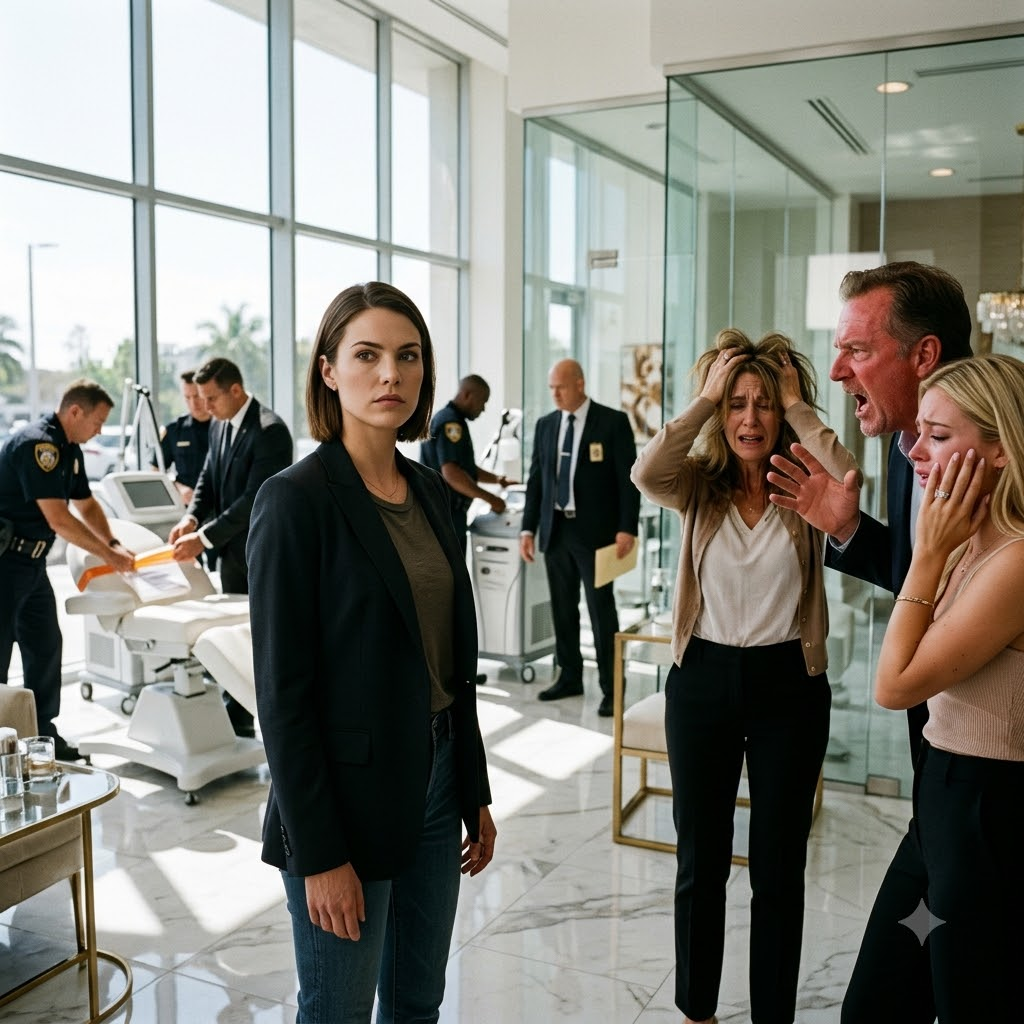
"Take that worthless piece of junk to the scrap yard, Fallon!" my mother snapped, pointing at the antique sewing machine.
Across the mahogany desk, probate attorney Charles Whitmore held a yellowed envelope bearing my grandmother's signature.
Three words were written beneath the seal.
For Fallon only.
My younger sister had just inherited three hundred thousand dollars.
But the attorney wasn't looking at her.
He was looking at me.
And for the first time that afternoon, my mother's smile disappeared.
Twenty minutes earlier, I had walked into Whitmore's downtown Chicago office expecting nothing more than a painful formality.
My grandmother, Margaret Bellamy, had been dead for eleven days.
Eleven days since I had held her thin, trembling hand in the bedroom where she'd spent the final three years of her life.
Eleven days since I'd watched the woman who raised me take her last breath.
And eleven days since my mother had finally remembered that I existed.
Not to ask whether I was grieving.
Not to thank me for the decade I'd spent caring for Grandma.
But to remind me to wear something respectable to the reading of the will.
"Don't embarrass us, Fallon," she'd said over the phone. "This is a professional occasion."
I almost laughed.
Professional.
That was the word my mother used whenever she wanted to disguise cruelty as good manners.
My name is Fallon Bellamy. I was thirty-eight years old, unmarried, and the owner of a small adaptive clothing and alterations business on Chicago's Northwest Side.
I designed garments for people whose bodies didn't fit the assumptions of ordinary fashion.
Wheelchair users who needed trousers that wouldn't bunch beneath their thighs.
Women recovering from mastectomies who wanted beautiful dresses without painful seams.
Children with muscular disorders who deserved to wear clothes that made them feel like everyone else.
My work was never glamorous.
It rarely made me rich.
But when a twelve-year-old girl who had spent her entire life wearing hospital gowns looked in the mirror and smiled at a dress I'd made for her, I knew exactly why I did it.
My mother never understood that.
"You're a seamstress," she would say whenever someone asked about my career.
Not a designer.
Not a business owner.
A seamstress.
She always managed to make the word sound like an apology.
My younger sister, Elodie, was twenty-nine.
Beautiful, charming, and completely incapable of hearing the word no.
She owned a luxury medical spa called Élan Aesthetics, where wealthy clients paid outrageous prices for treatments advertised with words like rejuvenation, renewal, and transformation.
Elodie loved transformation.
Especially when someone else was paying for it.
My parents had financed her business.
They'd paid for her apartment.
They'd purchased her first car, then her second.
And when she decided that ordinary designer handbags weren't sufficiently exclusive, my mother accompanied her to private shopping appointments.
Meanwhile, I had been caring for Grandma.
Ten years.
Three thousand six hundred and fifty days, give or take a few.
I knew the exact angle of her hospital bed that prevented pressure sores.
I knew which medications made her nauseated.
I knew how she liked her tea.
I knew the difference between the expression she made when she was genuinely in pain and the one she made when she was pretending she didn't need help.
There were nights I slept on a folding chair beside her bed.
Mornings when I washed her sheets before opening my shop.
Afternoons when I canceled paying appointments because she needed to see a specialist.
And there were holidays when my parents and Elodie sent flowers instead of visiting.
Usually expensive flowers.
My mother believed that spending money on something made it equivalent to caring.
Grandma never complained.
But sometimes, when I was brushing her hair, she'd catch my wrist.
"You're giving away too much of yourself, sweetheart."
I'd smile.
"You're worth it."
She would look at me for a long moment.
Then she'd say something that never quite made sense.
"One day, you'll understand why I kept the old things."
I assumed she meant memories.
I was wrong.
The attorney's office occupied the twenty-third floor of a building overlooking the Chicago River.
The furniture was expensive.
The carpet was thick enough to swallow footsteps.
And the receptionist had offered me sparkling water in a glass that probably cost more than my weekly groceries.
My mother arrived wearing a cream-colored designer suit and a diamond necklace she'd received for her sixtieth birthday.
My father, Richard Bellamy, followed behind her.
He was sixty-seven, a retired commercial property investor who still carried himself like a man accustomed to being obeyed.
He kissed Elodie's cheek.
He nodded at me.
"Fallon."
"Dad."
That was our entire conversation.
Elodie entered last, carrying a handbag with a gold clasp and wearing perfume strong enough to announce her arrival before the elevator opened.
She hugged my mother.
Then she looked at my clothes.
"You're wearing that?"
I glanced down at my charcoal trousers and simple blouse.
"What's wrong with it?"
"Nothing." She smiled. "It's just very you."
There are insults that don't require explanation.
That was one of them.
We entered the conference room at exactly two o'clock.
Charles Whitmore was a silver-haired attorney in his early sixties.
He had represented Grandma for nearly twenty years.
I remembered him visiting her house occasionally when I was younger, usually carrying a leather briefcase and speaking in the quiet, respectful manner of someone who understood that Grandma didn't tolerate nonsense.
He greeted us individually.
When he reached me, he held my hand a moment longer than necessary.
"I'm very sorry for your loss, Fallon."
"Thank you."
"Your grandmother spoke highly of you."
My throat tightened.
That was the first kind thing anyone in my family had said to me all afternoon.
We sat.
Whitmore opened a folder.
"Margaret Bellamy executed her final will and testament with the appropriate formalities. I will now explain the distributions."
My mother leaned forward.
Elodie crossed her legs.
My father checked his watch.
I stared at the edge of the table.
I hadn't come for money.
I had come because this was the final piece of paperwork connecting me to the woman I'd loved most in the world.
Whitmore adjusted his glasses.
"To my granddaughter, Elodie Bellamy, I leave the sum of three hundred thousand dollars, payable from my designated liquid estate account."
Elodie gasped.
Then she laughed.
"Oh my God."
My mother grabbed her hand.
"Darling!"
Elodie's eyes filled with delighted tears.
"Three hundred thousand?"
Whitmore nodded.
"That is correct."
She turned toward my father.
"Dad, I can finally finish the expansion!"
He smiled proudly.
"Your grandmother knew you had ambition."
I looked down.
Three hundred thousand dollars.
I hadn't known Grandma possessed that much cash.
But Grandma had always been careful with money.
She'd grown up during hard times, worked for decades, and invested quietly.
Still, the amount surprised me.
Not because I wanted it.
Because Elodie had visited Grandma perhaps six times during her final three years.
Four of those visits had been less than an hour.
One had ended when Grandma refused to give her money for a vacation.
The other had involved Elodie taking photographs beside Grandma's hospital bed for social media.
I remembered the caption.
Family is everything.
Grandma had asked me to remove the makeup Elodie had put on her afterward.
"It makes me itch," she'd whispered.
Whitmore turned a page.
"To my granddaughter, Fallon Bellamy, I leave my antique Singer sewing machine, together with its original oak cabinet and all components contained therein."
Silence.
I raised my head.
"The sewing machine?"
"Yes."
I knew exactly which machine he meant.
Grandma's Singer.
Black lacquer.
Gold floral detailing, most of it worn away.
A heavy iron treadle beneath a solid oak cabinet.
It had sat near her bedroom window for as long as I could remember.
When I was little, she would let me sit beside her and watch the needle move.
She'd taught me to thread it when I was eight.
By ten, I could sew a straight seam.
By twelve, I was making dresses for my dolls.
That machine had started everything.
And now it was mine.
I should have felt happy.
Instead, an ugly, unwanted thought entered my mind.
Was that really all?
Ten years.
Ten years of medication schedules, hospital bills, sleepless nights, and canceled plans.
And Grandma had left Elodie three hundred thousand dollars.
While I received an old machine that barely worked.
I hated myself for thinking it.
Grief and disappointment tangled together in my chest.
My mother broke the silence.
She laughed.
Not loudly.
Just enough to make sure everyone heard.
"Well, that's appropriate."
Elodie pressed her lips together.
I knew that expression.
She was trying not to laugh.
My mother turned toward me.
"At least Margaret gave you something useful for your little sewing hobby."
"It's a business, Mom."
"Of course, sweetheart."
She looked at Whitmore.
"Is the machine even worth anything?"
Whitmore's expression remained neutral.
"I haven't commissioned an appraisal."
My mother waved a hand.
"Probably twenty dollars in scrap metal."
Elodie giggled.
"Maybe fifty if the rust is vintage."
My father sighed.
"Let's not make a scene."
I almost thanked him.
Then he added, "Fallon should be grateful. Your grandmother could have left her nothing."
Something inside me went very still.
I looked at the three people sitting across from me.
My father, who had never once offered to sit with Grandma overnight.
My mother, who complained that visiting her own mother was depressing.
My sister, who had just inherited more money than I had earned in several years.
And I realized that none of them had asked whether I was all right.
Not once.
Whitmore cleared his throat.
"There are additional instructions regarding the transfer of the sewing machine."
My mother rolled her eyes.
"Good Lord. Does it need its own lawyer?"
Whitmore ignored her.
"Margaret specified that the machine and its cabinet must be delivered intact to Fallon. No components are to be removed, replaced, or separated before transfer."
My father frowned.
"That's oddly specific."
"It is her written instruction."
"Fine."
Whitmore looked directly at me.
"Fallon, your grandmother was particularly concerned that you receive the complete machine."
"Why?"
He paused.
"I can only say that she was very deliberate about the wording."
My mother checked her phone.
"Can we finish? Elodie has a dinner reservation."
Whitmore continued reading the remaining provisions.
There were modest charitable donations.
A few pieces of jewelry designated for distant relatives.
Some household possessions.
And instructions concerning Grandma's burial expenses, which had already been paid.
Nothing else for me.
When he finished, Elodie immediately began discussing the money.
"How soon can I get it?"
"Distributions are subject to estate administration and the applicable procedures," Whitmore replied.
"But soon?"
"I will provide a written timeline."
She smiled.
"Perfect."
I stood.
"Thank you, Mr. Whitmore."
He rose as well.
"Fallon, may I speak with you privately before you leave?"
My mother looked up.
"About what?"
"An administrative matter."
"Well, don't take too long."
She turned back to Elodie.
They were already discussing the spa expansion.
I followed Whitmore toward the door.
Before we reached it, my mother called after me.
"Fallon?"
I stopped.
She pointed toward the storage area where the machine had been prepared for collection.
"Take it straight to the scrap yard. Maybe the rusty metal will cover half a month's rent on your failing alteration shop."
Elodie burst out laughing.
I felt my face grow hot.
But I didn't answer.
Because I could still hear Grandma's voice.
Never argue with someone who enjoys making you smaller.
I followed Whitmore into his office.
He closed the door.
For several seconds, he said nothing.
Then he opened a drawer and removed a small envelope.
The paper was yellowed.
My grandmother's handwriting covered the front.
For Fallon only.
I recognized the uneven letters immediately.
During her final year, Grandma's hands had trembled so badly that writing even a birthday card became exhausting.
Whitmore placed the envelope on his desk.
"Your grandmother asked me to give you this separately."
My heart started beating faster.
"What is it?"
"A personal note."
"Why wasn't it included with the will?"
"Because she specifically requested that it be delivered to you privately."
I reached for it.
He hesitated.
"There's something else."
I looked up.
"Your grandmother made several changes to her estate documents during the last eighteen months."
"Changes?"
"Yes."
"Did she explain why?"
Whitmore folded his hands.
"She was concerned about certain family financial arrangements."
A cold sensation moved through my stomach.
"What arrangements?"
"I'm limited in what I can discuss without reviewing the relevant authorizations and records."
"Was someone taking advantage of her?"
His expression changed.
Only slightly.
But I saw it.
"Fallon, I would advise you to keep the machine secure."
I stared at him.
"What?"
"Do not dispose of it."
"I wasn't planning to."
"And do not allow anyone to remove any part of it."
"Why would anyone want to?"
He looked toward the closed door.
Then back at me.
"Your grandmother believed it was important that you receive it exactly as she left it."
I waited.
He said nothing more.
I picked up the envelope.
My hands were shaking.
"Can I open it?"
"Of course."
Inside was a single folded sheet.
I unfolded it carefully.
The handwriting was difficult to read.
But the message was short.
My darling Fallon,
You gave me ten years of your life when everyone else gave me excuses.
I know what they will say about the machine.
Let them say it.
Remember what I taught you when you were little.
The strongest stitches are the ones nobody sees.
Love always,
Grandma.
I read it twice.
Then a third time.
My vision blurred.
I pressed the paper against my chest.
Whitmore looked away politely.
For the first time since Grandma's funeral, I cried.
Not because of the money.
Not because of my family.
Because I could hear her speaking those words.
And because, for one terrible moment, I wanted to call her and ask what she meant.
But there was no one to call.
The sewing machine weighed nearly sixty pounds.
A maintenance employee helped me load it into the trunk of my battered Honda Civic.
The oak cabinet was scratched.
One hinge was loose.
The iron treadle had rusted around the edges.
But beneath the dust, I could still see the faded gold flowers Grandma used to polish with a soft cloth.
I ran my fingers across them.
"I've got you," I whispered.
I didn't know whether I was talking to the machine or to Grandma.
Maybe both.
As I closed the trunk, Elodie appeared beside me.
"Hey, Fallon."
I turned.
She was holding her phone.
"Listen, don't take Mom personally."
I almost laughed.
"Which part?"
"You know how she is."
"Yes. I do."
Elodie shifted her weight.
"Anyway, I wanted to ask something."
"Go ahead."
"Are you actually going to keep that thing?"
"The machine?"
"Yeah."
"Of course."
She frowned.
"Why?"
"Because Grandma left it to me."
"Right, but it's not like you're going to use it. You have modern equipment."
"That's not the point."
She looked toward my trunk.
Something flickered across her face.
Not amusement.
Not pity.
Something sharper.
"Did Whitmore say anything else about it?"
I watched her carefully.
"Like what?"
"I don't know. Special instructions?"
"He said to keep it intact."
Her expression tightened.
Then she smiled.
"That's so Grandma."
I didn't answer.
She reached into her handbag.
"Actually, I could probably find somewhere nice to display it at the spa."
I blinked.
"Your spa?"
"Sure. Vintage decor is trendy."
"Since when?"
"Fallon, don't be difficult."
"I'm not."
She glanced at the trunk again.
"Maybe we could work something out."
I shook my head.
"I'm keeping it."
Her smile disappeared.
For half a second, she looked genuinely angry.
Then she laughed.
"Fine. Whatever. Enjoy your rusty inheritance."
She walked away.
I stood beside my car, watching her disappear into the parking garage.
Something about that conversation bothered me.
Elodie had never shown the slightest interest in sewing.
She once told me that handmade clothes were what people bought when they couldn't afford designer labels.
And now she wanted Grandma's machine as decoration?
It didn't make sense.
But grief makes ordinary things feel strange.
I told myself I was imagining it.
Then I drove to my workshop.
My shop occupied the ground floor of a narrow brick building near Irving Park.
The sign above the window read:
FALLON BELLAMY — ADAPTIVE DESIGN & ALTERATIONS.
The letters were faded.
The front door stuck when it rained.
And the heating system made a noise like an angry lawn mower.
But it was mine.
Every inch of it.
I had built the business with a secondhand sewing machine, a borrowed cutting table, and savings from three jobs.
Over the years, I'd added industrial equipment, fitting stations, and shelves of fabric.
It wasn't impressive by my mother's standards.
But my clients trusted me.
That mattered more.
I parked behind the building and struggled to unload Grandma's machine.
By the time I got it inside, my shoulders ached.
I placed it near the back workbench.
For several minutes, I simply stood looking at it.
I remembered Grandma sitting beside me when I was eight.
"Don't pull the fabric," she'd said. "Guide it."
"But it keeps going crooked."
"Then stop and begin again."
"What if I ruin it?"
She'd smiled.
"Sweetheart, fabric is forgiving. People are the ones who make things difficult."
I smiled through fresh tears.
Then I opened the cabinet.
The interior smelled of old wood and machine oil.
A small drawer contained several empty bobbins, a broken thimble, and a packet of needles.
I touched each object.
They felt like pieces of a life that had suddenly become unreachable.
The machine itself was worse than I remembered.
Its balance wheel barely moved.
The needle bar seemed stuck.
A thick layer of dust covered the base.
I tried turning the wheel gently.
It resisted.
I stopped immediately.
Grandma had taught me never to force a mechanism.
I decided to clean it the following morning.
My phone rang.
Elodie.
I almost ignored it.
Then I answered.
"Hello?"
"Hey, Fallon!"
Her voice was unusually cheerful.
"Hi."
"Listen, I've been thinking."
"About what?"
"Grandma's machine."
I looked toward the workbench.
"What about it?"
"Well, I feel kind of guilty."
I said nothing.
"You know, getting all that money while you got the old machine."
"Okay."
"So Mom and I talked."
My stomach tightened.
"And?"
"We'd like to buy it from you."
I stared at the machine.
"Why?"
"Sentimental reasons."
"Sentimental?"
"Yes."
"Elodie, you haven't mentioned that machine in twenty years."
She laughed.
"People change."
"Apparently."
"Anyway, we'd give you five thousand dollars."
I stopped breathing for a moment.
"Five thousand?"
"Cash. Or wire transfer. Whatever you prefer."
I looked at the rusted treadle.
The scratched cabinet.
The worn lacquer.
Five thousand dollars.
For a machine my mother had called scrap metal.
"Why?"
"I just told you."
"Sentimental reasons?"
"Exactly."
"Then why didn't you ask Grandma for it when she was alive?"
Silence.
A short, uncomfortable silence.
Then Elodie sighed.
"Fallon, do you want the money or not?"
"No."
"What?"
"I'm keeping the machine."
"Don't be ridiculous."
"It's mine."
"Five thousand dollars is a lot of money for you."
I felt the familiar sting.
For me.
Not for her.
"Goodbye, Elodie."
"Wait—"
I ended the call.
For a long time, I stared at the screen.
Then I looked at Grandma's machine.
Something was wrong.
I didn't know what.
But I knew one thing.
Nobody in my family had ever offered me five thousand dollars out of guilt.
Not once.
At 6:42 p.m., Elodie called again.
I let it go to voicemail.
Her message was brief.
"Fallon, Mom says we can do ten thousand. Seriously. Just call me back."
At 7:18, another message arrived.
"Twelve thousand. Final offer. Don't make this weird."
I sat at my cutting table, listening to her voice.
Twelve thousand dollars.
For an antique sewing machine that might be worth a few hundred in restored condition.
My skin prickled.
I opened a search engine on my phone and looked up similar machines.
Some sold for a hundred dollars.
Others for three hundred.
Rare examples in exceptional condition could bring more.
But Grandma's machine was neither rare-looking nor well preserved.
It had rust.
Peeling lacquer.
A seized mechanism.
And a damaged cabinet.
I couldn't imagine anyone paying twelve thousand dollars for it.
Unless the machine itself wasn't what they wanted.
I looked toward the oak base.
Grandma's letter echoed in my mind.
The strongest stitches are the ones nobody sees.
I walked over and knelt beside the cabinet.
I examined the hinges.
The drawers.
The iron frame.
Nothing looked unusual.
Then I noticed a faint scratch near the underside of the cabinet.
It ran parallel to the wood grain.
Too straight to be accidental.
I touched it.
The wood felt slightly uneven.
I crouched lower.
There was a narrow seam.
Not where I expected one.
I tried pressing it.
Nothing moved.
My phone rang again.
This time, it was my mother.
I answered.
"Fallon."
Her voice was clipped.
"Yes?"
"Elodie tells me you're being unreasonable."
"About what?"
"The machine."
"It's mine."
"Don't start."
"I'm not starting anything."
"Your sister has generously offered you twelve thousand dollars for an object that has no practical value."
"Then why does she want it?"
"Because it belonged to my mother."
"So did the jewelry you took."
Silence.
Then her voice hardened.
"You always have to make everything difficult."
"I asked a question."
"Your grandmother wanted peace in this family."
I almost laughed.
"Did she?"
"Don't use her death to be cruel."
I stared at the phone.
There it was.
The familiar trick.
They insulted me.
I objected.
And suddenly I was the cruel one.
"Mom, I'm not selling the machine."
"Fallon."
"No."
"Listen carefully."
Her voice changed.
The sharpness disappeared.
Something colder replaced it.
"Some things are better left where they belong."
I felt a chill.
"What does that mean?"
"It means you're not equipped to handle certain family matters."
"Like what?"
"Don't play games with me."
"I'm not."
"Then take the money."
"No."
Her breathing became audible.
For a moment, I thought she might scream.
Instead, she said, very quietly, "You'll regret being stubborn."
The call ended.
I remained motionless.
My mother had threatened me before.
Usually with money.
Or embarrassment.
Or withdrawal of whatever affection she claimed I owed her.
But this was different.
This sounded like fear.
And fear was something I had never heard in Karen Bellamy's voice.
At 8:06 p.m., someone began pounding on the glass door of my shop.
I looked up from the cutting table.
Elodie stood outside.
Her copper-red hair was pulled into a tight ponytail.
She wore an expensive coat over her blouse and carried a designer handbag.
Her face was flushed.
She hit the glass again.
"Fallon!"
I walked toward the door but didn't unlock it.
"What are you doing here?"
"Open up!"
"It's after hours."
"I don't care!"
She leaned closer.
"Fifteen thousand dollars."
I stared at her.
"What?"
"Fifteen thousand cash. Right now."
She lifted her handbag.
"I brought it."
I looked at the bag.
Then at her face.
Her eyes were wide.
Her makeup was slightly smeared.
And she was breathing too quickly.
This wasn't the sister who'd laughed at me in the attorney's office.
This was someone frightened.
"Why do you want the machine so badly?"
"Because it's family property!"
"Grandma left it to me."
"She didn't know what she was doing!"
The words came out before Elodie could stop them.
I felt my stomach drop.
"What did you say?"
She blinked.
"Nothing."
"You said Grandma didn't know what she was doing."
"I meant she was old."
"She knew exactly what she was doing."
"Fallon, please."
Please.
Elodie had just said please.
I couldn't remember the last time.
She pressed her palm against the glass.
"Just take the money."
"No."
Her face twisted.
"You have no right to hoard that machine!"
I looked at her.
"Actually, I have every right. It's my inheritance."
She slammed her fist against the door.
"Open this damn door!"
I stepped backward.
She hit the glass again.
Harder.
Then she stopped.
Her eyes moved past me.
Toward the back of the shop.
Toward Grandma's machine.
For a moment, her face went completely pale.
She could see it from where she stood.
And I realized she wasn't looking at the sewing machine.
She was looking at its cabinet.
Specifically, the lower section.
The section where I'd noticed the strange seam.
My heart began pounding.
"Elodie," I said slowly.
"What?"
"What's inside the machine?"
She went still.
Then she smiled.
It was the worst smile I'd ever seen on her face.
"What are you talking about?"
"Why are you staring at the base?"
"I'm not."
"Yes, you are."
Her expression hardened.
"Fallon, I'm going to give you one last chance."
I took another step backward.
"Goodnight."
I turned off the front lights.
Elodie shouted something through the glass.
I didn't turn around.
After several minutes, I heard her footsteps retreat.
Then a car door slammed.
An engine started.
And she was gone.
I waited another ten minutes before moving.
Then I locked the rear entrance.
Checked the windows.
Pulled down the interior security shade.
And called the only person I knew who might understand an antique sewing machine better than Grandma had.
Boon Mercer.
Boon was seventy-three.
He'd spent most of his adult life restoring antique machinery.
Sewing machines.
Clocks.
Industrial looms.
Anything with gears, springs, and a history.
Grandma had known him for decades.
When I was a teenager, he'd repaired her Singer after I accidentally bent the needle assembly.
He'd refused payment.
Instead, he'd made me sit beside him while he explained how the mechanism worked.
"Machines tell the truth," he'd said. "You just have to listen."
He answered on the fourth ring.
"Fallon?"
"Hi, Boon."
A pause.
"How are you holding up, kid?"
I swallowed.
"I'm trying."
"Your grandmother was a remarkable woman."
"I know."
Another pause.
"What can I do for you?"
I looked toward the machine.
"I need you to look at something."
"Tonight?"
"Yes."
He heard something in my voice.
"What's wrong?"
"I don't know."
"Is it Margaret's Singer?"
I froze.
"How did you know?"
Boon didn't answer immediately.
Then he asked, "Where are you?"
"At my shop."
"Is the machine with you?"
"Yes."
"Has anyone else touched it?"
My skin prickled.
"Why?"
"Fallon."
His voice became firm.
"Lock your doors. Don't let anyone inside."
I stared at the phone.
"Boon, what's going on?"
"I'll be there in twenty minutes."
The call ended.
I looked toward the sewing machine.
For the first time in my life, the object that had always reminded me of safety made me feel afraid.
I walked over.
Ran my fingers across the oak cabinet.
And whispered, "Grandma, what did you leave me?"
Twenty-three minutes later, headlights swept across the front windows.
Boon's battered pickup truck pulled to the curb.
He climbed out carrying a heavy metal toolbox.
I unlocked the door and let him inside.
He didn't greet me with his usual joke.
He didn't ask about my business.
He went straight to the machine.
Then he stopped.
His eyes narrowed.
"Well," he murmured.
"What?"
He set down the toolbox.
"Margaret really did it."
My mouth went dry.
"Did what?"
Boon looked at me.
For several seconds, he seemed to be deciding whether to answer.
Then he reached toward the Singer's balance wheel.
He tried turning it.
The mechanism seized.
He frowned.
"That isn't right."
"What?"
"This machine was serviced recently."
I stared at him.
"Recently?"
He nodded.
"Within the last year, I'd say."
"But Grandma hadn't used it in years."
"Exactly."
He opened his toolbox.
Removed a flashlight.
And directed its narrow beam into the needle bar assembly.
His expression changed.
He leaned closer.
Then he whispered, "Someone jammed it."
I felt cold.
"What?"
"Look."
He pointed toward the gears.
A thick piece of dark denim had been wedged deep inside the mechanism.
It wasn't loose fabric.
It had been folded and forced into place.
Deliberately.
"Why would someone do that?" I asked.
Boon didn't answer.
He moved to the oak cabinet.
Knelt.
Tapped the wood.
Once.
Twice.
Three times.
The third tap produced a hollow sound.
He stopped.
I stopped breathing.
Boon looked up at me.
"Fallon, did Margaret ever tell you about the cabinet?"
"No."
"Nothing?"
"She taught me to sew on it. That's all."
He looked back at the wood.
"Then I think it's time you learned something."
He reached into his toolbox and removed a flat pry bar.
He slid it carefully into the narrow seam I'd noticed earlier.
The wood resisted.
He adjusted the angle.
Pressed again.
A quiet crack echoed through the shop.
Then the lower panel shifted.
My heart hammered.
Boon pulled the panel away.
Behind it was a rectangular cavity.
Dark.
Dusty.
And occupied by something wrapped in oilcloth.
He reached inside.
His hand closed around the bundle.
He lifted it onto my workbench.
It landed with a heavy thud.
I stared.
"What is that?"
Boon didn't answer.
He slowly unfolded the cloth.
Inside was a thick stack of documents secured with a faded red ribbon.
A small brass key lay beside them.
And beneath the key was a photograph.
I recognized the house immediately.
My grandmother's house.
The one my parents had claimed was lost to foreclosure.
Boon picked up the top document.
His eyes moved across the page.
Then stopped.
All the color drained from his face.
He turned to the next sheet.
And the next.
His hands began trembling.
"Boon?"
He didn't respond.
"Boon, you're scaring me."
He looked up.
There was something in his expression I'd never seen before.
Not confusion.
Not surprise.
Fear.
Real fear.
"Fallon," he whispered, "they will ruin you if they find out you have this."
My stomach tightened.
"Who?"
He grabbed my wrist.
"Call the police. Right now."
I stared at him.
"Why?"
He looked toward the locked front door.
Then back at the documents.
"Because your grandmother didn't leave you a sewing machine."
His voice cracked.
"She left you proof."
"Proof of what?"
Boon opened his mouth.
Before he could answer, my phone vibrated on the workbench.
An unknown number.
A text message.
I picked it up.
There were only six words.
WE KNOW YOU OPENED THE CABINET.
Then someone tried the locked rear door.
Once.
Twice.
And from the darkness outside, a familiar voice whispered my name.
"Fallon. Open up."






Comments 0