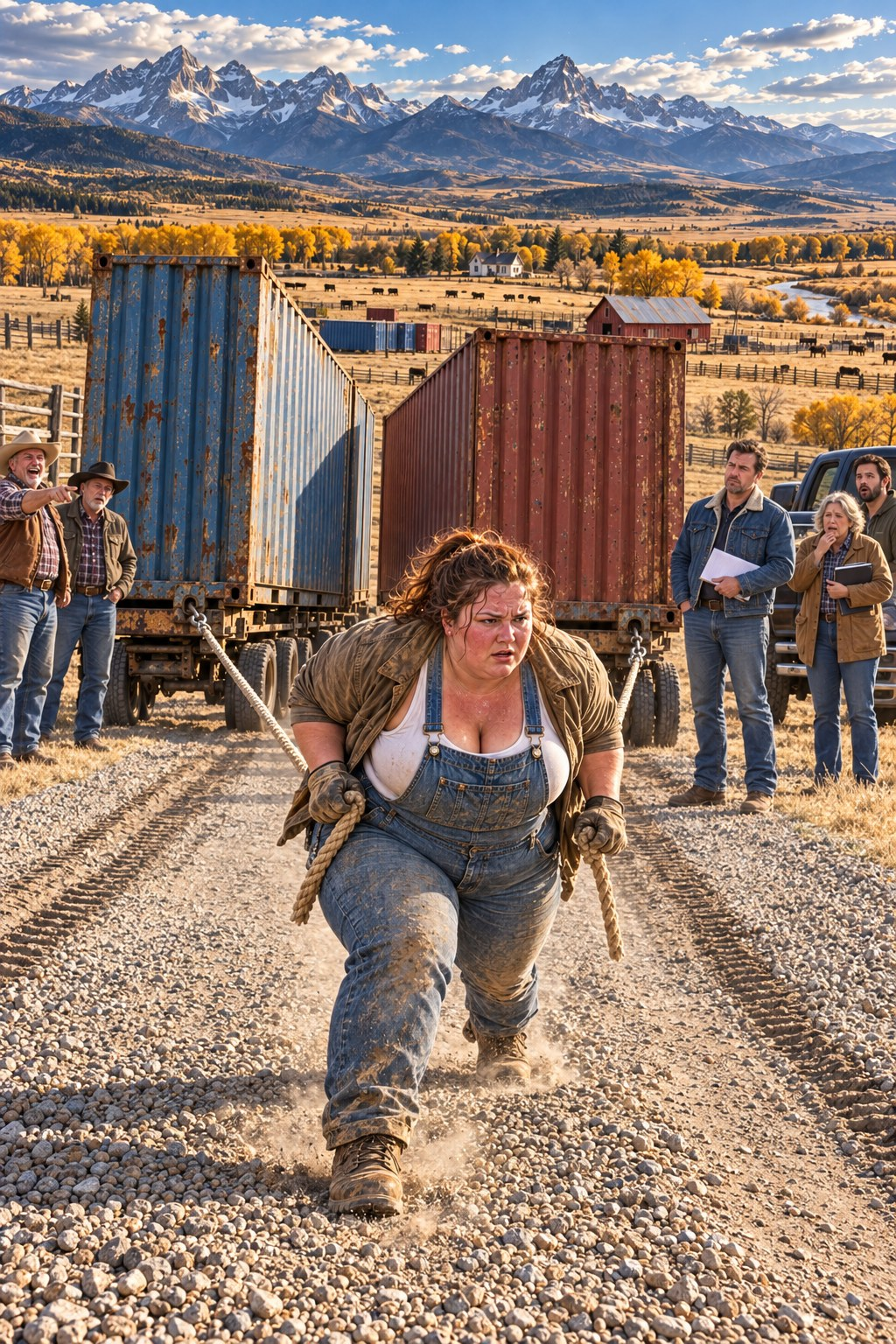
"Jolene, step away from that key."
My brother stood in the doorway of the study, holding an old photograph in his right hand.
For several seconds, neither of us moved.
Nathan Caldwell had driven from Cheyenne without calling, without warning, and without explaining how he had entered my farmhouse.
His eyes moved from the brass key in my hand to the open documents scattered across the kitchen table.
Then he looked at the photograph.
The one showing our grandfather beside Frank Harmon and Edwin Mercer.
"Where did you get that?" I asked.
Nathan swallowed.
"Grandpa gave it to me."
I stared at him.
"You're lying."
He looked down.
And for the first time in my life, my older brother appeared genuinely afraid of what our grandfather had left behind.
I didn't put the key down.
Nathan noticed.
"Jo, I'm serious. Give it to me."
"Why?"
"Because you don't understand what you're dealing with."
"Then explain it."
He stepped farther into the kitchen.
His dark jacket was dusty around the sleeves, and his hair looked as though he'd driven most of the way without stopping.
I glanced toward the window.
The white pickup remained parked near the entrance.
"Is that your truck?"
"No."
"Then whose is it?"
Nathan didn't answer.
I looked back at him.
"How did you get inside?"
"The back door was unlocked."
"It wasn't."
He looked away.
That was answer enough.
I tightened my grip on the key.
"You've been here before."
"Jolene—"
"You've been inside my house."
"I needed to check something."
"What?"
He looked at the documents.
"The notebook."
My stomach tightened.
"What about it?"
"Did you find the October 1968 entry?"
I felt the room become very still.
I hadn't told him about that entry.
I hadn't told anyone.
Not Russell.
Not Dale.
Not Garrett.
Not even the deputy.
Nathan knew.
He knew about the notebook.
He knew about the old project.
And judging by the photograph in his hand, he knew more than he was admitting.
"How do you know about that entry?" I asked.
He placed the photograph on the table.
"Because Grandpa showed it to me."
"When?"
"Before he died."
I shook my head.
"Grandpa never discussed that project with you."
"He did."
"No, he didn't."
"You were the one who spent every weekend here. You were the one who helped him with the cattle. That doesn't mean he told you everything."
The remark stung because it was partly true.
I had been closer to Virgil.
I had spent years learning his routines.
I knew which tools he preferred, how he repaired fencing, and how he could identify an approaching storm by watching the grass.
But Nathan had been his grandson, too.
Perhaps there were conversations I never knew about.
"Why didn't you tell me?" I asked.
Nathan rubbed his face.
"Because I promised him I wouldn't."
I almost laughed.
"That's convenient."
"Jo, listen."
"No. You listen. Someone from Bridger Plains came here offering eighty thousand dollars for my water rights. Somebody broke into my property. Garrett Slade tried operating an underground valve. And now you appear in my kitchen telling me to hand over a key that belongs to something Grandpa deliberately hid."
Nathan looked at the key.
"Where did you find it?"
"Container seventeen."
His face changed.
"Jesus Christ."
"What?"
"You opened it?"
"I found a hidden compartment."
Nathan sat down heavily.
He stared at the documents.
Then he whispered something I barely heard.
"Grandpa said this day would come."
I moved to the opposite side of the table.
"Start talking."
Nathan looked toward the window.
The white pickup was still there.
"First, we need to get rid of that vehicle."
"Why?"
"Because I don't know who's inside."
"Then tell me who you're afraid of."
He looked at me.
"William Slade."
I recognized the name.
The signature on the original agreement.
The father of Garrett Slade.
The man who had apparently arranged to have the original archive box removed.
"Is he alive?"
Nathan shook his head.
"No. He died years ago."
"Then why are you worried about him?"
"Because his son inherited more than his company."
I waited.
Nathan leaned forward.
"Garrett inherited his father's unfinished business."
The words settled over the table.
"What's the business?"
"The water system."
"Tell me what it is."
He hesitated.
"Grandpa called it the Western Conveyance Project."
"I've seen the name."
"Then you know it wasn't just a few irrigation pipes."
I shook my head.
"I know there's a buried system. I know it was built in 1968. I know the original agreement was never completed. That's all."
Nathan nodded slowly.
"Then there's a lot you don't know."
He pulled the chair closer.
"When Grandpa was young, the western part of the county had a serious water problem. Several ranches depended on shallow wells and seasonal drainage. During dry years, some properties lost access completely."
"I know."
"William Slade wanted to build a larger agricultural operation. He had money, equipment, and connections. Frank Harmon helped organize the financing. Grandpa contributed access to the western pasture."
"And Edwin Mercer?"
Nathan looked at the photograph.
"He designed much of the original system."
"Was he an engineer?"
"Not officially. He had worked on irrigation installations in several states. He understood pumps, pressure chambers, buried lines, and water distribution better than most people with engineering degrees."
"Why did he disappear?"
Nathan lowered his eyes.
"Because he refused to sign the final transfer."
"Why?"
"Because the system wasn't operating the way the agreement required."
I leaned forward.
"What does that mean?"
Nathan took a breath.
"William Slade wanted exclusive control over the main intake."
"But the agreement said the infrastructure would belong to the participating landowners."
"Exactly."
"So William wanted to take ownership?"
"He wanted control of the water before the transfer was completed."
I looked at the photographs.
The man holding the blueprint.
The steel valve.
The underground chamber.
Everything suddenly seemed more connected.
"Did Grandpa agree?"
"No."
"Did Edwin?"
"No."
"Then what happened?"
Nathan looked at me.
"That's where the story gets ugly."
Nathan explained that the project had begun with a straightforward idea.
A series of underground lines would connect an intake near the western drainage area to several ranches.
The system would use buried pipes, collection chambers, and pressure-control equipment to move water where it was needed.
The landowners would contribute access, labor, or money.
In return, each participating property would receive defined rights to the infrastructure and its available water allocation.
The arrangement had been intended to help struggling ranches survive drought.
But William Slade had a different plan.
He wanted to control the intake.
He believed that whoever controlled the main valve could determine which properties received water.
And whoever controlled the water could influence the value of every ranch connected to the system.
"Did Grandpa know?" I asked.
Nathan nodded.
"Eventually."
"How?"
"Edwin showed him the revised plans."
I glanced at the photograph.
"That's why he refused to sign."
"Yes."
"What happened to the other investors?"
"Some withdrew. Others were paid off. A few were told the project had failed."
"Did it fail?"
Nathan shook his head.
"Not completely."
I looked toward the western pasture.
"Then why was it abandoned?"
"Because the legal ownership was never settled. The system remained underground, but the final transfer documents were never recorded."
I looked at the paper from the county archive.
The blank signature section.
The missing completion date.
The note about the transfer being incomplete.
"Who owns it now?"
Nathan gave a tired laugh.
"That's the problem."
"Explain."
"The original agreement divided ownership according to contribution and property boundaries. But William Slade filed documents claiming that his company had financed the main infrastructure."
"Did the county accept them?"
"Some were accepted. Others were challenged."
"By whom?"
"Grandpa."
I sat down.
"How many times?"
"More than once."
"Why didn't he tell me?"
Nathan looked uncomfortable.
"Because he thought the matter was finished."
"But it wasn't."
"No."
He glanced at the key.
"Then he realized the Slades were trying to recover the original records."
I thought about the stranger on the porch.
The photograph.
The handwritten warning.
The messages.
"Who sent me those texts?"
Nathan's face tightened.
"You received messages?"
I nodded.
He looked genuinely surprised.
"From whom?"
"I don't know."
"Show me."
I handed him my phone.
He read the messages.
His expression changed with each one.
When he reached the final warning, he stopped.
"Where did you get this number?"
"I didn't."
He looked at me.
"Then someone has been watching you."
I didn't like the way he said it.
"Who?"
Nathan handed back the phone.
"I don't know."
But I could see that he was hiding something.
Again.
I returned to the photograph.
"Why did Grandpa give you this?"
Nathan picked it up.
"He gave me a packet of documents about six months before he died."
"Why?"
"He said he wanted me to keep them somewhere safe."
"Where?"
Nathan hesitated.
"At my house."
I stared.
"Do you still have them?"
"No."
"Where are they?"
He looked at the kitchen table.
"Somewhere else."
"Where?"
"Jolene, I need you to understand something. I didn't come here to steal from you."
"Then why did you enter my house?"
"Because I saw the white truck."
I looked toward the window.
"Whose is it?"
"I don't know. But I've seen it before."
"Where?"
"Outside my apartment in Cheyenne."
My stomach tightened.
"Someone followed you?"
"I think so."
"How long?"
"Three days."
I stepped away from the table.
"Why didn't you call the police?"
"Because I didn't know what they wanted."
"And you decided the best solution was to drive here without telling me?"
"I needed to see whether you had found the documents."
"Why?"
"Because if you had, then we were already in trouble."
I stared at him.
"We?"
Nathan nodded.
"Yes. We."
For a moment, I didn't know what to say.
My brother and I had spent the last year barely speaking.
He had told me to sell the ranch.
He had criticized my decisions.
He had suggested I move to the city and stop throwing money into a failing property.
Now he was standing in my kitchen acting as though we had been fighting the same battle all along.
I wasn't ready to believe him.
"Did you know Garrett Slade was coming?"
Nathan looked down.
"I knew somebody might."
"Did you arrange the eighty-thousand-dollar offer?"
"No."
"Did you tell him about my debt?"
Nathan didn't answer.
I felt the room tilt.
"Nathan."
He looked at me.
"I spoke to someone who knew the company."
"You gave them my financial information."
"I told them the ranch was struggling."
"You told them I was desperate."
"I thought they might make a fair offer."
"Fair?"
I slapped the photograph against the table.
"They want water rights to a system they can't even legally claim. They have been digging through old records. Someone entered my property at night. And you thought they might make a fair offer?"
Nathan stood.
"I didn't know it would turn into this."
"You should have told me."
"I know."
"No, you don't."
He lowered his head.
For the first time, I saw shame in his expression.
Not irritation.
Not defensiveness.
Shame.
"You're right," he said quietly.
I looked away.
I wanted to believe him.
But wanting something and trusting it were different things.
Nathan finally explained why he had become involved.
Six weeks earlier, a man had contacted him through a business associate.
The man represented an investment group interested in agricultural properties in Sheridan County.
He asked general questions about the ranch.
How much debt remained.
Whether the property was currently profitable.
Whether Jolene intended to keep operating it.
Nathan answered some of the questions.
He admitted that the ranch was struggling.
He admitted that Jolene had been considering selling equipment.
He even mentioned the containers.
The man had seemed interested.
Then he asked about the western pasture.
Nathan said he didn't know anything special about it.
The conversation ended.
Three days later, Nathan received a phone call from an unknown number.
The caller mentioned Virgil Caldwell.
He said the old man had left something unfinished.
He asked whether Nathan still had access to the ranch.
Nathan became suspicious.
He refused to answer.
But the caller knew details about the family.
He knew Virgil's final years.
He knew the name of the bank.
And he knew Nathan had inherited several personal belongings after the funeral.
"Why didn't you tell me?" I asked.
"Because I thought it was someone trying to pressure us into selling."
"And you thought you could handle it alone?"
"I thought I could find out who was behind it."
"Did you?"
Nathan shook his head.
"Not exactly."
He reached into his jacket.
Then he placed another photograph on the table.
This one showed the old Ford 8N tractor.
The image had been taken in the hay shed.
A circle had been drawn around the rear toolbox.
Beneath it was a handwritten note.
The original key is with the girl.
I stared.
"Where did you get this?"
"It was in the packet Grandpa gave me."
"Why didn't you show me earlier?"
"I didn't understand what it meant."
I looked at the brass key.
Then at the tractor.
The toolbox.
The hidden compartment.
Everything seemed to be pointing toward the same place.
"Did Grandpa tell you what was inside?"
Nathan shook his head.
"No."
"Did he tell you about the deed?"
"Only that it existed."
"Where?"
"He said it was somewhere nobody would think to look."
I stood.
"The tractor."
Nathan nodded.
"I think so."
I reached for my jacket.
"Then let's open it."
He immediately caught my arm.
"Wait."
I pulled away.
"Don't touch me."
"Listen to me. If the original deed is still there, we need to be careful."
"Why?"
"Because the Slades have been searching for it for nearly fifty years."
I looked at him.
"And you didn't think that was worth mentioning before?"
He swallowed.
"There's something else."
I waited.
Nathan glanced toward the hallway.
"Grandpa didn't just hide the deed."
"What else?"
"He hid a list."
"What list?"
"A list of everyone who helped build the system."
I felt my pulse quicken.
"Why would that matter?"
"Because some of those people were paid to lie."
We went outside together.
The white pickup had disappeared.
I checked the driveway.
No fresh movement.
No new tire marks.
Nathan walked toward the hay shed.
The old Ford 8N stood beneath its familiar layer of dust.
He stopped beside it.
For several seconds, he simply looked at the tractor.
"Grandpa used to let me sit here when I was little," he said.
"I remember."
"He'd tell me this machine was older than both of us."
"It was."
"He said it had survived more bad decisions than any man in the county."
I smiled faintly.
"That sounds like him."
Nathan crouched near the rear toolbox.
The metal housing was covered in rust.
A small lock secured the lid.
I took the brass key from my pocket.
It looked like it belonged.
But I didn't insert it immediately.
I examined the lock.
Then the surrounding metal.
The toolbox had been repaired several times.
One hinge was newer.
The latch had scratches around the keyhole.
Someone had tried to open it.
Recently.
I showed Nathan.
He frowned.
"That wasn't there when I last saw it."
"When was that?"
"Three weeks ago."
I looked at him.
"You've been here?"
He nodded.
"Once."
"Without telling me?"
"I came to check the toolbox."
My anger returned.
"You keep leaving out important details."
"I'm sorry."
I looked at the lock again.
"Did you try to open it?"
"No."
"Why not?"
"Because Grandpa told me not to."
I inserted the key.
It turned halfway.
Then stopped.
Nathan crouched beside me.
"Don't force it."
I pulled the key back.
The lock was stiff.
I applied a little lubricant and waited.
Then I tried again.
This time, the mechanism moved.
A small click sounded.
The lock opened.
Nathan exhaled.
I lifted the lid.
Inside were old tools, a wrench, a folded rag, and a small metal case.
The case was secured with a second lock.
I looked at Nathan.
He shook his head.
"I've never seen that before."
I examined the second lock.
It had a narrow keyhole.
The brass key didn't fit.
Then I noticed something attached to the underside of the toolbox lid.
A small envelope.
I peeled it free.
Virgil's handwriting appeared on the front.
For the children.
My hands trembled.
I opened it.
Inside were two small keys.
One was labeled J.
The other N.
Nathan stared.
"He made one for each of us."
I handed him his key.
He looked at it for a long time.
Then he inserted it into the lock.
It turned immediately.
The metal case opened.
Inside lay a folded document wrapped in waxed cloth.
A small notebook.
And a sealed letter.
Nathan lifted the letter.
His name was written on it.
Mine was written beneath.
We looked at each other.
I unfolded the document first.
It was a legal instrument.
The title appeared at the top.
ORIGINAL WATER INFRASTRUCTURE OWNERSHIP DEED.
My grandfather's signature was at the bottom.
So were the signatures of Frank Harmon and Edwin Mercer.
The date was November 1971.
The deed had been witnessed.
Notarized.
And stamped with a county registration mark.
I read the first paragraph.
Then the second.
My eyes stopped at the ownership section.
The document did not transfer the system to Bridger Plains.
It transferred the infrastructure to a group of participating landowners.
Among them was Virgil Caldwell.
And the final paragraph contained a clause I had never seen before.
If any participating property passed to a direct descendant, the associated ownership rights would pass with it.
I looked at Nathan.
"Do you understand what this means?"
He nodded slowly.
"It means the water rights may already belong to you."
"To us?"
He pointed to the document.
"To the heirs of the participating owners."
I looked at the signatures.
Virgil Caldwell.
Frank Harmon.
Edwin Mercer.
Then I noticed something else.
The deed included a handwritten amendment.
It was dated 1972.
And it had been signed by one additional person.
William Slade.
He had agreed to the ownership transfer.
He had signed away his claim.
But beneath his signature was a handwritten sentence.
The intake remains subject to the original access agreement.
I looked at Nathan.
"What does that mean?"
He shook his head.
"I don't know."
I unfolded the letter.
It was addressed to both of us.
My dear children,
If you have found this, then the people who wanted the water have returned.
I am sorry I kept so much from you.
I believed the matter had been settled. I was wrong.
The deed proves who owns the infrastructure. It does not prove who owns the source.
I stopped reading.
The source.
The water itself.
Not the pipes.
Not the collection chamber.
Not the machinery.
The source.
I continued.
Edwin Mercer knew the truth. He kept the original intake records because the final agreement was never completed.
If you want to understand what happened, find him.
Do not trust anyone who says he is dead.
My fingers went cold.
I read the final paragraph.
And whatever you do, never allow anyone to open the main valve until you know what lies beyond it.
Nathan slowly lowered the letter.
Neither of us spoke.
The wind moved through the open side of the hay shed.
I looked toward the western pasture.
Garrett had tried to turn the valve.
The underground system had responded.
And my grandfather had specifically warned us not to let anyone operate it.
I returned to the letter.
At the bottom was one final line.
If Edwin cannot be found, look for the woman who received his last payment.
I looked at Nathan.
"Do you know who that is?"
He shook his head.
"No."
I turned the letter over.
There was an address.
A name.
And a telephone number.
The name was written in Virgil's careful handwriting.
MARGARET MERCER.
We spent the next hour examining the documents.
The ownership deed was original.
The county stamp appeared genuine.
The signatures matched the photographs.
But we needed verification.
A document could establish a claim.
It could not automatically resolve every legal dispute.
We needed an attorney familiar with historical water rights and property agreements.
We also needed the complete original survey.
And we needed to establish whether the underground system remained operational.
Nathan photographed every page.
I placed the deed back inside the metal case.
Then I locked it.
The original key remained with me.
"Don't tell anyone about this," I said.
Nathan nodded.
"Agreed."
"Not Dale."
"Agreed."
"Not Russell."
"Of course."
"Not Garrett."
Nathan gave me a tired look.
"I think that's obvious."
I looked toward the road.
The white pickup was gone.
But I wasn't convinced the driver had left the area.
I carried the metal case into the farmhouse.
Nathan followed.
For the first time in months, we were working together.
Not arguing about the mortgage.
Not discussing whether the ranch should be sold.
Not repeating the same painful conversations.
We were trying to understand what our grandfather had left behind.
I placed the deed on the kitchen table.
Nathan opened his phone.
"Let's call the number."
I hesitated.
"Now?"
"Why not?"
I looked at the name.
Margaret Mercer.
If she was Edwin's daughter, she might know where he had gone.
She might know what happened in 1971.
She might know why the Slades had spent decades trying to recover the original records.
Nathan dialed.
The phone rang once.
Twice.
Three times.
Then someone answered.
A woman's voice.
"Hello?"
Nathan looked at me.
"Is this Margaret Mercer?"
"Who is calling?"
"My name is Nathan Caldwell. I'm calling about Edwin Mercer."
Silence.
Then the woman spoke again.
"Who gave you this number?"
"My grandfather."
"Who was your grandfather?"
"Virgil Caldwell."
The silence returned.
Longer this time.
Then the woman whispered something.
"Virgil is dead."
Nathan looked at me.
"Yes. He passed away four years ago."
The woman began breathing unevenly.
"Then it's finally happened."
"What happened?" I asked, leaning toward the phone.
She heard my voice.
"Who is that?"
"I'm Jolene Caldwell."
A sharp breath came through the speaker.
"Virgil's granddaughter?"
"Yes."
The woman didn't answer immediately.
Then she said something that made my heart stop.
"Your grandfather told me that one day his grandchildren would call."
I looked at Nathan.
"When?" I asked.
The woman lowered her voice.
"Forty-eight years ago."
Nathan gripped the edge of the table.
"Where is your father?"
Another silence.
Then Margaret answered.
"He's alive."
I closed my eyes.
Alive.
After everything we had been told.
After the missing records.
After the abandoned project.
After the warnings.
Edwin Mercer was alive.
"Where is he?" I asked.
Margaret hesitated.
"I can't tell you over the phone."
"Why?"
"Because somebody came to my house last night."
Nathan and I exchanged a look.
"What did they want?" I asked.
Margaret's voice broke.
"They wanted the same thing your grandfather spent his life protecting."
I leaned closer.
"Where is your father?"
She finally answered.
"He's at a care facility outside Billings. But before you go there, you need to understand something."
"What?"
Her voice dropped to a whisper.
"Your grandfather wasn't the only person who signed that original deed."
I looked down at the document.
"Who else?"
Margaret inhaled sharply.
Then she said a name I had never seen in the records.
And Nathan suddenly stood up so quickly that his chair fell backward.
"That's impossible," he whispered.
Margaret continued.
"Because that person is still listed as the legal owner of the original water source."
I looked at Nathan.
He was staring at the farmhouse window.
Outside, a black Dodge Ram had just pulled into the driveway.
Garrett Slade stepped out.
And he wasn't alone.
Behind him stood a man carrying a thick leather briefcase.
A man Nathan recognized immediately.
"Jo," my brother whispered.
"That's our father's attorney."
Then the telephone went silent.
And someone began knocking on the farmhouse door.






Comments 0