"She has your grandfather's original will."
I read the message again.
Then I looked at the photograph of Ruth Mercer standing inside my grandfather's study.
The hidden compartment was open.
The original deed was gone.
And somewhere beneath our pasture, an underground chamber was filling with water.
For several seconds, nobody spoke.
My father reached for my phone.
"Show me."
I handed it to him.
He examined the photograph, then looked toward Margaret.
"Where is Ruth?"
Margaret tightened her grip on the metal case.
"I don't know."
"You're lying."
"I'm not."
"She has the will."
Margaret shook her head.
"She doesn't have the will. She has a copy."
My father stared at her.
"Where is the original?"
Margaret looked toward the farmhouse.
"Somewhere William Slade never thought to look."
Deputy Bell stepped forward.
"Enough. Nobody moves until I understand what's happening."
But the pressure indicator suddenly made a sharp metallic noise.
The red needle jumped.
Robert turned toward it.
"Everyone away from the plate!"
A deep vibration traveled through the ground.
The steel cover lifted slightly.
Water began forcing its way through the edges.
Bell immediately ordered the officers to evacuate the area.
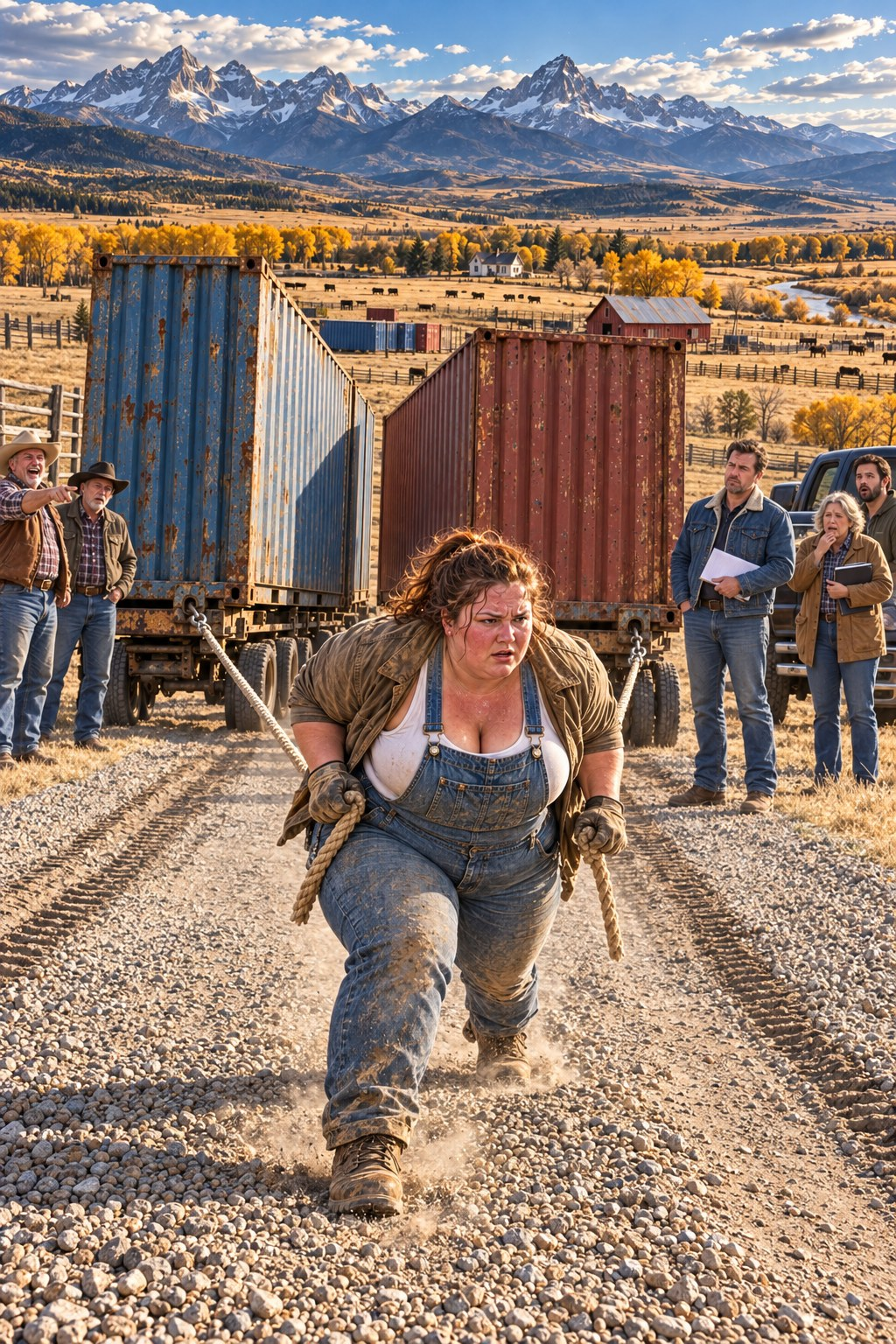
I looked at the containers.
Thirty discarded shipping boxes.
Thirty pieces of rejected steel.
And the strange mineral residue that had started everything.
My grandfather had known.
He had known what lay beneath the pasture.
He had known that someday somebody would find it.
And he had left the clues for me.
"Jolene!"
My father grabbed my arm.
"We need to move."
I looked at Margaret.
"What did my grandfather's will say?"
She opened the metal case.
Inside lay a leather-bound register, several folded documents, and a photograph.
She removed the photograph first.
It showed Virgil Caldwell standing beside Edwin Mercer and Frank Harmon.
Behind them was a small concrete building.
The same building shown in the photograph from 1971.
But there was something different about this one.
The entrance was open.
And standing inside it was a young woman.
Ruth.
Margaret turned the photograph over.
"Your grandfather didn't hide the will in the farmhouse."
I looked at her.
"Where did he hide it?"
She pointed toward the containers.
"Inside the one you bought last."
We returned to the farmhouse under Deputy Bell's supervision.
The engineering team had arrived and secured the western pasture.
They confirmed that the pressure system was unstable but could be controlled if the secondary valve was closed.
My father insisted that we examine the original documents before anyone attempted to open the chamber.
Margaret placed the leather register on the kitchen table.
Nathan stood beside me.
Edwin sat opposite our father.
For the first time, all four of us were looking at the same evidence.
Margaret opened the register.
The first pages contained the original ownership agreement.
Seven families.
Seven signatures.
Seven equal interests in the underground water source.
The final section contained a list of trustees.
Virgil Caldwell.
Edwin Mercer.
Frank Harmon.
Eleanor Whitcomb.
And Robert Caldwell.
But beneath those names was another section.
SUCCESSION AND BENEFICIAL OWNERSHIP.
I read the first paragraph.
The trust could never be sold by an individual trustee.
No company could acquire exclusive control.
Any transfer required the consent of all surviving participating families.
If a family line became inactive, its share would pass to its lawful descendants.
I looked at my father.
"So the water belongs to the families?"
He nodded.
"Yes."
"Not the Slades?"
"Never."
Margaret turned another page.
There was a handwritten amendment dated 1998.
It had been signed by Virgil.
The amendment established a permanent conservation provision.
The water source could be used for agriculture, livestock, and domestic needs.
But no individual could sell the entire supply for commercial extraction.
The provision was designed to protect the ranches from becoming dependent on outside corporations.
Jolene felt tears gathering.
"Grandpa was trying to protect us."
Robert nodded.
"He wanted the land to remain useful for the people who had worked it."
Nathan examined the final page.
"What's this?"
A list of seven names appeared.
Beside each name was a small notation.
One had been crossed out.
Another had been marked with a question mark.
At the bottom was a sentence written in Virgil's familiar handwriting.
The surface can be purchased. The truth cannot.
I recognized it immediately.
The same philosophy that had guided his notebook.
Never trust the surface.
Margaret finally explained the truth about Ruth.
Her sister had not died in 1971.
After discovering the financial fraud, Ruth had been taken to an abandoned warehouse with Edwin.
She escaped with the help of Eleanor Whitcomb.
But she was forced to leave her family behind.
William Slade threatened Margaret's life.
He told Ruth that if she returned, Margaret would disappear.
So Ruth made a terrible choice.
She stayed away.
For years, she pretended to cooperate with the Slades.
She became their source of information.
She helped them locate documents.
She attended meetings.
But secretly, she copied every financial record she could find.
She kept evidence of the stolen payments, the falsified land transfers, and the false death identification.
She had also preserved the original ownership register.
"Why didn't you tell me?" Edwin asked.
Margaret looked at him.
"Because you were the reason she had to disappear."
Edwin lowered his eyes.
"I gave William the key."
"Yes."
"I thought I could negotiate with him."
"And you nearly destroyed everything."
Edwin nodded.
"I know."
Margaret's expression softened slightly.
"Ruth never stopped loving you. But she couldn't forgive what you did."
Edwin looked down at his hands.
"Can I see her?"
Margaret nodded.
"Yes."
"Where?"
She looked toward the window.
"At the ranch."
We found Ruth inside the farmhouse study.
She stood beside the open compartment.
The original deed lay on the desk.
A small wooden box rested beside it.
She was older than the woman in the photographs.
Her dark hair had turned silver.
The scar above her left eyebrow remained.
But her eyes were unmistakable.
Margaret stopped in the doorway.
For several seconds, the sisters simply looked at each other.
Then Margaret whispered:
"Ruth."
Ruth turned.
Her face changed.
She put down the document.
And Margaret walked toward her.
They embraced.
Neither spoke.
They simply held on to each other.
I looked away.
Some reunions were too personal to witness.
When they finally separated, Ruth looked at my father.
"Robert."
He nodded.
"Ruth."
She glanced toward the photograph in his hand.
"You finally came home."
He looked at me.
"I had to."
Ruth smiled sadly.
Then she turned toward me.
"You're Jolene."
I nodded.
"Yes."
She took my hands.
"Your grandfather talked about you all the time."
I felt my throat tighten.
"What did he say?"
"That you were the only one who understood why the land mattered."
I looked toward the window.
The western pasture stretched into the distance.
The containers stood in two rows.
"What did he hide in the last container?"
Ruth smiled.
"The will."
The final container stood behind the hay shed.
It was number thirty.
Unlike the others, its original inspection records showed no mineral contamination.
It had carried agricultural machinery.
Its interior floor had been reinforced.
Ruth explained that Virgil had selected it because its steel construction made it suitable for long-term storage.
He had placed a sealed metal compartment beneath the floor.
The compartment had been concealed beneath a removable steel panel.
We opened the container together.
The hinges groaned.
The familiar smell of old iron filled the space.
My father found the panel.
Nathan removed the bolts.
And beneath it was a narrow metal box.
A small brass plate carried Virgil's name.
I knelt.
My hands trembled as I opened it.
Inside were three documents.
The original will.
A letter addressed to me.
And a sealed envelope marked:
FINAL TRUST DECLARATION.
I opened the will first.
It confirmed that Virgil had left me the ranch, the cattle, the buildings, and all associated property.
But the most important section concerned the water rights.
He had transferred his position as successor trustee to me.
Not ownership of the entire source.
Responsibility for protecting the family's share and honoring the original agreement.
I read the passage twice.
Then I opened the letter.
My dear Jolene,
If you are reading this, then you have found something I spent many years protecting.
I know the ranch has become difficult to maintain. I know the debt has grown. I know people will tell you that the sensible thing is to sell.
But I want you to remember something.
Land is not valuable because someone offers you money for it.
It is valuable because of what it can provide.
I cannot promise you that keeping the ranch will be easy.
But I can promise you that you were never meant to fight for it alone.
The water beneath the western pasture belongs to the families who built their lives around it. Protect their rights, and they will help protect yours.
Never trust the surface.
Look deeper.
With love,
Grandpa Virgil.
I lowered the letter.
For the first time in months, I cried without trying to stop myself.
The next morning, the engineering team began work on the underground system.
The secondary valve was damaged, but the main structure remained intact.
Using the original diagrams, the engineers identified the pressure release mechanism.
Robert and Edwin helped them locate the manual control.
The valve was buried beneath the northern edge of the pasture.
It took several hours to uncover.
When the mechanism finally moved, the pressure dropped.
The water stopped forcing its way through the steel plate.
The engineers confirmed that the underground chamber could be stabilized.
They also discovered a second passage leading toward the original intake.
Inside were several sealed storage compartments.
One contained the original financial ledger.
Another contained property-transfer records.
The third held seven personal files.
Each file belonged to one of the original participating families.
The documents established that the Slades had falsified the ownership records and redirected payments intended for the ranchers.
They also contained evidence connecting Arthur Whitcomb to the fraudulent transfers.
Deputy Bell secured everything.
Within days, the county prosecutor opened a formal investigation.
Arthur was arrested two days later while attempting to leave Wyoming.
Garrett Slade was arrested at his company's regional office.
The charges included fraud, conspiracy, unlawful interference with property rights, evidence tampering, and attempted theft of protected water assets.
The investigation also reopened the 2015 death case.
Samuel Pike's identity was confirmed through independent forensic testing.
His family was finally informed of what had happened.
The medical records were corrected.
And the false report naming Robert Caldwell as the victim was officially withdrawn.
My father was no longer legally dead.
He was Robert Caldwell.
Alive.
And finally free to come home.
The following months were not easy.
The ranch still had a mortgage.
The drought had not disappeared.
The fences still needed repairs.
The cattle still required feed.
But everything changed when the original trust was restored.
The seven participating families, represented by their lawful descendants, met at the county courthouse.
The ownership agreement was reviewed.
The forged amendments were invalidated.
The original trust was recognized.
No company could claim exclusive rights to the water.
The Slades' commercial acquisition attempts were rejected.
The ranches received legal access to the protected supply according to the original agreement.
A conservation engineer helped design a controlled irrigation system.
The underground reservoir could now provide water without exhausting its natural capacity.
The western pasture was gradually restored.
The first new irrigation lines were installed along the old buried pipes.
The soil began retaining moisture.
Grass returned in places where nothing had grown for years.
The cattle started using the western pasture again.
And for the first time since my grandfather's death, the ranch began to feel like a place with a future.
The bank eventually agreed to restructure my mortgage.
The arrangement was based on the restored value of the ranch and the verified water rights.
I did not receive a fortune.
I didn't need one.
I needed enough time to rebuild.
And this time, I had it.
Nathan changed too.
For months, he struggled with the guilt of what had happened in 2015.
He had kept silent because he was frightened.
He believed his silence had helped destroy our family.
But after the investigation, he gave a complete statement.
He provided the original photographs, messages, and Arthur's handwritten threat.
His testimony helped establish the timeline of the attack on Robert and the false accident report.
He also apologized to our father.
Not once.
Many times.
Eventually, Robert stopped him.
"You don't have to spend the rest of your life punishing yourself."
Nathan looked down.
"I should have done more."
"You were scared."
"I left you."
"And you came back."
My father put a hand on his shoulder.
"That's what matters now."
The two of them embraced.
I watched from the kitchen doorway.
For four years, my brother had carried something too heavy to explain.
Now he could finally put it down.
Edwin and Ruth were reunited properly several weeks later.
They met at the old research station.
The place had been secured by the county, and the original documents had been removed.
Edwin arrived first.
Ruth came with Margaret.
For a long time, nobody spoke.
Then Edwin said:
"I am sorry."
Ruth looked at him.
"You should be."
He nodded.
"I gave William the key because I thought I could bargain with him. I believed I could save the project."
"You helped him take control."
"Yes."
"And people disappeared because of it."
Edwin lowered his head.
"I know."
Ruth studied him.
Then she stepped closer.
"I cannot give you back the years we lost."
"I understand."
"But I don't want to spend whatever time remains carrying this anger."
Edwin looked up.
She took his hand.
They stood together beneath the old sign.
Margaret watched them with tears in her eyes.
Their family had lost decades.
But they had finally found one another again.
The following spring, I planted grass along the western drainage ditch.
The first irrigation season had gone better than anyone expected.
The engineers had installed a controlled distribution system.
The water was monitored.
The participating families received their agreed allocations.
And the old reservoir remained protected.
The thirty containers had become useful too.
I converted several into livestock shelters.
Others became equipment storage.
Two were reinforced and turned into feed buildings.
The seventeenth container remained where it was.
I didn't want to move it.
It was the first place where I had discovered the strange white residue.
The first clue.
The beginning of everything.
Russell Tate visited one afternoon.
He stood beside his pickup, examining the restored western pasture.
Boyd Kimell was with him.
Lyall Dunar had come too.
The same three men who had laughed when I bought the containers.
Russell removed his hat.
"Well, I'll be."
I smiled politely.
"Something wrong?"
He looked toward the irrigation lines.
"Looks like you've done something with that junk."
I nodded.
"Turns out it wasn't all junk."
Boyd studied the pasture.
"How much water are you getting?"
"Enough to keep the grass growing."
Russell glanced toward the containers.
Then he looked at me.
"I owe you an apology."
I waited.
He cleared his throat.
"We laughed at you."
"You did."
"Didn't understand what you were doing."
"Neither did I, at first."
He nodded.
Then he extended his hand.
I shook it.
Not because his approval mattered.
Because the past no longer had to control the future.
By summer, the ranch looked different.
The farmhouse roof had been repaired.
The worst fence sections had been replaced.
The cattle had access to reliable water.
The western pasture was green again.
The old Ford tractor still sat beneath the hay shed, but Nathan had restored its engine.
One evening, my father drove it across the yard.
The engine rattled.
The faded red paint caught the setting sun.
I stood beside the fence watching him.
He stopped near me.
"Your grandfather would have liked this."
I smiled.
"He would have complained about the engine."
Robert laughed.
"Probably."
He climbed down.
Then he looked across the pasture.
"I never thought I'd see this place again."
I took his hand.
"You're home now."
He nodded.
"Yes."
For the first time in four years, those words felt complete.
On the anniversary of Virgil's death, we gathered beside the old hay shed.
Nathan came.
My father came.
Margaret, Ruth, and Edwin came.
Deputy Bell attended too, along with several of the families whose names appeared in the original register.
We placed Virgil's notebook on a small wooden table.
Beside it was the restored ownership agreement.
The water trust was now legally protected.
The ranch was no longer facing immediate foreclosure.
And the underground source was being managed according to the agreement my grandfather had helped create.
I opened the notebook to the final page.
There was one sentence I had never noticed before.
It was written in the margin, beneath a small drawing of the western pasture.
The best inheritance is not what you leave behind. It is what you teach someone to protect.
I read it aloud.
My father looked toward the mountains.
Nathan put his arm around my shoulders.
Ruth held Margaret's hand.
Edwin stood quietly beside them.
And for the first time, I understood what my grandfather had been trying to tell me.
He had never expected me to save the ranch by myself.
He had expected me to discover that I wasn't alone.
A year after the thirty containers arrived, the first full harvest from the restored western pasture was completed.
The cattle were healthier.
The soil held moisture.
The irrigation system worked.
The bank had approved a manageable repayment schedule.
And the ranch was finally earning enough to support its own future.
I kept all thirty containers.
Not because they were worth a fortune.
Not because they had made me rich.
But because they reminded me that the things people rejected were sometimes the things they had never bothered to understand.
One evening, I stood outside container seventeen.
The wind moved through the grass.
The Bighorn Mountains glowed beneath the setting sun.
My father approached carrying two cups of coffee.
He handed me one.
"Thinking about Grandpa?"
I nodded.
"He knew."
"About the water?"
"About everything."
Robert smiled.
"He knew you would find it."
I looked toward the western pasture.
"Do you think he knew how difficult it would be?"
My father laughed softly.
"Of course."
"Then why leave it to me?"
He looked at the land.
"Because he knew you wouldn't mistake difficulty for impossibility."
I leaned against the container.
For a long time, neither of us spoke.
Then my father raised his cup.
"To Virgil."
I raised mine.
"To the man who taught us to look deeper."
We stood together as the last sunlight disappeared behind the mountains.
The ranch was still a working ranch.
There were still fences to mend, cattle to feed, bills to pay, and seasons to survive.
But there was water beneath the pasture.
There was grass above it.
There was a family around the table.
And there was a future worth protecting.
I had bought thirty rejected shipping containers for $150 each.
Three men had laughed at me.
A banker had doubted me.
A stranger had offered $80,000 because he believed I was desperate enough to surrender everything.
But my grandfather had left me something far more valuable than money.
He had left me the truth.
And this time, nobody would be able to bury it.






Comments 0