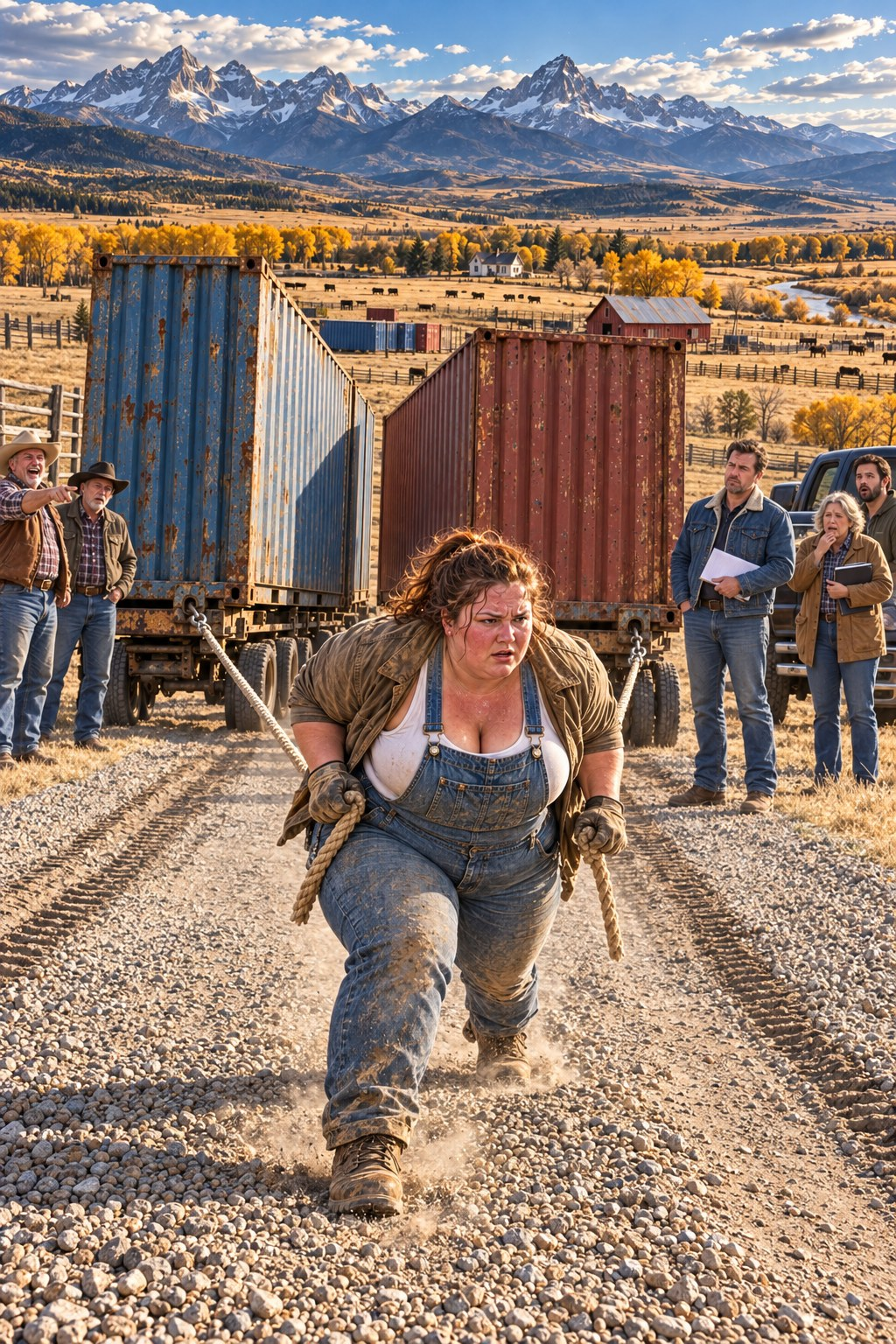
"Thirty containers? Jolene, have you completely lost your mind?"
Russell Tate shouted the question from beside his pickup truck, laughing so hard that he had to grab the tailgate.
In his hand was the auction receipt Jolene Caldwell had dropped while unloading the final container.
At the bottom, beside the number thirty, someone had written three words in red ink.
FINAL SALE. AS IS.
Russell looked at the receipt again.
Then he looked at the woman standing between two towering walls of rusted steel.
He thought he was looking at the last mistake of a desperate rancher.
He was wrong.
October 2019.
Sheridan County, Wyoming.
Jolene Caldwell stood with her boots planted in the gravel and her gloved hands resting against her hips.
Behind her, thirty rejected shipping containers occupied the ground beside her grandfather's old hay shed.
They were ugly things.
Some were faded blue. Others were brown, their paint blistered and peeling from decades of salt air and hard use.
Rust surrounded their hinges. Their doors were dented. Several carried numbers that had nearly disappeared beneath layers of corrosion.
They had crossed oceans, survived storms, and passed through ports Jolene would never visit.
Now they had reached what everyone in Sheridan County considered their final destination.
A struggling cattle ranch owned by a woman who could barely afford to keep the electricity running.
Russell Tate seemed delighted by the situation.
He was fifty-six, with a narrow face, silver-gray hair, and the weathered expression of a man who had spent most of his life believing he was smarter than his neighbors.
His family had owned cattle land in the county for four generations.
He never missed an opportunity to remind people.
Beside him stood Boyd Kimell, a stocky rancher with a reddish beard and a habit of laughing before he understood the joke.
The third man, Lyall Dunar, leaned against the pickup with his arms folded.
Lyall was younger than the others.
He rarely started trouble.
But he seldom objected when someone else did.
Russell waved the receipt.
"One hundred and fifty dollars apiece?"
Jolene nodded.
"That's right."
"For these?"
"That's what I paid."
Boyd let out a whistle.
"Four thousand five hundred dollars on junk."
"Plus hauling," Jolene said.
Russell stared at her.
"Plus hauling?"
"Yes."
He threw his head back.
Boyd slapped the tailgate.
Even Lyall smiled.
Jolene waited.
She had spent enough years around men like Russell to understand that laughter was sometimes less about humor than permission.
One man laughed.
Another joined.
Soon everyone felt entitled to treat the person standing in front of them as a fool.
She had learned that lesson long before she inherited the ranch.
Russell finally caught his breath.
"Tell me something, Jolene. What exactly are you planning to do with thirty rejected ocean boxes?"
"Use them."
"For what?"
"Storage. Livestock shelters. Windbreaks."
Boyd looked toward the nearest container.
"Those things look like they'll fall apart if a cow sneezes."
"They're stronger than they look."
Russell grinned.
"That's what people said about your grandfather's tractor."
Jolene's expression changed.
Only slightly.
But enough.
Russell noticed.
He always noticed when a remark found a tender place.
"Come on," he said. "Don't look at me like that. Virgil was a good man."
Jolene said nothing.
"He just had some strange ideas toward the end."
"My grandfather kept this ranch running for sixty years."
"And look what happened after he was gone."
The words settled between them.
Boyd stopped laughing.
Lyall glanced toward the ground.
Russell, however, continued.
"Listen, I'm not trying to hurt your feelings."
That was usually how Russell introduced the remarks that hurt the most.
"I'm saying there's a point where a person needs to recognize reality."
Jolene looked past him.
Beyond the containers, the western pasture stretched toward the distant Bighorn Mountains.
The grass was thin.
The soil was dry.
The cattle scattered across the land looked smaller than they should have in October.
Winter was coming.
And she knew exactly what reality looked like.
It looked like a mortgage payment she had no idea how to make.
It looked like feed prices rising while her checking account shrank.
It looked like a kitchen ceiling that leaked every spring.
It looked like two hundred and six cattle that needed food, shelter, and water whether their owner had money or not.
It looked like forty-three dead animals after a late spring blizzard eighteen months earlier.
Forty-three.
She still remembered the number without thinking.
She remembered finding them along the northern fence line.
Some had been standing when the cold took them.
Others had collapsed beside one another.
She had walked that fence with a flashlight, counting bodies while the wind cut through her coat.
The insurance company had sent a representative three weeks later.
He had worn polished shoes.
He had taken photographs.
He had explained why the policy would not cover everything.
Jolene had listened without interrupting.
Then she had gone outside and thrown up behind the barn.
She had not told anyone.
Not even her brother.
Especially not her brother.
Russell folded the receipt.
"You could have bought feed with that money."
"I know."
"You could have repaired the south fence."
"I know."
"You could have made a mortgage payment."
Jolene's jaw tightened.
Russell smiled.
"There it is."
"What?"
"That look. The same one Virgil used to get when somebody told him something he didn't want to hear."
Jolene reached for the receipt.
Russell held it another second before returning it.
"Your grandfather was stubborn, too."
"He was."
"And where did it get him?"
Jolene carefully folded the paper.
"He died owning the land he loved."
Russell's smile faded.
For a moment, the only sound came from the wind moving through the dry grass.
Then Boyd cleared his throat.
"Well, I guess we'll leave you to your shipping empire."
Russell laughed again.
"Maybe she'll start a navy."
Boyd grinned.
"In Wyoming?"
"Why not? She's already bought the ships."
The men climbed back into the pickup.
Russell rolled down his window.
"One more thing, Jolene."
She waited.
"If you ever decide to sell, give me a call before the bank takes it. I'd rather see the place stay with somebody local."
He tipped his hat.
The truck pulled away.
Gravel snapped beneath its tires.
A cloud of dust rose behind it.
Jolene watched until the vehicle disappeared around the bend.
Only then did she allow her shoulders to drop.
She was tired.
Not the kind of tired that disappeared after a good night's sleep.
She was tired in places sleep couldn't reach.
For two years, she had been waking before sunrise, working until dark, and lying awake calculating numbers that never added up.
Every solution seemed to require money.
Every dollar seemed to belong to someone else.
She looked down at the receipt.
Thirty containers.
One hundred and fifty dollars each.
Four thousand five hundred dollars before transportation.
The hauling fees had hurt worse than she expected.
When the final charge cleared her account, the remaining balance was so small she had stared at the screen for several minutes.
She could still hear her brother's voice.
"Sell the ranch, Jo."
He had called from Cheyenne in August.
"You can't save every broken thing Grandpa left behind."
She had told him the land wasn't broken.
He had laughed.
"Then why does it keep costing you everything?"
She had no answer that would satisfy him.
So she stopped answering his calls.
Jolene tucked the receipt into her jacket pocket and turned toward the containers.
Thirty enormous steel boxes.
The county called them junk.
The auction company called them surplus.
Russell called them a joke.
But Jolene saw something else.
She saw shelter.
She saw storage space that didn't require expensive new construction.
She saw walls strong enough to stand against Wyoming wind.
She saw a way to protect feed without building another barn.
Most of all, she saw thirty things nobody else wanted.
And she knew something about being unwanted.
Jolene had inherited the ranch four years earlier.
Her grandfather, Virgil Caldwell, had died at eighty-three after spending most of his life working the same four hundred and twelve acres.
He had left her the land, the cattle, the equipment, and a mortgage that had grown heavier during his final years.
The inheritance surprised almost everyone.
Her brother expected the property to be sold.
Her cousins expected the equipment to be divided.
A few neighbors assumed Jolene would keep the farmhouse and lease the pastures.
Nobody expected her to try running the entire operation herself.
But Virgil had.
He had known.
On the afternoon he signed the final documents, he had called Jolene into the kitchen.
She remembered him sitting beneath the old yellow light, his hands wrapped around a chipped coffee mug.
He had pushed a worn notebook across the table.
"Take this."
She had smiled.
"Grandpa, I've seen that thing a thousand times."
"Then you know where to find it."
The notebook was thick, water-stained, and held together by a cracked leather cover.
Inside were decades of handwritten observations.
Cattle weights.
Fence repairs.
Rainfall totals.
Soil conditions.
Pasture sketches.
Water sources.
Small details nobody else thought worth recording.
Jolene had opened it.
"You're giving me your homework?"
Virgil smiled.
"I'm giving you sixty years of mistakes."
"That sounds encouraging."
"Most folks pay good money to learn what not to do."
He had leaned forward.
"Promise me something."
She remembered the seriousness in his eyes.
"What?"
"Don't let somebody who only sees the price tell you what this land is worth."
At the time, she thought he meant the ranch.
The house.
The cattle.
The memories.
She hadn't understood why he kept glancing toward the western pasture.
Not then.
By late afternoon, Jolene had inspected eleven containers.
She carried a flashlight, a small toolbox, and a notebook of her own.
She checked the hinges.
Measured the door openings.
Marked damaged sections with chalk.
Some containers had holes near the corners.
Others needed new seals.
Two had floors that would require reinforcement.
But most were structurally sound.
Better than Russell believed.
Better than the auction yard had advertised.
She opened the twelfth container and stepped inside.
The temperature dropped immediately.
The steel walls held the cold.
Her boots echoed against the floor.
The air smelled of old rubber, iron, and something sharp she couldn't identify.
She swept her flashlight along the walls.
Empty.
A few scratches.
Several dents.
Nothing unusual.
Then she noticed a pale streak near the rear corner.
At first, she assumed it was dried salt.
Shipping containers often carried residue from their previous cargo.
She crouched.
A thin layer of white material covered part of the steel floor.
She rubbed it between two gloved fingers.
It crumbled easily.
Almost like frost.
Except it was completely dry.
She brought it closer to her face.
There was a faint mineral smell.
She frowned.
"That's strange."
She had seen calcium deposits before.
She had seen fertilizer residue.
She had seen salt left behind by livestock supplements.
But something about this material reminded her of a lesson from childhood.
Virgil had taken her into the pasture when she was ten.
He had handed her three small stones.
One was limestone.
One was sandstone.
The third was a pale mineral fragment he had found near an old drainage ditch.
He made her examine each one.
"Ground tells stories," he said.
She had rolled her eyes.
"Rocks don't talk, Grandpa."
"They do if you know how to listen."
Then he made her taste a tiny piece of limestone.
She spat it out immediately.
Virgil laughed so hard he nearly dropped his hat.
"Now you'll remember."
She had.
For twenty-nine years.
Jolene stood inside the container, staring at the white residue.
Then she walked back outside.
She retrieved an empty coffee can from the toolbox.
Returning to the container, she scraped a small sample into it.
The material made a faint scratching sound against the metal.
She closed the lid.
Then she checked the next container.
Nothing.
The next held a small amount of similar residue near its rear wall.
Another had more.
She began marking the container numbers.
By sunset, she had found the pale material in several units.
Not all thirty.
Only certain ones.
That bothered her.
If the residue came from ocean salt, why wasn't it everywhere?
If it came from the same kind of cargo, why did some containers have more than others?
And why did the material seem concentrated near particular seams?
She checked the auction paperwork.
The containers had come from different shipping routes.
Some had carried grain.
Others agricultural supplies.
Several had transported equipment associated with mining operations.
The auction company had labeled them rejected because of contamination readings and poor resale condition.
Nothing in the paperwork suggested an immediate hazard.
Still, Jolene knew better than to assume an unidentified powder was harmless.
She sealed the sample and decided not to handle any more without proper testing.
She placed the coffee can beside her tools.
Then she looked toward the western pasture.
The setting sun stretched long shadows from the containers across the dry grass.
She had originally planned to move several boxes closer to the cattle feeding area.
But the hauler had left them in two rough rows near the western boundary because the ground there was level enough to support the trucks.
The placement was temporary.
At least, that had been the plan.
Now Jolene wondered whether the containers might remain there longer.
The western pasture needed protection from the winter wind.
And the ground beneath the containers was unusually firm.
She had noticed it when the delivery trucks arrived.
The drivers had expected their tires to sink into the dry soil.
Instead, the ground held.
Even after repeated passes.
At the time, she considered it good luck.
Now she wondered why.
The farmhouse kitchen smelled of coffee and old wood.
Jolene entered after dark, removed her boots, and washed the dirt from her hands.
The faucet rattled.
The water ran weakly.
She waited until it warmed.
Then she stopped.
Water.
Everything on the ranch eventually came back to water.
The drought had reduced grazing.
Reduced grazing had weakened the cattle.
Weak cattle had lowered sale prices.
Lower sale prices had made the mortgage harder to pay.
The eastern creek no longer flowed reliably through August.
The old stock tanks needed repairs.
And every year, Jolene spent more money hauling water to places where it used to appear naturally.
She dried her hands and looked toward the kitchen table.
Virgil's notebook sat beneath a stack of bills.
She moved the bills aside.
The notebook was heavier than it looked.
She opened it carefully.
The first pages were filled with familiar handwriting.
Dates.
Temperatures.
Rainfall measurements.
Notes about cattle.
She turned past the entries from the 1980s.
Then the 1970s.
Some pages were loose.
Others carried stains from spilled coffee.
Near the middle, she found a hand-drawn map of the ranch.
The western pasture occupied most of the page.
Virgil had marked fence lines, drainage areas, and soil types.
A small symbol appeared near the place where Jolene had positioned the containers.
She leaned closer.
It looked like two parallel lines.
She searched the legend.
Nothing.
She turned another page.
A note from June 1994 described unusually dense soil near the western fence.
Another entry mentioned an old drainage route.
Then she found a sentence she had underlined years earlier.
Never trust the surface.
Beneath it, Virgil had drawn a small arrow pointing downward.
Jolene touched the faded ink.
She remembered asking him about the sentence.
He had been sitting on the porch, watching a storm gather over the mountains.
"What's it mean?"
He had smiled.
"Exactly what it says."
"That's not an answer."
"It's the only one you've earned so far."
She had laughed.
Now she wasn't laughing.
She looked at the map again.
The parallel lines.
The arrow.
The western pasture.
A strange feeling moved through her.
Not certainty.
Not even understanding.
Just the uncomfortable sense that she had overlooked something important.
She turned several more pages.
There were notes about soil color.
Water pressure.
Old fence repairs.
Then a faded entry from May 1968.
She leaned toward the light.
The writing was difficult to read.
One line had been crossed out.
Another had been circled.
She could make out the word steel.
Then water.
But the rest disappeared beneath an old brown stain.
Jolene reached for a magnifying glass from the kitchen drawer.
She studied the page.
Nothing.
The ink had faded too much.
She closed her eyes.
"Grandpa, what were you trying to tell me?"
The house answered with silence.
At 8:17 that evening, her phone rang.
Dale Harmon.
First Wyoming Bank.
Jolene stared at the screen.
She considered letting it ring.
Then she answered.
"Hello, Dale."
"Evening, Jolene."
His voice sounded friendly.
That worried her.
Dale was always friendliest when he wanted something unpleasant.
"How's the ranch?"
"Still here."
He chuckled.
"That's good to hear."
She waited.
He cleared his throat.
"I wanted to touch base about your loan."
"There it is."
"Excuse me?"
"The reason you called."
Dale sighed.
"Jolene, you know I don't enjoy these conversations."
"Neither do I."
"We're approaching the end of the quarter. The bank needs to see progress."
"I made the last payment."
"Part of it."
"I paid what we agreed."
"And I appreciate that. But we need a plan for the remaining balance."
Jolene looked at the stack of bills.
Electricity.
Feed.
Equipment repairs.
Insurance.
Mortgage.
Each envelope seemed heavier than the last.
"I'm working on it."
"That's what you said in August."
"And I was working on it in August."
"Look, I'm trying to help."
She rubbed her forehead.
"Then give me time."
Silence.
Dale lowered his voice.
"There's been interest in properties west of town."
Jolene stopped moving.
"What kind of interest?"
"Private agricultural investment."
"I'm not selling."
"I didn't say you were."
"You were getting there."
He sighed again.
"Jolene, sometimes selling a portion of the land is better than losing all of it."
She looked through the kitchen window.
Beyond the dark glass lay the western pasture.
The containers were barely visible beneath the moonlight.
"No."
"At least hear what people are offering."
"No."
"You're making this harder than it needs to be."
Jolene felt something cold settle in her chest.
She had heard that sentence before.
From Russell.
From her brother.
From a contractor who wanted to buy her equipment for half its value.
From men who believed that financial trouble erased a woman's right to make her own decisions.
She spoke carefully.
"Dale, I'm going to pay what I owe."
"I hope so."
"But I won't sell my grandfather's land because somebody thinks I'm desperate enough to accept a bad deal."
Dale said nothing.
Then he replied, "You have a good night, Jolene."
The call ended.
She set the phone down.
For several minutes, she sat without moving.
Then she opened the notebook again.
Never trust the surface.
The words stared back at her.
The following morning, Jolene woke before sunrise.
She fed the cattle.
Checked the water tanks.
Repaired a loose section of fencing.
Then she walked toward the old Ford 8N tractor parked behind the hay shed.
Its faded red paint had turned almost brown.
One headlight was missing.
The seat had a crack running down the middle.
The engine had been unreliable for years.
But it was still the machine Virgil had used to work the ranch.
Jolene climbed onto the seat.
She turned the key.
The engine coughed.
Stopped.
She tried again.
Another cough.
"Come on, old girl."
The third attempt produced a low rumble.
Then the engine caught.
Jolene smiled for the first time that morning.
Virgil used to say machines remembered the hands that kept them alive.
She wasn't sure she believed that.
But she liked the thought.
She drove toward the western pasture.
The tractor bounced across the uneven ground.
Behind her, the containers stood in two rows.
Their steel walls caught the morning sunlight.
Jolene stopped near the first container.
She had brought a shovel, measuring tape, and a few wooden stakes.
Before converting the containers into permanent shelters, she needed to check the ground.
The western pasture was harder than most of the ranch.
She wanted to know whether the soil would support additional weight.
She stepped down from the tractor.
The wind caught her jacket.
She pulled the shovel free.
Then she walked to a patch of exposed earth near the container's corner.
She pressed the blade into the ground.
The first few inches were dry and powdery.
Exactly what she expected.
At six inches, the soil changed.
It became darker.
She frowned.
At twelve inches, the texture grew heavier.
Clay-rich.
Dense.
Unusual for that particular stretch of pasture.
She dug deeper.
At eighteen inches, the shovel struck something solid.
Clang.
Jolene stopped.
She lifted the shovel.
Then she tried again.
Clang.
Not stone.
Metal.
She knelt beside the hole.
Using her gloved hands, she brushed away loose dirt.
A narrow black surface emerged.
She cleared more soil.
The object was curved.
Corroded.
About two inches in diameter.
A pipe.
Jolene stared.
She had repaired enough irrigation systems to recognize one immediately.
But this pipe was old.
Very old.
And she had never seen it before.
She scraped away another inch of dirt.
The pipe continued west.
She looked toward the fence line.
Then back toward the container.
A buried irrigation pipe.
In a pasture that had never been listed as irrigated.
She stood.
Her heart began beating faster.
She remembered the notebook.
The parallel lines.
The arrow pointing downward.
The faded word steel.
She followed the pipe with her eyes.
It disappeared beneath the hard earth.
She moved several feet west and pressed the shovel into the ground again.
More dirt.
More clay.
Then another metallic sound.
Clang.
Jolene knelt.
She cleared the soil.
The same black pipe emerged.
It ran straight toward the western boundary.
She stood slowly.
For the first time in months, her thoughts were moving faster than her worries.
Someone had installed this pipe.
Someone had buried it.
Someone had used it.
And somehow, nobody had told her.
She looked toward the distant mountains.
Then back at the containers.
The ground beneath her feet suddenly felt different.
As though the ranch she had known all her life had been keeping a secret.
She retrieved the notebook from the tractor's toolbox.
Turning to the old pasture map, she compared the markings with the pipe's direction.
The parallel lines pointed west.
Exactly west.
Her hands began to tremble.
She turned to the faded entry from May 1968.
The sunlight fell across the page.
She tilted the notebook.
For the first time, the words became clear.
Water follows the steel.
Jolene read them twice.
Then she heard something.
A low mechanical sound.
Not the tractor.
Not a passing truck.
It came from somewhere beneath the ground.
She lowered the notebook.
The sound stopped.
She waited.
Nothing.
Then it came again.
A faint metallic vibration.
She looked down at the exposed pipe.
The loose dirt beside it trembled.
Jolene crouched.
She removed one glove.
Carefully, she placed her bare fingertips against the old steel.
The pipe was cold.
Then—
Something moved inside it.
She pulled her hand away.
A second later, she heard a sharp metallic knock from farther beneath the pasture.
She turned toward the western fence.
There, beyond the patch of dry grass, another section of earth had begun to shift.
Jolene grabbed her shovel and hurried toward it.
She knelt.
Brushed away the loose dirt.
And uncovered the edge of something much larger than a pipe.
A flat steel plate.
Buried beneath the pasture.
Four rusted bolts held it in place.
At its center was a stamped marking.
Jolene wiped away the dirt.
The first characters became visible.
V.C.
Her grandfather's initials.
Beneath them was a date.
MAY 1968.
And below the date, scratched deeply into the steel, were three words.
DO NOT OPEN.
Jolene stared at the warning.
Then she heard the unmistakable sound of a vehicle approaching from the ranch road.
She turned.
A black Dodge Ram was coming toward the containers.
Its windows were dark.
Its headlights were off.
The truck stopped beside the hay shed.
The driver's door opened.
A man stepped out.
He was holding a folded document.
And before Jolene could say a word, he looked directly toward the freshly exposed steel plate.
His face changed.
He knew what she had found.






Comments 0