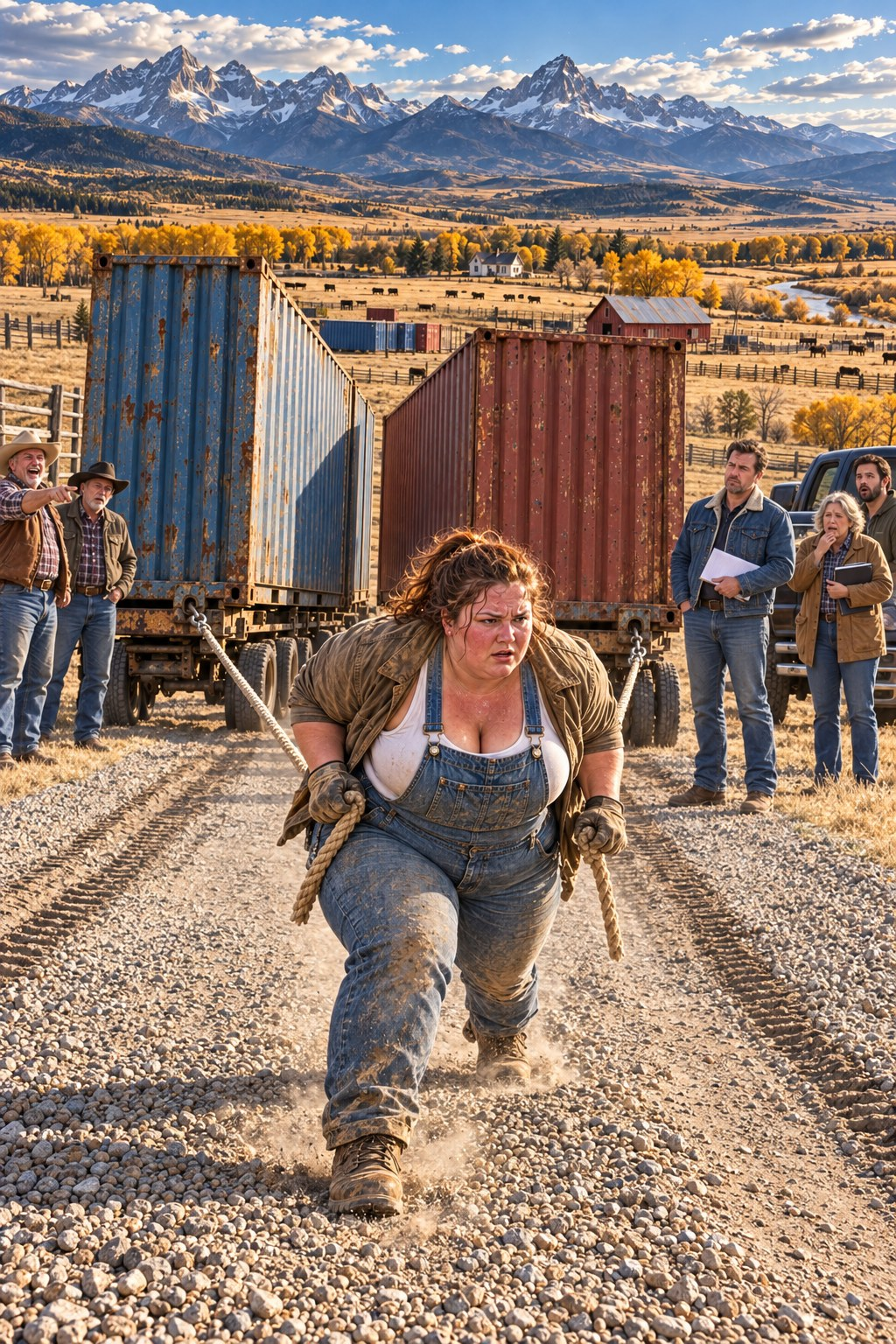
The knocking came again.
Three hard strikes against the farmhouse door.
Nathan Caldwell stood beside the kitchen table, staring at the man outside through the narrow window.
"Don't open it," he whispered.
Jolene looked at him.
"Why?"
"Because that's not just Garrett Slade."
She moved toward the window and pulled the curtain aside.
Garrett stood on the porch in his charcoal-gray jacket. Beside him was a tall man carrying a leather briefcase. His silver hair was neatly combed, and his dark overcoat looked expensive enough to belong in a courtroom rather than on a Wyoming ranch.
Jolene recognized him.
Not personally.
But she recognized his face from an old photograph in her grandfather's study.
It was the same man who had stood beside Virgil Caldwell at a county agricultural meeting in 1971.
The man who had witnessed the original water infrastructure agreement.
And the man whose signature appeared beside William Slade's on a document her grandfather had never wanted anyone to find.
"Who is he?" she whispered.
Nathan swallowed.
"Arthur Whitcomb."
"Who?"
"Our father's attorney."
Jolene turned.
"Our father never mentioned him."
"That's because Arthur handled something for him before he died."
"What?"
Nathan looked at the leather briefcase.
"An inheritance agreement."
The knocking came again.
This time, Garrett spoke through the door.
"Jolene, we know you're inside. We need to discuss something important."
She looked at the original deed on the table.
Then at the brass key.
Then at her brother.
Whatever happened next, she knew one thing.
They could not let those men inside without understanding what they wanted.
"Should I call Deputy Bell?" Jolene asked.
Nathan shook his head.
"Not yet."
"Why?"
"Because Arthur knows how to make everything sound legal."
"That doesn't mean he can walk onto my property and demand anything."
"No. But he can make a legal problem very expensive."
Jolene picked up the ownership deed and placed it inside the metal case.
She locked it.
Nathan watched her.
"Where are you putting that?"
"Somewhere they won't find it."
She carried the case into the study.
Behind a row of agricultural books, she found a narrow storage compartment her grandfather had built into the shelving.
She placed the case inside.
Then she returned to the kitchen.
The knocking stopped.
Garrett's voice came again.
"Miss Caldwell, we know you've recovered documents belonging to the original Western Conveyance Project."
Jolene froze.
Nathan closed his eyes.
"They know," he whispered.
She looked toward the door.
"How?"
Nathan didn't answer.
Jolene walked to the entrance but kept the door locked.
"What documents?"
Arthur Whitcomb spoke this time.
His voice was smooth and controlled.
"An original ownership instrument dated November 1971, accompanied by related correspondence."
Jolene felt a cold sensation move through her chest.
The original deed.
They knew about it.
"How do you know what I have?" she asked.
Arthur adjusted his coat.
"Because those documents were referenced in a legal matter involving your grandfather."
"Then you should know they belong to his heirs."
A pause.
"That is precisely what we need to discuss."
Jolene looked at Nathan.
He shook his head.
She continued.
"Send whatever you want to discuss through my attorney."
Garrett stepped closer.
"You're making this unnecessarily difficult."
"Then you shouldn't have come here."
Arthur raised one hand.
"Mr. Slade, please."
He turned toward the door.
"Miss Caldwell, my name is Arthur Whitcomb. I represented several parties involved in the original agricultural development agreement. I also represented your father in certain personal legal matters."
Jolene's expression changed.
"My father?"
"Yes."
"What matters?"
Arthur glanced at Nathan.
"Perhaps your brother can explain."
Jolene turned sharply.
Nathan looked down.
Another secret.
Another piece of information he had kept from her.
She felt her patience disappearing.
"Open the door," Nathan said quietly.
Jolene stared at him.
"Are you sure?"
He nodded.
"Let them talk."
She unlocked the door.
Arthur entered first.
Garrett followed.
Neither man offered a greeting beyond a brief nod.
Arthur placed his leather briefcase on the kitchen table.
His eyes moved over the papers.
The photographs.
The notebook.
The empty coffee can that had once held mineral residue.
He noticed everything.
Then he looked at Jolene.
"Your grandfather was a complicated man."
Jolene folded her arms.
"He was a rancher."
"Yes. And much more than that."
"Get to the point."
Arthur opened the briefcase.
He removed a thin folder.
Inside were several documents.
"I represent the legal interests of Bridger Plains Agricultural Holdings regarding the historical water infrastructure located beneath your property."
Jolene laughed without smiling.
"That sounds familiar."
"Your grandfather entered into a development agreement with several parties in 1968."
"I've seen it."
"Then you understand that the agreement was never fully completed."
"I've also seen the 1971 deed."
Arthur's hand stopped.
Garrett looked at him.
The attorney recovered quickly.
"Ah. Then you've found the document."
"Yes."
"May I see it?"
"No."
Arthur nodded slowly.
"That's understandable."
He removed another document.
"This is a certified copy of a subsequent agreement signed by your grandfather."
Jolene glanced at it.
The document was dated March 1972.
The title read:
AMENDMENT TO WESTERN CONVEYANCE ACCESS AGREEMENT.
She scanned the first paragraph.
It referred to the original project.
The same underground pipes.
The same collection chambers.
But the language near the bottom was different.
It appeared to grant temporary operational control to William Slade.
Jolene looked up.
"What's this?"
"An amendment."
"Why didn't the county records office have it?"
"Because it was filed separately."
"Was it registered?"
Arthur turned the page.
A county stamp appeared near the bottom.
Jolene examined it carefully.
The number was different from the one on the original deed.
"Why does this amendment contradict the ownership agreement?"
"It doesn't."
"It gives William Slade control over the infrastructure."
"Temporary control."
"For how long?"
Arthur smiled.
"Until the original access conditions were satisfied."
"Which conditions?"
He folded his hands.
"That's what we're here to establish."
Jolene looked at Nathan.
Her brother's expression had become unreadable.
Then Arthur said something that changed the conversation completely.
"Your father was aware of this agreement."
Jolene slowly turned back.
"What did you say?"
"Your father knew about the historical claims."
"Which claims?"
Arthur opened another folder.
"Before his death, he was investigating the ownership of the original water source."
Nathan stood abruptly.
"Arthur, stop."
The attorney looked at him.
"Your sister deserves to know."
Jolene felt her heart pounding.
"What did Dad find?"
Arthur looked directly at her.
"He discovered that your grandfather had never owned the water source."
Jolene didn't answer.
The kitchen seemed suddenly too small.
She looked at the ownership deed hidden in the study.
Then at Arthur's amendment.
"You're saying Grandpa owned the pipes but not the water?"
"That's correct."
"Then who owned the source?"
Arthur closed the folder.
"That is a matter of historical record."
"Name them."
He hesitated.
Then he looked at Nathan.
Nathan's face had gone pale.
"Arthur," he said again.
But the attorney continued.
"The original intake property belonged to a separate family trust established in 1968."
"Whose trust?"
"Mercer."
Jolene felt the name strike her.
Edwin Mercer.
Margaret Mercer.
The woman who had just confirmed that Edwin was alive.
"Then why is Bridger Plains trying to buy my water rights?"
Arthur gave a small smile.
"Because the system cannot operate without the infrastructure on your property."
"And they want control of both."
"Naturally."
"Then the eighty-thousand-dollar offer wasn't for water rights."
"It was an offer to resolve an ownership complication."
Jolene stepped closer.
"You're trying to make me sign away something you don't even own."
Arthur's expression hardened.
"I would advise you to be careful with that accusation."
"And I'd advise you to stop treating me like I don't understand what you're doing."
Garrett moved toward the table.
"You're wasting everyone's time."
Jolene turned to him.
"You tried opening an emergency valve on my property yesterday."
Garrett said nothing.
"You brought an industrial key. You operated a mechanism you didn't understand. Water started coming out of the ground."
Arthur looked at Garrett.
The expression between them lasted only a second.
But Jolene saw it.
The attorney had not known about the valve operation.
Or at least, he hadn't expected her to know.
"Is that true?" Arthur asked.
Garrett shrugged.
"We were conducting an inspection."
"Without authorization?"
"The mechanism was part of the historical system."
"On my land," Jolene said.
Arthur raised his hand.
"Enough."
He returned to his folder.
"Miss Caldwell, I think we should discuss a settlement."
He slid a second document across the table.
This one contained a new offer.
$150,000.
Jolene stared at the number.
One hundred fifty thousand dollars.
Almost twice the amount Garrett had offered before.
The figure was enough to clear the most urgent portion of the ranch debt.
Enough to repair the worst fences.
Enough to keep her cattle fed through winter.
Enough to give her a chance to start again.
Arthur watched her carefully.
"We believe this is a reasonable resolution."
Jolene looked at the document.
Then at Garrett.
"Why the increase?"
"Because we recognize the importance of your cooperation."
"No."
Arthur sighed.
"Miss Caldwell—"
"No."
Garrett's face reddened.
"You haven't even read the terms."
"I don't need to."
Arthur carefully retrieved the document.
"Then perhaps you would prefer to hear the consequences of refusing."
Jolene stood.
"Try me."
The attorney looked at her for a long moment.
Then he said:
"Your grandfather's ownership claim may not be valid."
After the men left, Jolene locked the door and checked every window.
Nathan remained standing in the kitchen.
Neither spoke for nearly a minute.
Finally, Jolene turned.
"Tell me about Dad."
Nathan sat down.
"Arthur wasn't exaggerating."
"Start from the beginning."
He rubbed his forehead.
"About two years before Dad died, he started asking questions about Grandpa's old project."
"Why?"
"I don't know exactly. He had been sorting through family documents after Grandpa's health started getting worse."
"And?"
"He found a reference to the original intake agreement."
Jolene remembered the final line in Virgil's letter.
The source is not in the farmhouse.
"Did Dad know Edwin Mercer?"
"Not personally."
"Did he know Margaret?"
Nathan shook his head.
"Not that I know of."
"Then what did he discover?"
Nathan took a breath.
"He found out that the Slades had been using an old document to claim operational control of the system."
"The 1972 amendment?"
"Yes."
"But the original deed transferred ownership."
"That's what Dad believed."
"Did he find proof?"
Nathan nodded.
"He found a letter from Edwin."
Jolene's eyes widened.
"Where?"
Nathan looked toward the study.
"In Grandpa's old filing cabinet."
"Why didn't you tell me?"
"Because I thought it had been destroyed."
"Was it?"
"I don't know."
Jolene stood.
"Let's find it."
They searched the study.
They opened every drawer.
They examined the old filing cabinet.
They removed the folders one by one.
Finally, Nathan found a thin envelope tucked behind a metal divider.
It had no stamp.
No address.
Only two words.
For Robert.
Their father's name.
Nathan opened it.
Inside was a single handwritten letter.
The writing was unfamiliar.
But the signature was clear.
Edwin Mercer.
Jolene read over Nathan's shoulder.
Robert,
Your father-in-law was right to distrust William Slade.
The original system was never designed to serve one company. It was designed to distribute water among participating ranches.
William attempted to change the intake agreement after the infrastructure was installed.
Virgil refused.
I refused.
The original deed was executed to protect the participating owners. The amendment he is showing people does not grant permanent ownership. It only grants temporary access under conditions that were never fulfilled.
Jolene continued reading.
There is another problem.
The water source is not what William believes it to be.
Her eyes moved down the page.
The intake connects to a natural underground reservoir. Its capacity is unknown, and its pressure behavior has never been fully documented.
The emergency valve must remain closed until the original intake records are recovered.
If the system is opened without those records, water may move through an abandoned pressure chamber.
That chamber was sealed for a reason.
Jolene stopped.
She remembered the muddy water.
The vibration.
The industrial key.
The warning.
She looked at Nathan.
"There's a sealed pressure chamber."
He nodded slowly.
"That's what the letter says."
She continued.
I have kept the original intake records.
They identify the source, the access boundary, and the conditions under which the system can operate safely.
Without them, nobody should attempt to reopen the main line.
At the bottom was a final paragraph.
If you ever need to find me, contact Margaret. She knows where I went.
Jolene looked at the date.
September 1998.
Twenty-one years earlier.
Her father had received the letter.
And he had kept it.
But he had never told her.
Nathan sat on the edge of the desk.
"I think Dad wanted to protect you."
Jolene folded the letter.
"From what?"
"From the Slades."
"Then why did he never tell me?"
"Maybe he thought keeping quiet would make the problem disappear."
She looked at him.
"That's what Grandpa did."
Nathan nodded.
"Yes."
Jolene walked toward the window.
The western pasture stretched beyond the hay shed.
The containers stood in their rows.
The buried pipes ran beneath them.
Somewhere beyond the fence was the original intake.
Somewhere beyond that was a sealed pressure chamber.
And somewhere in Montana, a man who had supposedly disappeared nearly fifty years earlier was still alive.
She turned.
"We're going to see Margaret."
Nathan nodded.
"I'll drive."
"No. I'll drive."
"Jo—"
"I don't want anyone knowing where we're going until we get there."
Nathan accepted that.
She picked up her phone.
The message thread from the unknown number remained open.
She typed:
We found the deed. We found the letter. Who are you?
The response came almost immediately.
Someone who helped your grandfather keep the water from falling into the wrong hands.
Jolene stared.
She typed again.
Are you Edwin Mercer?
The screen remained still.
Then three dots appeared.
Disappeared.
Appeared again.
Finally, a new message arrived.
No. I'm the person who buried him.
Jolene felt her blood run cold.
She looked at Nathan.
He had noticed her expression.
"What?"
She handed him the phone.
He read the message.
Then he looked toward the front door.
Neither of them spoke.
They decided to leave for Montana the following morning.
Before going, Jolene wanted to secure the documents and make copies.
She photographed the deed, the letter, the amendment, and every page recovered from container seventeen.
Nathan saved copies to an encrypted drive.
They agreed not to tell Arthur or Garrett about the letter from Edwin.
They also agreed not to operate any part of the underground system.
At 6:40 p.m., Jolene went outside to check the livestock.
The cattle were gathered near the southern pasture.
She counted them.
Two hundred and six.
All present.
She checked the water troughs.
The main line was working.
Nothing appeared unusual.
But as she approached the western fence, she noticed something.
A small wooden stake had been placed beside the buried emergency shutoff.
It wasn't there that morning.
She crouched.
A strip of white cloth had been tied around it.
Beneath the cloth was a small metal tag.
Jolene brushed away the dirt.
The tag carried a number.
214-7.
The same number from the archive receipt.
She photographed it.
Then she looked toward the western road.
A vehicle was approaching.
A dusty silver sedan.
It stopped beside the gate.
The driver's door opened.
A woman stepped out.
She was in her late sixties, with short gray hair and a dark green coat.
She looked directly at Jolene.
"Are you Virgil Caldwell's granddaughter?"
Jolene stood.
"Yes."
The woman approached slowly.
"My name is Margaret Mercer."
Jolene's heart began beating faster.
"You're Edwin's daughter?"
Margaret nodded.
"I spoke to your brother earlier."
"Where is your father?"
Margaret looked toward the buried pipes.
Then she looked at the containers.
"Not where the records say he is."
Jolene stepped closer.
"What does that mean?"
Margaret reached into her coat.
She removed an old photograph.
It showed a younger Edwin Mercer standing beside a woman and a little girl.
The little girl wore a red coat.
On the back was a handwritten date.
November 1971.
Jolene looked at the woman.
"Who is the girl?"
Margaret's eyes filled with tears.
"Me."
Jolene examined the photograph again.
"Why are you showing me this?"
Margaret lowered her voice.
"Because your grandfather saved my life."
Jolene felt her throat tighten.
"What happened?"
Margaret glanced toward the farmhouse.
"Can we talk inside?"
Jolene nodded.
They walked toward the back door.
But before reaching it, Margaret stopped.
She looked directly at Jolene.
"There's something your grandfather never told you about the night the water project was shut down."
"What?"
Margaret's hands trembled.
"Edwin didn't disappear because he refused to sign the agreement."
Jolene stared at her.
"Then why?"
Margaret looked toward the western pasture.
"Because someone tried to kill him."
Inside the farmhouse, Nathan was waiting.
He stood when Margaret entered.
She recognized him immediately.
"You're Robert's son."
Nathan nodded.
"Yes."
Margaret sat at the kitchen table.
She placed the photograph beside the original deed.
For several seconds, she seemed unable to speak.
Then she began.
In November 1971, Edwin Mercer had discovered that William Slade intended to activate the system before the ownership dispute was resolved.
The original pressure chamber had not been fully inspected.
The main intake had been designed to remain closed until several engineering conditions were met.
But William wanted the water flowing.
He believed the system would give him control over the surrounding agricultural properties.
Edwin refused.
Virgil supported him.
Frank Harmon had already begun cooperating with William.
The conflict became personal.
One night, Edwin returned to the project site and discovered that someone had removed several safety components.
He confronted William.
An argument followed.
Then a truck appeared on the access road.
Edwin was struck and left unconscious near the drainage ditch.
Virgil found him.
He and Margaret's mother took him away before the men returned.
The official report claimed Edwin had left the county voluntarily.
But the truth was that he had been forced into hiding.
"Why didn't he go to the police?" Jolene asked.
Margaret looked at her.
"Because the sheriff at the time was William Slade's cousin."
Nathan swore under his breath.
Margaret continued.
"Your grandfather helped us leave. He gave my father money and arranged for him to receive medical treatment under another name."
"Where did he go?"
"First Colorado. Then Montana."
"Why didn't he return?"
"Because the people who attacked him never stopped looking."
Jolene stared at the photograph.
"And the original intake records?"
Margaret nodded.
"My father kept them."
"Where?"
She looked at Nathan.
Then at Jolene.
"At the facility where he lives now."
Jolene felt relief and fear at the same time.
"Then we can see him tomorrow."
Margaret shook her head.
"That's what I came to tell you."
"What?"
"My father is missing."
The room fell silent.
"When?" Nathan asked.
"Yesterday morning."
Jolene stood.
"Was he taken?"
Margaret nodded slowly.
"The facility says he left voluntarily."
"Do they have security footage?"
"They say the cameras weren't working."
Nathan looked at the photograph.
"Did anyone contact you?"
Margaret reached into her coat.
She removed a folded piece of paper.
"I found this inside his room."
She placed it on the table.
The writing was shaky.
But Jolene recognized the name.
Edwin Mercer.
She opened the paper.
Only one sentence appeared.
If the Caldwell children come looking for me, tell them the original source is beneath the place where their grandfather buried the first key.
Jolene read it twice.
Then she looked at Nathan.
"Where did Grandpa bury the first key?"
Nathan shook his head.
"I don't know."
Margaret looked at the western pasture.
"Your grandfather told my father something different."
"What?"
She leaned forward.
"He said the first key was never buried."
Jolene felt a chill.
"Then where is it?"
Margaret pointed toward the old Ford tractor.
"Your grandfather gave it to someone he trusted."
Nathan stood.
"Who?"
Margaret looked directly at Jolene.
And whispered:
"Your father."
Jolene stared at the woman.
"That's impossible."
Margaret didn't blink.
"Your father had it."
"He's been dead for years."
"I know."
Nathan shook his head.
"Dad never mentioned a key."
"Perhaps he didn't know what it opened," Margaret replied.
Jolene looked toward the study.
The documents.
The photographs.
The letter.
The tractor toolbox.
Everything they had discovered seemed to point toward one final missing object.
The first key.
"Where would Dad have kept it?" she asked.
Margaret looked down.
"Your grandfather said Robert would know."
Nathan suddenly stood.
"Wait."
He walked toward the hallway.
Jolene followed him.
"Where are you going?"
"To the old house records."
"What records?"
"After Dad died, I collected his personal belongings. There was a small wooden box he always kept in his bedroom."
"Where is it?"
"At my apartment."
"What's inside?"
"I never opened it."
Jolene stared at him.
"Why?"
"Because it had your name written on it."
She felt her pulse quicken.
Nathan reached for his phone.
"I'll call my landlord. I'll have him check whether the box is still there."
But before he could dial, his phone rang.
Unknown number.
He answered.
"Hello?"
A man's voice came through.
Nathan's expression changed.
He listened without speaking.
Then he slowly looked at Jolene.
"What?" she whispered.
He raised one finger.
The caller continued.
Nathan's face turned pale.
Finally, he said:
"Who told you that?"
Silence.
Then the call ended.
Jolene grabbed his arm.
"What happened?"
Nathan looked at her.
"The wooden box is gone."
"From your apartment?"
He nodded.
"Someone broke in."
Jolene looked at Margaret.
The older woman closed her eyes.
Then Nathan's phone vibrated.
A message appeared.
It contained a photograph.
The small wooden box sat on an unfamiliar table.
Beside it lay a brass key.
And underneath the photograph were seven words.
WE FOUND YOUR FATHER'S KEY. NOW COME ALONE.






Comments 0