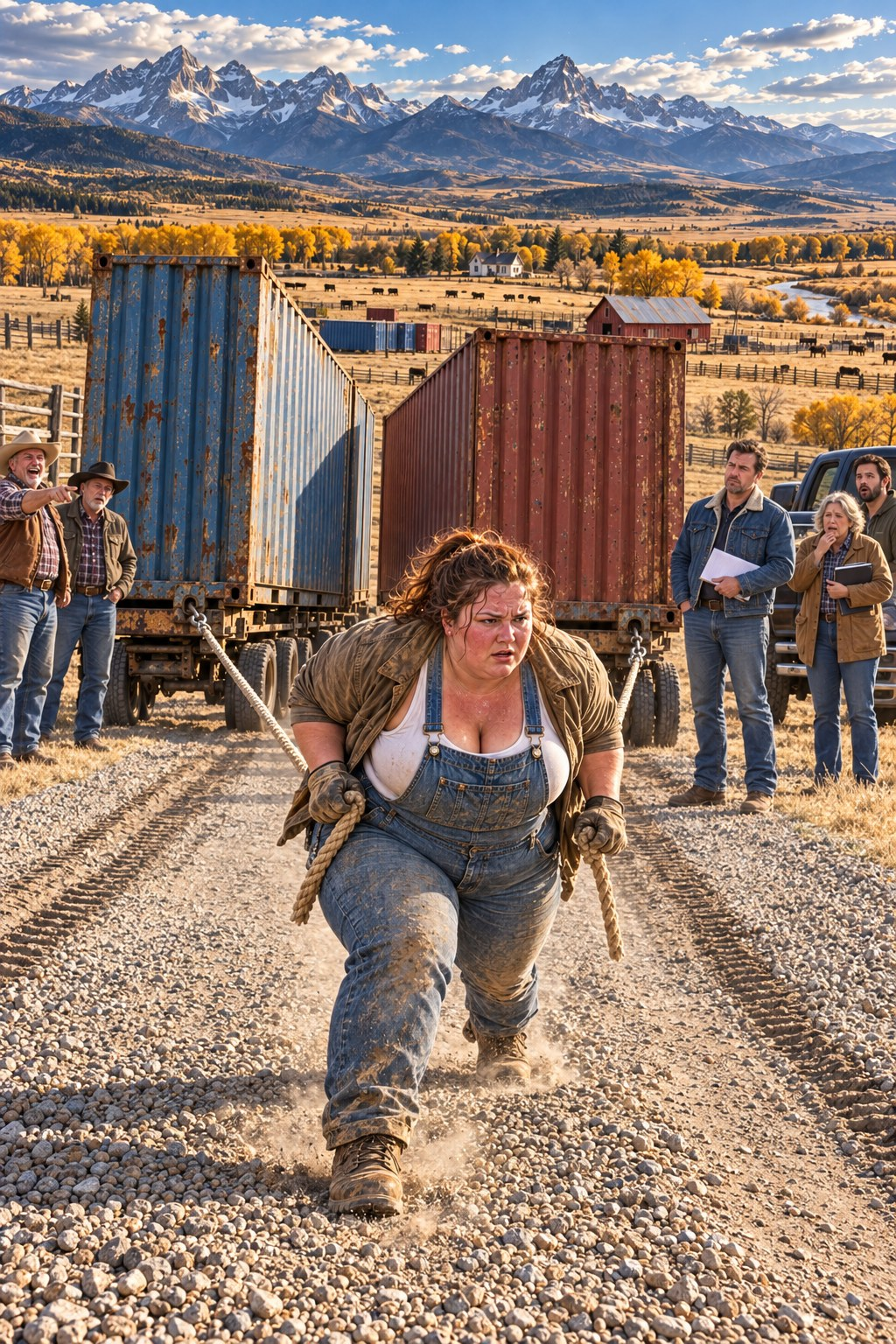
"Don't touch that plate!"
The stranger's voice cut across the western pasture before Jolene Caldwell could put her shovel down.
She looked up.
The man who had stepped out of the black Dodge Ram was walking toward her, his clean leather boots crunching against the gravel. He carried a folded document in one hand and wore the confident expression of someone who expected doors to open before he reached them.
Jolene remained beside the shallow excavation.
"Excuse me?"
The man stopped several feet away.
His eyes moved from her face to the exposed steel plate.
Then to the four rusted bolts.
Then to the initials stamped into the metal.
V.C.
MAY 1968.
DO NOT OPEN.
For one brief moment, the stranger looked as though he had walked into the wrong room at the worst possible time.
Then he smiled.
"Sorry. I thought you were about to hurt yourself."
Jolene glanced at the shovel in her hand.
"With this?"
"Old buried equipment can be dangerous."
"So can walking onto somebody else's property without permission."
His smile tightened.
"Fair enough."
He extended his hand.
"Garrett Slade."
Jolene didn't take it.
Garrett waited a second before lowering his arm.
"I represent Bridger Plains Cattle Company. We operate across three counties."
"Congratulations."
He studied her.
"You're Jolene Caldwell."
"You already knew that."
"Of course."
"Then you also know this is private property."
Garrett looked toward the containers.
"Quite a collection you've got here."
Jolene said nothing.
"Thirty of them, I hear."
"News travels fast."
"In cattle country, it certainly does."
He glanced at the steel plate again.
Jolene noticed.
It wasn't a casual glance.
It was the look of a man checking whether something he had feared was actually happening.
She shifted her body slightly, blocking his view.
"What do you want, Mr. Slade?"
"Just a conversation."
"About?"
"Your ranch."
"Not for sale."
"I didn't say it was."
"You drove all the way out here to discuss something."
Garrett unfolded the document.
"Actually, I'm interested in something more specific."
He held the paper toward her.
At the bottom was a number printed in bold.
$80,000.
Jolene stared at it.
Eighty thousand dollars.
Enough to bring the mortgage current.
Enough to replace the worst sections of fencing.
Enough to purchase winter feed without begging another supplier for credit.
Enough to give her a chance to breathe.
Garrett watched her expression carefully.
"My clients are prepared to offer that amount for certain water rights associated with your property."
Jolene looked up.
"My water rights?"
"That's correct."
"Which ones?"
"The western portion of the ranch."
She felt something tighten beneath her ribs.
The western pasture.
The buried pipes.
The steel plate.
The timing was too precise.
She folded her arms.
"How did you know I had water rights worth eighty thousand dollars?"
Garrett gave a practiced shrug.
"We conduct research."
"On ranches that aren't for sale?"
"On agricultural opportunities."
Jolene looked toward his truck.
It was newer than anything she owned.
Its black paint reflected the afternoon sunlight.
The tires were clean.
Even the license plate frame looked expensive.
Garrett continued.
"We understand you've had a difficult couple of years."
Jolene's eyes returned to him.
"Do you?"
"Drought. Livestock losses. Rising operating costs."
"That's public knowledge."
"Of course."
He paused.
"Your banker, Dale Harmon, also mentioned your situation."
The wind moved through the grass.
Jolene didn't blink.
"You spoke to my banker?"
"We had a general conversation."
"About me?"
"About opportunities in the area."
"Did he tell you what I owe?"
Garrett's expression remained smooth.
"Nothing confidential."
"That wasn't my question."
He folded the document.
"Miss Caldwell, I'm offering you a chance to solve a serious financial problem."
Jolene looked at the paper.
Then at the exposed steel plate behind her.
She remembered something her grandfather had told her when she was sixteen.
When a man offers to rescue you before you've asked for help, find out what he expects to carry away.
She held out her hand.
Garrett smiled and passed her the document.
She read the first paragraph.
Then the second.
The language was dense.
Water access.
Subsurface infrastructure.
Transferable interests.
Exclusive operational rights.
She stopped at a phrase halfway down the page.
"Associated underground conveyance systems."
She looked up.
"What does that mean?"
Garrett's smile barely moved.
"Standard legal terminology."
"For what?"
"Existing water infrastructure."
Jolene turned the page toward him.
"You're asking for rights to pipes you haven't inspected?"
"That's why we'd conduct due diligence."
"Then why is the offer already eighty thousand dollars?"
He didn't answer immediately.
Jolene folded the document.
"No."
Garrett's eyebrows lifted.
"You haven't considered it."
"I just did."
"Miss Caldwell—"
"No."
He studied her for several seconds.
Then his voice softened.
"Eighty thousand dollars could make a considerable difference to someone in your position."
Jolene felt the insult hidden beneath the concern.
"My position?"
"Your financial circumstances."
"You mean desperate."
"I wouldn't use that word."
"But you were thinking it."
Garrett's expression changed.
Only slightly.
Jolene handed the document back.
"I don't sell something until I know what it's worth."
Garrett accepted the paper.
His eyes drifted toward the excavation again.
"That's a sensible philosophy."
"Then we agree."
"Perhaps."
He looked at the steel plate.
"May I ask what you've uncovered?"
"No."
A longer silence followed.
Garrett slipped the document into his jacket.
"Well, I won't take any more of your afternoon."
"Good."
He started toward his truck.
Then stopped.
Without turning around, he said, "Old systems are often abandoned for a reason, Miss Caldwell."
Jolene stared at his back.
"What reason?"
Garrett turned.
"Sometimes the cost of reopening them is greater than their value."
He smiled again.
"Have a good day."
Jolene watched him climb into the Dodge Ram.
The engine started.
The truck pulled away.
But at the end of the gravel drive, Garrett stopped.
For several seconds, the vehicle remained motionless.
Then it turned onto the county road and disappeared.
Jolene looked down at the steel plate.
DO NOT OPEN.
Her grandfather had left that warning.
And a stranger had just offered her eighty thousand dollars for whatever lay beneath it.
Jolene didn't open the plate.
Not because Garrett had warned her.
Because she had learned that curiosity and carelessness were two different things.
The exposed metal might have covered an old valve chamber, a pressurized line, or a confined underground space.
She had no intention of discovering which by putting her face over it and removing four bolts.
Instead, she photographed the plate.
Then the pipe.
Then the surrounding soil.
She measured the distance between the excavation and the nearest container.
Thirty-seven feet.
She wrote it down.
She measured the pipe's direction.
West.
Almost perfectly west.
She wrote that down, too.
By the time she finished, her notebook contained three pages of measurements and questions.
The biggest question was simple.
Why had her grandfather hidden a water system?
Virgil Caldwell had never been a wealthy man.
He repaired equipment rather than replacing it.
He saved bent nails in coffee cans.
He could make a fence post last another five years with wire, patience, and language that would have embarrassed a preacher.
A man like that wouldn't have buried expensive irrigation equipment without a reason.
And he certainly wouldn't have forgotten it.
Jolene returned to the tractor.
She opened the toolbox and took out the sealed coffee can containing the white residue.
The powder had been sitting in her kitchen overnight.
She had brought it back to compare with the soil around the buried pipe.
Now she studied the can differently.
The containers.
The mineral residue.
The western pasture.
The old steel system.
They might have nothing to do with one another.
She understood that.
The containers had traveled across oceans before arriving in Wyoming.
Their residue could have come from any number of previous cargoes.
It would be foolish to assume that material inside a shipping container somehow proved the presence of valuable minerals beneath her ranch.
But the timing of Garrett's arrival made her unwilling to dismiss anything.
She needed facts.
Not guesses.
Not stories.
Facts.
That evening, Jolene spread the auction documents across the kitchen table.
Thirty containers.
Thirty serial numbers.
Different manufacturers.
Different years.
Different shipping histories.
She organized them into three piles.
Containers with visible white residue.
Containers without visible residue.
Containers she hadn't inspected thoroughly enough.
Then she opened her laptop.
The internet connection took nearly a minute to load the liquidation company's website.
Jolene found the contact number and called.
A woman answered after four rings.
"High Plains Liquidation, this is Melissa."
"Hi. My name's Jolene Caldwell. I purchased thirty shipping containers from your October auction."
There was a pause.
"Thirty?"
"Yes."
"Well, you must be the Wyoming buyer."
"That's me."
Melissa laughed politely.
"How can I help?"
"I need the inspection records."
"They should have been included with your invoice."
"I have the basic condition reports. I'm looking for the original rejection information."
"Those records aren't usually requested."
"I'd like them anyway."
Melissa typed something.
"May I ask why?"
"Some of the containers have white mineral residue inside."
Another pause.
"Are you planning to store food products?"
"No."
"Then it shouldn't affect your intended use, assuming the material is properly identified and the units are cleaned."
"That's what I'm trying to do."
Melissa sounded more interested now.
"Let me check the archived files."
Jolene waited.
She heard typing.
Then a quiet whistle.
"That's unusual."
"What is?"
"Several of these units were flagged under the same inspection category."
"Which category?"
"Mineral contamination."
Jolene sat straighter.
"Can you be more specific?"
"I'm seeing calcium carbonate, sodium chloride, and trace silica listed on some of the reports."
"Are they hazardous?"
"The reports don't classify them as hazardous, but you should have the residue tested before using the containers for livestock or feed."
"I understand."
Melissa continued scrolling.
"Some units transported agricultural products. Others carried mining equipment. A few have incomplete cargo histories."
"Why were they rejected?"
"Cleaning and refurbishment costs. Mostly."
"Mostly?"
"One second."
Jolene heard more typing.
"There's a note attached to seventeen of the units."
"Seventeen?"
"Yes."
Jolene looked at her handwritten list.
She had already found residue in several.
"What's the note?"
Melissa read slowly.
"Unusual mineral accumulation. Repeated cleaning unsuccessful. Not approved for standard cargo reuse."
Jolene wrote every word.
"Can you email me the complete records?"
"I can request them from archives."
"How long?"
"Possibly a day or two."
"I'd appreciate it."
Melissa hesitated.
"Miss Caldwell?"
"Yes?"
"Did you buy these for storage?"
"Originally."
"Well, I hope you got a good price."
Jolene looked at the bills beside her laptop.
"That depends on what happens next."
The following morning, she drove into Sheridan.
She carried the sealed mineral sample, her notebook, and photographs of the exposed pipe.
Her first stop was an agricultural testing service that accepted soil and material samples for laboratory analysis.
A technician named Hannah met her at the counter.
Hannah was in her early thirties, with dark-framed glasses and the focused expression of someone who preferred measurements to opinions.
Jolene placed the coffee can on the counter.
"I need to know what's in this."
Hannah examined the sealed container.
"Where did it come from?"
"An old shipping container."
"What was stored inside?"
"That's part of what I'm trying to establish."
Hannah nodded.
"We can arrange mineral identification and screen for contaminants."
"How much?"
The answer made Jolene wince.
She stared at the price sheet.
Hannah noticed.
"We can start with a limited analysis and expand if necessary."
"How limited?"
"Enough to identify the major mineral components. Not enough to certify it safe for every possible use."
Jolene considered the numbers.
Then she nodded.
"Do that."
Hannah completed the paperwork.
"Results should take several business days."
Jolene handed over her debit card.
The payment went through.
Barely.
She tucked the receipt into her jacket.
"One more question."
Hannah looked up.
"Do minerals from old cargo containers tell you anything about the ground where those containers are sitting?"
"Not by themselves."
"That's what I thought."
"You'd need independent samples from the soil or water system."
Jolene nodded.
"Thank you."
Outside, she sat in her truck for several minutes.
She had spent more money.
Again.
Money she didn't have.
But this time, she was buying information.
And information was something nobody could repossess as easily as a tractor.
Her next stop was the county records office.
The building smelled of paper, old carpet, and coffee.
A clerk named Evelyn Mercer had worked there long enough to remember when records were stored in cabinets rather than computers.
Jolene approached the counter.
"I need historical irrigation maps for my property."
Evelyn adjusted her glasses.
"Parcel number?"
Jolene recited it.
Evelyn typed.
"Caldwell Ranch?"
"Yes."
"Your grandfather was Virgil?"
"He was."
Evelyn's expression softened.
"Good man."
"Thank you."
"He used to come in here with questions about land surveys."
Jolene leaned forward.
"What kind of questions?"
"Oh, all sorts. Boundaries. Drainage. Old easements."
"Do you remember anything about the western pasture?"
Evelyn frowned.
"Not specifically."
Jolene placed a photograph on the counter.
It showed the exposed black pipe.
"I found this buried on my property."
Evelyn studied the image.
"Looks old."
"It is."
"Could be a private irrigation line."
"There's no record of it on my maps."
Evelyn turned toward her computer.
"Let's see what we have."
For the next forty minutes, they searched historical records.
Survey maps.
Property transfers.
Irrigation filings.
Water-related easements.
The western pasture appeared repeatedly.
But none of the modern maps showed the buried pipe.
Then Evelyn found an older document.
A survey from 1972.
She opened the scanned image.
Jolene leaned closer.
The western boundary was marked in black.
A drainage ditch crossed the lower portion of the property.
Near the fence line, someone had drawn a faint dotted line.
Jolene pointed.
"What's that?"
Evelyn enlarged the image.
The dotted line extended across the western pasture.
Then stopped near the old hay shed.
"Could be a utility reference," Evelyn said.
"Water?"
"Possibly."
"Can we find the original survey?"
Evelyn searched the archive number.
Her expression changed.
"Huh."
"What?"
"The original file isn't attached."
"Missing?"
"Not necessarily. Some older documents were never scanned."
"Where would it be?"
"Physical archives, probably."
"Can I see it?"
Evelyn hesitated.
"I'd need to request the box."
"How long?"
"Maybe tomorrow."
Jolene nodded.
"I'll come back."
As she gathered her papers, Evelyn said something that made her stop.
"Your grandfather asked about that same survey."
Jolene turned.
"When?"
Evelyn looked at the computer.
"There's a handwritten reference note from 1994."
Jolene felt a small chill.
"What does it say?"
Evelyn read from the screen.
"V. Caldwell requested historical western drainage documents."
"Did he receive them?"
"Looks like he signed for copies."
"Are those copies here?"
Evelyn shook her head.
"Not in this file."
Jolene looked at the dotted line again.
Her grandfather had investigated the western pasture twenty-five years earlier.
And he had never told her why.
By the time Jolene returned home, the sun was dropping toward the mountains.
She parked beside the farmhouse.
The black Dodge Ram was gone.
But fresh tire marks remained near the gravel drive.
She got out and followed them.
The tracks led toward the containers.
Then stopped near the western pasture.
Jolene crouched.
The tread pattern was wide and clean.
Not from Russell's old pickup.
Not from her own truck.
She looked toward the road.
Had Garrett returned?
She couldn't prove it.
But the thought made her uneasy.
She walked to the exposed steel plate.
The dirt around it looked different.
Someone had stepped near the excavation.
She could see the impression of a boot.
A large boot.
With a sharp, nearly unworn tread.
Jolene stood slowly.
She hadn't been alone on the ranch.
At least, not the entire day.
She photographed the footprint.
Then she covered the excavation with a heavy sheet of plywood and marked the area so neither livestock nor equipment would cross it.
She didn't remove the bolts.
She didn't touch the plate again.
Instead, she returned to the farmhouse and locked the door.
At 7:42 p.m., her brother called.
Jolene stared at his name.
For a moment, she considered ignoring him.
Then she answered.
"Hello, Nathan."
"Well, look who remembers how a phone works."
"Hello to you, too."
"I heard you bought shipping containers."
Jolene closed her eyes.
"Of course you did."
"Thirty?"
"Yes."
"Jo, tell me that's a joke."
"It isn't."
Nathan exhaled loudly.
"You're unbelievable."
"That's what Russell said."
"Russell Tate?"
"Apparently he's the county news service now."
Nathan didn't laugh.
"How much did you spend?"
"Enough."
"How much?"
"Nathan."
"You're behind on the mortgage."
"I know."
"And you bought thirty rusted boxes?"
"I have a plan."
"You always have a plan."
Jolene looked toward Virgil's notebook.
"Sometimes plans work."
"Sometimes they don't."
He paused.
"Listen, I talked to somebody who might be interested in the property."
Her stomach tightened.
"Who?"
"A company looking at agricultural land in northern Wyoming."
"What company?"
"I don't remember the exact name."
"Bridger Plains?"
Silence.
Jolene sat straighter.
"Nathan?"
"How do you know that name?"
A cold sensation moved through her.
"Someone came here."
"Who?"
"Garrett Slade."
Nathan swore quietly.
"What did he want?"
"Water rights."
Another silence.
Longer this time.
Jolene gripped the phone.
"Nathan, what do you know?"
"Nothing."
"Don't lie to me."
"I'm not lying."
"Then why did you stop talking?"
He lowered his voice.
"Because I didn't think they'd contact you directly."
Jolene stood.
"What does that mean?"
"I made an inquiry. That's all."
"About selling my ranch?"
"About helping you."
"You gave strangers my information?"
"I told them you were having trouble keeping the place afloat."
Jolene stared at the kitchen wall.
Her brother had discussed her financial problems with people she didn't know.
People who had then arrived with an offer.
People who already seemed interested in something buried beneath her land.
"Nathan, you had no right."
"I was trying to keep you from losing everything."
"By inviting somebody to take it?"
"That's not fair."
"Neither is what you did."
He sighed.
"Jo, you can't keep fighting everybody."
"I'm not fighting everybody."
"Then what are you doing?"
She looked through the window.
Thirty containers stood beneath the darkening sky.
"I'm trying to find out why people suddenly want something they ignored for decades."
Nathan didn't answer.
Then he said quietly, "Be careful."
Jolene frowned.
"Of what?"
"Just be careful."
The call ended.
She stared at the phone.
Her brother knew more than he was saying.
She was certain of it.
That night, Jolene returned to the notebook.
She read the entries surrounding May 1968.
Some were ordinary.
Fence repairs.
Cattle weights.
A broken tractor belt.
Then the writing changed.
Virgil had begun recording measurements.
Distances between markers.
Depths beneath the surface.
Directions.
Several entries referred to steel lines.
One mentioned pressure.
Another referred to a western collection point.
Jolene copied the measurements onto a separate sheet.
Then she compared them with her own observations.
The buried pipe ran almost exactly along the direction Virgil had recorded.
She felt her pulse quicken.
She turned another page.
There was a rough drawing of four parallel lines.
At one end stood a small rectangle.
At the other, a circle.
Beside the circle, Virgil had written:
Main access.
Jolene stared at the drawing.
The steel plate.
The four bolts.
The warning.
Was that the main access?
She looked closer.
Beneath the drawing was another note.
The handwriting was smaller.
Almost hurried.
Do not confuse the mineral traces with the source.
Jolene read it again.
Mineral traces.
She looked toward the coffee can's empty place on the table.
The white powder.
Her grandfather had written about mineral traces in 1968.
Long before the shipping containers arrived.
Long before she bought them.
Long before Garrett Slade appeared.
The containers couldn't have created the underground system.
Their residue couldn't explain Virgil's old notes.
But perhaps the powder had reminded her of something her grandfather had once studied.
Perhaps she had stumbled onto two separate mysteries that pointed toward the same question.
What was beneath the western pasture?
She turned the page.
A loose sheet slipped from the notebook and fell onto the floor.
Jolene bent to retrieve it.
It was a folded piece of yellowed paper.
She didn't remember seeing it before.
The edges were brittle.
One corner had been torn away.
She opened it carefully.
At the top was a handwritten date.
October 14, 1968.
Beneath it were several columns of figures.
Pressure readings.
Depth measurements.
A list of locations.
And at the bottom, a sentence written in darker ink.
If they come asking about the water, they already know about the steel.
Jolene's breath caught.
She read it twice.
Then a third time.
Garrett had come asking about the water.
He had looked directly at the steel plate.
And he had offered eighty thousand dollars without ever inspecting the system.
Her grandfather's warning suddenly felt less like an old note and more like a message meant for this exact moment.
She looked at the date.
October 14, 1968.
Fifty-one years earlier.
Someone had been interested in that water system before.
Someone Virgil hadn't trusted.
Jolene turned the paper over.
There was writing on the back.
Only one line.
Ask who paid for the first survey.
She sat motionless.
Then she reached for her phone.
She searched the number for the county records office.
Closed.
She checked the time.
9:18 p.m.
Tomorrow.
She would go back tomorrow.
She would ask Evelyn Mercer to find the original survey.
And she would find out who had paid for it.
At 10:06 p.m., an email arrived from High Plains Liquidation.
Jolene opened it immediately.
Melissa had sent the archived inspection records.
Seventeen files.
Each named by container serial number.
Jolene downloaded them.
The first showed elevated mineral residue.
The second contained similar readings.
The third listed the same major components.
Calcium carbonate.
Sodium chloride.
Trace silica.
Nothing that proved a valuable deposit existed beneath her ranch.
Nothing that explained the buried irrigation system.
But the records contained something else.
A notation she hadn't noticed in the original auction documents.
Several of the seventeen containers had been inspected at the same inland storage facility before being transferred to the liquidation yard.
The facility name was abbreviated.
B.P. Logistics.
Jolene frowned.
She searched the company name.
Several unrelated businesses appeared.
Then she found an archived corporate listing.
Bridger Plains Logistics.
The name made her sit upright.
Bridger Plains.
The same words Garrett Slade had used.
She checked the records again.
The containers had been rejected before they reached the auction yard.
Their inspection histories included earlier cargo routes and handling locations.
A shared storage facility did not prove anything improper.
Large companies handled thousands of containers.
But seventeen units with similar residue, a common facility reference, and a stranger from a company with a similar name were enough to justify more questions.
Jolene opened the last file.
A scanned inspection form appeared.
At the bottom was a handwritten notation.
Transfer authorized.
Below it was a signature.
The writing was faint.
She enlarged the image.
The first name was difficult to read.
The last name was clearer.
Slade.
Jolene leaned toward the screen.
She opened another file.
Same signature.
Then another.
Same name.
She counted.
Eleven of the seventeen inspection records carried authorization from someone named Slade.
Jolene felt her mouth go dry.
The man who had offered her eighty thousand dollars might have been connected to the containers before she ever purchased them.
She checked the dates.
The signatures were from several years earlier.
She couldn't tell whether they belonged to Garrett or someone else.
But she could no longer believe his visit was merely an ordinary business inquiry.
She printed the documents.
Then placed them beside her grandfather's notebook.
On one side lay records from 1968.
On the other lay inspection reports from the shipping industry.
Between them sat a woman who had spent nearly every dollar she owned buying thirty unwanted steel boxes.
Jolene rubbed her temples.
She needed sleep.
But she knew she wouldn't get much.
At 11:31 p.m., the motion light outside the farmhouse turned on.
Jolene looked up.
The yard beyond the kitchen window glowed pale yellow.
She waited.
A gust of wind moved the branches beside the porch.
Nothing else.
The light switched off.
She returned to the paperwork.
Three minutes later, it came on again.
This time, she heard gravel crunch.
Jolene froze.
Someone was outside.
She stood quietly and switched off the kitchen light.
The farmhouse fell into darkness.
She moved toward the window, keeping to one side.
Beyond the glass, the yard appeared empty.
The containers stood farther away, their dark outlines barely visible beneath the moon.
Then she saw movement.
A figure near the hay shed.
Tall.
Wearing a dark jacket.
The person moved slowly between the first two containers.
Jolene's heartbeat quickened.
She reached for her phone.
She didn't go outside.
Instead, she photographed the figure through the window.
The image was blurry.
She took another.
The figure stopped.
For one terrible second, Jolene thought the person was looking directly at the farmhouse.
Then the stranger disappeared behind a container.
A metallic sound echoed across the yard.
Clang.
Jolene recognized it.
A container door.
Someone was opening one.
She called the sheriff's nonemergency number and reported an unknown person on her property.
The dispatcher asked whether she was safe.
Jolene said she was inside with the doors locked.
The dispatcher told her a deputy would be sent.
She remained by the window.
Another metallic sound came from the containers.
Then silence.
A few minutes later, headlights appeared near the gravel road.
A vehicle started.
Jolene couldn't see it clearly.
It moved away without turning on its headlights until it reached the county road.
By the time the deputy arrived, the person was gone.
Jolene showed him the photographs.
He examined the yard.
Checked the container doors.
Looked at the tire marks.
He couldn't identify the visitor.
There was no obvious damage.
No clear evidence of theft.
But one container door stood partially open.
The seventeenth.
The one where Jolene had found a particularly heavy concentration of white mineral residue.
She hadn't left it open.
She was certain.
The deputy advised her to improve the lighting and call immediately if anyone returned.
Jolene thanked him.
Then she watched his patrol vehicle disappear down the road.
The yard became quiet again.
Too quiet.
She locked the farmhouse door.
Checked the windows.
Then returned to the kitchen table.
The inspection reports lay exactly where she had left them.
She opened the file for container seventeen.
The signature at the bottom was clearer than the others.
Slade.
She stared at it.
Then she noticed a second handwritten notation near the top of the page.
Original documentation retained separately.
Jolene frowned.
She searched the email attachments.
Nothing.
She checked the invoice.
Nothing.
She looked at the photograph of container seventeen.
Its door had been opened tonight.
Someone had gone directly to it.
Not the first container.
Not the nearest.
The seventeenth.
She felt a cold certainty forming.
Whoever had entered her property knew which container mattered.
And they had been looking for something.
Jolene reached for Virgil's notebook.
A loose page near the back caught against her sleeve.
She turned it carefully.
There was a small drawing she had overlooked.
A rectangle.
A number.
17.
Beneath it, in her grandfather's handwriting, were four words.
The answer is inside.
Jolene stared.
The number could have referred to a measurement, an old map location, or something unrelated to the shipping container.
Her grandfather had died years before she bought it.
There was no sensible reason for the two seventeens to be connected.
But someone had entered that exact container tonight.
Someone had opened its door.
And someone had left without taking anything she could see.
Jolene looked at the clock.
12:14 a.m.
She should have waited until morning.
She knew that.
Instead, she picked up her flashlight and the printed inspection report.
She stopped at the back door.
Her hand rested on the lock.
Outside, the wind pushed against the farmhouse.
She thought about Garrett Slade.
The eighty-thousand-dollar offer.
The signatures.
The buried pipes.
The steel plate marked with her grandfather's initials.
Then she looked down at the last inspection report.
A small handwritten number appeared beside the authorization signature.
She hadn't noticed it before.
17-B.
Jolene turned the paper over.
The same notation had been stamped on the reverse.
Below it were two words.
Secondary compartment.
Her pulse jumped.
She looked toward the dark yard.
Container seventeen had a second compartment.
One that wasn't listed on the auction inventory.
One that somebody might have tried to open tonight.
She unlocked the door.
Then stopped.
A sound came from the porch.
Not footsteps.
Not wind.
Three slow knocks.
Jolene froze.
The knocks came again.
Then a man's voice spoke from the darkness.
"Miss Caldwell, don't open container seventeen."
She stared at the door.
The voice was unfamiliar.
Then the man said something that made her blood run cold.
"Your grandfather told me you'd find it eventually."
Jolene reached for the porch light.
Before her fingers touched the switch, the man spoke again.
"And he told me what to give you when you did."
Something slid beneath the door.
A yellowed envelope.
Jolene looked down.
Her grandfather's handwriting covered the front.
Across the center were five words.
FOR JOLENE. IF THEY RETURN.
She bent to pick it up.
The envelope was already open.
And inside was a photograph of someone she recognized.






Comments 0