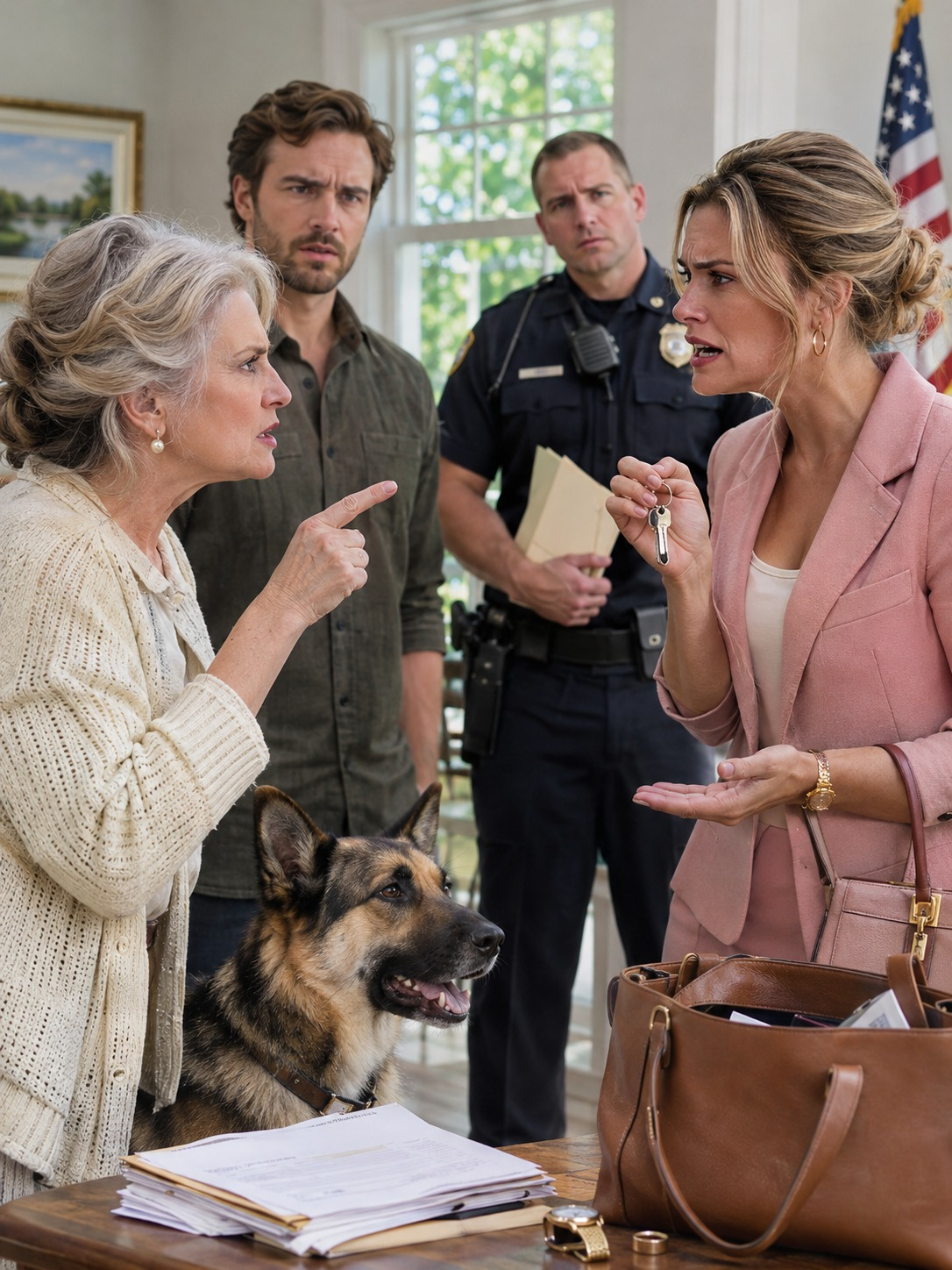
"Linda Carver," Caleb whispered.
Then the line went dead.
I sat motionless at my kitchen table.
Linda Carver.
I hadn't heard that name spoken aloud in almost four years.
She had worked at the probate court for nearly two decades, first as a records assistant and later as a deputy clerk. She was efficient, organized, and particularly good at finding documents other people misplaced.
We had shared a small office for seven years.
She knew my birthday.
She knew Peter's favorite restaurant.
She had attended Caleb's wedding.
And now my son was telling me that her name appeared on a document supposedly transferring an interest in my house.
I stared at the telephone.
For a moment, I wanted to believe Caleb had misunderstood.
Linda had retired shortly before I did. She moved to a smaller town outside Newark, and we'd exchanged Christmas cards for a while.
We weren't close anymore.
But I had trusted her.
Then I remembered something.
Linda had been a notary public.
She often notarized documents for people outside the courthouse, provided she followed the applicable requirements.
Her commission had been active when we worked together.
I didn't know whether it was still active.
And I didn't know whether the name Caleb saw referred to a genuine notarization, an old stamp, or something someone had simply typed onto a page.
But I knew one thing.
I had never appeared before Linda to sign away my property.
I opened my notebook.
Under the date, I wrote:
Caleb identified Linda Carver as the person listed as witness or notary on disputed property document. Source: telephone conversation. Not independently verified.
Then I added the time.
8:19 p.m.
I looked at Peter's photograph.
"Well," I whispered, "this just keeps getting worse."
At seven thirty the following morning, I called Rebecca Sloan.
She answered before her assistant arrived.
"Evelyn, are you all right?"
"I'm safe."
"That's not quite the same thing."
"No."
I told her what Caleb had said.
When I mentioned Linda Carver, Rebecca became quiet.
"I remember Linda."
"So do I."
"Did Caleb say she personally witnessed the signature?"
"He said her name was on the document."
"Those aren't necessarily the same thing."
"I know."
"Did he see a notary seal?"
"He didn't say."
Rebecca made a small sound.
"All right. We'll verify the commission records and request the complete instrument."
I looked toward the kitchen window.
"Rebecca, if Linda really witnessed a signature I never made—"
"Then there are serious questions to investigate."
"Could she lose her commission?"
"Potentially, depending on what happened. But we're not there yet."
I nodded.
Rebecca continued.
"I've also been examining the alleged seventy-eight-thousand-dollar obligation."
My stomach tightened.
"What did you find?"
"The supplemental inventory refers to a private debt. But the document attached to it is incomplete."
"Incomplete how?"
"There's a signature page, a summary of the claimed amount, and a property description. The underlying terms aren't fully included."
"That sounds convenient."
"It certainly makes verification necessary."
I looked at the folder on my table.
"Rebecca, I have never borrowed seventy-eight thousand dollars from Caleb or Tessa."
"I understand."
"I've never borrowed anything from them."
"Then we'll obtain your financial records and challenge the claim."
She paused.
"Evelyn, I want you to come to my office at ten. There's something else I need to show you."
"What?"
"Your son's sworn statement."
My chest tightened.
"I thought we'd already discussed it."
"We discussed what Caleb said he signed. I now have the complete copy."
I closed my eyes.
"All right."
After we hung up, I sat quietly.
I had spent my career reading sworn statements.
I knew how powerful they could be.
A statement under oath wasn't merely someone's opinion written on paper.
It was a formal representation of facts.
And my son had signed one against me.
Rebecca placed the document in front of me without speaking.
I recognized Caleb's signature immediately.
He had always formed the capital C with a wide curve and finished his last name with an impatient upward stroke.
That was his handwriting.
There was no question.
I began reading.
The first paragraph described me as a seventy-two-year-old widow living alone.
True.
The second stated that I had become increasingly isolated since Peter's death.
Partly true.
I had grieved. I had declined invitations. There were months when I preferred the quiet of my own home.
But grief wasn't incapacity.
The third paragraph claimed I had begun forgetting financial obligations.
False.
The fourth alleged that I had misplaced important documents and accused family members of taking them.
I stopped reading.
"Rebecca."
She waited.
"He knows Tessa was found with my documents."
"Yes."
"Then why would he write this?"
"Keep reading."
I swallowed.
The next paragraph claimed I had become suspicious of ordinary family assistance.
Then came a sentence that made my hands shake.
I believe my mother may no longer understand the consequences of her financial and personal decisions.
I stared at it.
My son had written that.
Or at least signed beneath it.
I looked at Rebecca.
"He never asked me whether I understood my decisions."
"I know."
"He never reviewed my finances."
"I understand."
"He didn't even know I'd paid the property taxes."
Rebecca nodded.
"Continue."
The final section described Rook.
It claimed I had adopted a large, potentially dangerous dog despite warnings that I couldn't safely manage him.
I felt heat rise behind my eyes.
The statement omitted the shelter's instructions.
It omitted my warning to Tessa.
It omitted the fact that I hadn't been home when she entered.
Instead, it suggested the bite proved I couldn't make reasonable decisions.
I put the document down.
For several seconds, I couldn't speak.
Rebecca waited.
Finally, I whispered, "He made me sound like a stranger."
She leaned forward.
"Evelyn, this statement is evidence that Caleb made these assertions. It isn't proof that they're true."
I looked at her.
"He signed it."
"Yes."
"He swore it was accurate."
"Yes."
"And he knows some of it isn't."
"That's something we'll need to establish."
I pressed my hands together.
Rebecca continued.
"We can challenge the factual basis. We can present your records. We can question the circumstances under which he signed."
I looked down.
"I raised him to tell the truth."
Her expression softened.
"I know."
"Peter used to say that a person's word was the only thing they truly owned."
I swallowed.
"Caleb used to believe that."
Rebecca didn't offer easy reassurance.
I appreciated that.
She let me sit with what I'd read.
Then she said, "Would you like a few minutes?"
I shook my head.
"No."
I picked up the statement again.
"I want to finish."
The last page contained a declaration that Caleb believed immediate intervention was necessary to protect my welfare and property.
Beneath it was his signature.
And below that, the date.
I frowned.
"Rebecca."
"Yes?"
"This was signed before Rook bit Tessa."
She looked at the page.
"Correct."
"But it mentions the bite."
She leaned closer.
For a moment, neither of us spoke.
Then Rebecca reached for her legal pad.
"That's important."
I looked at the date again.
The statement bore a date three days before the incident.
Yet the paragraph describing the bite was written as though it had already happened.
"Could the date be a mistake?" I asked.
"Possibly."
"Could someone have added that paragraph later?"
"That's another possibility."
I stared at the document.
"Or could Caleb have signed a different version?"
Rebecca nodded slowly.
"We need to ask him."
I felt my pulse quicken.
For the first time since reading the statement, I saw a question that could be answered with something more reliable than competing memories.
The dates didn't agree.
The document itself contained a discrepancy.
Rebecca made a copy of the page and placed it in a separate folder.
"We'll preserve the version received from the filing," she said. "And we'll seek information about when the statement was prepared and executed."
I nodded.
Then I asked, "Can I speak with Caleb?"
"You can. But don't pressure him to change his account. We need him to tell the truth in his own words."
"I understand."
Rebecca studied me.
"Do you?"
I looked at her.
"Yes."
She nodded.
"Good."
I drove home slowly.
The leaves along the road had begun turning yellow.
Peter used to love this time of year.
He would insist on driving through the countryside to look at the trees, even when I reminded him that we had perfectly good trees in our own yard.
He always said the best things were worth making time for.
I wished he were beside me.
Not because I expected him to solve everything.
Because I wanted someone who remembered our life the way I did.
Someone who knew how hard we'd worked.
Someone who understood that the house wasn't merely an asset.
It was the place where we had built a family.
And now our son had signed papers suggesting I could no longer be trusted to live there.
When I reached home, Margaret was waiting on her porch.
She waved.
I waved back.
Then I went inside.
Rook's empty bed was still beside the radiator.
I had washed his blanket the previous evening.
It smelled faintly of laundry soap.
I knelt beside it and pressed my hand against the fabric.
"Hang on, sweetheart," I whispered.
Then I stood.
I had work to do.
At two o'clock, Officer Merritt called.
"Mrs. Marlowe, do you have a moment?"
"Yes."
"We've received additional information concerning the documents recovered from your residence."
I sat down.
"All right."
He explained that investigators were reviewing the contents of Tessa's handbag alongside the items found near the open safe.
They had identified a small flash drive.
My stomach tightened.
"A flash drive?"
"Yes."
"Was it mine?"
"That's what we're trying to determine."
I thought about Peter's old computer.
He had kept digital copies of insurance records and tax returns.
After he died, I transferred some files to an external drive.
But I didn't remember owning a small flash drive that might have been in the safe.
"Can you describe it?"
"Black casing. Silver connector. No label."
I frowned.
"That doesn't sound familiar."
Officer Merritt continued.
"We haven't determined ownership. I wanted to ask whether you stored electronic copies of property documents."
"Yes."
"Where?"
"On my laptop and an external backup drive."
"Did anyone else have access?"
"Possibly Caleb."
"Did Tessa?"
"Not with my permission."
He made a note.
Then he said, "There's also a printed document we haven't discussed."
I felt my pulse quicken.
"What kind?"
"A proposed authorization concerning your financial affairs."
I closed my eyes.
"Was it signed?"
"It contains a signature purporting to be yours."
"I didn't sign anything."
"I understand."
"Was it notarized?"
There was a pause.
"There's a notarial acknowledgment on the copy."
My heart pounded.
"Whose name?"
He hesitated.
"Linda Carver."
I stared at the wall.
The name was no longer just something Caleb remembered seeing.
It appeared on a document collected during the investigation.
"Officer, I know Linda."
"How?"
"We worked together at the probate court."
He made another note.
"Have you appeared before her recently to sign documents?"
"No."
"Have you spoken with her?"
"Not in years."
"Would you be willing to provide a written statement about that?"
"Yes."
He paused.
"Mrs. Marlowe, I also want to ask whether anyone has recently contacted you about selling or transferring your house."
I thought about Martin Ellis.
The inspection.
The photograph.
The alleged private loan.
"Yes."
I explained what I knew.
Officer Merritt listened carefully.
Then he said, "Please send the photograph to the secure address on my card. Preserve the original message."
"I will."
Before ending the call, he added, "We're coordinating with the appropriate investigators to review the document concerns."
I thanked him.
Then I sat quietly.
The police had found more than stolen jewelry.
They had found paperwork that someone wanted to use.
And every new document seemed to point toward the same objective.
Control of my property.
That evening, Caleb came to the house.
He rang the bell twice.
When I opened the door, he looked worse than he had a few days earlier.
His face was pale.
His eyes were red.
"Mom."
"Come in."
He stepped inside.
For a moment, he looked toward Rook's empty bed.
"Is he coming home?"
"I hope so."
Caleb nodded.
Then he sat at the kitchen table.
I made coffee.
He didn't drink it.
We sat in silence until he finally said, "Tessa knows I called you."
I looked at him.
"What happened?"
"She got angry."
"Did she hurt you?"
He shook his head.
"No."
"Did she threaten you?"
He hesitated.
"She said if I kept talking to you, she'd make sure everyone knew what I'd signed."
I sat down.
"Caleb, the court already has your statement."
"Not that one."
My stomach tightened.
"What other document?"
He rubbed his face.
"The loan agreement."
I waited.
He continued.
"She says if the police investigate it, they'll think I forged your signature."
"Did you?"
"No."
"Did you see anyone sign my name?"
He hesitated.
"No."
"Then tell the police exactly that."
He looked frightened.
"Martin says my signature makes me responsible."
I leaned forward.
"Caleb, signing a document can have serious consequences. But hiding what happened won't make those consequences disappear."
He stared at his hands.
"I know."
I took a breath.
"Did you read the guardianship statement before you signed it?"
He nodded.
"All of it?"
He hesitated.
"Most of it."
"Did it mention Rook?"
He frowned.
"Rook?"
"The dog bite."
He looked confused.
"No."
I felt my pulse quicken.
"Are you sure?"
"Yes."
I opened my folder.
I placed the statement in front of him.
He read the paragraph.
His face changed.
"That's not what I signed."
I watched him carefully.
"Caleb, I need you to be certain."
He looked up.
"Mom, I signed a statement about you being forgetful. I know I shouldn't have. But this paragraph wasn't there."
I felt cold.
"Did Tessa give you a copy?"
"No."
"Did you sign every page?"
"Just the last one."
I closed my eyes.
Rebecca had suspected that possibility.
Now Caleb was describing it.
I took out my notebook.
"Would you be willing to tell Rebecca that?"
He looked at me.
Then, slowly, he nodded.
"Yes."
I felt tears rise.
Not because everything was fixed.
It wasn't.
But for the first time in weeks, my son had made a decision without first asking what Tessa wanted.
"Thank you," I whispered.
He looked down.
"Mom, I'm sorry."
I didn't answer immediately.
There were too many things to forgive.
Too many questions still unanswered.
But I reached across the table and placed my hand over his.
"I love you, Caleb."
He began to cry.
I let him.
When he could speak again, he told me more.
Tessa had been struggling financially since her business closed.
There were unpaid suppliers.
Credit card balances.
A personal loan.
He had known about some of it.
Not all.
She had told him that if they could obtain control of my house, they could borrow against it, settle their debts, and eventually repay everything.
I stared at him.
"Did she actually say that?"
He nodded.
"She said it would only be temporary."
"Caleb, my house isn't a checking account."
"I know."
"Did you agree?"
He looked miserable.
"I told her I didn't want to."
"Then why did you keep helping?"
He swallowed.
"Because she said she'd leave me."
I felt a deep sadness.
"Sweetheart, that isn't a reason to take something that doesn't belong to you."
"I know."
He wiped his eyes.
"She kept saying you wouldn't mind once everything was sorted out."
I looked at him.
"Did you believe that?"
He shook his head.
"No."
There it was.
The truth.
Not a complete explanation.
Not an excuse.
But the truth.
I sat back.
"Then you need to decide what kind of man you want to be."
He stared at me.
I continued.
"Your father loved you more than anything. But he would never have asked you to lie for him."
Caleb began crying again.
I let him sit with that.
After a while, he said, "I'll talk to Rebecca."
I nodded.
"Good."
"And the police."
I felt my throat tighten.
"That would be the right thing."
He looked toward the window.
"Tessa won't forgive me."
I took his hand.
"That's something you'll have to face."
Caleb left shortly after nine.
He promised to call Rebecca the next morning.
I watched him walk to his car.
For the first time in months, he looked directly at me before driving away.
He raised one hand.
I raised mine.
Then he was gone.
I locked the door.
I checked the camera.
I placed my notebook beside the telephone.
And I allowed myself one small moment of hope.
Maybe Caleb would finally tell the truth.
Maybe the court would see the contradictions.
Maybe Rook would come home.
Maybe I could keep the house Peter and I had built without spending the rest of my life defending my right to live in it.
Then my phone vibrated.
A message from an unfamiliar number.
Mrs. Marlowe, my name is Linda Carver. I understand you've been asking questions about a document bearing my name.
I stared at the screen.
Another message appeared.
I need to speak with you before anyone else does.
My heart began pounding.
Then a third message arrived.
Please don't tell Tessa I contacted you.
I sat down.
I typed carefully.
Why?
The reply came immediately.
Because the signature on that document isn't the only thing someone copied.
I stared at the words.
Then the phone rang.
Linda Carver.
I answered.
"Linda?"
Her voice sounded frightened.
"Evelyn, I don't have much time."
"What happened?"
"I need you to listen very carefully."
"I'm listening."
She took a shaky breath.
"Someone used my notary information. I didn't witness your signature."
I closed my eyes.
"Who?"
"I think I know. But there's something you need to see first."
"What?"
"A recording."
My heart pounded.
"What recording?"
She hesitated.
"From Martin's office."
I gripped the phone.
"Linda, what does it show?"
Her voice dropped to a whisper.
"Evelyn, it shows who actually signed your name."
I couldn't breathe.
"Who was it?"
There was a sound in the background.
A door opening.
Linda stopped speaking.
Then she whispered, "Oh, God. They're here."
The line crackled.
I heard footsteps.
A man's voice.
Then Linda said one final thing.
"Evelyn, if anything happens to me, the recording is hidden inside—"






Comments 0