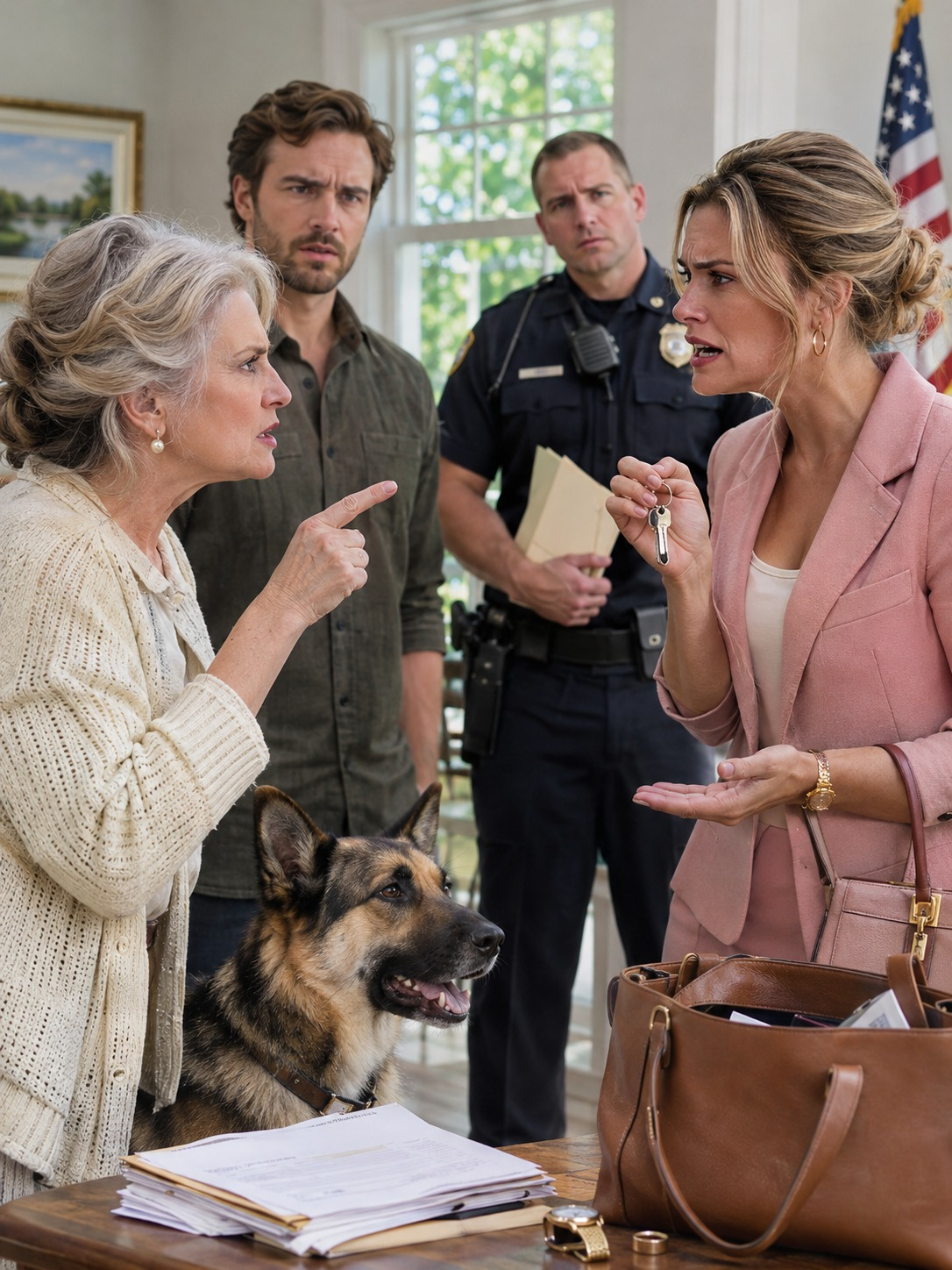
"Margaret Bell."
I whispered the name aloud.
For several seconds, I couldn't move.
My neighbor's name appeared at the bottom of the medical evaluation, beside a field labeled Referral Contact.
Margaret.
The woman who had brought me casseroles after Peter died.
The woman who kept my spare emergency key.
The woman who had hugged me two days earlier and promised that I wasn't facing this alone.
I stared at the document until the letters blurred.
Then I reached for my reading glasses, although I was already wearing them.
That was how badly the name unsettled me.
Margaret Bell had lived next door for twenty-six years. She had watched Caleb grow up. She had sat beside me at Peter's funeral. When I adopted Rook, she was one of the first people to welcome him.
And now her name appeared on a document claiming I could no longer manage my own affairs.
I wanted to call her immediately.
Instead, I called Rebecca Sloan.
She answered on the second ring.
"Evelyn?"
"Rebecca, have you looked at the referral contact on the evaluation?"
A brief silence.
"I'm looking at it now."
"Do you see the name?"
"Margaret Bell."
"She's my neighbor."
"Is she involved in your care?"
"No."
"Has she ever arranged a medical appointment for you?"
"Never."
"Does she have access to your house?"
I hesitated.
"She has an emergency key."
Rebecca was quiet.
Then she said, "Don't draw conclusions yet."
I looked toward the window facing Margaret's house.
"How am I supposed to explain this?"
"We don't explain it until we know what it means."
"But her name is there."
"Yes. That establishes that someone entered her name. It doesn't establish that Margaret knew about it."
I closed my eyes.
Rebecca was right.
I knew she was right.
Yet it hurt to hear her say it.
"Could Tessa have used Margaret's name?"
"Possibly."
"Why?"
"That's what we need to find out."
I sat down.
Rebecca continued, "I also want you to preserve the original PDF exactly as received. Don't edit it, mark it, or change the file."
"I haven't."
"Good. Send me the public court order you mentioned. We'll compare the documents and determine what can actually be established."
I glanced at the two signatures on my laptop.
"They look identical."
"That may be significant. But visual similarity alone isn't enough to prove who copied a signature or when."
"I understand."
"One more thing, Evelyn."
"Yes?"
"Don't confront Margaret tonight."
I looked toward the window again.
Her kitchen light was on.
"All right."
"Promise me."
I swallowed.
"I promise."
After we hung up, I remained at the table.
Across the street, a car passed slowly.
Somewhere in the neighborhood, a dog barked.
Ordinary sounds.
Ordinary life.
And I was sitting in my own kitchen wondering whether the person I trusted most had helped someone take my independence.
I met Margaret the following morning.
Not because I had changed my mind about Rebecca's advice.
Because Margaret came to me.
At nine fifteen, the doorbell rang.
I checked the camera.
She stood on the porch carrying a paper bag from the bakery.
I opened the door.
"Morning, Evelyn."
"Good morning."
She looked at my face.
"Oh, honey. You look exhausted."
"I didn't sleep well."
"Then I brought reinforcements."
She lifted the bag.
"Cinnamon rolls."
I stepped aside.
She entered, placed the bag on the kitchen counter, and began searching for plates as naturally as she had done for years.
I watched her.
Margaret wore a pale lavender sweater and dark trousers. Her silver hair was pinned neatly behind her ears. She moved around my kitchen without hesitation.
I had never minded that familiarity before.
Now I noticed every movement.
She turned toward me.
"What's wrong?"
"Nothing."
She narrowed her eyes.
"Evelyn Marlowe, you've never been a convincing liar."
I almost smiled.
Almost.
She placed two cinnamon rolls on plates.
"Did the lawyer find something?"
I looked at her.
"Some paperwork."
"Good or bad?"
"I'm not sure yet."
She sat down.
"Want to talk about it?"
I remembered Rebecca's warning.
"Not until I understand it."
Margaret studied me for a moment.
Then she nodded.
"Fair enough."
We ate in silence.
It was uncomfortable.
Not because Margaret behaved strangely.
Because she didn't.
She asked about Rook.
She asked whether I had slept.
She reminded me that the dog warden's office might have information about the observation schedule.
She was exactly the woman I had known for twenty-six years.
And that made the name on the evaluation even harder to understand.
Before leaving, she touched my arm.
"Whatever happens, I'm next door."
I looked at her hand.
Then at her face.
"I know."
After she left, I watched her cross the lawn.
I wanted desperately to believe her.
But I had learned something during my years at the courthouse.
Trust was not evidence.
Neither was suspicion.
At eleven, Officer Merritt called.
"Mrs. Marlowe, I have some information about the property recovered from your home."
I sat down immediately.
"Have you found Peter's power of attorney?"
"Not yet. But we've completed a more detailed inventory of the items collected at the scene."
I reached for my notebook.
"Go ahead."
He explained that Tessa's handbag had contained the gold wristwatch, my mother's bracelet, and several documents from the bedroom safe.
Among the papers were photocopies of my deed, an old mortgage satisfaction document, and portions of Peter's estate records.
Then he mentioned something I hadn't expected.
"There was also a small notebook."
I frowned.
"What kind?"
"Blue cover. Approximately six inches tall. Handwritten entries."
I stopped writing.
"Did it have a white label on the front?"
"Yes."
"What did the label say?"
"Household Accounts."
My mouth went dry.
That notebook belonged to me.
I had used it for years to record household expenses, property taxes, insurance payments, and repair costs.
It was the kind of habit I developed while working at the courthouse.
I liked being able to find information without searching through old statements.
"Where was it found?" I asked.
"In the handbag."
"That's impossible."
Officer Merritt paused.
"Why?"
"Because I kept it in the bottom drawer of my desk."
"Was the drawer locked?"
"No."
"Did you authorize Tessa to take it?"
"No."
He made a note.
I stared at the table.
The notebook wasn't valuable in the usual sense.
It contained no passwords.
No cash.
No negotiable documents.
But it recorded years of financial decisions.
Every property tax payment.
Every major repair.
Every insurance renewal.
If someone wanted to know exactly what I owned and how much it cost to maintain, that notebook would be useful.
Very useful.
"Officer, may I ask something?"
"Of course."
"Did Tessa explain why she had it?"
"She said she was reviewing your household finances."
"Without my permission?"
"That is one of the matters we're documenting."
I pressed my fingers against my forehead.
Then he continued.
"There's another item."
I straightened.
"What?"
"A photocopy of a letter."
"From whom?"
"It appears to be from a financial institution."
My heart began pounding.
"Which one?"
He gave me the name of my bank.
I recognized it immediately.
"What did the letter concern?"
"An inquiry about account access and authorized representatives."
I stared at the wall.
"Was it addressed to me?"
"Yes."
"Did I sign it?"
"There's a signature on the copy."
My stomach tightened.
"Officer, I haven't authorized anyone to access my accounts."
"I understand."
"Can you tell whether the signature is mine?"
"Not from the information I have."
I took a breath.
"Then I need to contact my bank."
"That would be reasonable. Preserve any related correspondence."
I thanked him.
Before hanging up, I asked whether Tessa had been arrested.
"No arrest has been made at this point," he said. "The investigation is continuing."
I understood.
Finding property in someone's handbag was significant.
But determining criminal responsibility required more than my anger or my certainty.
Still, I felt something change.
The case was no longer just about jewelry.
Someone had been collecting information about my home, my money, and my ability to control both.
I called the bank immediately.
The representative verified my identity and transferred me to the branch manager.
His name was Thomas Reed.
I had known him for years.
"Mrs. Marlowe, how can I help?"
"Thomas, I need to know whether anyone has requested access to my accounts."
He paused.
"Are you concerned about unauthorized activity?"
"Yes."
His tone became more formal.
He explained that he could review account records and help me secure my banking access.
I told him about the opened statement and the documents recovered from Tessa's handbag.
He listened carefully.
Then he asked whether I had signed any recent authorization forms.
"No."
"Have you given anyone your online banking credentials?"
"No."
"Has anyone helped you complete financial paperwork recently?"
I thought about Tessa sitting at my kitchen table.
Her fingers resting on my bank statement.
Her voice telling me I needed supervision.
"No," I said. "Not with my permission."
Thomas asked me to come to the branch.
I drove there that afternoon.
He met me in a private office.
For nearly an hour, we reviewed my accounts.
There were no unexplained withdrawals.
No unauthorized transfers.
No new joint owners.
I felt an enormous wave of relief.
Then Thomas showed me something.
An inquiry had been submitted requesting information about the procedure for adding an authorized financial representative.
The inquiry itself hadn't changed my accounts.
But the contact name was familiar.
Tessa Marlowe.
I stared at the screen.
"Did she say she had my permission?"
Thomas chose his words carefully.
"The record indicates she described herself as a family member assisting with future financial planning."
"Did you give her information?"
"No account-specific information was released through that inquiry."
I let out a breath.
"Thank you."
He leaned forward.
"Mrs. Marlowe, would you like us to add additional verification requirements to your accounts?"
"Yes."
We updated my security arrangements.
I changed my online banking password.
I reviewed contact information.
I confirmed that no one else was authorized to act on my behalf.
When I left the bank, I felt steadier.
Tessa had asked questions.
But she hadn't gained control.
Not yet.
That evening, Caleb called.
His voice sounded tired.
"Mom, Tessa says you're accusing her of stealing your money."
"I haven't accused her of stealing money."
"She says you went to the bank."
"I did."
"Why?"
"Because the police found banking correspondence in her handbag."
Silence.
Then he said, "She was trying to help."
I closed my eyes.
There it was again.
The same explanation.
The same words.
"Caleb, do you know what she asked the bank?"
"No."
"Then how do you know she was helping?"
He didn't answer.
I continued.
"She asked about adding someone to my accounts as an authorized representative."
"Maybe she was planning ahead."
"For what?"
"Mom, please."
I looked toward Peter's photograph on the mantel.
"Your father and I planned ahead. We bought insurance. We paid our mortgage. We wrote wills. We kept records."
"I know."
"Then why does your wife think I need her permission to manage what we built?"
He sighed.
"She's worried about your judgment."
"Because I adopted a dog?"
"Because the dog hurt her."
"After she entered without permission."
He was quiet.
Then he said, "Her lawyer thinks the bite proves you're making unsafe decisions."
I felt my pulse quicken.
"Is that what you think?"
"Mom—"
"Answer me."
He hesitated.
"I think things have gotten out of control."
I looked at my notes.
"Yes. They have."
"Then maybe we should all sit down and talk."
"We've tried that."
"With a mediator."
"Who suggested that?"
"Tessa."
I almost laughed.
"Of course."
He sounded hurt.
"Why do you always assume the worst?"
I thought about the lathe.
The opened mail.
The camera recordings.
The safe.
The bank inquiry.
"I don't assume the worst, Caleb. I keep finding things I wish weren't true."
He didn't answer.
Then he said quietly, "I miss how things used to be."
My throat tightened.
"So do I."
For a moment, neither of us spoke.
Then he whispered, "I don't know how to fix this."
I wanted to tell him.
I wanted to give him instructions.
Tell the truth.
Stop making excuses.
Look at the evidence.
But I knew he had to make those choices himself.
So I said only, "Start by being honest with me."
He was silent.
Then the call ended.
The next morning, Rebecca invited me back to her office.
She had reviewed the guardianship application and the attached evaluation.
I brought my copy of the public court order involving Dr. Harold Vance.
Rebecca spread the documents across the conference table.
"Let's begin with what we know."
I nodded.
"The application identifies Tessa as the proposed guardian," she said. "Caleb has provided a supporting statement. The evaluation claims Dr. Vance examined you last month."
"He didn't."
"That's your account, and we need to corroborate it."
She pointed toward the signature.
"The similarity you noticed is concerning."
I leaned closer.
The two signatures appeared nearly identical.
Even the small scanning mark beneath the final stroke matched.
Rebecca continued.
"We need to establish whether the signature was copied, whether the physician authorized the document, and how the evaluation was prepared."
"What about Margaret?"
She looked at me.
"I haven't forgotten."
"Have you contacted her?"
"Not yet. First, I want to understand why her name appears."
I nodded.
Rebecca turned another page.
"There's something unusual about the referral section."
"What?"
"The form lists Margaret as the referral contact, but the mailing address belongs to a commercial office."
I frowned.
"Whose office?"
She pointed.
I recognized the street.
It was near the shopping center where Tessa had operated her home-decor business.
Rebecca continued.
"The address appears to be associated with a private document preparation service."
I stared at her.
"Not a medical office?"
"Not according to the public business information I've reviewed."
My mouth went dry.
"Then why would a medical evaluation use that address?"
"That's one of the questions we need answered."
She closed the folder.
"I've requested verification through appropriate channels. Until we receive a response, we should avoid making accusations about the physician or anyone else."
I nodded.
But my thoughts were racing.
A doctor's signature that appeared copied.
A referral contact who might not know her name had been used.
A business address connected to document preparation.
And Tessa's application asking a court to place my property under her control.
I had seen questionable paperwork before.
But never with my own name at the top.
On my way home, I stopped at the county animal control office.
The dog warden, a woman named Linda Harris, met me in a small interview room.
She had Rook's file open on the table.
"Mrs. Marlowe, thank you for coming."
"How is he?"
"He's eating. He's alert. The staff say he's nervous but manageable."
I felt my eyes fill.
"Can I see him?"
"Not during this part of the observation period, but we'll explain the next steps."
I nodded.
Linda reviewed the shelter's behavioral notes.
She asked about Rook's vaccination history.
She asked whether Tessa had been introduced to him.
She asked whether I had been home.
I answered each question carefully.
Then I showed her the text message warning Tessa not to enter.
Linda read it.
"She acknowledged receiving this?"
"Yes."
She made a note.
"That will be included in the review."
I leaned forward.
"Please understand something. Rook has never hurt anyone while he's been with me."
"I understand."
"He met my neighbor outside. He was gentle."
"That's useful information."
"He's not a vicious dog."
Linda looked at me kindly.
"Mrs. Marlowe, we're evaluating the circumstances of the incident. We aren't making a decision based solely on what one person says."
I nodded.
It was all I could ask.
Before leaving, I asked whether Tessa had submitted a complaint.
Linda hesitated.
"Yes."
My stomach tightened.
"What did she request?"
"A formal review of whether Rook should be classified as dangerous."
I swallowed.
"And?"
"She also requested that euthanasia be considered."
For a moment, I couldn't speak.
I thought about Rook leaning against my leg at the shelter.
His bent ear.
His cautious eyes.
The way he slept beside the radiator.
I gripped the edge of the table.
Linda continued gently.
"That request doesn't determine the outcome."
I nodded.
But I was frightened.
More frightened than I had been when I saw the guardianship application.
Because Rook couldn't speak for himself.
He couldn't explain that he'd been scared.
He couldn't tell anyone that I had warned Tessa.
He depended on me.
And I wasn't going to fail him.
When I returned home, Margaret was standing near my driveway.
She looked worried.
"Evelyn, can we talk?"
I stopped beside my car.
"Of course."
She glanced toward her house.
"Something strange happened this morning."
My stomach tightened.
"What?"
"A woman called me."
"Who?"
"She said she was confirming information for a medical evaluation."
I went still.
Margaret continued.
"She asked whether I'd noticed changes in your memory."
I stared at her.
"What did you say?"
"I told her you were sharper than most people half your age."
I let out a breath.
"Did she give her name?"
"No. She said she worked with a medical office."
"Did she mention a doctor?"
"Dr. Vance."
I felt cold.
Margaret looked at me.
"Evelyn, why would somebody be asking me questions about your mental capacity?"
I hesitated.
Then I told her.
Not everything.
Just about the evaluation.
And her name appearing as the referral contact.
Margaret's face changed.
"My name?"
"Yes."
"On a medical document?"
"Yes."
She stared at me.
Then her expression hardened.
"I never referred you to any doctor."
"I hoped you hadn't."
She looked hurt.
"You thought I might have?"
I swallowed.
"I didn't know what to think."
For a moment, she said nothing.
Then she reached into her pocket.
"I wrote down the number that called me."
She handed me a small piece of paper.
I looked at it.
The number had a local area code.
Beneath it, Margaret had written the time.
10:38 a.m.
I photographed the note.
Then I looked at her.
"Would you be willing to tell my attorney exactly what happened?"
"Of course."
Her eyes filled.
"Evelyn, I've known you since Caleb was a boy. I would never help somebody take your home."
I believed her.
Not because I wanted to.
Because she had given me something specific that could be checked.
A phone number.
A time.
A conversation.
Evidence.
I hugged her.
And for the first time since seeing her name on the evaluation, I felt the weight in my chest ease.
That night, I emailed Rebecca the number Margaret had received.
Then I called Officer Merritt and left a message about the banking inquiry.
I placed the latest documents in my folder.
I was exhausted.
But I was beginning to see the outline of something larger.
Tessa hadn't simply been entering my home.
She had been gathering information.
About my finances.
My property.
My medical history.
My daily routines.
And now someone was contacting people who knew me, apparently searching for statements that might support a claim of incapacity.
I looked toward Peter's photograph.
"You always said paperwork tells a story," I whispered.
He had.
Whenever we argued about keeping old receipts, Peter would laugh and say that I could reconstruct a person's entire life from the contents of a filing cabinet.
He wasn't entirely wrong.
I opened my laptop one final time.
An email from Rebecca had arrived.
The subject line read:
URGENT — ADDITIONAL DOCUMENT LOCATED
I clicked it.
Rebecca had attached a scanned page obtained from the guardianship filing.
It was a supplemental property inventory.
At the top was my name.
Below it were my house, savings account, and personal property.
Then I noticed another entry.
A life insurance policy.
Peter's life insurance policy.
I stared at the screen.
That policy had been paid out after his death.
The proceeds had been deposited into my savings account.
There was no separate policy left to control.
Yet the inventory listed it as an active asset.
And beside it was a handwritten notation.
Beneficiary change pending.
I leaned closer.
Someone had included an insurance transaction that made no sense.
I reached for my phone to call Rebecca.
Before I could dial, another email appeared.
This one came from an unfamiliar address.
There was no subject line.
Only one attachment.
A photograph.
I opened it.
The image showed Tessa sitting at a desk in a small office.
Beside her stood a man holding a folder.
I recognized him immediately.
Martin Ellis.
The contractor she had brought to my house.
But he wasn't wearing work clothes.
He wore a dark suit.
And on the desk between them lay a document with my name printed across the top.
I enlarged the photograph.
At the bottom of the page was a signature.
My signature.
Except I had never signed that document.
Then I noticed the date.
It was the morning Tessa had entered my house and Rook had bitten her.
I stared at the photograph.
The office door behind Tessa was open.
A third person stood partly outside the frame.
Only one hand was visible, resting on the door.
On that hand was a gold wedding ring with a distinctive black inlay.
I knew that ring.
I had bought it for Caleb on his wedding day.
And as I enlarged the photograph one final time, I saw what he was holding in his other hand.
A second document.
Folded in half.
With the words TRANSFER OF REAL PROPERTY printed across the top.
I reached for my phone.
Then it rang.
Caleb's name appeared on the screen.
I answered.
"Mom," he whispered, "there's something I need to tell you about the morning Tessa went into your house."
I couldn't speak.
He took a shaky breath.
Then said, "I wasn't at work when it happened. I was—"






Comments 0