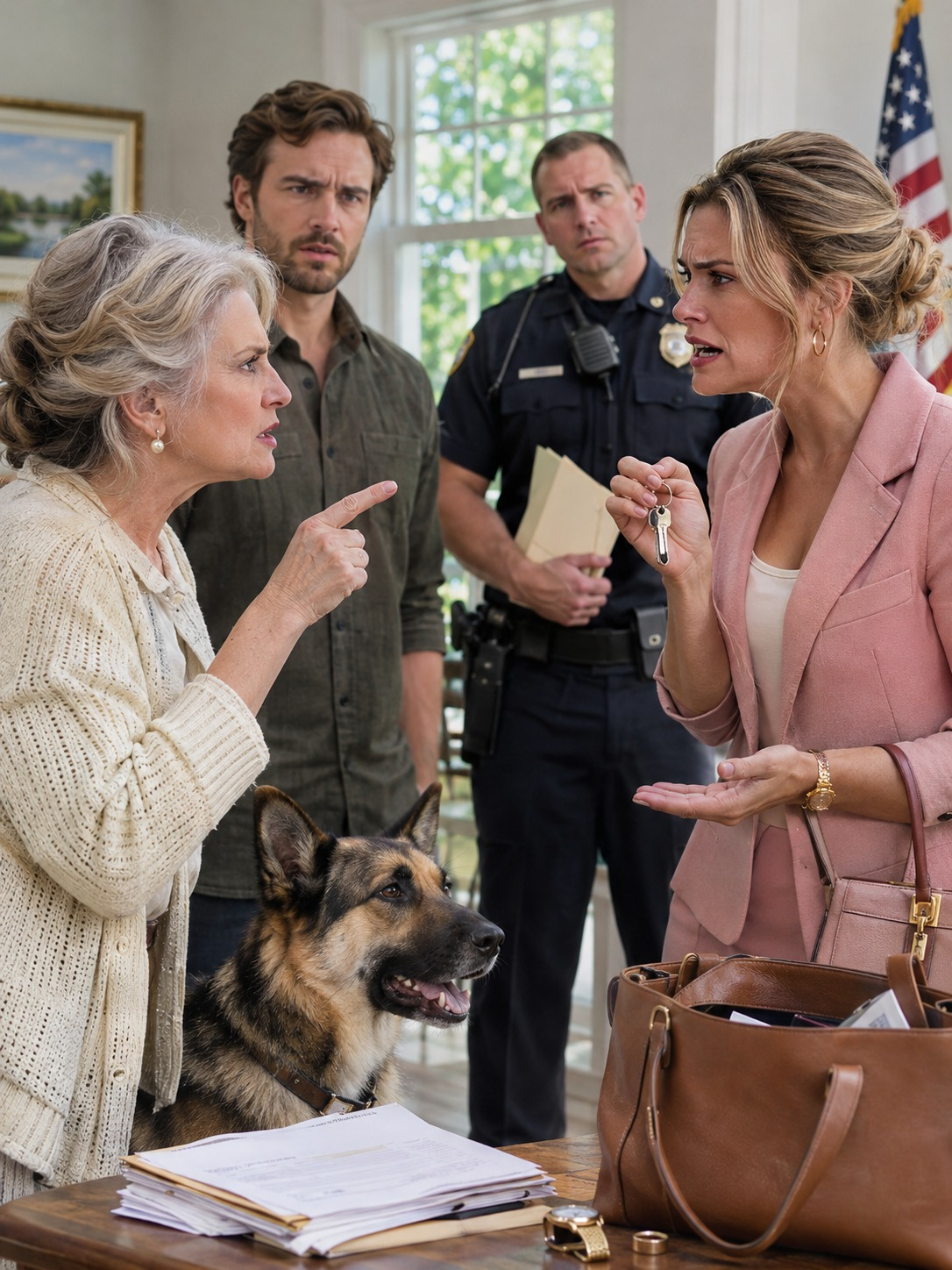
"Open the door, Mrs. Marlowe. These papers concern your legal rights."
The woman on my porch held a thick envelope beneath the doorbell camera. Her dark coat was buttoned to the throat, and her expression suggested she had delivered unpleasant news often enough to stop feeling uncomfortable about it.
I stared at the words printed above the courthouse seal.
APPLICATION FOR EMERGENCY GUARDIANSHIP.
For thirty years, I had handled documents bearing those words. I knew what they could mean when an elderly person genuinely needed protection.
I also knew what they could mean when somebody wanted control.
"Who filed that application?" I asked through the intercom.
"Dana Whitcomb. I'm an attorney representing your daughter-in-law."
"That wasn't my question."
She lowered the envelope slightly.
"The proposed guardian is Tessa Marlowe."
My stomach tightened.
"And the person allegedly needing a guardian?"
She looked directly into the camera.
"You, Mrs. Marlowe."
I closed my eyes for one second.
Then I opened them.
"Leave the documents on the porch."
"I need acknowledgment of delivery."
"You can document that you attempted delivery. I'm not opening my door to someone I wasn't expecting."
Her expression changed.
Perhaps she hadn't anticipated that answer.
"Mrs. Marlowe, refusing to cooperate may complicate matters."
"Then I suggest you make a careful record of exactly what I've refused."
Silence.
I continued.
"I haven't refused to receive legal documents. I've refused to open my home to an unexpected visitor at nine o'clock at night."
She studied the camera.
Then she nodded.
"I'll leave my contact information."
"Thank you."
I watched her place a business card inside the storm door.
She returned to her car, remained there for several minutes, and finally drove away.
Only then did I unlock the front door.
The night air smelled of wet leaves.
I retrieved the card and locked the door again.
Dana Whitcomb.
Attorney at Law.
I recognized the name.
She had appeared occasionally at the probate court during my final years there. She represented clients in property disputes and contested estates. I remembered her as a woman who prepared thoroughly and disliked surprises.
I wondered what Tessa had told her.
More importantly, I wondered what Caleb had signed.
I didn't sleep much that night.
At eleven, I sat at the kitchen table reviewing my records.
At midnight, I checked the county court's public filing system.
There was no guardianship case under my name.
That didn't necessarily mean nothing had been submitted. An application could be in preparation, pending processing, or handled through procedures that weren't immediately visible online.
But I wasn't going to treat a document displayed through a doorbell camera as proof that a judge had already done anything.
I wrote down the date, time, and attorney's name.
Then I saved the recording.
At one in the morning, I made tea.
At two, I opened Peter's old photo album.
I wasn't looking for evidence.
I wanted to remember a time when Caleb had looked at me without suspicion.
There he was at eight, holding a fish too small to keep.
At twelve, wearing a crooked baseball cap.
At sixteen, standing beside his father in the garage with sawdust on his shirt.
Peter had one arm around him.
Both were laughing.
I touched the photograph.
"Where did we go wrong?" I whispered.
There was no answer.
Only the hum of the refrigerator and the ticking clock above the doorway.
I finally went to bed shortly before three.
At seven, I woke with a headache and the uneasy certainty that something important was approaching.
Rebecca Sloan's office occupied the second floor of an old brick building near downtown Granville.
I arrived fifteen minutes early.
Her receptionist recognized me.
"Mrs. Marlowe? It's wonderful to see you."
"I wish it were under better circumstances."
She smiled sympathetically and led me into a conference room.
Rebecca entered carrying a legal pad.
She was in her early sixties, with short brown hair beginning to turn gray at the temples. She wore a dark green suit and the same expression I remembered from the courthouse: attentive, skeptical, and impossible to rush.
"Evelyn."
"Rebecca."
We shook hands.
Then she sat across from me.
"Tell me everything."
I placed my folder on the table.
She looked at its thickness.
"Goodness."
"I brought documentation."
A faint smile crossed her face.
"Of course you did."
For the next forty minutes, I explained what had happened.
I started with Peter's illness.
The spare key.
Tessa's unauthorized visits.
The opened bank statement.
The missing lathe.
The contractor.
The camera recordings.
Rook's adoption.
The warning messages.
The bite.
The open safe.
The missing power of attorney.
And finally, Dana Whitcomb standing on my porch with an envelope labeled emergency guardianship.
Rebecca listened without interrupting.
Occasionally, she wrote something down.
When I finished, she rested her pen on the table.
"Evelyn, I need to ask you a question."
"Go ahead."
"Have you experienced any recent problems managing your finances, remembering appointments, or understanding medical instructions?"
"No."
"Any significant health changes?"
"No."
"Have you been diagnosed with a condition affecting your decision-making?"
"No."
She nodded.
"I'm asking because I need to understand what evidence someone might claim to have."
"I understand."
"Do you have your recent medical records?"
"I can request them."
"Do that."
She turned a page.
"Now, about the guardianship application. Has anything actually been served on you?"
"Not yet."
"Then we need to establish what has been filed, if anything. An attorney standing on your porch with an envelope doesn't establish that a court has granted emergency authority."
"I know."
Rebecca studied me.
"You sound as though you're trying very hard not to panic."
"I am."
"That's sensible. But you don't have to pretend this isn't frightening."
I looked down at my hands.
"They want my house."
"Perhaps. We need to prove what they're doing, not just what we suspect."
I nodded.
She continued.
"A guardianship proceeding concerns whether someone can manage personal or financial decisions and whether court intervention is necessary. It isn't an inheritance proceeding. Your son doesn't acquire ownership of your home simply because he may inherit it someday."
"I told Tessa that."
"I'm sure you did."
"She doesn't listen."
"Then she'll have to listen to the evidence."
For the first time in days, I felt my shoulders relax.
Rebecca asked permission to copy my records.
I agreed.
She also advised me not to communicate with Tessa's attorney about the substance of the dispute without consulting her first.
Then she asked about Rook.
My throat tightened.
"He's in observation."
"Do you have his vaccination records?"
"Yes."
"And the shelter's behavioral instructions?"
"Yes."
"Good. We'll want to understand the county's review process. The bite and the property dispute may involve different legal questions, even though they arose from the same incident."
I nodded.
"I don't want anyone pretending Tessa wasn't hurt."
Rebecca looked at me.
"That's important."
"She was hurt. I understand that. But she wasn't supposed to be inside my house."
"Both facts can be true."
I felt unexpectedly grateful.
That was all I'd wanted someone to say.
Both facts could be true.
Tessa could be injured.
And Tessa could have entered without permission.
I could be concerned about her medical treatment.
And still refuse to surrender my property.
Rebecca closed her legal pad.
"Let's begin by confirming the filing status. Then we'll address the documents and the missing property."
I hesitated.
"There's something else."
She waited.
"Caleb knew where the safe was."
"Did he know the combination?"
"I don't know."
"Have you asked?"
"Yes."
"What did he say?"
"He ended the call."
Rebecca wrote that down.
Then she looked up.
"Evelyn, don't assume your son is innocent. But don't assume he's guilty either."
I swallowed.
"I know."
"Let the facts tell us."
When I returned home, Margaret was waiting on her porch.
She crossed the lawn as soon as I stepped out of the car.
"How did it go?"
"Rebecca's helping me."
"Good."
She glanced toward my front door.
"Somebody came by earlier."
My stomach tightened.
"Who?"
"A woman in a blue car."
"Tessa?"
"No. Younger. Dark hair. She stayed in the driveway for a few minutes, then left."
"Did she come to the door?"
"No."
"Did she take photographs?"
Margaret thought for a moment.
"She held up her phone. I couldn't tell what she was doing."
I thanked her.
Inside, I checked the camera.
At 10:26 that morning, a blue sedan had stopped near the driveway.
A woman stepped out.
She wore a tan coat and carried a tablet.
She walked toward the porch, paused, and looked through the front window.
Then she photographed the house.
I didn't recognize her.
She returned to her car and drove away.
I saved the recording.
Then I called Rebecca's office.
Her assistant took the information and promised to pass it along.
I was beginning to understand how exhausting it could be to defend yourself against accusations nobody had yet explained.
Every ordinary activity became something to document.
Every unfamiliar car became a question.
Every telephone call made my stomach tighten.
I had spent thirty years helping other people navigate that uncertainty.
Now I was living inside it.
That afternoon, Officer Merritt called.
"Mrs. Marlowe, do you have a few minutes?"
"Of course."
"I wanted to update you on the property recovered from your home."
I sat at the kitchen table.
"All right."
"We've documented the watch, bracelet, and papers found in Tessa's handbag. The investigation is ongoing."
"Have you found Peter's power of attorney?"
"Not yet."
I closed my eyes.
"Did Tessa explain why she had my documents?"
"She maintains she was trying to safeguard them."
"From what?"
"That's part of what we're reviewing."
He paused.
"Mrs. Marlowe, I'd like to clarify something about the safe."
"Yes?"
"Did it show any signs of forced entry before the incident?"
"Not that I'm aware of."
"Did you change the combination after your husband's death?"
"No."
"Why not?"
The question was reasonable.
I had asked myself the same thing.
"Because I believed the only other person who might know it was my son."
"Did your husband ever write the combination down?"
I thought carefully.
"He kept a notebook."
"Where?"
"In his desk."
"Do you still have it?"
"Yes."
"Would you check whether the combination is recorded there?"
"I can."
"Please don't alter anything you find. Photograph it first."
After the call, I went into Peter's study.
His old notebook was in the bottom drawer.
Brown leather cover.
A broken elastic band.
He had used it for measurements, phone numbers, and reminders.
I turned the pages carefully.
There were sketches of woodworking projects.
A list of hardware supplies.
The name of the nurse who helped during his rehabilitation.
Then, near the back, I found a page labeled:
HOUSE — IMPORTANT NUMBERS
Below it were the alarm code, the garage keypad code, and the safe combination.
I stared at the numbers.
Peter had written them in blue ink.
But beside the safe combination, someone had made a small pencil mark.
A check mark.
It wasn't Peter's handwriting.
I knew his handwriting better than my own.
He made check marks with a long upward stroke.
This one was short and square.
I photographed the page.
Then I called Officer Merritt.
He asked me to preserve the notebook.
I agreed.
Before ending the call, he said, "Mrs. Marlowe, has anyone recently had access to that desk?"
I looked around the room.
"Tessa."
"Are you certain?"
"She's entered my house repeatedly. But I can't prove she opened this drawer."
"Understood."
I appreciated that word.
Understood.
Not believed.
Not dismissed.
Just understood.
At four o'clock, Caleb arrived.
He rang the doorbell.
I watched him through the camera before opening the door.
He looked tired.
His sandy-blond hair was uncombed, and there were dark circles beneath his eyes.
"Hi, Mom."
"Hello, sweetheart."
He glanced past me.
"Can I come in?"
I stepped aside.
"Of course."
He walked into the kitchen.
His eyes moved toward Rook's empty bed.
"How's the dog?"
"Still in observation."
He nodded.
We sat at the table.
For several minutes, neither of us spoke.
Then Caleb said, "Tessa's really upset."
"I imagine she is."
"She thinks you're trying to ruin her life."
I looked at him.
"By asking her not to enter my house?"
He rubbed his hands together.
"Mom, it's more complicated than that."
"Then explain it."
He stared at the table.
"Tessa thinks you're having trouble making decisions."
"Which decisions?"
He hesitated.
"Keeping the house. Managing money. Living alone."
"Those are choices, Caleb. Not symptoms."
He looked uncomfortable.
"She says you forget things."
"Name one."
He opened his mouth.
Then closed it.
I waited.
"She says you misplaced some paperwork."
"Which paperwork?"
"I don't know."
"Caleb, your wife was found with documents from my safe."
He looked away.
"She says she was trying to organize them."
"Why?"
"Because she thought you needed help."
I leaned forward.
"Did you give her the safe combination?"
He stared at me.
For several seconds, I thought he might finally answer.
Then he said, "Mom, can we not do this?"
"No."
His expression hardened.
"You're making me choose between you and my wife."
I shook my head.
"I'm asking whether you gave someone access to my private property."
He pushed back his chair.
"I came here to make peace."
"Peace requires the truth."
He stood.
I didn't.
That seemed to surprise him.
Usually, when Caleb became upset, I followed him.
I apologized.
I softened my words.
I tried to make him comfortable.
This time, I remained seated.
He walked toward the doorway.
Then stopped.
"Mom?"
"Yes?"
His voice changed.
"Tessa's attorney says the court might appoint somebody to help you."
I looked at him.
"Has Tessa filed for guardianship?"
He hesitated.
"I signed something."
The room seemed to contract.
"What did you sign?"
"Just a statement."
"What did it say?"
He rubbed his forehead.
"I don't remember the exact wording."
"Did you read it?"
"Yes."
"Then tell me what you agreed to."
He looked miserable.
"That you've been having trouble managing things."
I felt a sharp pain beneath my ribs.
"Caleb, have you ever seen me fail to pay a bill?"
"No."
"Have you ever seen me forget where I live?"
"No."
"Have you ever seen me unable to understand a medical decision?"
"No."
"Then why would you sign a statement suggesting I can't manage my own affairs?"
His eyes filled.
"Because Tessa said it was the only way to get you help before something terrible happened."
I looked at my son.
Something terrible had already happened.
He had put his name beneath a claim about me that he couldn't support.
And he hadn't even told me.
"Caleb," I said quietly, "you need to get me a copy of what you signed."
He shook his head.
"Tessa has it."
"Then ask her."
"She'll be furious."
I felt a sadness so deep it almost made me dizzy.
"Your wife being furious is not the worst thing that can happen."
He stared at me.
Then he walked out.
I heard the front door close.
I remained at the table for a long time.
That evening, Rebecca called.
She had located a newly entered filing.
A guardianship application had been submitted, but the court had not appointed anyone.
Tessa was listed as the proposed guardian.
Caleb had provided a supporting statement.
The application claimed I had become increasingly forgetful, suspicious, and unable to protect my property.
It mentioned the dog bite as evidence of poor judgment.
It also claimed I had resisted reasonable family assistance.
I listened without interrupting.
Then Rebecca said, "Evelyn, there's an attachment."
"What kind?"
"A statement of expert evaluation."
My hand tightened around the phone.
"From whom?"
"A physician."
"Which physician?"
She gave me the name.
Dr. Harold Vance.
I knew him.
Not personally.
But I remembered seeing his signature on documents filed at the courthouse years earlier.
"Rebecca, when was the evaluation supposedly performed?"
"According to the attachment, last month."
I stared at the wall.
"Last month?"
"Yes."
"I haven't seen that doctor."
"Are you certain?"
"Absolutely."
Rebecca was quiet.
Then she said, "I'm going to obtain a complete copy. Don't contact him yourself yet."
I swallowed.
"Rebecca, there's something you should know."
"What?"
"During my years at the courthouse, I handled several cases involving that doctor's evaluations."
"All right."
"And I remember a particular problem with one of his signatures."
Rebecca's voice sharpened.
"What problem?"
I looked toward Peter's old desk.
"I need to check something before I say more."
We agreed to speak the following morning.
After hanging up, I went to my filing cabinet.
I had kept personal notes from my career, but no confidential court records. Among them were copies of publicly available orders and professional correspondence I had been permitted to retain.
I searched through the folders.
Retirement.
Training.
Procedural updates.
Then I found a thin file labeled:
SIGNATURE VERIFICATION — PUBLIC RECORDS
I opened it.
Inside was a printed copy of a publicly filed court order discussing authentication concerns in an unrelated matter.
I read the relevant paragraph twice.
Then I looked at the doctor's name.
Dr. Harold Vance.
My heart began pounding.
I reached for my phone to call Rebecca.
Before I could dial, an email notification appeared.
The sender was her office.
The subject line read:
CONFIDENTIAL — EXPERT EVALUATION ATTACHMENT
I opened the message.
There was a PDF attached.
I downloaded it.
The document displayed my name.
My address.
My date of birth.
And a statement claiming that I had been personally examined by Dr. Harold Vance.
I scrolled to the signature page.
There it was.
A black signature beneath the physician's printed name.
I enlarged the image.
Then enlarged it again.
The final letter curved sharply upward.
The first initial had an unusual double loop.
And beneath the signature was a handwritten date.
I stared at it.
I had seen that exact signature before.
Not merely something similar.
The same uneven pressure.
The same broken line.
The same tiny ink mark beneath the final stroke.
I opened the old public court document beside it.
Placed the two signatures next to each other on my screen.
And realized the signature on my supposed medical evaluation matched the one from the old filing down to a small scanning defect.
Someone appeared to have copied it.
I reached for the telephone.
Then stopped.
Because the date printed beneath the signature on my new evaluation was three weeks after Dr. Harold Vance had supposedly retired from medical practice.
I looked at the two documents again.
There was another detail.
A small line of text at the bottom of the evaluation.
It identified the person who had requested the examination.
I leaned closer.
The name wasn't Tessa's.
It wasn't Caleb's.
It was someone I had known for more than thirty years.
And when I read it, I realized the person behind the application might be someone I had trusted long before Tessa ever entered my family.
The name was—






Comments 0