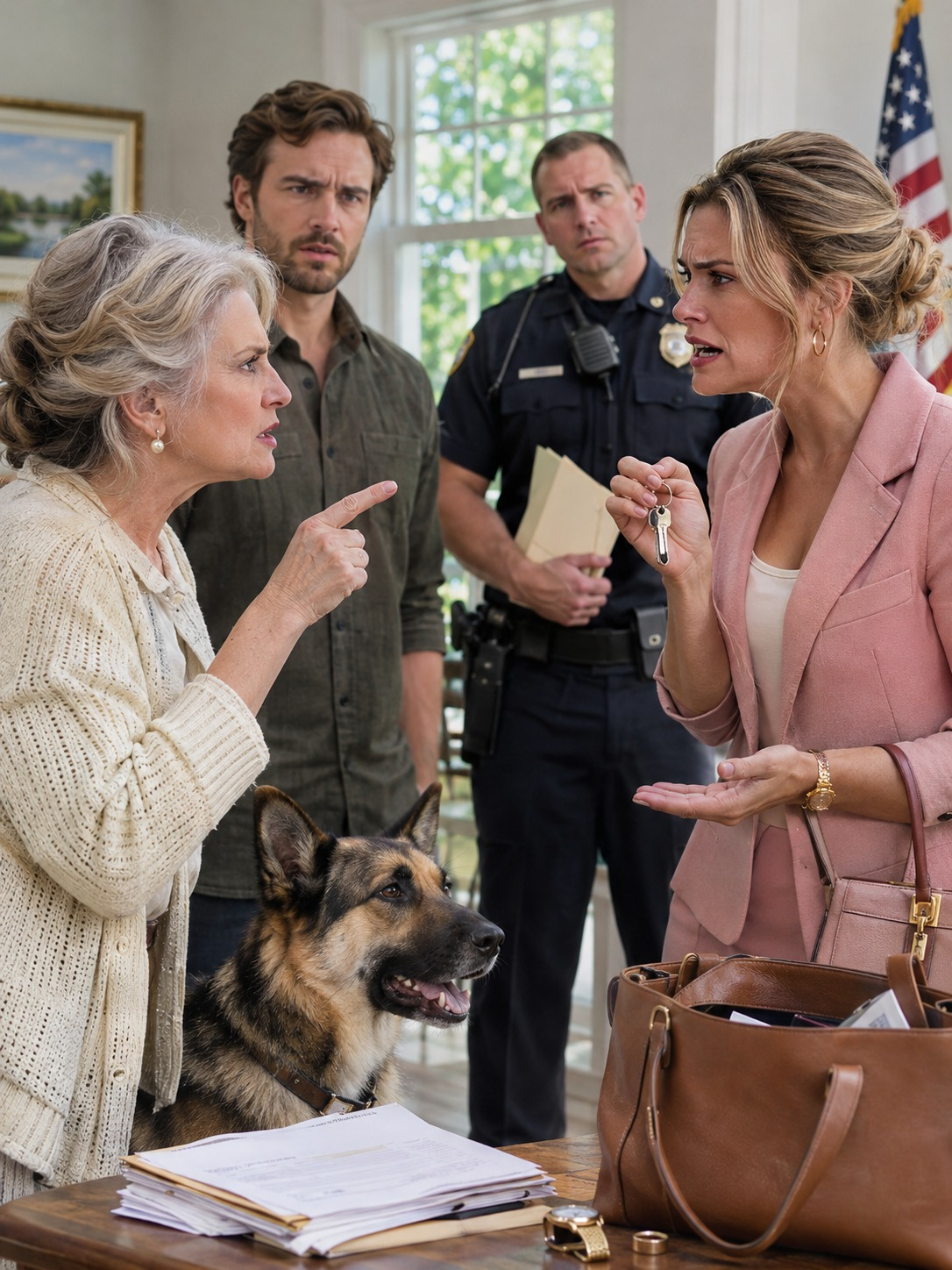
"Give me back my house key," I said, holding out my hand across the kitchen table.
My daughter-in-law, Tessa, lifted a silver key between two fingers and smiled as though I'd asked her to surrender something that belonged to her.
Beside her coffee cup lay my bank statement.
The envelope had been opened.
The account number was visible.
And the key she was holding had a tiny scratch near its head—the same scratch my late husband, Peter, had made when he labeled our emergency keys.
That was when I understood something.
Tessa hadn't simply forgotten to return it.
She had decided it was hers.
"You don't need privacy from family," she said, sliding my bank statement toward me. "You need somebody making sure you're all right."
I looked at the statement, then at my son.
"Caleb, did you know your wife was opening my mail?"
He stared into his coffee.
That silence told me more than his answer would have.
I was seventy-two years old, a widow, and a retired probate court clerk. I'd spent thirty years watching families fight over property, inheritances, and money. I'd seen brothers lie about sisters, children manipulate parents, and respectable people become unrecognizable when they believed something valuable was within reach.
But I never imagined I would sit at my own kitchen table and watch my only child pretend not to notice his wife treating me like an incompetent stranger.
"Mom," Caleb finally said, "Tessa's just worried about you."
"Worried about what?"
He rubbed his forehead.
"Living alone. The house. Your medications. You know."
I looked around the kitchen.
The dishes were washed. My bills were paid. My refrigerator was stocked. The calendar beside the pantry listed my appointments, and the property tax receipt was pinned neatly beneath it.
"What exactly have I done that makes either of you think I can't take care of myself?"
Tessa gave a little sigh.
Not a tired sigh.
A rehearsed one.
"Evelyn, nobody is accusing you of anything."
"Then why are you reading my bank statements?"
"I found it open."
"Inside my locked mailbox?"
Her expression barely changed.
"I don't remember where I found it."
I turned toward Caleb.
"Do you believe that?"
He looked at his wife.
Then he looked away.
I had raised a man who could negotiate contracts worth hundreds of thousands of dollars for the heating company where he worked. He could argue with suppliers, challenge unreasonable invoices, and stand up to contractors twice his size.
But put him in a room with his wife and his mother, and he became a boy waiting for someone else to decide what happened next.
I knew I had helped create that habit.
When Caleb was young, I had protected him from arguments. Peter had been the firmer parent, the one who insisted that avoiding a problem didn't make it disappear.
After Peter's stroke, I became even more protective of our son.
There were hospital bills, rehabilitation appointments, medications, and long nights when Peter couldn't remember how to button his shirt.
Caleb had a wife and a demanding job.
I told him not to worry.
I told him I could manage.
And I did.
For nearly four years, I helped my husband eat, bathe, walk, and eventually endure the slow loss of the independence he had always treasured.
Peter died three years before that conversation.
He was seventy-four.
On his last clear afternoon, he squeezed my hand and asked me to promise one thing.
"Don't let anybody make you feel like a guest in our home, Evie."
I laughed then.
I thought he was being sentimental.
Now, sitting across from Tessa, I wished I had understood why he sounded so serious.
Our house stood outside Granville, Ohio, on a quiet street where the neighbors knew each other's dogs and the mail carrier still waved from the curb.
Peter and I bought it when Caleb was in kindergarten.
It was a sturdy brick house with white-trimmed windows, a comfortable kitchen, a small dining room, and a garage that Peter had gradually transformed into his woodworking shop.
We paid off the mortgage eleven years earlier.
Every room held memories.
The doorway where we'd measured Caleb's height.
The kitchen counter where Peter had taught him to make pancakes.
The dining table where we'd celebrated birthdays, graduations, promotions, and one wedding announcement.
And the bedroom where I had held Peter's hand when he could no longer speak.
I wasn't planning to leave.
Not for a retirement community.
Not for an apartment.
And certainly not because my daughter-in-law thought my property would eventually become hers.
"Tessa," I said, "I want the key back today."
She leaned against her chair.
"What if you fall?"
"I have a phone."
"What if you can't reach it?"
"I have neighbors."
"What if something happens at night?"
"Then you can call emergency services."
She looked at Caleb with an expression that said, See what I have to deal with?
"She's being impossible."
"No," I said. "I'm being specific."
Caleb shifted in his seat.
"Could we just give it a few days? Let everybody calm down?"
I looked at my son.
"A few days for what?"
"So we can talk about it."
"We're talking about it now."
He didn't answer.
Tessa picked up her handbag.
A large burgundy leather bag with polished silver hardware.
She had bought it shortly before her home-decor shop closed, back when she still liked to tell people that appearances mattered in business.
The shop had failed six months earlier.
I knew she was under financial pressure.
I'd offered to help her review the business accounts, but she refused.
She said I didn't understand modern retail.
Perhaps she was right.
But I understood arithmetic.
And I understood that money disappearing from one place usually appeared somewhere else.
Tessa stood.
"We're not getting anywhere."
"Because you haven't returned my key."
She slipped it into her handbag.
"Caleb, we're leaving."
My son rose immediately.
He kissed my cheek on the way out.
"Love you, Mom."
I wanted to ask him whether loving me had become something he could only say when his wife wasn't listening.
Instead, I said, "I love you too."
The door closed.
I stood alone beside three coffee mugs.
One was mine.
One belonged to Caleb.
The third was Peter's old blue mug, which Tessa had taken from the cupboard without asking.
I picked it up carefully.
There was a small chip near the handle.
Peter had made that chip himself while trying to wash dishes one-handed after his stroke.
I never replaced the mug.
I never intended to.
That afternoon, I called a locksmith.
The woman who answered could send someone Thursday morning.
I booked the appointment.
Twenty minutes later, Caleb called.
"Mom, did you really schedule someone to change the locks?"
I went still.
"How do you know that?"
"Tessa said you might."
"She guessed?"
A pause.
"Mom, please."
"Caleb, answer me."
He exhaled.
"She checked with the locksmith because she thought you were upset."
I looked at the phone.
Tessa hadn't simply anticipated my decision.
She had interfered with it.
"Why does your wife believe she gets to approve my locks?"
"She doesn't."
"Then why are we having this conversation?"
He sounded exhausted.
"Tessa's going through a lot since the business closed. She feels like you don't trust her."
"She opened my mail."
"She said she found it that way."
"And you believe her?"
He said nothing.
I closed my eyes.
There had been a time when Caleb would tell me everything.
At twelve, he confessed that he'd broken the neighbor's greenhouse window before anyone even knew it was damaged.
At seventeen, he admitted he'd scraped the family car against a concrete post.
He hadn't been afraid to tell the truth then.
Somewhere along the way, silence had become easier.
"Give me until the weekend," he said. "I'll talk to her."
I knew what I should do.
Keep the appointment.
Change the locks.
Set a boundary that couldn't be negotiated away.
Instead, I canceled.
That decision would cost me more than the locksmith's fee.
Two days later, I went into Peter's garage looking for a clamp.
I was repairing a loose shelf in the laundry room.
Peter's tools still hung above the workbench, each one outlined in pencil where he liked it stored.
He had been a patient woodworker.
He made pepper mills, small boxes, and picture frames.
He could spend an entire afternoon sanding a piece of walnut until it felt like polished stone.
His favorite machine was a heavy wood lathe.
He bought it secondhand when Caleb was fourteen.
It wasn't especially valuable, but Peter loved it.
Once, Caleb dropped a wrench against the metal base and left a deep gouge.
Peter used to point at that mark and joke that his son had signed the machine.
I walked toward the corner where the lathe stood.
Then stopped.
The space was empty.
For a moment, I thought I'd entered the wrong garage.
The outline of the machine's feet remained in the dust.
The electrical cord was gone.
So were the turning tools Peter kept in a wooden rack beside it.
I called Caleb.
He answered during lunch.
"Hey, Mom."
"Where's your father's lathe?"
Silence.
Then a nervous laugh.
"Oh. You noticed."
I sat down on the garage step.
"What does that mean?"
"Tessa sold it."
The words didn't make sense.
"Sold it?"
"Online. A couple of weeks ago."
"Without asking me?"
"She thought it might be upsetting for you to keep seeing Dad's things."
I stared at the empty corner.
"Caleb, I liked seeing his things."
"I know."
"Then why would she sell them?"
He hesitated.
"She said the money could go toward house repairs."
"What repairs?"
"Just things the house might need."
"How much?"
"Five hundred and twenty dollars."
I looked at the old workbench.
Peter had built it himself.
A pencil still lay in the groove along its edge.
"That lathe belonged to your father."
"I know, Mom."
"He used it to make the pepper mill you gave Tessa for Christmas."
"I remember."
"Did you know she was selling it?"
Another pause.
"I knew she was thinking about it."
I felt something inside me settle.
Not break.
Settle.
Like a heavy object finally reaching the bottom of a deep well.
"Did she give me the money?"
"No."
"Did she ask me whether I wanted to sell it?"
"No."
"Then she sold something that didn't belong to her."
Caleb lowered his voice.
"Please don't turn this into another fight."
I looked at the empty floor.
"Your father loved that machine."
"I know."
"No, Caleb. I don't think you do."
I ended the call.
Then I cried.
Not loudly.
Not for very long.
I sat on the garage step with my hands folded in my lap and let myself grieve a machine that had carried the sound of my husband's happiness.
Afterward, I went inside and opened my laptop.
It took forty minutes to find the listing.
There it was.
Peter's lathe.
Photographed against our garage door.
The gouge from Caleb's wrench was clearly visible.
The seller's description called it a well-maintained woodworking machine from a private estate.
Private estate.
I read those two words three times.
I wasn't dead.
My house wasn't an estate waiting to be divided.
And my belongings weren't inventory for somebody else's financial problems.
I saved the listing.
I printed the photographs.
Then I ordered a doorbell camera.
When the package arrived, I installed it myself.
It took longer than the instructions promised.
I had to watch a tutorial twice and borrow a small drill bit from my neighbor.
But by supper, the camera was working.
It recorded anyone who approached my front door.
I didn't tell Caleb.
I didn't tell Tessa.
For the first time in months, I wanted to know what happened at my house when nobody believed I was watching.
The first week was uneventful.
The mail carrier.
A delivery driver.
My neighbor bringing over tomatoes.
Then, on Tuesday morning, while I was at the pharmacy, the camera recorded Tessa arriving at 10:14.
She walked up the porch steps.
Looked toward the street.
Took a key from her handbag.
And entered my home.
She stayed thirty-seven minutes.
I watched the recording twice.
Then I checked the calendar.
She hadn't called.
She hadn't texted.
She hadn't asked permission.
The next Thursday, she came again.
This time she stayed nearly an hour.
Over the following five weeks, the camera recorded nine visits while I was away.
Nine.
I wrote each date and time in a notebook.
I printed still photographs.
I made copies of the recordings.
Thirty years at the probate counter had taught me something important.
Suspicion was a feeling.
Evidence was something another person could verify.
And I was beginning to collect evidence.
But the camera only showed the porch.
It couldn't tell me what Tessa did inside.
I checked my drawers.
My jewelry box.
The kitchen cabinets.
Nothing obvious appeared missing.
Then I began noticing small changes.
A folder moved from my desk to the dining table.
A prescription bottle placed on the wrong shelf.
A drawer in Peter's old writing desk left slightly open.
Each change was small enough to dismiss.
Together, they made my home feel unfamiliar.
One evening, I called Caleb.
"Has Tessa been coming over when I'm out?"
He hesitated.
"I don't know."
"Ask her."
"Mom, why?"
"Because I want to know."
He sighed.
"You're making this bigger than it needs to be."
I looked at the camera footage playing silently on my laptop.
"Am I?"
He promised to call me back.
He never did.
The next morning, I received a text from Tessa.
You really need to stop worrying about every little thing. Stress isn't good for your memory.
I stared at those words.
My memory.
There it was again.
The suggestion that I was forgetting things.
Misunderstanding things.
Imagining things.
I opened my notebook and added the message to my records.
Then I made another decision.
The house had been too quiet since Peter died.
I had spent three years listening to the refrigerator hum and the old clock strike the hour.
I wanted company.
Not someone who would manage my life.
Someone who would simply share it.
That Saturday, I drove to the county animal shelter.
I wasn't looking for a particular breed.
I wasn't even certain I wanted a dog.
Then I saw him.
A large shepherd mix with a dark coat, a black muzzle, and one bent ear.
He sat at the back of his kennel, watching me without barking.
His name was Rook.
He was seven years old.
He had been surrendered after his previous owner moved into assisted living.
Jocelyn Brooks, the shelter worker, told me he was cautious around unfamiliar people.
"He needs consistency," she said. "Especially when people enter enclosed spaces."
I understood that better than she knew.
We sat together in the outdoor visiting area.
For several minutes, Rook kept his distance.
Then he walked over.
Sniffed my shoes.
And leaned his weight against my leg.
I placed my hand gently on his shoulder.
"Well," I whispered, "I suppose we understand each other."
Jocelyn smiled.
I signed the adoption papers.
Before I left, she gave me a sheet explaining Rook's adjustment needs.
No unsupervised visitors.
Introduce unfamiliar guests outdoors.
Use a leash during introductions.
Avoid unexpected entries while the dog was settling into his new home.
I read every line.
Then I photographed the instructions and sent them to Caleb and Tessa.
Don't let yourselves in when I'm away. Rook is settling in. I mean this.
Caleb replied with a heart.
Tessa replied one word.
Understood.
That evening, Rook slept beside the kitchen radiator.
For the first time in years, the house didn't feel empty.
I sat at the dining table with a cup of tea and watched him dream.
His paws twitched.
One ear moved.
I thought Peter would have liked him.
Then my phone vibrated.
A notification from the doorbell camera.
I opened the application.
The screen showed my front porch.
Tessa stood outside.
She was holding her burgundy handbag.
And beside her was a man I had never seen before.
She looked directly into the camera.
Then reached into her bag.
She took out my spare key.
The stranger leaned closer to the door.
Tessa said something I couldn't hear.
And then she turned the key in the lock.
The door began to open.
But I was sitting inside the house.
And Rook had just heard them.






Comments 0