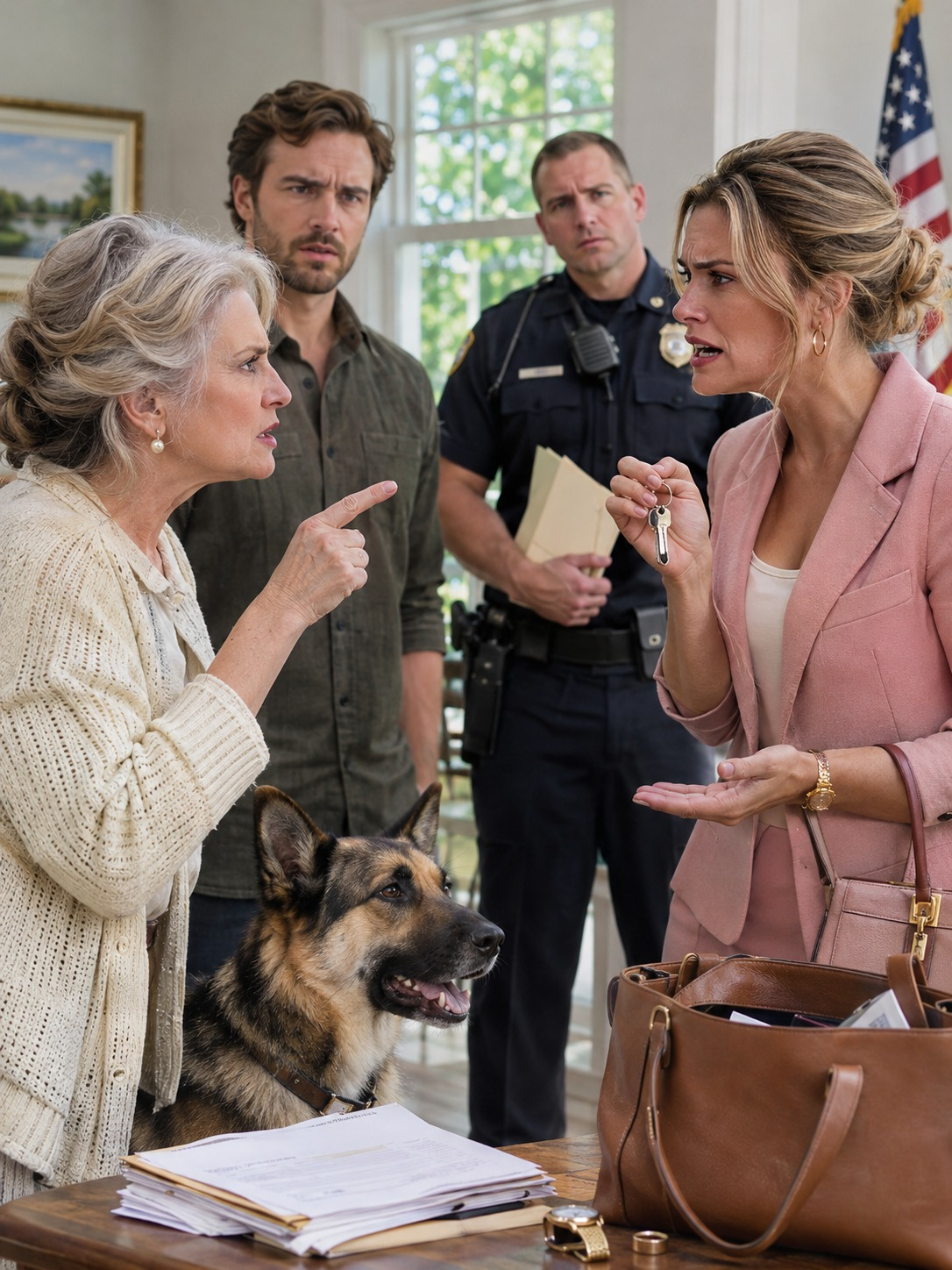
"Don't open that door!" I shouted.
Tessa's hand froze on the knob.
Behind her, a stranger in a gray jacket stepped back from my porch. The silver key was still in the lock, and my newly adopted dog stood between the kitchen and the hallway, his ears raised and his body perfectly still.
For three seconds, nobody moved.
Then Tessa pushed the door open another inch.
"Evelyn? What on earth are you yelling about?"
I stood beside the dining table, gripping my phone.
"I told you not to come inside without calling."
She looked down at Rook.
"Oh, for heaven's sake. Is that the dog?"
Rook gave a low warning sound.
Not a bark.
Not a growl that shook the walls.
Just a quiet, unmistakable message that he wasn't comfortable with strangers entering his home.
"Close the door, Tessa."
The man behind her shifted his weight.
Tessa glanced at him, then back at me.
"Could you please put that animal somewhere? You're embarrassing me."
I walked toward the hallway, stopping several feet behind Rook.
"Rook. Come."
He turned his head.
I tapped my thigh.
He walked back to me, and I clipped his leash onto his collar.
Only then did I approach the front door.
"Who is this gentleman?"
Tessa gave an impatient sigh.
"This is Martin. He's helping me with something."
The man lifted one hand.
"Martin Ellis, ma'am."
He looked to be in his late fifties, with thinning brown hair and the tired expression of someone who had already decided he didn't want to be involved in whatever was happening.
"Helping you with what?" I asked.
Tessa answered before he could.
"Your house."
I stared at her.
"My house?"
"Just some preliminary information."
"For what?"
She rolled her eyes.
"Maintenance, Evelyn. You know the place needs work."
I looked past her at Martin.
"Did my daughter-in-law tell you she owned this property?"
His expression changed.
"She said she was authorized to arrange an inspection."
"She isn't."
Tessa made a sharp sound.
"That's ridiculous."
"No," I said. "What's ridiculous is bringing a stranger to my home without asking me."
Martin immediately stepped away from the doorway.
"Ma'am, I apologize. I was under the impression this had been arranged."
"It hasn't."
He nodded.
"Then I won't take up any more of your time."
Tessa turned toward him.
"Martin, wait. We talked about this."
He looked uncomfortable.
"I think you two should sort it out first."
He walked down the porch steps.
Tessa watched him leave.
Then she turned back to me.
"Are you happy now?"
I looked at the key still hanging from my lock.
"Take that out."
She pulled it free.
"You're making a scene."
"You're standing on my porch."
"Caleb said we could help you."
"Caleb doesn't own this house."
Her mouth tightened.
"Not yet."
The words came so quickly that I almost missed them.
Not yet.
I looked at her for a long moment.
"What did you say?"
She slipped the key into her handbag.
"Nothing. You're twisting my words again."
Rook sat beside my leg.
I could feel the warmth of his shoulder against my knee.
"Tessa, listen carefully. You are not to enter this house without my permission. You are not to bring anyone here to inspect it, repair it, photograph it, or discuss selling it."
"Nobody said anything about selling."
"Then we understand each other."
She gave me a cold smile.
"You're going to regret treating family like strangers."
I closed the door.
And this time, I locked it.
I stood in the hallway for several minutes after she left.
Rook remained beside me, watching the door.
"Well," I told him, "that wasn't much of a welcome."
He looked up at me.
I scratched behind his bent ear.
My hands were trembling.
That bothered me more than I wanted to admit.
I had dealt with angry attorneys, grieving families, and people who threatened court employees when probate decisions didn't go their way.
I knew how to remain calm in difficult situations.
But Tessa had found a way to make me feel like a trespasser inside my own home.
I returned to the kitchen and opened the doorbell application.
The entire encounter had been recorded.
The camera showed Tessa arriving with Martin.
It showed her taking out the key.
It showed him leaning toward the doorway.
And it showed her pushing the door open after I had told her not to.
I saved the video.
Then I added another entry to my notebook.
Sunday, 6:42 p.m. Tessa arrived without permission. Brought unidentified man, later identified as Martin Ellis. Attempted entry using spare key. Told to leave.
I paused.
Then I added:
Said Caleb would own the house "not yet." Exact meaning unclear.
That last sentence mattered.
I wasn't going to turn a careless remark into proof of something I couldn't establish.
But I wasn't going to forget it either.
The following morning, I called Caleb.
He answered on the fourth ring.
"Mom, I'm at work."
"I need to ask you something."
He sighed.
"Is this about yesterday?"
"Yes."
"Tessa told me."
"Did she tell you she brought a man to inspect my house?"
A pause.
"She said he was a contractor."
"Did you authorize that?"
"Not exactly."
"What does that mean?"
He lowered his voice.
"She mentioned getting estimates."
"Estimates for what?"
"Repairs."
"Which repairs?"
"I don't know, Mom."
I closed my eyes.
"Caleb, your father and I spent forty years taking care of this house. If it needs repairs, I can arrange them."
"I know."
"Then why is your wife making appointments for my property?"
He sounded irritated.
"She's trying to help."
"She brought a stranger to my door and used a key I asked her to return."
"She's worried about you being alone."
"Being alone doesn't make me incompetent."
"Nobody said that."
"Then tell her to stop acting like it."
Silence.
I heard voices in the background.
A door closed.
Then Caleb spoke again.
"Mom, Tessa thinks you've become suspicious of everyone since Dad died."
I looked toward Peter's empty chair.
"Does she?"
"She says you're writing things down all the time."
"Because things keep happening that nobody admits happened."
He exhaled.
"See? That's what I mean."
Something about his tone hurt.
Not because he was angry.
Because he sounded as though he were repeating an explanation he'd heard so often that he'd stopped questioning it.
"Caleb, did you know your wife sold your father's lathe before she sold it?"
He didn't answer.
"Did you?"
"She thought you wouldn't mind."
"That wasn't my question."
"Mom, I can't do this right now."
"Then call me when you can."
He ended the conversation.
I waited all day.
He didn't call.
Over the next week, I began reviewing the camera recordings more carefully.
I had originally counted nine unauthorized visits over five weeks.
Now I wrote down every detail.
On the first recording, Tessa entered at 10:14 in the morning and left thirty-seven minutes later.
On the second, she arrived carrying an empty shopping bag.
When she left, the bag appeared fuller.
I couldn't see what was inside.
I wrote that down exactly.
On the third, she stood on the porch speaking into her phone before unlocking the door.
On the fourth, she arrived with a large envelope.
On the fifth, she spent almost an hour inside.
On the sixth, she carried a small cardboard box to her car.
On the seventh, she returned after dark.
On the eighth, she entered while I was at a medical appointment.
And on the ninth, she stayed forty-six minutes before leaving with her handbag pressed tightly against her side.
There was no way to know from the porch footage what she had done inside.
I refused to invent an answer.
Instead, I started checking what I could verify.
The jewelry box in my bedroom still contained my wedding ring, Peter's cuff links, and my mother's pearl earrings.
My important papers appeared to be where I'd left them.
The deed was in the small safe inside my bedroom closet.
So was Peter's will.
The safe had a combination lock.
Tessa didn't know the combination.
At least, I didn't think she did.
I sat on the edge of my bed and looked at the closet.
Peter had installed the safe years earlier.
He had never trusted bank safe-deposit boxes for documents we might need quickly.
"Keep the important things where you can reach them," he used to say.
I remembered how he had shown Caleb the safe during his illness.
He wanted our son to know where the insurance papers were kept in case something happened to both of us.
Had Caleb ever told Tessa about it?
I didn't know.
And not knowing was beginning to feel dangerous.
That afternoon, I called the locksmith again.
The same woman answered.
"Of course, Mrs. Marlowe. We can send someone Thursday."
I confirmed the appointment.
Then I asked whether anyone else could cancel it.
"Only you, ma'am."
"Please put a note on the account. I must personally approve any changes."
She agreed.
I felt a little better.
Then I made another call.
This one was to Martin Ellis.
His business number was printed on the card he'd left in my mailbox.
He answered politely.
"Ellis Property Services."
"Mr. Ellis, this is Evelyn Marlowe. You came to my house with Tessa last Sunday."
There was a pause.
"Yes, ma'am. I remember."
"I wanted to apologize for the uncomfortable situation."
"You don't owe me an apology."
"May I ask what kind of inspection she requested?"
He hesitated.
"Mrs. Marlowe, I don't want to get involved in a family disagreement."
"I understand. I'm only asking what work you were hired to perform."
"She wanted an informal assessment of the property's condition."
"Why?"
"She mentioned the possibility of future renovations."
"What kind?"
"Accessibility changes. Bathroom modifications. Things of that nature."
I stared at the wall.
Accessibility changes.
I walked without assistance.
I drove myself to appointments.
I climbed the stairs every day.
"Did she say I needed those modifications?"
"She said the family was planning ahead."
I thanked him.
Before hanging up, I asked one final question.
"Did she tell you I had agreed?"
Another pause.
"She said the arrangements were being handled by the family."
That was an answer.
Not the one I wanted.
But an answer.
On Thursday morning, the locksmith arrived at nine.
He was a cheerful man named Daniel who worked efficiently and didn't ask unnecessary questions.
He replaced the front and back door cylinders.
He checked the garage entry.
He tested every key twice.
When he finished, he handed me three new keys.
"Anybody else need copies?"
"No," I said.
He smiled.
"Then these are all yours."
I paid him.
After he left, I stood at the front door holding the new keys in my palm.
Such small objects.
Such an enormous difference.
For the first time in months, I knew Tessa couldn't simply let herself inside.
I put one key on my ring.
One in a labeled envelope inside the safe.
And one with my neighbor, Margaret Bell, who had lived next door for twenty-six years.
Margaret was seventy-five, a retired elementary school teacher with a sharp memory and absolutely no patience for nonsense.
When I explained the situation, she listened without interrupting.
Then she said, "Evelyn, your son needs to grow a backbone."
I laughed.
It was the first genuine laugh I'd had in days.
"That's one way of putting it."
Margaret leaned against her kitchen counter.
"Peter would have changed those locks the first time somebody walked in without asking."
"I know."
"Then why didn't you?"
I looked down.
"Because I didn't want Caleb to think I was shutting him out."
She softened.
"Honey, asking somebody to knock isn't shutting them out."
I knew she was right.
But knowing something and acting on it were not always the same.
Before I left, Margaret promised to keep an eye on the house.
"And if that woman shows up again," she said, "I'll be watching."
The next few days were unusually peaceful.
Rook settled into a routine.
He slept beside the radiator at night and followed me from room to room during the day.
He liked the backyard, especially the patch of sunlight near Peter's old rosebushes.
He wasn't an aggressive dog.
He was cautious.
There was a difference.
When Margaret visited, I introduced them outside on a leash, exactly as Jocelyn had instructed.
Rook sniffed her shoes.
Margaret offered him a treat.
Within ten minutes, he was sitting beside her chair.
"See?" she said. "He just wants to know who's supposed to be here."
I smiled.
"Don't we all?"
That evening, I received a message from Tessa.
Caleb says you changed the locks.
I read it without replying.
Another message appeared.
You know this makes things harder if there's an emergency.
I set the phone down.
Then it vibrated again.
I hope you realize how hurtful this is.
I waited several minutes before answering.
I have changed the locks. Please call before visiting. I will let you know when it's convenient.
She didn't respond.
I thought perhaps the matter was finally settled.
I was wrong.
The following Tuesday, I found something strange in Peter's old desk.
I was looking for a receipt from the hardware store when I noticed that the bottom drawer didn't close properly.
A folder had slipped behind it.
I removed the drawer and reached into the space.
The folder was pale yellow.
On its front, in Peter's handwriting, were the words:
HOUSE — ORIGINAL DOCUMENTS
I remembered the folder.
Peter used it before we moved the most important papers into the bedroom safe.
I opened it.
Inside were old tax receipts, insurance correspondence, and a photocopy of our mortgage satisfaction document.
There was also a handwritten inventory Peter had made years earlier.
I smiled when I saw his careful block letters.
He had listed everything from the deed to the spare garage remote.
But halfway down the page, something caught my attention.
Beside the words Emergency House Key, Peter had written:
Caleb — one copy only.
Below that, in smaller letters, he had added:
Return after medical emergency. No further copies authorized.
I sat very still.
Peter had given Caleb the key during his illness.
He had never intended it to become permanent access for Tessa.
I already knew that.
But seeing it in his handwriting made me feel less alone.
I photographed the page.
Then I placed the folder back in the drawer.
As I pushed it closed, my phone rang.
Caleb.
I answered.
"Hello, sweetheart."
His voice was strained.
"Mom, we need to talk."
"All right."
"Not over the phone."
I looked toward the front window.
"Is something wrong?"
He hesitated.
"Tessa says you've been telling people she stole from you."
"I told Margaret that your wife sold your father's lathe without my permission."
"She's furious."
"That doesn't change what happened."
"Mom, please. She's having a terrible time."
"So am I."
He was quiet.
Then he said something that made my stomach tighten.
"She's thinking about talking to somebody."
"About what?"
"Your situation."
"What situation?"
"Living alone. Managing the house. All of it."
I stared at the phone.
"Caleb, are you talking about having somebody evaluate my ability to live independently?"
He didn't answer immediately.
"Nobody's making decisions yet."
I felt cold.
"Yet?"
"Mom, don't start."
"Caleb, listen to me carefully. I am not confused. I am not helpless. And I am not giving your wife control over my life."
"Nobody said you were."
"Then tell me exactly what she's planning."
He sighed.
"I have to go."
The call ended.
I sat at the kitchen table for a long time.
Rook rested his head against my knee.
I stroked his fur and tried to think clearly.
There were procedures for evaluating an adult's capacity.
I knew that from my years in probate court.
A family member couldn't simply declare someone incompetent and take their property.
There had to be filings.
Evidence.
Professional evaluations.
Judicial review.
But I also knew how frightening the process could become when someone used it as a weapon.
I opened my notebook.
Under the date, I wrote:
Caleb mentioned possible evaluation of my ability to manage independently. No specific filing identified.
Then I added:
Preserve all records.
I closed the notebook.
I was beginning to understand that the spare key had never been the whole problem.
It was only the easiest part of Tessa's plan to see.
That Friday, I drove into town to buy dog food.
I left Rook at home.
He had eaten breakfast, walked around the yard, and settled comfortably on his bed.
Before leaving, I checked the doors.
Both locked.
I looked at the camera application.
Everything appeared normal.
At the grocery store, I spent too long comparing two brands of dog food.
Rook had a sensitive stomach, and Jocelyn had recommended introducing new food gradually.
I was reading the ingredients on a large blue bag when my phone vibrated.
An unfamiliar number.
I almost ignored it.
Then I answered.
"Hello?"
"May I speak with Evelyn Marlowe?"
"This is Evelyn."
"My name is Officer Ian Merritt. I'm calling regarding an incident at your residence."
My hand tightened around the phone.
"What incident?"
"Ma'am, are you currently at home?"
"No. I'm at the grocery store."
There was a brief pause.
"Your daughter-in-law has been taken to the hospital for treatment."
I gripped the shopping cart.
"Treatment for what?"
"A dog bite."
For a moment, the aisle seemed to tilt.
"Rook?"
"Your dog is currently secured inside the residence. Animal control has been notified."
I could barely breathe.
"Is he hurt?"
"Not that we're aware of."
"And Tessa?"
"She's receiving medical attention. Her injuries are not believed to be life-threatening."
I closed my eyes.
"Officer, I told her not to enter my house."
"I understand, ma'am. That's one of the reasons I'm calling."
"What do you mean?"
His voice became more deliberate.
"Mrs. Marlowe, I need to ask you a question about some property recovered at the scene."
I stood motionless beside the dog food.
"What property?"
"A wristwatch, a bracelet, and several documents concerning your home."
My heart began pounding.
"Where did you find them?"
Another pause.
"In your daughter-in-law's handbag."
I couldn't speak.
Then Officer Merritt asked one final question.
"Mrs. Marlowe, did you give Tessa permission to open the safe inside your bedroom closet?"
I looked at the phone.
The safe.
The one Peter had installed.
The one that held our deed, his will, and the jewelry we'd saved for decades.
"No," I whispered.
The officer's voice lowered.
"Then there's something else you need to know."
I gripped the shopping cart harder.
"What?"
He hesitated.
"Ma'am, the safe was open when we arrived. And according to the first officer on the scene, someone had already removed a document that wasn't among the papers we recovered."
I stopped breathing.
"Which document?"
There was a rustle of paper on his end.
Then he said, "Mrs. Marlowe, I'm looking at the inventory now. The missing document is listed as—"






Comments 0