"Ask who really died."
I read the four words again.
The photograph of my father lay on the guesthouse floor, exactly where the stranger had pushed it beneath the door.
My hands were shaking.
Outside, a man waited on the porch.
"Grace Anne Cain," he called. "I know you can hear me."
Evelyn appeared in the kitchen doorway with her phone pressed against her ear.
She took one look at my face and stopped.
"What's happening?"
I pointed toward the front door.
She lowered her phone.
The man knocked again.
Three slow knocks.
Not angry.
Not impatient.
Almost polite.
That frightened me more than shouting would have.
"Who are you?" I called.
"My name is Samuel Price."
I didn't recognize it.
"What do you want?"
"Your father asked me to find you if certain things happened."
I looked at the photograph.
My father had been dead for years.
"That's impossible."
"No, ma'am. What's impossible is explaining this through a locked door."
Evelyn shook her head sharply.
I understood.
We weren't opening it.
"Leave whatever you have on the porch," I said.
A pause.
Then the man answered, "I already did."
I heard footsteps moving away.
A car door opened.
An engine started.
Evelyn hurried to the window.
She watched a dark green sedan pull down the driveway.
Only when it disappeared behind the cedar trees did she turn toward me.
"Grace, we need to call the police."
I looked down at the photograph.
"We already have a deputy asking questions because Gabriel accused me of stealing my own father's papers."
"Then we call a different department."
She was right.
But I was afraid.
Not because I had done anything wrong.
Because Gabriel had spent thirty-six years teaching me that the truth didn't matter nearly as much as who controlled the room.
And Gabriel always controlled the room.
Until now.
Evelyn carefully opened the front door.
A small cardboard envelope rested on the porch.
She picked it up using the corner of her sweater.
"Don't touch anything else," she said.
We brought it inside.
On the envelope, someone had written:
For Grace Anne. Not Gabriel.
My father's name appeared beneath it.
Thomas Anne.
I stared at the handwriting.
It wasn't Dad's.
The letters were too narrow.
Too deliberate.
Evelyn opened the envelope.
Inside were three items.
A photocopy of an old death certificate.
A newspaper clipping.
And a handwritten note.
I reached for the death certificate first.
The name was unfamiliar.
Harold Vance.
Date of death: November 18, 1994.
Cause of death: Accidental fall.
Place of death: Gillespie County, Texas.
I frowned.
"I don't know this man."
Evelyn examined the newspaper clipping.
It showed a photograph of a younger Gabriel standing beside Richard Bellamy outside a construction site.
The headline read:
LOCAL DEVELOPMENT PARTNERS CLEARED FOLLOWING WORKSITE DEATH
My stomach tightened.
I remembered the incident.
Barely.
Gabriel had come home one evening looking pale and exhausted.
He told me a worker had fallen from an unfinished structure.
He said the accident had nearly destroyed his first development project.
For weeks afterward, he barely slept.
I had comforted him.
I had told him it wasn't his fault.
I had believed him.
Evelyn read the clipping aloud.
"Authorities determined that Harold Vance, forty-one, died after falling from an elevated platform at a construction site operated by Cain-Bellamy Development."
She stopped.
"Grace."
I looked at her.
"Your husband and Richard were partners back then?"
I nodded.
"They started the company together."
She continued reading.
"The investigation found insufficient evidence of criminal negligence."
I swallowed.
"What does this have to do with my father's land?"
Evelyn unfolded the handwritten note.
Her expression changed.
"What?" I asked.
She handed it to me.
The message contained only two sentences.
Harold Vance discovered what Gabriel was hiding beneath the eastern boundary.
Thomas Anne found out before he died.
I sat down.
The room seemed suddenly too small.
Beneath the eastern boundary.
The same boundary my father had marked in red on the property survey.
The same land Gabriel had demanded I pledge as collateral.
I thought about the key marked 214.
The hidden drawer.
The mysterious document Daniel Mercer had shown me.
And Margaret Whitcomb's interrupted telephone call.
For the first time, I wondered whether Gabriel's obsession with my father's property had begun long before his business troubles.
Maybe the eleven acres weren't simply valuable.
Maybe they were dangerous.
Evelyn pulled out a chair.
"Grace, listen to me. We don't know whether any of this is true."
I nodded.
She was right.
A stranger had delivered photocopies and accusations.
That wasn't proof.
But the details were too specific to ignore.
"Rebecca needs to see everything," Evelyn said.
"Did you reach her?"
"Yes. She's calling back from her office."
I looked at the clock.
6:37 a.m.
The wedding had ended only hours earlier.
Yet it felt as though I had been living inside a nightmare for weeks.
My phone vibrated.
A message from Nora.
Mom, Dad says you're refusing to come home because you're embarrassed about what happened. Please stop making everyone worry.
I stared at the words.
Embarrassed.
As though the worst thing that had happened was that I had made a scene.
I began typing.
Your father slapped me.
I stopped.
Deleted it.
Typed again.
I didn't ruin your wedding, Nora.
Then deleted that too.
What could I say to a daughter who had watched her father strike me and decided I was the problem?
I put the phone down.
Evelyn watched me.
"You don't have to answer her."
"I know."
But I didn't know.
Not really.
For twenty-nine years, being Nora's mother had been the center of my life.
I had attended every school play.
Every parent-teacher conference.
Every dance recital.
I had stayed awake when she was sick and driven through thunderstorms to bring her forgotten homework.
When she was fourteen and broke her wrist falling from a horse, I slept in a hospital chair for two nights.
When she was twenty-two and had her heart broken, I drove four hours to sit beside her.
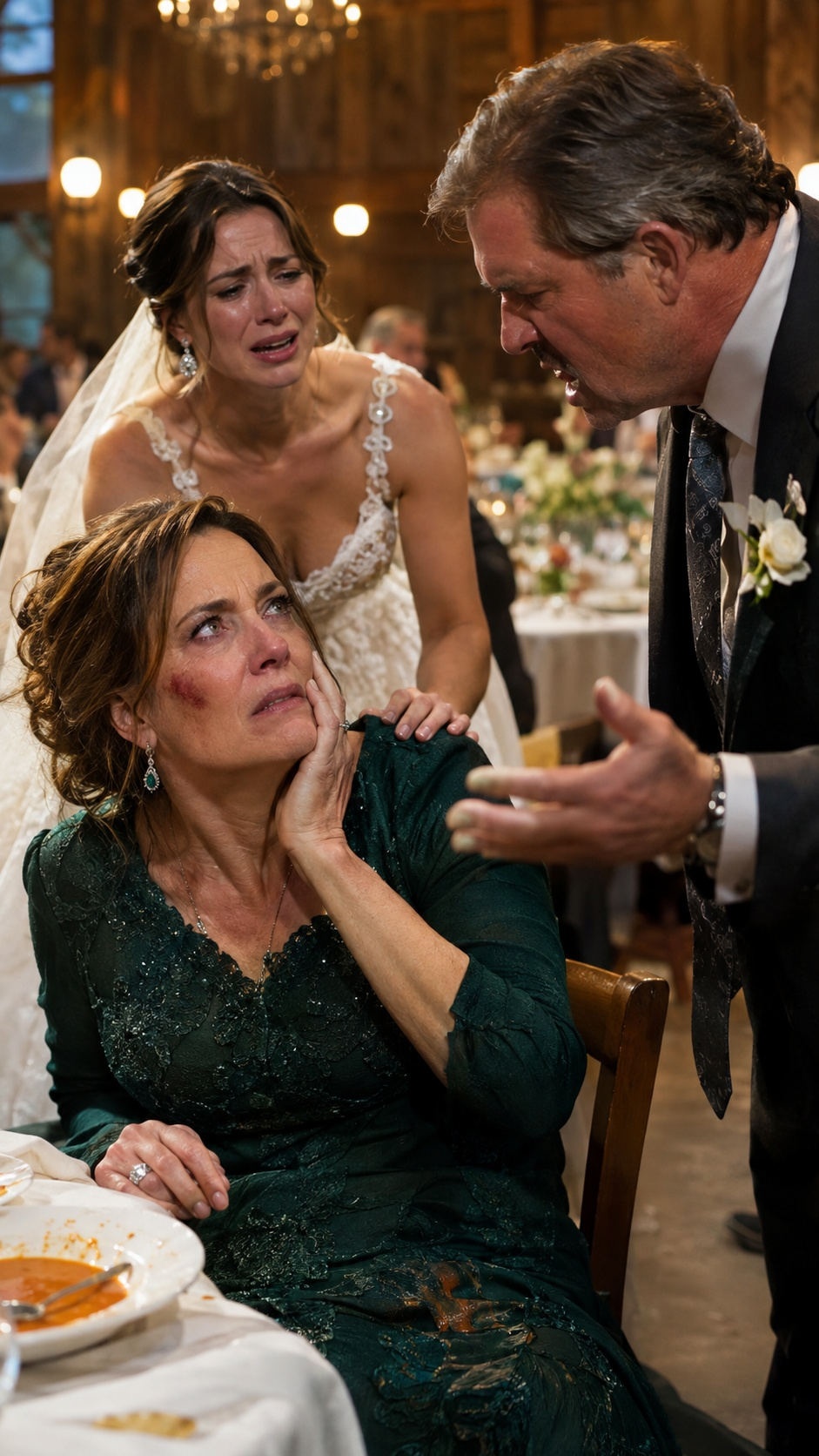
I had never imagined that one day she would look at me while I held my injured cheek and tell me to leave.
The memory hurt so much I pressed my palm against my chest.
Evelyn reached across the table.
"Grace?"
I shook my head.
"I keep thinking she'll call and say she's sorry."
Evelyn's eyes softened.
"Maybe someday she will."
I looked away.
"But not today."
"No," Evelyn said gently. "Probably not today."
Her phone rang.
She answered immediately.
"Rebecca?"
I watched her listen.
Then she handed me the phone.
"She wants to speak with you."
I took it.
"Hello?"
A clear, professional voice answered.
"Mrs. Cain, I'm Rebecca Sloan. Evelyn has told me some of what's happened."
"Please call me Grace."
"All right, Grace. First, are you somewhere safe?"
"I think so."
"Have you received medical attention for your injury?"
"No."
"I'd like you to do that today. It's important for your health, and the records may help document what happened."
I looked at Evelyn.
She nodded.
Rebecca continued.
"Second, don't sign anything Gabriel sends you. Don't agree to meet him alone. And don't surrender your father's original documents without legal advice."
"I understand."
"Third, I need you to tell me exactly what you found."
I explained the hidden drawer.
The deed.
The survey.
The brass key.
Margaret Whitcomb.
The strange visitor.
The photographs of the law office.
Rebecca listened without interrupting.
When I finished, she was silent for several seconds.
Then she asked, "Did your father ever mention a company called Vance Land Holdings?"
My heart jumped.
"Vance?"
"Yes."
I looked at the death certificate.
"Harold Vance?"
Rebecca paused.
"Where did you hear that name?"
I explained the envelope.
Her voice became serious.
"Grace, I want you to photograph those documents and send them to my secure office address. Keep the originals with you."
"Why?"
"Because your husband's business history may be more complicated than you realize."
I swallowed.
"Do you think he killed someone?"
"I don't have evidence to say that."
Her answer was careful.
I appreciated it.
For the first time in years, someone was refusing to tell me what I wanted to hear simply to make me feel better.
Rebecca continued.
"What I do know is that your husband has no right to force you to pledge separately owned property as collateral. And if he's threatening you over it, we need to document that immediately."
I looked at the envelope.
"Can he take the land?"
"Not simply because he's your husband."
Relief washed through me.
But Rebecca wasn't finished.
"However, if he's created fraudulent documents or misrepresented ownership to lenders, we may have a much larger problem."
I remembered Daniel Mercer.
The paper pressed against my truck window.
Gabriel's signature.
A date three months after Dad's death.
"Rebecca, I think he may already have done that."
"Then we need to find out exactly what he filed."
She arranged to meet us later that morning.
Before ending the call, she asked one more question.
"Grace, do you have somewhere to stay for the next few days?"
I looked around the guesthouse.
"Yes."
"Good. But if you believe someone has found that location, don't remain there."
I glanced toward the front door.
Someone had already found us.
Rebecca seemed to hear the hesitation in my voice.
"Grace?"
"Yes?"
"Your safety comes first. The property can wait."
I wanted to believe her.
But I knew Gabriel.
He didn't wait.
He pushed.
He threatened.
He found the weakest place in a person's life and pressed until they surrendered.
For thirty-six years, that weak place had been my desire to keep my family together.
Now he had another advantage.
He knew I was afraid.
And he knew I was alone.
Or at least, he thought I was.
After the call, Evelyn insisted that we leave the guesthouse.
We packed the documents.
I placed the brass key inside a small fabric pouch and tied it around my neck beneath my sweater.
It felt foolish.
Like something from an old adventure movie.
But I wasn't willing to lose it.
Evelyn drove us to a medical clinic.
The nurse who examined my cheek was kind.
She asked what had happened.
I told her.
"My husband slapped me."
The words sounded strange aloud.
So plain.
So ugly.
The nurse didn't look surprised.
That hurt in a different way.
She documented the swelling and bruising.
She asked whether I felt safe returning home.
I said no.
Then she asked whether I wanted information about domestic violence resources.
For a moment, I almost said I didn't need them.
I had money.
A car.
An education.
A father who had taught me a trade.
I wasn't the kind of woman I had imagined needing that kind of help.
Then I realized how foolish that thought was.
Abuse didn't care how old I was.
Or what neighborhood I lived in.
Or how much my husband's suits cost.
I accepted the information.
And I thanked her.
Afterward, Evelyn drove me to Rebecca Sloan's office.
It occupied the second floor of a modest brick building in Austin.
There were no marble floors.
No expensive paintings.
No receptionist offering imported coffee.
Just shelves of legal books, framed certificates, and a woman who looked me directly in the eyes when she spoke.
Rebecca was in her early fifties.
She wore a navy suit and practical shoes.
Her dark hair was cut just above her shoulders.
She shook my hand firmly.
Then she looked at the bruise on my cheek.
"I'm sorry that happened to you."
I nearly cried.
Not because the words were extraordinary.
Because they were so simple.
Nobody at the wedding had said them.
Rebecca spread the documents across her conference table.
For nearly two hours, we examined everything.
She studied the deed.
The survey.
My father's letter.
The old attorney correspondence.
The photograph.
The death certificate.
Then she reached the map.
She stopped.
"Interesting."
I leaned forward.
"What?"
She pointed to the eastern boundary.
"This access strip may be important to the development parcels surrounding your father's property."
"Gabriel owns those parcels."
"His company does, according to the information you've given me."
She studied the map.
"If your land controls the only practical route to those parcels, your refusal to grant access could create serious problems for his project."
I looked at her.
"So he needs my land."
"Possibly. Or he needs rights across it."
She turned the map toward me.
"But this doesn't explain why your father was concerned about illegal activity."
I thought of Harold Vance.
Rebecca picked up the newspaper clipping.
"I'll have someone research this."
Then she examined the brass key.
"Two fourteen."
I nodded.
"Margaret said it opened the place where the rest of the records were kept."
Rebecca looked thoughtful.
"Did she mention a bank?"
"No."
"A storage facility?"
"No."
"An office?"
"Nothing."
Rebecca placed the key on the table.
"We'll start with the attorney's old records."
I hesitated.
"Rebecca, what happened to Margaret?"
She looked at me.
"I've made inquiries."
"And?"
"Her office was entered overnight. Police are investigating."
My stomach tightened.
"Is she alive?"
Rebecca paused.
"Yes."
I closed my eyes.
Relief almost overwhelmed me.
"She's in the hospital."
My eyes opened.
"What happened?"
"I don't have confirmed details. But she was injured."
I pressed a hand against my mouth.
Rebecca leaned forward.
"Grace, this is why I want you to stay somewhere secure."
I nodded.
But my thoughts were racing.
Margaret had been injured after speaking with me.
A stranger had followed me.
Gabriel had accused me of stealing.
Someone had found Evelyn's guesthouse.
And now there was a dead construction worker connected to my father's land.
I looked at Rebecca.
"Can we go to the police?"
"Yes. We should report the threats and provide the information we have. But we need to distinguish what we know from what we suspect."
I appreciated her caution.
Gabriel had always treated suspicion as proof when it suited him.
I didn't want to become like him.
Rebecca arranged for copies of the documents to be secured.
She also began preparing paperwork to protect my property interests and address Gabriel's threats.
Then she asked a question I hadn't expected.
"Grace, do you want to remain married to Gabriel?"
The room went quiet.
I stared at her.
For thirty-six years, the answer had always been yes.
Even when I was unhappy.
Even when I was afraid.
Even when I felt invisible.
Marriage had become something I maintained rather than something I lived.
I looked down at my bare ring finger.
"No," I said.
The word was barely audible.
Rebecca waited.
I took a breath.
"No. I don't."
Evelyn reached for my hand.
Rebecca nodded.
"Then we can discuss divorce and protective options."
I felt something loosen inside my chest.
Not happiness.
Not yet.
But the beginning of freedom.
That afternoon, Rebecca helped me take the first legal steps toward separating from Gabriel.
She warned me that the process could become difficult.
Gabriel might contest everything.
He might hide assets.
He might attempt to use Nora to pressure me.
I listened.
Then I said, "I don't want his money."
Rebecca looked at me.
"Grace, don't decide what you're entitled to while you're still recovering from what happened."
I shook my head.
"I just want my father's land."
She nodded.
"Then we'll protect it."
But I knew the land was only part of what I needed.
I needed work.
A place to live.
A life that belonged to me.
And for the first time in decades, I remembered something Gabriel had spent years making me forget.
I knew how to build furniture.
Not as a hobby.
Not as a way to pass time.
I had learned from one of the finest craftsmen in our county.
My father had taught me everything.
How to choose lumber.
How to read the grain.
How to shape a curved chair leg.
How to make a table that would last longer than the people who gathered around it.
Gabriel used to call my woodworking embarrassing.
He said wealthy women didn't need to work with their hands.
But sitting in Rebecca's office, I realized those hands might be the one thing he had never managed to take from me.
That evening, Evelyn drove me to a small rental property owned by a friend of Rebecca's.
It was outside the city.
Quiet.
Private.
The landlord agreed to rent it to me without asking questions about Gabriel.
I paid the deposit with money Evelyn lent me, promising to repay every dollar.
The house had two bedrooms.
A small kitchen.
And a detached garage.
When I saw the garage, I stopped.
It was empty.
Concrete floor.
One window.
A single overhead light.
I stood in the doorway for a long time.
Evelyn watched me.
"What are you thinking?"
I looked at the space.
"I could put a workbench here."
She smiled.
"Yes, you could."
"A small one."
"Of course."
"Maybe start with repairs."
"Grace."
I turned.
She was smiling through tears.
"You could start with whatever you want."
That night, I slept in a bed Gabriel had never touched.
I woke several times.
Every sound made me tense.
But nobody shouted.
Nobody slammed a door.
Nobody demanded to know where I had been.
In the morning, I made coffee and sat beside the window.
The sun rose over a quiet yard.
For the first time in years, I didn't have to ask anyone what they wanted for breakfast.
I could simply sit.
And breathe.
Over the following weeks, my life changed in ways I hadn't imagined.
Rebecca handled communications with Gabriel's attorneys.
I reported the assault and threats.
I preserved every message.
I gave statements about the workshop and the strangers who had approached me.
The investigation into Margaret's injury continued, though I received few details.
Gabriel denied wrongdoing.
Of course he did.
He claimed the wedding incident had been exaggerated.
He claimed I was emotionally unstable.
He claimed I had taken confidential business documents.
And when those accusations failed to bring me home, he began sending messages through Nora.
Dad says he wants to work things out.
Mom, please answer me.
You're hurting everyone by disappearing.
I read them.
Sometimes I cried.
Sometimes I wanted to call her.
But every message asked me to return.
Not one asked whether my cheek had healed.
Not one said she was sorry.
So I remained silent.
Rebecca helped me establish a separate bank account and secure my personal records.
Evelyn helped me find used woodworking tools.
A neighbor gave me an old workbench.
I repaired it myself.
Then I began taking small jobs.
A broken dining chair.
A scratched dresser.
A kitchen cabinet with a damaged hinge.
My first customer paid me eighty dollars.
I held the bills in my hand for a long time.
It wasn't much.
But it was mine.
I had earned it.
Not because I was Gabriel Cain's wife.
Not because I belonged to a wealthy family.
Because I had fixed something with my own hands.
I placed the money inside a small wooden box.
Then I cried.
The months passed.
My work improved.
Customers began recommending me.
I restored antique tables.
Repaired family heirlooms.
Built custom shelves.
Eventually, I made my first dining table from scratch.
Solid oak.
Six feet long.
Simple tapered legs.
Hand-rubbed finish.
The customer was a young couple furnishing their first home.
When they saw it, the wife ran her hand across the surface.
"It's beautiful," she whispered.
I smiled.
"Thank you."
She looked at me.
"How long have you been doing this?"
I thought of my father.
Of the workshop.
Of all the years Gabriel had convinced me that my skills were worthless.
"Most of my life," I answered.
The woman smiled.
"You can tell."
That evening, I returned to my little rental house and sat at the kitchen table.
I opened my father's envelope.
The brass key was still there.
So were the documents.
Rebecca had continued investigating the property records, but the trail had become complicated.
Gabriel's company had reorganized several times.
Some records were missing.
Others had been transferred between related businesses.
The mystery surrounding Harold Vance remained unresolved.
Margaret had survived her injuries, but her recovery was slow, and she had been unable to provide a complete explanation of the old records.
The key marked 214 still had no confirmed location.
And Gabriel continued fighting every attempt to settle our separation.
But I was no longer waiting for him to decide what happened next.
I was building something.
Piece by piece.
Day by day.
A life.
My own life.
One evening, nearly a year after the wedding, Rebecca called.
"Grace, I have news."
I put down the sandpaper I was holding.
"Good news?"
"Some of it."
I sat on the workbench.
"Tell me."
"Your father's property remains legally titled in your name. Gabriel's attempt to assert an interest through his business documents has not succeeded."
I closed my eyes.
Relief washed through me.
"Thank God."
"But there's something else."
My stomach tightened.
"What?"
"Gabriel has stopped responding to our latest settlement proposal."
"Isn't that good?"
"Not necessarily."
I frowned.
Rebecca continued.
"His attorney says Gabriel believes you're no longer entitled to make decisions concerning certain family assets."
I stared at the wall.
"What does that mean?"
"I don't know yet."
"Rebecca..."
"I'm investigating."
I looked at the brass key hanging from a small hook beside my workbench.
The number 214 caught the light.
"Do you think he's still trying to take the land?"
Rebecca was quiet.
Then she said, "Grace, I don't think he ever stopped."
After we ended the call, I remained seated.
Outside, evening settled over the yard.
I could hear a neighbor mowing his lawn.
A dog barking in the distance.
Ordinary sounds.
The sounds of a life I was learning to love.
But Gabriel's shadow still stretched across it.
I looked at my hands.
They were rough now.
Marked by small cuts and calluses.
I no longer wore expensive rings.
I no longer had perfectly manicured nails.
And I had never felt more capable.
I picked up a piece of walnut.
Ran my thumb along the grain.
Then returned to work.
Because I had learned something important.
I couldn't control what Gabriel did.
I couldn't force Nora to understand.
I couldn't make the past disappear.
But I could decide what to build next.
And I intended to build something that would last.
Three years later, my furniture began appearing in design magazines.
Five years later, wealthy clients started asking for custom commissions.
By the seventh year, my workshop had grown into a respected business.
I had employees.
A waiting list.
And customers willing to pay more for one of my tables than Gabriel had once paid for a luxury vacation.
But I still kept my father's envelope locked inside a steel cabinet.
I still wore the brass key on a chain beneath my blouse.
And I still hadn't spoken to Nora.
Then, one afternoon, a letter arrived at my workshop.
It was addressed to Grace Anne Cain.
No return address.
Inside was a photograph of an enormous walnut dining table.
Fourteen feet long.
Elegant.
Beautiful.
Beneath it was a handwritten message.
I would like you to build this for my home in Highland Park.
The letter was signed by a man whose name I recognized immediately.
A billionaire whose business dealings had once crossed paths with Gabriel's.
I stared at the signature.
Then I turned the page.
There was a second message.
Only one sentence.
Before you accept, Mrs. Cain, there's something you should know about your husband.
I reached for the enclosed business card.
A telephone number was written on the back.
And beneath it, in handwriting I had not seen in seven years, was a single name.
Nora.






Comments 0