The workshop door handle turned again.
I stood frozen beside my father's workbench, clutching the brown envelope against my chest.
The light above me flickered.
Outside, someone pulled at the door.
"Grace?"
My heart stopped.
It was a man's voice.
Not Gabriel's.
But I recognized it.
"Mrs. Cain? Are you in there?"
Richard Bellamy.
My husband's business partner.
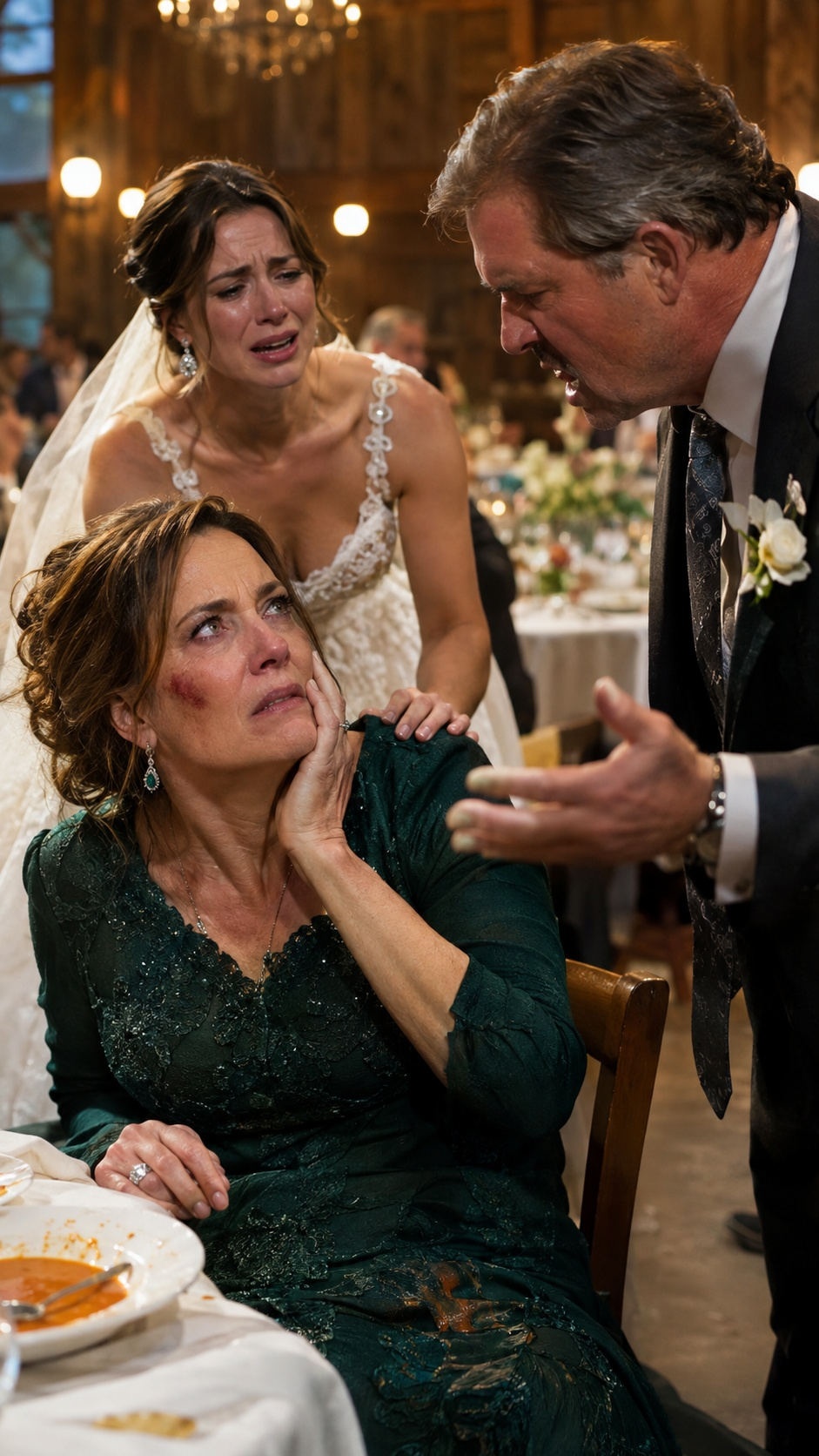
The same man who had laughed when Gabriel spilled pumpkin soup into my lap.
The same man who had watched my husband slap me in front of two hundred wedding guests without lifting a finger.
And now, less than an hour after I had left the reception, he was standing outside my father's workshop.
I looked down at the envelope.
He will come looking for this.
My father's handwriting seemed to burn through the paper.
I had never believed in coincidences.
Not after thirty-six years of marriage to Gabriel Cain.
I moved quickly.
The hidden drawer was still open beneath the workbench. I pushed it shut, careful not to make a sound, then slipped the envelope beneath the loose lining of my evening purse.
My hands were shaking.
I hated that.
I had spent most of my life making things with my hands. I could carve a perfect dovetail joint, restore a century-old rocking chair, or repair a broken cabinet without leaving a visible seam.
But tonight, I could barely close my purse.
Richard knocked.
"Grace, I know you're in there. Your car's outside."
I glanced toward the windows.
The curtains were thin enough that he could probably see the light.
There was no point pretending the building was empty.
"What do you want, Richard?"
A pause.
Then his voice softened.
"Gabriel asked me to check on you."
I almost laughed.
My husband had slapped me.
My daughter had thrown me out.
And now Gabriel was sending his business partner to check on me?
"Tell Gabriel I'm fine."
"Come on, Grace. Open the door."
I looked toward the entrance.
"Why?"
"Because it's nearly midnight, and you're out here alone."
"I'm sixty-two years old, Richard. I've been alone before."
Another pause.
"Gabriel's worried."
That time, I did laugh.
It was a small, bitter sound.
"Is he worried about me, or is he worried about where I went?"
Richard didn't answer immediately.
That silence told me more than his words.
I stepped toward the door but left the deadbolt in place.
"Did he tell you to follow me?"
"Grace, you're upset."
"That's not an answer."
"Nobody wants this to become something bigger than it already is."
I stared at the wooden door.
Something bigger.
My husband had assaulted me at our daughter's wedding, and Richard was talking as though I had spilled a glass of wine.
"Go home, Richard."
"Just open up for a minute."
"No."
His tone changed.
Only slightly.
But I heard it.
"Gabriel really needs you to be reasonable about the property."
There it was.
Not an apology.
Not concern.
The land.
Even tonight.
Especially tonight.
I leaned against the workbench.
"The property belongs to me."
"Nobody's disputing that."
"Then why are you here?"
"Because you're making a business decision based on emotion."
I looked at the fresh stain on my dress.
The orange soup had dried around the silver embroidery.
"My husband hit me tonight."
Richard sighed.
"Gabriel had too much to drink."
"He hit me."
"I'm not defending what happened."
"You haven't condemned it either."
Silence.
Then he said something that made my stomach tighten.
"Grace, eleven acres aren't worth destroying a family over."
I closed my eyes.
There are moments when a person says something so revealing that you can never hear their voice the same way again.
Richard had just given me one.
To him, the land mattered more than what Gabriel had done.
And he expected me to agree.
"Good night, Richard."
I turned away.
"Grace, wait."
I stopped.
His voice dropped.
"Whatever your father left you in that workshop, don't make the mistake of thinking it'll protect you."
For several seconds, I couldn't move.
Then I turned slowly toward the door.
"What did you say?"
Nothing.
"Richard?"
I heard footsteps retreating across the wooden porch.
A car door opened.
An engine started.
I hurried to the window.
Through the fog, I saw the red taillights of a black sedan disappearing down the gravel driveway.
Richard Bellamy knew.
He knew there was something inside my father's workshop.
And Gabriel had sent him to find out whether I had discovered it.
I waited until the sound of the engine faded.
Then I locked the door again.
Twice.
Only after that did I return to the workbench.
I pulled out my father's old wooden chair and sat beneath the yellow light.
The envelope rested on my lap.
It was thick.
Heavy.
The brown wrapping had faded along the edges, but the string binding it was still tight.
My father had been a careful man.
He measured twice before cutting once.
He saved every receipt.
He labeled every drawer.
If he had hidden something beneath his workbench, there was a reason.
I untied the string.
Inside were several documents, a small brass key, and a photograph.
The photograph showed my father standing beside a younger man in front of the workshop.
I recognized Dad immediately.
He was wearing his favorite denim shirt, his sleeves rolled to the elbows.
The younger man stood beside him, smiling.
I didn't recognize him.
On the back, my father had written:
August 14, 1989.
The day we made sure the land would stay in the family.
I turned the photograph over again.
The younger man was holding a rolled document.
Behind them, the workshop looked almost exactly as it did now.
I set the photograph aside.
The first document was an old property deed.
I recognized the legal description.
Eleven acres in Gillespie County.
My father's homestead.
But there was something unusual about the deed.
Attached to it was a handwritten statement signed by my father and witnessed by two people.
I read it slowly.
The land had been purchased with money inherited from my grandmother.
My father had held the property separately from his business.
He had wanted it preserved for his descendants.
I knew most of that already.
But the next document was different.
It was a letter addressed to me.
I recognized my father's handwriting before I unfolded it.
My dearest Gracie,
If you're reading this, then someone has made you afraid of losing what belongs to you.
My throat tightened.
I could almost hear his voice.
I hope I'm wrong about the kind of man Gabriel will become. I hope he proves me wrong every day of your marriage.
I stopped reading.
Dad had never liked Gabriel.
He had been polite to him.
He had attended our wedding.
He had even helped Gabriel build the first office for his development company.
But there had always been distance between them.
I used to think it was because Dad was old-fashioned.
Gabriel liked expensive cars and polished shoes.
Dad liked work boots and honest labor.
They were different men.
I had never imagined the difference went deeper.
I continued.
Years ago, Gabriel asked me to transfer the homestead into a family partnership. He said it would help with taxes and future development. I refused.
I stared at the page.
Gabriel had never told me that.
Afterward, I began keeping copies of every document related to the property. I also asked an attorney to record additional protections so nobody could quietly change the ownership without leaving a trail.
My eyes moved faster.
You are the rightful owner of this land. No husband, business partner, or lender should ever convince you otherwise.
Then came a sentence that made my hands go cold.
If Gabriel ever claims I promised him the property, he's lying.
I read it twice.
My father had anticipated this.
Years before the wedding.
Years before Gabriel's business began collapsing.
Years before I understood what kind of man I had married.
Dad had known enough to leave a warning.
I pressed the letter against my chest.
For a moment, I was no longer sixty-two.
I was seventeen again, sitting beside my father while he taught me how to sand a walnut tabletop.
He would place his hand over mine and guide the motion.
"With the grain, Gracie. Always with the grain."
I could still remember the warmth of his hand.
I wished he were there.
I wished I could ask him why he hadn't told me more.
Then I remembered something.
He had tried.
A few months before his death, he had asked me to come to the workshop alone.
Gabriel had insisted on accompanying me.
Dad had looked disappointed when we arrived together.
Later, while Gabriel took a phone call outside, Dad had whispered, "Come back when you have time, sweetheart. There's something important we need to discuss."
I never did.
He died six weeks later.
And I had spent years believing we had simply run out of time.
I wiped my eyes and continued examining the documents.
There were copies of tax records.
Survey maps.
An original deed with recording information.
A letter from a law office in San Antonio.
And a sealed packet marked:
For Grace Anne only.
I opened it carefully.
Inside was a signed statement from my father describing the history of the property.
He explained how he had purchased the land, how he had built the workshop, and how he intended to leave the entire homestead to me.
Attached was a copy of his will.
The same will that had been admitted to probate after his death.
But tucked behind it was another document.
A letter from an attorney named Margaret Whitcomb.
The letter was dated eighteen years earlier.
Dear Mr. Cain,
As requested, I have retained copies of the ownership records and the supporting documents concerning your daughter's inheritance.
I strongly recommend that Grace keep the original instruments in a secure location separate from her marital residence.
I read the sentence again.
Separate from her marital residence.
My father hadn't merely worried that Gabriel might pressure me.
He had worried that Gabriel might get his hands on the documents.
I looked around the workshop.
Gabriel had searched this place before.
I remembered coming here two years earlier and finding several drawers open.
When I asked him about it, he said he had been looking for an old tool.
At the time, I believed him.
Now I wondered how many times he had come here without telling me.
I picked up the brass key.
It was small and tarnished.
A number had been stamped into its head.
214.
I searched the envelope for an explanation.
Nothing.
Then I noticed a second handwritten note tucked inside the photograph.
If the originals aren't enough, Margaret knows where the rest are.
Margaret Whitcomb.
I remembered hearing the name once or twice when Dad was alive.
She had been his attorney.
I had no idea whether she was still practicing.
Or even alive.
But I knew one thing.
I needed someone who understood the law.
Someone Gabriel couldn't intimidate.
I gathered the papers into a neat stack.
Then I heard a sound from outside.
A car.
Again.
I froze.
This time, the engine didn't approach the workshop.
It stopped farther down the road.
I switched off the light.
Darkness filled the room.
I moved carefully toward the side window.
Through the fog, I could see a pair of headlights near the entrance to the property.
They remained stationary.
I waited.
Five seconds.
Ten.
Twenty.
Then the headlights went dark.
Someone was sitting outside.
Watching.
My first instinct was to call Gabriel.
The realization made me feel sick.
For thirty-six years, whenever something frightened me, I had called my husband.
He had trained me to believe that he was the person who could solve every problem.
Even when he was the problem.
I took out my phone.
There were six missed calls.
Four from Gabriel.
Two from Nora.
A text message from my daughter appeared beneath them.
Mom, please don't make tonight worse. Dad says you took something from the house. Just come home.
I stared at the screen.
Something from the house?
I hadn't taken anything.
Not even a change of clothes.
I had left the wedding with my purse, my car keys, and a dress covered in soup.
Gabriel was already inventing a story.
Another message appeared.
This one from Gabriel.
I know where you are.
My stomach tightened.
A second message followed.
Bring back whatever you found.
I looked toward the dark window.
The headlights remained off.
I understood now why Richard had come.
Gabriel hadn't sent him to check on me.
He had sent him to search for the documents.
And when Richard failed, Gabriel had found another way to watch the property.
I slipped the papers back into the envelope.
Then I removed my wedding ring.
For a long moment, I held it between my fingers.
Thirty-six years.
Thirty-six anniversaries.
A daughter.
A house.
A life built around a man who had gradually convinced me that I couldn't survive without him.
I remembered the first time Gabriel had called me stupid.
We had been married for three years.
I had made a mistake balancing our checking account.
He had laughed and said, "Good thing you're pretty, Grace."
I laughed too.
Because I thought he was joking.
Later came the comments about my clothes.
My friends.
My cooking.
My work.
By the time Nora was born, I had learned to apologize before I even knew what I had done wrong.
I looked down at the ring.
I had worn it through every insult.
Every disappointment.
Every lonely night.
But tonight, when Gabriel struck me, something had finally broken.
Not my marriage.
That had been breaking for years.
What broke was the belief that I deserved what was happening.
I placed the ring inside the hidden drawer.
Beside the note from my father.
Then I closed it.
The click sounded final.
I didn't know where I would go.
I didn't know how I would support myself.
I didn't even know whether Gabriel would allow me to leave without a fight.
But I knew I couldn't go home.
Not tonight.
Not ever again.
I took the envelope, the brass key, and my purse.
Then I moved toward the rear door of the workshop.
My father had installed it years earlier so he could carry lumber directly from the storage shed.
It opened onto a narrow path behind the building.
From there, I could reach the old equipment barn.
I remembered that Dad had kept a spare set of car keys in a metal box beneath the workbench.
I checked.
They were still there.
Keys to his old pickup truck.
The truck had been sitting inside the equipment barn for years.
I had paid to keep it registered and maintained because I couldn't bear to sell it.
Gabriel called it junk.
I called it Dad's truck.
Tonight, it might be my way out.
I opened the rear door.
Cold air rushed inside.
The fog had thickened.
I could barely see the fence twenty feet away.
I stepped outside and pulled the door shut behind me.
The gravel was damp beneath my shoes.
My evening gown caught against a wooden post.
I freed it carefully.
Then I heard a voice.
"Grace?"
I stopped breathing.
It came from the front of the workshop.
A familiar voice.
Gabriel.
"Grace, I know you're here."
He sounded sober now.
That frightened me more than the shouting.
I crouched behind a stack of lumber.
Footsteps crossed the porch.
The front door rattled.
"Grace, open the damn door."
I remained still.
Then another voice spoke.
Richard.
"Her car's still here."
Gabriel answered quietly.
"Then she's inside."
I pressed a hand over my mouth.
They had come together.
Gabriel tried the door again.
Locked.
"She couldn't have found it," Richard said.
Gabriel's reply was so quiet I almost missed it.
"If she did, we're finished."
I stared into the darkness.
Finished?
What could my father have hidden that frightened two powerful businessmen?
The deed proved the land belonged to me.
That was important.
But it shouldn't have been enough to destroy Gabriel's business.
There had to be something else.
Something I hadn't found.
I thought of the brass key.
214.
A storage locker?
A safe-deposit box?
A filing cabinet?
I didn't know.
But Gabriel apparently did.
A loud crash came from the front of the workshop.
Wood splintered.
They had forced the door.
I moved.
Keeping low, I hurried along the path toward the equipment barn.
The fog concealed me.
My heart pounded so hard I could hear it.
Behind me, Gabriel shouted my name.
I reached the barn.
The sliding door was heavy.
I pulled it open just far enough to squeeze through.
Inside, the old pickup sat beneath a canvas cover.
I yanked the cover away.
A faded blue Ford.
My father had driven it for nearly twenty years.
I climbed into the driver's seat.
The interior smelled of leather, dust, and cedar shavings.
I inserted the key.
The engine turned over.
Once.
Twice.
Then started.
I nearly cried with relief.
I switched off the headlights.
The barn doors opened onto a narrow service road that connected to the back of the property.
Dad had used it to transport lumber.
Gabriel didn't know about it.
At least, I hoped he didn't.
I eased the truck forward.
The tires rolled over packed dirt.
Behind me, I heard Gabriel shouting.
"Richard! Check the back!"
I pressed the accelerator.
The truck moved into the fog.
I didn't turn on the headlights until I reached the county road.
By then, my hands were shaking again.
But I was moving.
And for the first time that night, Gabriel was behind me.
I drove for nearly forty minutes before stopping at a twenty-four-hour gas station outside Kerrville.
The fluorescent lights made my stained gown look even worse.
I parked beside an empty pump.
Then I sat in the truck and tried to think.
I had no suitcase.
No change of clothes.
No plan.
I had a few hundred dollars in my purse and a bank card connected to an account Gabriel monitored.
Using it would tell him exactly where I was.
I couldn't risk that.
I looked at the envelope.
Then at the brass key.
214.
There had to be a reason Dad included it.
I took out the letter from Margaret Whitcomb.
At the bottom was a telephone number.
I stared at it.
It was nearly one in the morning.
Calling an attorney at that hour seemed absurd.
But so did everything else that had happened tonight.
I dialed.
The number rang four times.
Then a recorded voice answered.
"Whitcomb Legal Services. Our office is currently closed."
I almost hung up.
Then the message continued.
"If you are calling regarding the private estate files of Thomas Anne's family trust, please leave your name and contact information after the tone."
I froze.
Thomas Anne.
My father's full name.
The message sounded old.
Perhaps the office had never updated it.
Perhaps Margaret Whitcomb had retired years ago.
But why would a law office still mention my father's estate?
The tone sounded.
I swallowed.
"My name is Grace Anne Cain. Thomas Anne was my father. I found some documents he left me, and I need help."
My voice trembled.
I forced myself to continue.
"My husband is trying to take my father's land. I think he may have been looking for these papers. Please call me."
I gave my cell number.
Then I ended the call.
For several minutes, I sat staring through the windshield.
The gas station was almost empty.
A truck driver walked toward the convenience store carrying a paper coffee cup.
Somewhere nearby, a dog barked.
The world continued as though nothing extraordinary had happened.
I wondered how many women were sitting alone in parked cars that night, trying to figure out how to begin again.
I wondered how many had been told they were worthless.
How many had believed it.
My phone vibrated.
An unfamiliar number appeared.
I hesitated.
Then answered.
"Hello?"
A woman's voice spoke.
"Is this Grace Anne Cain?"
"Yes."
"My name is Margaret Whitcomb."
I sat upright.
"Ms. Whitcomb?"
"I received your message."
"But it's the middle of the night."
"I know."
Her voice was steady.
Professional.
And strangely urgent.
"Grace, are you somewhere safe?"
I looked around the empty parking lot.
"I think so."
"Are you alone?"
"Yes."
"Good. Listen carefully. Do you have the documents your father left you?"
I looked at the envelope.
"Yes."
"All of them?"
"I don't know."
"Did you find a brass key?"
My fingers tightened around the phone.
"Yes."
"What number is on it?"
"Two fourteen."
There was a long silence.
Then Margaret exhaled.
"Thank God."
I closed my eyes.
"Ms. Whitcomb, please tell me what's happening."
"I can't explain everything over the telephone."
"Why not?"
"Because I don't know who might be listening."
My stomach tightened.
She continued.
"Your father came to me years ago because he believed Gabriel was preparing to use the property for something illegal."
I stared at the dashboard.
"Illegal?"
"Grace, your father didn't hide those records simply to protect your inheritance."
I couldn't speak.
"He hid them because he discovered something about your husband's business."
The gas station lights hummed overhead.
I looked at the envelope resting beside me.
"What did he discover?"
Margaret hesitated.
Then she said, "There's a second set of records. The key opens the place where they're kept."
"Where?"
"I'll give you the address. But you must promise me something."
"What?"
"Do not tell Gabriel you have that key."
I swallowed.
"He already knows I found something."
"Then we have less time than I thought."
I heard papers rustling on her end of the line.
"Grace, I need you to meet me tomorrow morning. Eight o'clock. My office in San Antonio."
"All right."
"And bring everything."
"I will."
"One more thing."
Her voice changed.
"Do not go home."
I looked down at my wedding ring finger.
Bare.
"I wasn't planning to."
"Good."
She paused.
Then said something I would remember for the rest of my life.
"Your father was afraid Gabriel would eventually try to take the land. But he was even more afraid of what Gabriel might do if you refused."
I felt cold.
"Ms. Whitcomb..."
"Call me Margaret."
"Margaret, did my father know something about Gabriel that I don't?"
A long silence followed.
Then she answered.
"Yes, Grace. And I think it's time you knew it too."
Before I could ask another question, a loud noise sounded through the phone.
A door slamming.
Margaret gasped.
"Who's there?"
I sat forward.
"Margaret?"
I heard footsteps.
Then a man's voice in the background.
Low.
Unfamiliar.
Margaret spoke quickly.
"Grace, listen to me. If anything happens, the key—"
The line went dead.
I stared at the phone.
"Margaret?"
Nothing.
I called back.
Straight to voicemail.
I tried again.
No answer.
My hands were trembling so badly that I nearly dropped the phone.
I looked toward the gas station windows.
The cashier was wiping down a counter.
The truck driver had disappeared.
A dark SUV had pulled into the parking lot.
I hadn't heard it arrive.
Its headlights were off.
The driver's door opened.
A man stepped out.
He wore a dark jacket and carried a phone.
He looked directly toward my father's pickup.
Then he began walking toward me.
My phone vibrated again.
A new message appeared from Margaret's number.
Only five words.
Grace, do not trust him.
I looked up.
The man was almost at my door.
He raised one hand.
Then knocked on the glass.
"Mrs. Cain?"
I didn't move.
He reached into his jacket.
Pulled out a folded document.
And pressed it against my window.
Across the top, in bold letters, was my father's name.
Beneath it was a signature I recognized.
Gabriel's.
The man leaned closer.
"Your husband told me you'd have questions about this."
Then he turned the document around.
And I saw the date.
It was signed three months after my father died.






Comments 0