"Nora?"
I whispered my daughter's name into the empty workshop.
Seven years.
Seven years without hearing her voice.
Seven years without seeing her face.
And now her name was written on the back of a billionaire's business card.
I stood beside my workbench, holding the card between fingers that had spent the morning shaping a walnut cabinet.
The handwriting was unmistakable.
Nora had always made her capital N with an exaggerated curve. Her elementary school teachers used to complain that her handwriting looked too decorative.
I had loved it.
Now that single letter made my knees feel weak.
The letter had arrived that morning in a cream-colored envelope.
The sender was Charles Whitmore, a Dallas billionaire whose fortune came from commercial real estate, energy investments, and private equity.
I recognized his name.
Almost everyone in Texas did.
But I recognized it for another reason.
Years earlier, Gabriel had mentioned Whitmore during one of his business dinners.
He had called him a difficult man.
A man who never forgot a debt.
A man who could destroy a development company with a single telephone call.
Gabriel had said those things with resentment.
And fear.
I looked again at the letter.
Before you accept, Mrs. Cain, there's something you should know about your husband.
Beneath those words was a business card.
And on the back, Nora's name.
I turned it over.
Charles Whitmore.
Whitmore Holdings.
Highland Park, Dallas.
A private telephone number.
I stared at it for several minutes.
Then I picked up my phone.
My thumb hovered over the number.
I wanted to call.
I wanted answers.
But seven years had taught me something Gabriel never expected me to learn.
Not every mystery deserved an immediate reaction.
Sometimes the smartest thing a woman could do was sit quietly and let other people reveal what they wanted.
I placed the card on my workbench.
Then I called Evelyn.
She answered on the second ring.
"Please tell me you're not working through lunch again."
I smiled faintly.
"Hello to you too."
"Grace, it's almost two o'clock. Have you eaten?"
"Coffee."
"Coffee isn't food."
"I had toast."
"When?"
"Yesterday."
"Grace Anne."
I laughed softly.
It was a familiar conversation.
Evelyn had been looking after me since the night I left Gabriel.
Not because I couldn't look after myself.
Because she believed friendship meant showing up, even when the other person insisted she didn't need anything.
"Evelyn, I received a strange letter."
Her tone changed immediately.
"From Gabriel?"
"No."
"His lawyer?"
"No."
"Then who?"
"Charles Whitmore."
Silence.
Then she said, "The billionaire?"
"That one."
"What does he want?"
"A dining table."
Evelyn laughed.
"Well, that part isn't strange. You're one of the best furniture makers in Texas."
I looked around my workshop.
Seven years earlier, I had been repairing broken chairs in a rented garage.
Now I owned a twelve-thousand-square-foot workshop outside Austin.
Six skilled craftsmen worked with me.
We built custom furniture for wealthy families, interior designers, boutique hotels, and private collectors.
My work had appeared in three national design magazines.
One of my walnut dining tables had sold for more than forty thousand dollars.
Gabriel used to tell me nobody would pay for furniture made by a woman with sawdust in her hair.
I sometimes wondered what he would say if he saw my waiting list.
But I no longer cared enough to find out.
"There's something else," I told Evelyn.
I read the second sentence aloud.
Then I told her about Nora's name.
Evelyn didn't speak for several seconds.
"Are you sure it's her handwriting?"
"Yes."
"After seven years?"
"I'd recognize it anywhere."
Evelyn sighed.
"Grace, I don't like this."
"Neither do I."
"Have you called Rebecca?"
"Not yet."
"Call her before you do anything else."
I looked at the letter.
"Do you think Nora is trying to contact me?"
"I don't know."
That was one of the things I loved about Evelyn.
She never pretended to know what she didn't.
"Maybe Whitmore knows something," she continued. "Maybe somebody is trying to get your attention. But after everything Gabriel did, you don't walk into a meeting without understanding why you're there."
I nodded.
"You're right."
"I know."
I smiled.
"You're impossible."
"And you're hungry. Go eat something."
After we hung up, I called Rebecca Sloan.
She had remained my attorney throughout the years.
Our relationship had changed from urgent legal meetings to occasional conversations about property records and business contracts.
But there were still unresolved matters.
Gabriel had fought our divorce proceedings so aggressively that the case had become tangled in disputes over financial disclosures, jurisdiction, and his attempts to challenge documents connected to my father's property.
At one point, he stopped cooperating entirely.
Rebecca had warned me that his behavior was unusual.
Then Gabriel's attorneys began claiming they couldn't locate him for certain proceedings.
The case stalled.
I had chosen not to spend every dollar I earned chasing a man who seemed determined to make the process endless.
Instead, I concentrated on protecting my property and building my business.
Rebecca continued monitoring the records.
The eleven acres remained titled in my name.
And the brass key marked 214 remained locked inside my office safe.
I had never forgotten it.
But Margaret Whitcomb had retired from legal practice after her injuries, and the old records connected to the key had become difficult to trace.
Every lead seemed to end in another closed office, another missing file, another company that no longer existed.
Now Charles Whitmore had appeared.
And somehow, Nora was connected.
Rebecca answered.
"Grace, what can I do for you?"
"I received a letter."
I explained everything.
She listened carefully.
When I finished, she asked, "Have you contacted Whitmore?"
"No."
"Good."
I leaned against my desk.
"Do you know him?"
"By reputation."
"Is that good or bad?"
"Depends on which side of a contract you're standing."
I looked at the business card.
"He wants me to build a fourteen-foot walnut dining table."
Rebecca was quiet.
Then she asked, "Did he mention Gabriel in the commission itself?"
"No. Only in the handwritten note."
"Interesting."
"What do you think it means?"
"I think we should verify that the letter actually came from Whitmore."
I nodded.
"And if it did?"
"Then we ask why a billionaire is using a furniture commission to communicate something about your husband."
I looked toward the workshop floor.
One of my employees was carefully sanding a curved chair back.
The sound of machinery hummed in the distance.
My life was peaceful now.
Or at least, I had worked hard to make it that way.
I didn't want Gabriel dragging me back into his world.
But I couldn't ignore Nora's name.
"Rebecca," I said quietly, "what if my daughter needs help?"
Her voice softened.
"Then we'll find out. But we won't assume that until we have evidence."
I closed my eyes.
"All right."
She promised to investigate Whitmore's connection to Gabriel.
Meanwhile, she advised me to respond through my business office.
Professionally.
Nothing personal.
I agreed.
That afternoon, I dictated a short letter to my office manager, Hannah.
Hannah was thirty-four, efficient, and fiercely protective of my schedule.
She had joined the company when I still worked out of a small rented warehouse.
Now she handled contracts, client appointments, and the endless requests from designers who wanted their furniture completed yesterday.
"Fourteen feet?" she asked when I explained the commission.
"Fourteen."
"Solid walnut?"
"That's what he requested."
She raised her eyebrows.
"That's going to be expensive."
I smiled.
"Then we'll make sure it's worth every dollar."
Hannah studied the letter.
"Charles Whitmore?"
"Yes."
"The Charles Whitmore?"
I nodded.
She let out a low whistle.
"Well, Mrs. Cain, I think we've officially entered a different tax bracket."
I laughed.
"Hannah, I still drive a pickup truck."
"A very nice pickup truck."
"It has sawdust in the seats."
"That's branding."
I shook my head.
For a moment, the tension eased.
Then Hannah looked at me more carefully.
"Are you all right?"
I hesitated.
She had never met Gabriel.
She knew only that I had left a difficult marriage years earlier.
I didn't discuss the details with employees.
But Hannah had seen enough to understand that some subjects hurt.
"I'm fine," I said.
She didn't look convinced.
"Do you want me to decline the commission?"
I looked at the photograph of the proposed table.
Fourteen feet of walnut.
A broad, uninterrupted surface.
Elegant proportions.
A design that would require extraordinary precision.
My father would have loved the challenge.
"No," I said.
"You're sure?"
"Yes."
I took the photograph from her.
"We're going to build it."
Three days later, Charles Whitmore's office confirmed the commission was genuine.
The contract arrived through his private design consultant.
The budget was generous.
The timeline was reasonable.
And the specifications were exact.
Fourteen feet long.
Four feet wide.
Solid American black walnut.
Hand-selected boards.
A natural oil finish.
No visible metal fasteners.
The table would be installed in Whitmore's Highland Park residence.
I studied the plans for hours.
Then I began selecting lumber.
There is something deeply honest about wood.
You cannot bully it into becoming something it isn't.
You cannot shout at a warped board until it straightens.
You have to understand it.
Respect it.
Work with its strengths.
My father taught me that.
Gabriel never understood.
He believed everything could be forced into submission.
People.
Money.
Land.
Even love.
But wood doesn't respond to threats.
Neither, I had finally learned, did I.
The project consumed the next several months.
I traveled to a specialty lumber supplier in East Texas to inspect the walnut.
I rejected several boards because the grain patterns didn't match.
I spent hours arranging the slabs until the natural lines flowed across the tabletop like a river.
My employees thought I was being obsessive.
Perhaps I was.
But I wanted the table to be perfect.
Not because Charles Whitmore was wealthy.
Because every piece I made carried my father's lessons.
And because this commission felt different.
Something about it unsettled me.
Whitmore's design consultant visited twice.
A quiet woman named Patricia Lang.
She inspected the progress, approved the finish samples, and asked detailed questions about construction.
On her second visit, she stood beside the unfinished tabletop and ran her fingers along the grain.
"Mr. Whitmore will be pleased."
I smiled.
"I hope so."
She hesitated.
Then asked, "Mrs. Cain, may I ask you something personal?"
I looked up.
"That depends."
"Have you ever met Mr. Whitmore?"
"No."
"Not even years ago?"
I frowned.
"Why?"
She looked uncomfortable.
"He seemed familiar with your work before we contacted you."
I smiled faintly.
"My work has been published."
"Yes, of course."
But she didn't look satisfied.
I set down my sanding block.
"Patricia, is there something I should know?"
She glanced toward the workshop entrance.
Then lowered her voice.
"Mr. Whitmore doesn't usually commission furniture this way."
"What do you mean?"
"He normally lets his designers handle everything."
"And this time?"
"He chose you personally."
I stared at her.
"Why?"
She hesitated.
"I don't know."
I waited.
Then she added, "But he specifically requested that you attend the installation."
I looked toward the enormous walnut tabletop.
"That's unusual?"
"For him, yes."
She left shortly afterward.
I stood beside the table for a long time.
The letter had mentioned Gabriel.
The business card carried Nora's name.
Now Whitmore had personally selected me.
I was beginning to believe the commission had never been only about furniture.
That evening, Rebecca called.
"I found something."
I closed my office door.
"What?"
"Charles Whitmore was involved in a financing group that considered investing in one of Gabriel's development projects about ten years ago."
I sat down.
"Which project?"
"A luxury residential development outside Fredericksburg."
My stomach tightened.
"Near my father's property?"
"Yes."
I looked toward the safe.
The brass key was inside.
Rebecca continued.
"Whitmore's group withdrew before the project was completed."
"Why?"
"The public records don't say."
I swallowed.
"Did Gabriel lose money?"
"Apparently a great deal."
I stared at the wall.
"Rebecca, do you think Whitmore knows what Gabriel was doing with the land?"
"I think it's possible."
"And Nora?"
A pause.
"I haven't found a connection yet."
I closed my eyes.
Seven years.
Seven years of wondering whether my daughter thought about me.
Whether she regretted what happened.
Whether she had children.
Whether she was happy.
I had stopped looking at her social media accounts after the first year.
Every photograph hurt.
Her smiling beside Gabriel.
Her celebrating birthdays.
Her attending family gatherings.
A life continuing without me.
I had learned to live with that pain.
But I had never stopped loving her.
"Grace?" Rebecca asked.
"I'm here."
"Don't let hope make you careless."
I nodded.
"I won't."
But after we hung up, I opened the old wooden box on my desk.
Inside were three photographs.
One showed Nora at five years old, sitting on my father's lap.
Another showed her graduating from high school.
The third was from her wedding.
It had been taken before the reception.
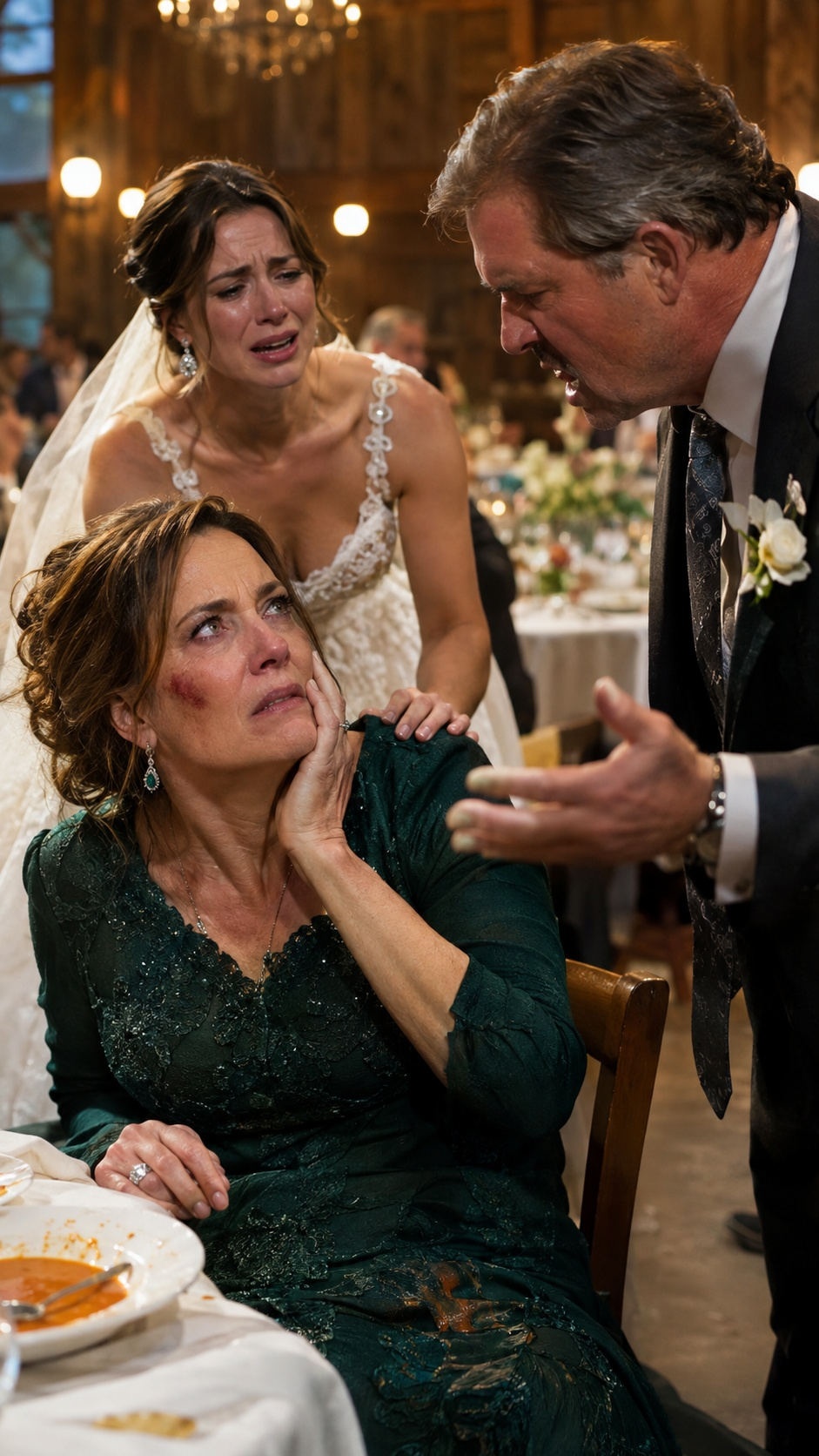
Before the soup.
Before the slap.
Nora stood beside me in her beautiful gown.
We were both smiling.
I looked at the photograph for a long time.
Then I put it away.
The table was completed six weeks later.
It was the finest piece of furniture I had ever made.
Fourteen feet of rich walnut.
The grain flowed from one end to the other.
The edges were gently shaped by hand.
The legs were strong but elegant.
Every joint was precise.
Every surface smooth.
When we applied the final coat of oil, the wood seemed to come alive.
Hannah stood beside me.
"Grace."
I looked at her.
"What?"
She smiled.
"Your father would be proud."
I couldn't answer.
I simply nodded.
The table was delivered to Highland Park on a Thursday morning.
A specialized moving crew transported it in a climate-controlled truck.
I followed in my own vehicle.
Whitmore's residence stood behind tall iron gates on a tree-lined street.
The house was enormous.
Pale limestone.
Tall windows.
Perfectly maintained gardens.
Inside, the dining room overlooked a landscaped courtyard.
The room was elegant but restrained.
Cream-colored walls.
Original artwork.
A long crystal chandelier.
And enough space for the fourteen-foot table to sit comfortably beneath it.
I supervised the installation personally.
The crew worked carefully.
Every movement was measured.
When the final protective covering came off, the walnut glowed beneath the chandelier.
I stepped back.
For a moment, I forgot Gabriel.
I forgot Nora.
I forgot the letter.
All I saw was the table.
Something beautiful that had begun as rough lumber and become exactly what I intended.
A man's voice spoke behind me.
"Extraordinary."
I turned.
Charles Whitmore stood in the doorway.
He was in his early seventies, tall and silver-haired, wearing a dark blue suit without a tie.
He looked less intimidating than I expected.
But his eyes were sharp.
He approached the table slowly.
Ran one hand across the surface.
Then looked at me.
"Mrs. Cain."
"Mr. Whitmore."
He extended his hand.
I shook it.
"Your work is even better than I imagined."
"Thank you."
He studied the table.
"Do you know why I chose walnut?"
I smiled.
"It's beautiful."
"Yes."
He paused.
"But also because it's strong."
I waited.
He looked at me.
"Strong enough to survive generations."
Something about the way he said it made me uncomfortable.
"That depends on how it's treated," I replied.
He smiled faintly.
"An excellent answer."
We walked around the table together.
He asked questions about the construction.
The joinery.
The finish.
The lumber.
I answered them all.
Then he stopped at the head of the table.
"Your father taught you this trade?"
I froze.
"Yes."
"Thomas Anne."
I stared at him.
"You knew my father?"
Whitmore nodded.
"Not well. But I knew of him."
My heart began beating faster.
"How?"
He looked toward the windows.
"Your father was a man who understood the value of keeping records."
I felt cold.
"Mr. Whitmore..."
He raised one hand gently.
"Please. Call me Charles."
I didn't move.
"Charles, why did you write that letter?"
He looked at me for several seconds.
Then he said, "Because your husband has spent years trying to make certain people believe you no longer exist."
I stared at him.
"What?"
He didn't answer immediately.
Instead, he walked toward a small cabinet and poured two glasses of water.
He handed me one.
I didn't drink.
"Grace, Gabriel Cain has been involved in several questionable financial arrangements."
"I know."
"Some of them concern your father's property."
"I know that too."
Whitmore studied me.
"Then you understand why your existence is inconvenient to him."
I felt my fingers tighten around the glass.
"What are you saying?"
"I'm saying that your husband has been trying to remove you from a legal problem."
I stared at him.
"Remove me how?"
He looked toward the dining room entrance.
"That's what I intend to help you discover."
I swallowed.
"And Nora?"
His expression changed.
Only slightly.
But I noticed.
"What about my daughter?"
Whitmore was quiet.
Then he said, "I believe she knows more than she's willing to admit."
My heart tightened.
"Have you spoken to her?"
He didn't answer directly.
Instead, he placed his glass on the table.
"Grace, I'm hosting a private dinner next Friday evening. Forty guests. Investors, collectors, and a few old friends."
I stared at him.
"Why are you telling me this?"
"Because I'd like you to attend."
"As a guest?"
"As the artist who created this table."
I looked at the walnut surface.
He continued.
"I want everyone to know who made it."
I felt a strange mixture of pride and suspicion.
"Charles, if this is about Gabriel—"
"It's about your work," he interrupted gently. "And perhaps an opportunity for certain people to see something they've been avoiding."
I didn't understand.
But I wanted to.
"Will Gabriel be there?"
"No."
Relief washed through me.
"Will Nora?"
Whitmore hesitated.
Then he said, "I can't promise that."
I looked at him.
There was something he wasn't telling me.
Something important.
But I had spent seven years learning not to let powerful men control conversations simply because they possessed information.
So I set my water glass down.
"Charles, I appreciate the commission. But I won't be manipulated."
He studied me.
Then smiled.
Not mockingly.
Respectfully.
"Your father would have liked that answer."
I looked at the table.
Then back at him.
"I'll attend your dinner."
He nodded.
"Good."
As I turned to leave, he spoke again.
"Grace?"
I stopped.
"Yes?"
"Whatever happens that evening, remember something."
I waited.
"You built this table. Nobody can take that away from you."
I didn't understand why his words sounded like a warning.
But I remembered them.
The following Friday, I arrived at Whitmore's residence wearing an elegant emerald-green evening gown.
My silver-blonde hair was arranged in soft curls.
I wore pearl earrings.
No wedding ring.
For the first time in years, I felt beautiful without wondering whether Gabriel would approve.
The dining room was filled with wealthy guests.
Forty people.
Investors.
Collectors.
Business executives.
Designers.
They gathered around the fourteen-foot walnut table, admiring the grain and craftsmanship.
Charles introduced me.
"This is Grace Anne Cain, the artist responsible for this extraordinary piece."
Applause filled the room.
I smiled.
For a moment, I felt something I hadn't experienced in decades.
Pride.
Not borrowed pride.
Not pride in Gabriel's business.
Not pride in the house we owned.
Pride in something I had created.
A woman approached and asked about my techniques.
Another guest requested my business card.
Someone mentioned commissioning a matching cabinet.
I answered their questions.
I laughed.
I enjoyed myself.
Then dinner began.
I sat near Charles at the center of the table.
The food was exquisite.
The conversation lively.
A pianist played softly in the adjoining room.
I looked around.
Seven years earlier, I had been humiliated at a wedding reception.
Now I sat among people who respected my work.
I thought of my father.
I wished he could see me.
Then a waitress approached with a silver water pitcher.
She wore a crisp black uniform.
Her hair was pulled back.
She moved carefully between the chairs.
I barely noticed her until she stopped beside me.
The pitcher tilted.
Water spilled across the polished walnut.
Several guests gasped.
The waitress froze.
I looked up.
Her face had gone white.
Her eyes widened.
The pitcher trembled in her hand.
Then she whispered one word.
"Mom?"
My heart stopped.
I knew that voice.
I had heard it in my dreams for seven years.
"Nora?"
Her lips trembled.
She looked over her shoulder toward the dining room entrance.
Then back at me.
Her eyes filled with terror.
She leaned close enough that only I could hear.
"Dad's telling a judge you're dead."
I couldn't breathe.
"What?"
"Friday after next," she whispered. "There's a will."
Before I could respond, she pushed something into my hand.
A folded document.
Then her manager called from across the room.
"Nora!"
She stepped backward.
Her face was pale.
"Please," she whispered. "Read it."
Then she hurried toward the dining room entrance.
I stared after her.
My daughter.
Alive.
Standing only a few feet away.
Working as a waitress in a billionaire's house.
And warning me that Gabriel was trying to convince a judge I was dead.
I looked down at the folded paper.
My hands were shaking.
Slowly, beneath the table I had built, I opened it.
The first line read:
IN THE MATTER OF THE ESTATE OF GRACE ANNE CAIN, DECEASED.
The second line read:
APPLICATION TO PROBATE WILL.
I stopped breathing.
Then I saw the property description.
Eleven acres.
Gillespie County.
My father's land.
And beneath it was a reference to a document supposedly signed by me.
A will.
A will I had never written.
I gripped the paper.
Then I noticed the name of the person requesting authority over my estate.
Gabriel Cain.
My husband.
The man who had slapped me.
The man who had spent seven years trying to take my father's property.
He wasn't simply claiming I had abandoned him.
He was claiming I was dead.
I looked toward the dining room entrance.
Nora had disappeared.
Then my eyes returned to the document.
At the bottom of the page was a handwritten notation.
A case reference.
A hearing date.
And beside it, a familiar number.
214.
My father's brass key.
I stared at the number.
Then another detail caught my attention.
Attached to the application was a witness declaration.
The witness claimed to have personally verified my death.
I turned the page.
The signature was clear.
And the name beneath it made my blood run cold.
Nora Cain.






Comments 0