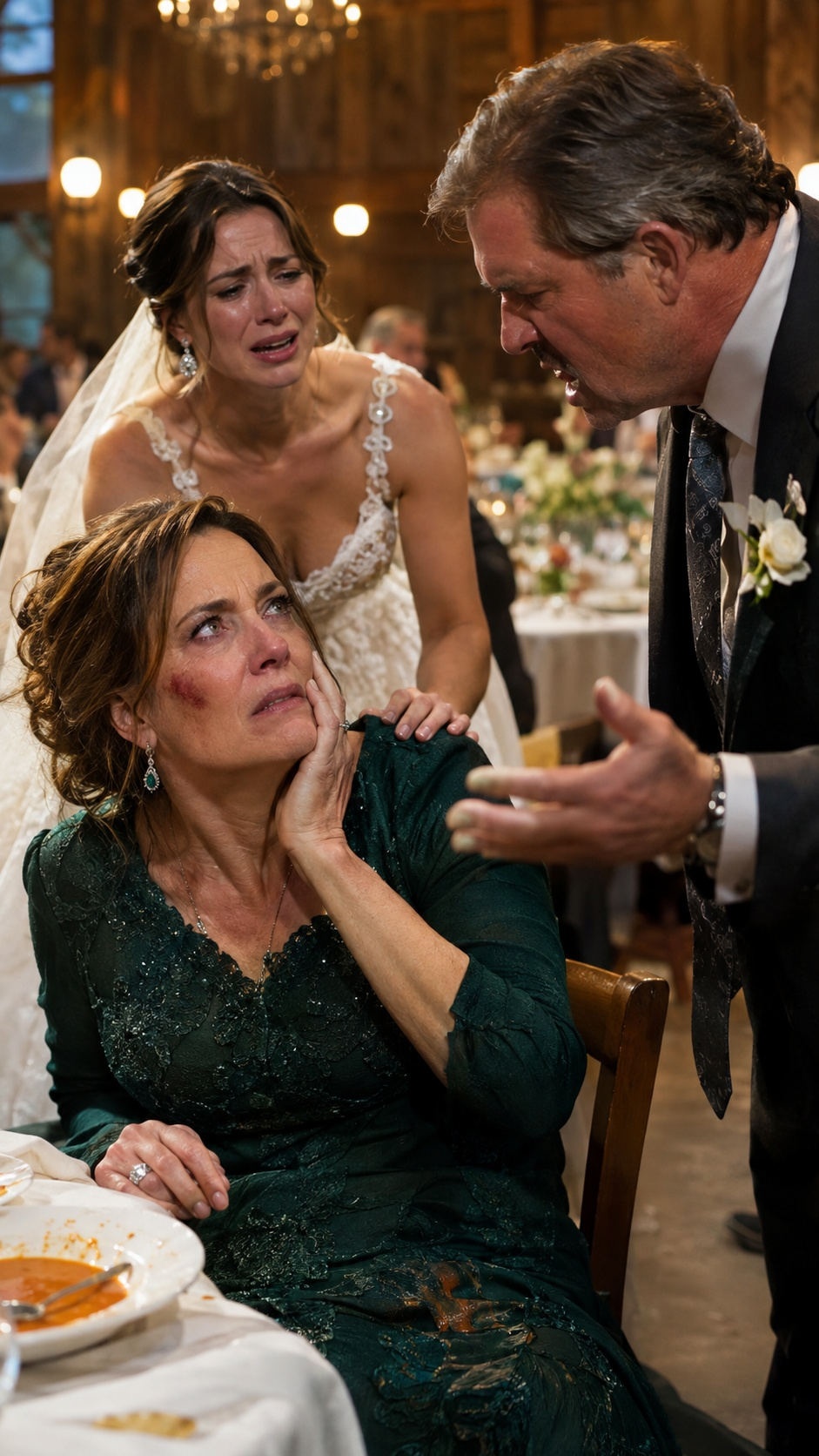
"Gabriel, please! Sit down!"
I reached for my husband's sleeve as he raised his whiskey glass above the wedding table.
Gabriel Cain, one of the wealthiest property developers in our part of Texas, looked down at the white napkin in my hand.
Three small orange fingerprints marked its edge.
They were mine.
And suddenly, I understood that the pumpkin soup spilled across my dress had never been an accident.
My husband's hand struck my face before I could move.
The sound cracked through the reception hall.
For one terrible second, I heard nothing else.
Not the music.
Not the laughter.
Not the voices of the two hundred people who had gathered to celebrate our daughter's marriage.
Only the ringing in my ears.
I was sixty-two years old, and my husband had just slapped me in front of everyone we knew.
My name is Grace Anne Cain.
Until that October evening, I believed there were certain humiliations a marriage could survive.
I was wrong.
My cheek burned as though someone had pressed a hot iron against it. My right hand rose instinctively to my face, and I felt the wetness gathering in my eyes.
Across the table, a woman wearing a silver evening gown covered her mouth.
Someone whispered my name.
A fork struck a plate.
Then silence settled over the barn.
It was the kind of silence that made every breath feel like an interruption.
Gabriel stood over me in his expensive charcoal-gray suit, his face flushed with whiskey and anger.
He was sixty-eight, broad-shouldered, and still carried himself like a man who expected doors to open before he reached them.
His silver-streaked hair was combed neatly backward. A white rose boutonniere rested against his lapel.
He looked like a distinguished father of the bride.
Except for the hatred in his eyes.
"Don't you ever embarrass me again," he said.
His voice was low enough that only the nearest tables could hear.
I stared at him.
"Gabriel..."
He leaned closer.
I smelled whiskey on his breath.
"You are furniture, Grace. You sit where you're put until someone has a use for you."
A strange thought crossed my mind.
My father had spent forty years building furniture.
Beautiful furniture.
Tables, chairs, cabinets, and beds made from walnut, oak, cherry, and maple.
He had taught me that a good piece of furniture deserved respect because somebody had put their heart into making it.
Gabriel had managed to turn the very thing my father loved into an insult.
I looked down at my dress.
Midnight-blue velvet.
Silver embroidery along the sleeves.
A gown I had saved for months to purchase because I wanted to look beautiful at my only daughter's wedding.
Now a dark orange stain spread across my lap.
The pumpkin soup had been hot enough to burn through the fabric.
Earlier, Gabriel had knocked the bowl toward me with his elbow.
I had gasped as the liquid soaked my dress.
He had laughed.
"Grace, for God's sake. Can't you do anything without making a mess?"
His business partner, Richard Bellamy, had chuckled beside him.
I remembered the sound clearly.
A short, satisfied laugh.
I had apologized.
Imagine that.
I had apologized for being burned.
Now, sitting beneath the warm chandeliers of the historic Texas barn, I understood that the soup had been only the beginning.
Gabriel wanted me humiliated.
He wanted everyone to see it.
And he wanted me to accept it.
"Mom?"
I turned.
My daughter Nora was coming toward us.
She was twenty-nine, with long copper-red hair arranged beneath a delicate bridal veil. Her champagne-colored wedding gown moved around her like something from a magazine.
She looked beautiful.
For one brief, foolish moment, I felt relief.
My little girl was coming.
The same little girl who had once climbed into my lap during thunderstorms.
The same girl who had cried when her first bicycle broke and begged me to fix it.
The same girl whose wedding dress I had helped choose.
Surely she had seen what happened.
Surely she would say something.
"Nora," I whispered.
She reached me.
Her hands closed around my shoulders.
I waited for her to turn toward Gabriel.
Instead, she looked directly at me.
Her face was tight with anger.
"Mom! Look what you're doing!"
I blinked.
"What?"
"Everyone is staring!"
I looked past her.
She was right.
The guests were watching.
Some looked horrified.
Others stared down at their plates.
Gabriel's business partner suddenly became very interested in his wineglass.
"Nora," I said softly, "your father just—"
"Just stop!"
Her voice cut through mine.
I felt her fingers tighten on my shoulders.
"This is my wedding!"
I couldn't understand what I was hearing.
"I know, sweetheart."
"Then why can't you just let me have one perfect day?"
My heart seemed to stop.
I looked at Gabriel.
He was watching us with a small, satisfied expression.
I turned back to my daughter.
"Nora, I didn't do anything."
She shook her head.
"Please don't start."
The room seemed to tilt.
My cheek throbbed.
The soup was cooling against my skin.
I could feel two hundred pairs of eyes waiting to see what I would do next.
Nora leaned closer.
"Mom. Just go."
Three words.
They hurt worse than the slap.
I searched her face for some sign that she didn't mean them.
There was none.
"You're asking me to leave?"
Her eyes filled with frustrated tears.
"Yes. Please. Before you make this worse."
I looked at the young man standing several feet behind her.
My new son-in-law, Ethan.
He looked pale.
His mouth opened slightly, but he said nothing.
Nobody said anything.
Not the guests.
Not the wedding coordinator.
Not Richard Bellamy.
Not even the man who had just struck me.
I realized then that silence could be a kind of agreement.
Slowly, I placed my napkin on the table.
My hands were trembling.
I didn't want anyone to see.
So I folded them together.
"All right," I said.
Nora looked surprised.
Perhaps she expected an argument.
Perhaps she expected tears.
Perhaps she expected me to beg.
But something inside me had gone very still.
I pushed my chair backward.
The wooden legs scraped against the floor.
Gabriel stepped aside.
Not to help me.
To let me pass.
As I stood, I noticed a small stain on his cuff.
Orange pumpkin soup.
I stared at it for a moment.
Then I looked into his eyes.
He smiled faintly.
That smile told me everything.
He had planned to make me look foolish.
He had succeeded.
But I knew why.
Seven days earlier, Gabriel had come into our kitchen carrying a thick folder.
He had placed it beside my morning coffee.
"Sign these," he said.
I had opened the folder.
Inside were documents from a lending company.
A loan agreement.
A personal guarantee.
And a proposed lien against eleven acres of land outside Fredericksburg.
My father's land.
The property he had left me when he died.
The land where I had grown up.
The land where his workshop still stood.
I had looked at Gabriel.
"What is this?"
"Business."
"Why is my father's property listed?"
"Because the bank wants additional security."
I remembered the way he said it.
As casually as someone asking me to pass the salt.
"Security for what?"
He sighed.
"Grace, don't make this complicated."
I turned another page.
The amount made my stomach tighten.
Two million, four hundred thousand dollars.
I looked up.
"Gabriel, your company owes this much?"
"That's not what it says."
"Then what does it say?"
"It says I need you to trust me."
I had trusted Gabriel for thirty-six years.
I had trusted him when he opened his first development office.
I had trusted him when he mortgaged our house to finance a commercial project.
I had trusted him when he insisted that I stop working in my father's workshop because a developer's wife shouldn't come home smelling of sawdust.
And I had trusted him when he told me that every marriage required sacrifices.
But the land was different.
My father had left it to me alone.
Not to Gabriel.
Not to his company.
To me.
I closed the folder.
"No."
Gabriel stared at me.
"What did you say?"
"I'm not signing."
He laughed once.
It wasn't a pleasant sound.
"Don't be ridiculous."
"I'm not risking Dad's land."
"That land is sitting there doing nothing."
"It's not doing nothing."
"Grace, it's eleven acres of weeds and an old shed."
I felt anger rise in my chest.
"That shed is where my father worked."
Gabriel slammed his palm against the counter.
"Your father is dead!"
The words had struck me harder than he knew.
I stood very still.
Gabriel lowered his voice.
"Look, sweetheart. I need this."
I shook my head.
"No."
His expression changed.
It was subtle.
The smile disappeared.
The warmth left his eyes.
"You'll regret making me ask twice."
For the next seven days, he barely spoke to me.
Then came Nora's wedding.
And the soup.
And the slap.
Now I understood.
Gabriel wasn't simply drunk.
He was punishing me.
I walked past the tables.
Nobody stopped me.
A woman I had known for twenty years looked away when our eyes met.
I passed the wedding cake.
Five white tiers decorated with sugar flowers.
I remembered helping Nora choose the flavor.
Vanilla bean with raspberry filling.
Her favorite.
I had paid the baker's deposit myself.
At the barn doors, I stopped.
Behind me, someone began speaking into a microphone.
Gabriel.
"Well," he said, forcing a laugh, "let's not let a little family drama ruin a beautiful evening."
A few people laughed nervously.
Then the music started again.
I stood with my back to the room.
My daughter had not followed me.
I pushed open the doors.
Cold October air touched my burning cheek.
Fog drifted across the gravel parking lot.
I walked toward my car, holding my stained gown away from my legs.
Halfway there, I stopped.
My hands were shaking so badly that I couldn't find my keys.
I leaned against the driver's door.
For the first time that evening, I cried.
Not loudly.
Not dramatically.
Just a few broken breaths that seemed to come from somewhere deep inside my chest.
I had spent thirty-six years trying to keep my family together.
I had made excuses for Gabriel.
I had protected Nora from arguments she was too young to understand.
I had smiled through dinners where my husband mocked my clothes, my cooking, and my education.
I had told myself that marriage was difficult.
That everyone had problems.
That things would improve.
But tonight my husband had struck me.
And my daughter had sent me away.
I looked at the wedding ring on my finger.
A simple gold band.
Gabriel had given it to me when we were young and poor.
Back then, he had held my hands and promised to build a beautiful life with me.
I wondered when he had stopped seeing me as a person.
Then I remembered my father's voice.
It came to me as clearly as if he were standing beside the car.
Gracie, never let anybody convince you that something valuable belongs to them just because they want it.
He had said those words when I was sixteen.
We had been working in his shop.
A customer had tried to convince him to sell a handmade walnut cabinet for half its price.
Dad had refused.
Afterward, he had explained that some people confused kindness with weakness.
I wiped my eyes.
The workshop.
I hadn't visited it in almost a year.
Gabriel hated when I went there.
He called it a waste of time.
But my father had left something inside that building.
Something Gabriel didn't know about.
I remembered the last conversation Dad and I had before he died.
He had been sitting at his maple workbench, his hands resting on the worn wooden surface.
"There's a drawer beneath the bench," he told me.
"I know, Dad."
"No. Not the regular drawers."
He had smiled.
"The other one."
I thought he was joking.
He had taken my hand.
"If anybody ever tries to take the land, you go there first."
At the time, I hadn't understood.
Now, standing alone outside my daughter's wedding, I finally did.
I got into my car.
I didn't drive home.
I didn't call Gabriel.
I didn't call Nora.
I drove west toward my father's property.
The roads were nearly empty.
Fog gathered along the fence lines.
By the time I reached the old workshop, the clock on my dashboard read 11:47 p.m.
The building stood behind a row of pecan trees.
Its windows were dark.
I parked beside the wooden steps.
For a moment, I sat listening to the engine tick as it cooled.
Then I took my father's old brass key from the glove compartment.
I had carried it for years.
I climbed the steps.
The lock resisted at first.
Then turned.
Inside, the familiar smell of cedar, machine oil, and old wood wrapped around me.
I found the light switch.
A single bulb illuminated the workshop.
Everything was exactly as I remembered.
The wall of hand tools.
The wooden clamps.
The unfinished rocking chair.
And in the center of the room, my father's seven-foot maple workbench.
I approached it slowly.
I ran my fingers across the surface.
Then I knelt.
Beneath the bench, behind a narrow support beam, I felt a small wooden catch.
My father had shown it to me only once.
I pressed it.
Something clicked.
A hidden drawer slid forward.
Inside lay a thick envelope wrapped in faded brown paper.
My name was written across the front.
GRACE ANNE.
In my father's handwriting.
My throat tightened.
I carefully lifted the envelope.
Beneath it was a smaller folded sheet.
I opened the sheet first.
There were only six words.
He will come looking for this.
I stared at the message.
Then I heard a car engine outside.
Headlights swept across the workshop windows.
A vehicle stopped beside my car.
Someone had followed me.
And then the workshop door handle began to turn.






Comments 0