For forty-five years, I had believed my first child was dead.
Now a man stood in front of me, holding a photograph of a newborn baby, and called me Mom.
Behind him stood Gabriel Cain.
My husband was smiling.
Not the nervous smile he had worn in court that morning. Not the charming smile he had used to impress bankers and business partners.
This was the smile of a man who believed he still possessed the one thing that could make me surrender.
My son.
I stared at the stranger.
He had dark hair, broad shoulders, and gray-blue eyes so much like my father's that looking at him hurt.
"What's your name?" I whispered.
The man swallowed.
"Matthew."
I felt my knees weaken.
"Matthew what?"
"Matthew Warren."
Behind him, Gabriel gave a quiet laugh.
"Now, Grace. Don't get emotional."
I turned toward my husband.
For thirty-six years of marriage, he had decided when I was allowed to cry, when I was allowed to speak, and when I was expected to smile.
He was not going to decide what I felt about my child.
"Get away from him."
Gabriel's smile faded.
"Excuse me?"
"Move away from my son."
The room went silent.
Matthew looked at me.
His eyes filled.
Then he stepped forward.
Gabriel reached for his arm.
"Matthew, wait."
Matthew pulled away.
"Don't touch me."
I heard something in his voice that made me understand he had come here knowing exactly what Gabriel was.
Rebecca Sloan moved between Gabriel and the rest of us.
"Mr. Cain, this is a private conference room. You need to leave."
Gabriel adjusted his cuffs.
"I have a right to be here. This concerns my family."
Matthew turned toward him.
"You lost the right to call yourself my family when I found out what you did."
Gabriel's expression hardened.
"You don't know the whole story."
Matthew lifted the photograph.
"I know enough."
Then he looked at me.
"Mrs. Cain, I'm sorry. I didn't mean to frighten you."
I shook my head.
"Please don't call me Mrs. Cain."
He hesitated.
"What should I call you?"
I looked at his face.
At the familiar eyes.
At the small crease beside his mouth.
And I whispered, "Grace is fine. For now."
He nodded.
I reached for the back of a chair.
"How do you know?"
Matthew understood the question.
"That you're my mother?"
I nodded.
He opened a leather folder.
"Medical records. Adoption documents. A court order from forty-five years ago. And a DNA test."
I stared at him.
"A DNA test?"
He nodded.
"I found biological relatives through a genealogy service. One of them was connected to your father's family. I had the records reviewed by an independent genealogist."
Rebecca stepped closer.
"Have you brought the supporting documentation?"
"Yes."
He handed her the folder.
She examined the papers.
I watched her expression change.
Then she looked at me.
"Grace, these records appear consistent with what Matthew is telling us. We'll arrange independent confirmation, but there is substantial reason to believe he's your son."
My eyes filled.
I looked at Matthew.
"How long have you known?"
"Almost six months."
"Six months?"
He nodded.
"I tried to contact you through your business."
My heart tightened.
"My workshop?"
"Yes. I sent two letters."
I remembered Hannah telling me about an unfamiliar man who had written asking whether I was related to Thomas Anne.
At the time, I had assumed it was another person interested in the old property dispute.
I had asked her to forward the letters to Rebecca.
Rebecca looked up.
"They were among the correspondence we flagged for review. We couldn't verify his identity then."
Matthew nodded.
"I understand."
I stared at him.
"Why didn't you come sooner?"
His face changed.
"Because Gabriel found me first."
I slowly turned toward my husband.
He stood beside the doorway, his jaw tight.
"What did you tell him?" I asked.
Gabriel shrugged.
"The truth."
Matthew shook his head.
"No. You told me my mother abandoned me."
The words struck harder than a slap.
I stared at Gabriel.
He looked away.
Matthew continued.
"You told me she was unstable. You said she signed papers giving me up and never wanted to see me again."
My throat closed.
"No."
Matthew looked at me.
"I know."
"No," I repeated. "I never gave you away."
His eyes filled.
"I know that now."
I covered my mouth.
Forty-five years.
Forty-five years of birthdays I had missed.
School mornings.
Christmases.
Graduations.
First heartbreaks.
Every ordinary moment a mother should have had the chance to share.
Gabriel had taken them.
And for most of those years, I hadn't even known what was missing.
I looked at him.
"Why?"
He stared at me.
"Grace—"
"Why?"
My voice rose.
"Why did you take my baby?"
For the first time since entering the room, Gabriel had no immediate answer.
Then he said, "You were young. You were injured. The doctors weren't sure you would recover."
I stared at him.
"So you gave away our child?"
He looked irritated.
"I made a difficult decision."
"No."
I stepped toward him.
"You made a cruel decision."
His eyes narrowed.
"You have no idea what I was dealing with."
Matthew spoke quietly.
"I was a baby."
Gabriel turned.
"Matthew—"
"I was a baby," he repeated. "You didn't have a problem to solve. You had a child."
The room went still.
Gabriel looked toward the door.
I recognized that movement.
He was calculating.
Looking for the person he could intimidate.
The argument he could change.
The exit he could use.
But Rebecca was already speaking into her phone, requesting courthouse security and notifying the investigators handling the document fraud.
Gabriel heard her.
His face hardened.
"This is a private family matter."
Rebecca looked directly at him.
"That is not a defense to falsifying records."
Gabriel was escorted from the conference room several minutes later.
He wasn't arrested that afternoon. Investigators still had to establish what had happened forty-five years earlier and whether the surviving records supported criminal charges.
But he left without controlling the conversation.
Without taking Matthew.
Without making me apologize.
I sat across from my son.
For several minutes, neither of us spoke.
Then I asked the question that had been breaking my heart since he entered.
"Did you have a good childhood?"
Matthew looked surprised.
"Yes."
I closed my eyes.
Relief washed through me so suddenly that I began crying.
He leaned forward.
"Grace?"
I shook my head.
"I'm sorry."
"Don't apologize."
I laughed through my tears.
"I just needed to know."
He nodded.
"My adoptive parents were good people. My father was a schoolteacher. My mother was a nurse."
I smiled weakly.
"Are they still alive?"
"My mother is. Dad passed away five years ago."
"I'm sorry."
"Thank you."
He looked at the photograph in his hands.
"They told me I was adopted when I was eight. They said my birth mother had been very young and that the circumstances were complicated."
I swallowed.
"They didn't know?"
He shook his head.
"They believed the adoption was lawful. My mother was devastated when I showed her what I'd found."
I reached across the table.
"Please tell her I don't blame her."
Matthew looked at my hand.
Then took it.
His fingers were warm.
Real.
My son was real.
"She wants to meet you," he whispered.
I began crying again.
"Then I'd like that."
For the first time, Matthew smiled.
And I saw my father's smile.
Not exactly.
But enough.
Enough to make forty-five years collapse into a single breath.
Over the following months, the truth emerged slowly.
Not in one dramatic confession.
Not in one courtroom speech.
It came through hospital archives, adoption records, old correspondence, financial documents, and the testimony of people who had spent decades protecting themselves.
The accident when I was twenty-four had left me badly injured and heavily medicated.
I had delivered a living baby boy.
Gabriel had arranged for Celeste Warren, then working through an adoption intermediary, to place Matthew with another family.
The documents contained a purported consent bearing my signature.
A forensic examiner concluded that the signature had been copied from an unrelated medical authorization.
I had never knowingly consented to the adoption.
Gabriel had told me the baby died.
He had told the adoptive family that I voluntarily surrendered him.
And he had told Matthew, decades later, that I never wanted him.
Three lies.
One stolen childhood.
Celeste eventually admitted that Gabriel had paid her to arrange the paperwork. Her testimony, supported by financial records and surviving hospital files, established how the false consent had been created.
My father had discovered irregularities years afterward.
He had tried to locate Matthew.
But the records had been sealed under a different name, and the people involved refused to cooperate.
Gabriel threatened to ruin him if he told me.
Dad kept searching anyway.
That was why he had written letters to Margaret Whitcomb.
That was why he had preserved copies of old medical records.
And that was why his final instructions included a warning about Gabriel's ability to falsify identities.
My father had not told me everything.
That truth hurt.
He had believed he was protecting me from another devastating loss until he could prove what happened.
He had been wrong to keep it from me.
But he had never stopped trying to find my son.
I learned that from a letter Margaret had preserved.
It was written in Dad's careful handwriting.
If I cannot bring him home, please make sure Grace knows he was loved before he ever took his first breath.
I read those words until the paper blurred.
Then I folded the letter and placed it beside Matthew's photograph.
The other mysteries began unraveling after Richard Bellamy agreed to cooperate with investigators.
He had survived the shooting.
His injuries required months of recovery, but he eventually gave a detailed statement.
Richard admitted that he had helped Gabriel prepare fraudulent property transfers and conceal records connected to the old development.
He also admitted that he had participated in the scheme to have me declared dead.
But the investigation established that Richard had been keeping copies of the original documents as protection against Gabriel.
He had feared that Gabriel would eventually make him the scapegoat for everything.
He had been right.
The original will Richard brought to Charles's house was not the document Gabriel had submitted to probate court.
It was a later, properly executed instrument prepared by Margaret Whitcomb, together with supporting records from my father.
It confirmed that the eleven acres belonged to me.
It also contained provisions designed to prevent Gabriel or his companies from gaining control through my marriage.
The document bearing my genuine signature from Nora's wedding was something else entirely.
It was a family asset acknowledgment Gabriel had persuaded me to sign while I was under intense pressure.
He had later combined pages from that acknowledgment with language from Nora's estate-planning documents to create the appearance of a valid transfer.
My real signature had been attached to terms I had never approved.
The evidence recovered from Richard's files exposed the alteration.
And the judge rejected Gabriel's attempt to use those papers to claim my property.
The court also determined that the purported declaration of my death had no factual foundation.
The fraudulent filings were referred for further investigation.
Gabriel's financial scheme began collapsing.
The four-hundred-million-dollar financing commitment expired.
His lenders demanded answers.
His business partners withdrew.
And the development that had once seemed unstoppable became the subject of lawsuits, environmental investigations, and criminal proceedings.
For decades, Gabriel had believed that enough money could turn any lie into an official record.
He finally discovered that records could also preserve the truth.
Peter Lang survived.
After recovering from his injuries, he explained what had happened in 1994.
He had been the engineer responsible for inspecting the excavation near my father's eastern boundary.
During the project, workers discovered buried industrial containers and an old maintenance chamber that had not been disclosed in the development plans.
Peter ordered the work stopped.
Gabriel and Richard refused.
They were already facing financial pressure, and an environmental investigation would have delayed the project indefinitely.
Peter documented the site.
Then he threatened to report the violations.
Shortly afterward, he disappeared.
Richard helped arrange his disappearance under threats from Gabriel and Daniel Mercer. Peter lived under assumed identities for years, afraid that exposing the truth would endanger his family.
When he finally tried to come forward, Richard had him brought to the underground chamber beneath the old well.
Mercer's men kept him there while they searched for the remaining records.
The well had once connected to the maintenance passage through an old access shaft.
My father knew about the passage.
He had used it to inspect the excavation after Peter first reported the problem.
That explained the warning I remembered.
You can't leave him down there.
Dad had been arguing with Gabriel about an injured worker who had been trapped during the unauthorized excavation.
That worker had been rescued, but the incident was never properly reported.
It was the first time my father understood how far Gabriel would go to protect his investment.
Peter's identification tag had been left near the well during one of his earlier visits to the site.
The photograph showing him in my father's workshop eighteen months earlier was genuine.
Peter had secretly met Richard there while attempting to recover documents that could protect his family.
The meeting had ended with another threat.
And another disappearance.
Harold Vance's story was equally complicated.
He had helped Gabriel and Richard establish the original development companies.
When he discovered the concealed excavation and fraudulent transfers, he tried to withdraw.
Gabriel arranged for records to show Harold had died in a construction accident.
The death certificate was false.
A different worker, whose death had been improperly documented, had been buried under Harold's name.
The worker's family was eventually identified and notified.
His remains were reexamined, and his true identity was restored.
Harold had lived for decades under the name Samuel Price.
He had returned to help me because he knew my father had left evidence.
But he had also betrayed Dad by revealing where some of the documents were hidden.
He admitted that betrayal under oath.
His cooperation did not erase his responsibility.
Neither did his fear.
The courts determined what penalties were appropriate for his part in the old fraud.
I never became close to Harold.
But I accepted that telling the truth, even late, was better than carrying another lie to the grave.
Daniel Mercer was arrested after investigators connected him to Evelyn's kidnapping, the threats against my employees, Peter's unlawful confinement, and the attack on Richard Bellamy.
The surveillance footage from Charles's house helped identify the vehicle used by the attacker.
Phone records and financial transfers connected Mercer to the operation.
The emergency excavation invoice from November 1994 became part of a much larger body of evidence.
The old room marked 214 was examined by investigators.
So was the steel door beneath the well.
The number had originally identified an industrial access section in the development's engineering plans.
My father's brass key opened one of the old maintenance locks.
He had kept it because he knew the chamber might someday need to be inspected.
He had hidden it beneath his workbench when Gabriel began searching for the records.
And he had left instructions ensuring that I would find it if Gabriel ever tried to take the land.
The environmental investigation uncovered buried materials that required containment and remediation.
The work was expensive.
The liability was enormous.
And the responsibility did not fall on me simply because the contamination lay near my property.
The companies and individuals involved in the unauthorized disposal were pursued through the appropriate legal processes.
The eastern boundary remained protected.
The proposed access road was abandoned.
And the eleven acres my father had fought to preserve were finally secure.
Ethan Walker's role was harder for Nora to accept.
He admitted that he had signed a false statement claiming to have identified my body.
He had been paid by Gabriel's company and had helped arrange paperwork connected to the supposed burial.
The grave itself had been part of an elaborate deception.
It contained remains falsely associated with my identity in records prepared by Gabriel's associates.
Forensic examination established that the remains were not mine, and investigators worked to identify the deceased person and restore the correct records.
Ethan had never seen my body.
He had signed the declaration because Gabriel promised him money and continued employment.
Nora learned the full truth during his testimony.
I sat beside her in court.
She cried quietly.
I held her hand.
Afterward, she asked me a question I recognized.
"How could I have loved someone like that?"
I looked at her.
"Because you believed what he wanted you to believe."
She wiped her cheeks.
"That sounds like an excuse."
"It can be," I said. "If you use it to avoid taking responsibility."
She looked at me.
"And if I don't?"
"Then it becomes something you learn from."
Nora nodded.
She cooperated with investigators and corrected the false statements she had signed.
She accepted that her actions had consequences.
She didn't ask me to pretend the past hadn't happened.
And I didn't.
But slowly, carefully, we began building something honest.
A relationship without Gabriel standing between us.
Gabriel's criminal trial began the following year.
By then, investigators had assembled evidence of forgery, financial fraud, witness intimidation, and his involvement in the schemes surrounding the old development.
Separate proceedings addressed the adoption records and the crimes committed against Matthew and me.
Not every accusation resulted in a conviction.
Some events were too old to prosecute.
Some records had been destroyed.
Some witnesses had died.
But the central fraud was established.
Gabriel was convicted on multiple charges arising from the forged documents, fraudulent filings, and conspiracy involving the property scheme.
He received a substantial prison sentence.
His companies lost the disputed financing.
His remaining assets became entangled in judgments, restitution orders, and civil claims.
The man who had once controlled entire rooms with a raised eyebrow could no longer make people obey him.
I attended the sentencing.
Not because I wanted to watch him suffer.
Because I wanted to hear the truth spoken aloud.
When the judge asked whether I wished to make a statement, I stood.
Gabriel looked at me.
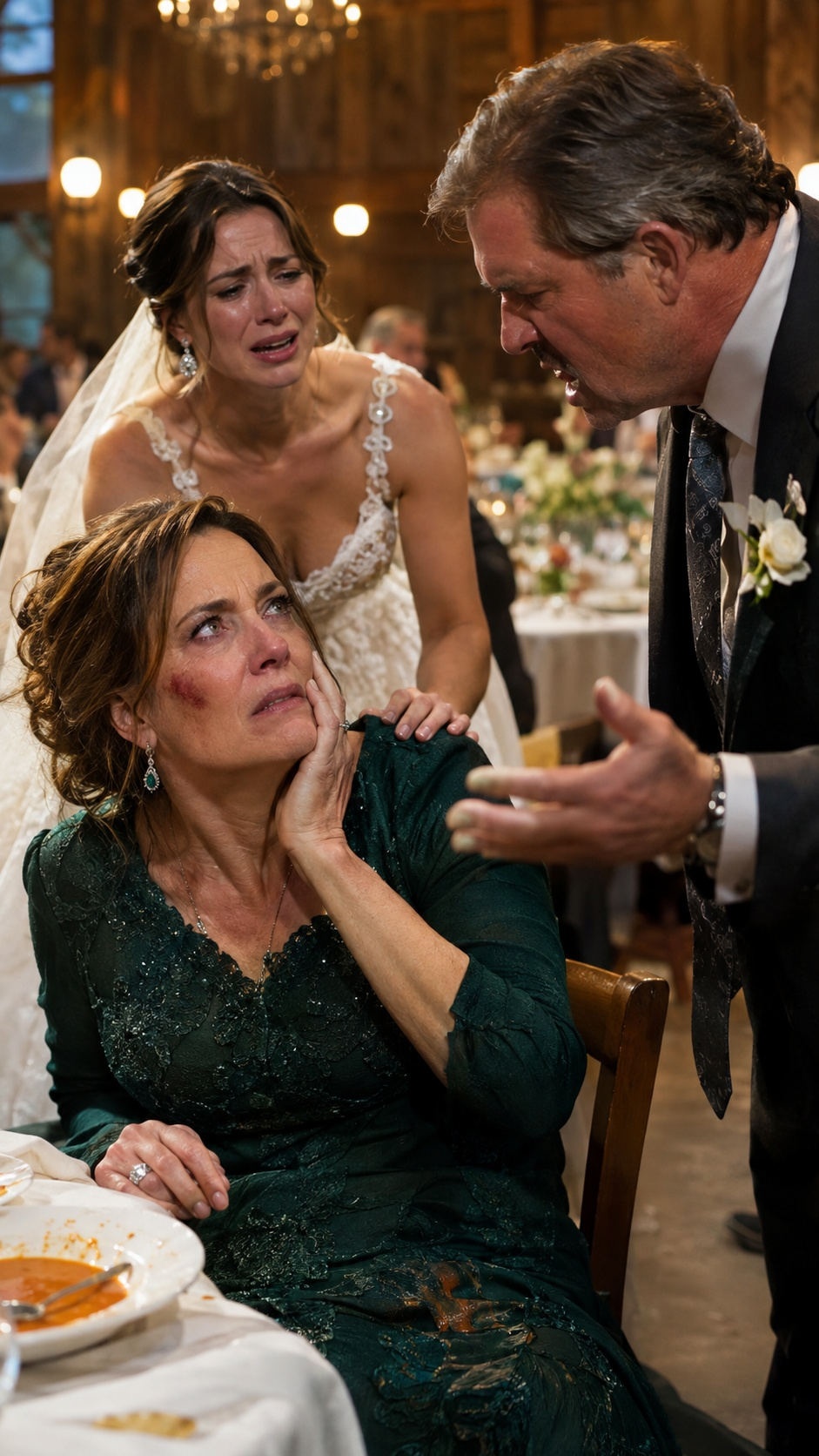
For a moment, I remembered the wedding.
The chandelier.
The flowers.
The two hundred silent guests.
The sound of his hand striking my face.
I took a breath.
"For thirty-six years," I said, "I believed my value depended on whether my husband was pleased with me."
The courtroom was silent.
"I believed that keeping my family together meant keeping quiet."
I looked at Gabriel.
"But silence didn't protect my family. It protected the person hurting us."
His face tightened.
I continued.
"You took my dignity. You tried to take my inheritance. You tried to erase my existence."
My voice trembled.
"And you took forty-five years of my son's life from me."
Matthew sat behind Rebecca.
Nora sat beside him.
Evelyn held his hand.
I looked at them.
Then back at Gabriel.
"But you didn't take everything."
I paused.
"You didn't take my ability to begin again."
Gabriel looked away.
I finished quietly.
"I don't need you to admit that I matter anymore."
Then I sat down.
And for the first time in my life, I didn't care whether Gabriel approved of what I had said.
My divorce was finalized after the criminal proceedings.
I signed the papers in Rebecca's office.
There was no shouting.
No threat.
No dramatic confrontation.
Just a pen.
A signature.
And a legal document confirming what had already been true for years.
I was free.
I kept the name Grace Anne for my furniture business.
It was the name I had built with my own hands.
The name customers knew.
The name stamped beneath every piece of furniture that left my workshop.
I no longer needed Gabriel's surname to explain who I was.
And I no longer needed to erase every part of my past to move forward.
Two years after the courthouse hearing, I stood on my father's eleven acres beneath a clear Texas sky.
The land looked different.
The old well had been secured.
The contaminated areas had been remediated under independent oversight.
The eastern pasture was beginning to recover.
Wildflowers had returned along the fence line.
And the workshop had been restored.
I had kept the old maple workbench exactly where Dad left it.
The brass ruler was back in place.
Not because it needed to hide anything anymore.
Because it belonged there.
Beside the workshop, we had built a small teaching studio.
I called it the Thomas Anne Woodworking Center.
Twice a week, students came to learn how to use hand tools, repair furniture, and make something that would last.
Some were teenagers.
Some were retirees.
Some were women starting over after difficult marriages.
I never asked them to explain why they had come.
I simply handed them a piece of wood and showed them how to begin.
That afternoon, Matthew stood beside me carrying a walnut board.
He had become a regular visitor.
At first, our conversations had been careful.
We talked about ordinary things.
His work.
His children.
His favorite books.
The family who raised him.
I learned that he loved strong coffee, hated thunderstorms, and could never remember where he left his glasses.
He learned that I sang badly while sanding furniture and refused to throw away useful scraps of wood.
We didn't try to recover forty-five years in a single afternoon.
We built a relationship one visit at a time.
Eventually, he began calling me Mom without hesitation.
The first time it happened naturally, I went into the workshop and cried for ten minutes.
Then I washed my face and returned to the table.
Matthew never mentioned it.
But he hugged me a little longer that day.
Now he stood beside me examining a walnut board.
"Mom, is this straight enough?"
I looked at it.
Then at him.
"Measure it."
He laughed.
"You always say that."
I smiled.
"So did your grandfather."
Matthew looked toward the workbench.
"I wish I'd known him."
I touched the edge of the wood.
"He would have loved you."
Matthew smiled.
Then he picked up the measuring tape.
"All right. Twice?"
"Always."
We laughed.
Outside, I heard a car approaching.
Nora had arrived.
She stepped out carrying a basket of food.
Behind her came Evelyn, moving more slowly these days but still determined to supervise everyone.
Charles Whitmore followed with a bottle of sparkling cider.
And Matthew's adoptive mother, Margaret Warren, climbed carefully from the passenger seat.
I went to meet her.
She smiled.
"Grace."
"Margaret."
We embraced.
The first time we met, we had both cried.
She had apologized for raising a child I had never knowingly surrendered.
I had told her there was nothing to apologize for.
She had given Matthew love.
A home.
A childhood.
The very things I had wanted him to have.
There was no competition between us.
We were two mothers who loved the same son.
And Matthew had room in his life for both of us.
That evening, we gathered around a long walnut dining table inside the restored workshop.
It wasn't the fourteen-foot table I had made for Charles.
That one still stood in his Dallas home.
This table was smaller.
Ten feet.
Built from walnut harvested years earlier from a fallen tree on my father's property.
I had made it with Matthew.
Nora had helped sand the edges.
Evelyn had insisted on choosing the chairs.
And Charles had paid for the lights, despite my repeated objections.
"You can argue with me all you like," he had said. "I'm still buying the lights."
Now the room glowed warmly.
Dinner filled the table.
Roasted chicken.
Potatoes.
Fresh bread.
Salad.
A pie Nora had baked herself.
We sat together while the evening light faded beyond the windows.
Matthew's two children chased each other around the workshop until he reminded them that sharp tools were not toys.
Nora laughed.
Evelyn complained that nobody had made enough coffee.
Charles raised his glass.
"To Grace."
I shook my head.
"Oh, please."
He smiled.
"To the woman who built a fourteen-foot table and somehow managed to bring down a four-hundred-million-dollar fraud."
Everyone laughed.
I felt my cheeks warm.
Charles continued.
"And to Thomas Anne, who understood that the most valuable thing you can leave your children isn't money."
He looked toward the old workbench.
"It's the knowledge that they can stand on their own."
I raised my glass.
"To Dad."
"To Thomas," everyone repeated.
For a moment, I imagined him standing in the doorway.
His sleeves rolled up.
His hands covered in sawdust.
Smiling at the sight of his workshop filled with people.
I knew he would have liked that.
Later, after dinner, Nora found me standing outside beneath the oak trees.
The sky was turning purple.
Crickets sang in the grass.
She came to stand beside me.
"Mom?"
I looked at her.
"Yes?"
"Are you happy?"
I considered the question.
Not because I didn't know the answer.
Because I wanted to give her an honest one.
"I am."
She smiled.
"Really?"
I nodded.
"Really."
She looked toward the workshop.
Matthew was helping his children clean up.
Evelyn was arguing with Charles about whether the pie needed more cinnamon.
Margaret was laughing.
Nora watched them for a moment.
Then whispered, "I never thought we'd have this."
I looked at her.
"Neither did I."
She swallowed.
"I'm still sorry about the wedding."
I took her hand.
"I know."
"I wish I could go back."
I shook my head.
"We can't."
Her eyes filled.
"But I can tell you something."
She looked at me.
"What?"
"The day your father slapped me, I thought I'd lost my daughter forever."
She began crying.
I squeezed her hand.
"But you're here."
She nodded.
"And I'm here."
She smiled through her tears.
"And tomorrow?"
I looked toward the workshop.
"Tomorrow, we keep showing up."
She embraced me.
I held her tightly.
Not because everything had been forgotten.
Not because the past no longer mattered.
But because we had stopped allowing it to decide our future.
Before bed, I walked alone into my father's workshop.
The lights were dim.
The tools hung neatly along the wall.
The old maple workbench stood beneath the window.
I approached it and rested my hands on the surface.
The wood was smooth in places.
Scarred in others.
Just like me.
I reached beneath my blouse and removed the brass key from its chain.
Number 214.
For years, I had worn it because I was afraid of losing the last clue my father left me.
Now the mystery was solved.
The documents had been found.
The land was safe.
The truth had been established.
I no longer needed to carry the key everywhere.
I opened the small drawer beneath the workbench.
Inside was a wooden box with a carved rose on its lid.
The same box that had appeared in Richard's photographs.
Investigators had recovered it with the other documents, and it had eventually been returned to me.
I opened it.
Inside were three things.
My father's photograph.
A letter in his handwriting.
And a small silver bracelet.
Matthew's hospital bracelet.
The one Dad had spent years trying to trace.
I placed the brass key beside it.
Then unfolded the letter.
I had read it many times.
But tonight, I read it again.
My dearest Gracie,
If you are reading this, then I have not been able to protect you from everything I feared.
I'm sorry for the truths I couldn't bring myself to tell you before I could prove them.
I wanted to give you a safe home, but I know now that safety cannot be built from silence.
The land is yours. Not because it is valuable, but because it is a place where you can choose your own life.
Whatever happens, never believe that you are too old, too frightened, or too brokenhearted to begin again.
You have always been stronger than you know.
Love, Dad.
I folded the letter carefully.
For a moment, I stood in the quiet workshop and let myself miss him.
Then I smiled.
Because he had been right about one thing.
The land was not valuable because of what Gabriel could build on it.
It was valuable because of what I could build there.
A workshop.
A school.
A family.
A life.
I closed the box.
Turned off the light.
And stepped outside.
The house was warm.
My family was waiting.
I could hear Matthew laughing.
Nora calling for me.
Evelyn insisting that somebody had stolen her favorite chair.
I walked toward their voices.
Seven years earlier, I had left a wedding reception with a bruised face and a broken heart.
I had believed my life was over.
Now, at seventy-one, I had a son I thought I had lost, a daughter I was learning to trust again, friends who had stood beside me, and a home built on land my father had loved.
I had not recovered every stolen year.
No one could give those back.
But the years ahead belonged to me.
At the doorway, Matthew turned.
"Mom, are you coming?"
I looked at him.
At Nora.
At the people gathered around the table.
And I smiled.
"Yes," I said.
"I'm home."






Comments 0