The date on the notice was tomorrow.
I read it again.
Then I read it a third time, hoping I had misunderstood the words.
NOTICE OF MINERAL SURVEY AND FORCED REMOVAL.
Beneath the official heading was the name of Lafayette T. Foxwell.
My brother.
The man who had watched me walk away from the only home I had ever known.
I looked at the stranger standing outside my cave.
"Who gave you this?"
He shifted his weight.
"Mr. Foxwell's representative."
"Which representative?"
"I wasn't given a name."
"Where is Lafayette?"
"Back at his property, I suppose."
I stared at the document.
The paper carried an official seal, a date, and several lines of legal language. It appeared genuine, but something about the timing bothered me.
I had only been living in the cave for a short time.
Nobody had informed me of any survey.
Nobody had asked whether I occupied the land.
And now someone was telling me that I had less than a day to leave.
"Does this order come from the territorial authorities?" I asked.
The man shrugged.
"That's what I was told."
"Who signed it?"
He pointed toward the bottom.
I examined the signature.
It belonged to Marshal Yoro Ridgeway.
I had heard of him.
He was responsible for maintaining order in several settlements throughout the surrounding district. People described him as a serious man who preferred paperwork to arguments.
I looked up.
"Did the marshal personally give you this?"
"No."
"Have you seen him?"
"No, ma'am."
"Then you don't know whether he authorized it."
The stranger frowned.
"I'm only delivering the paper."
"Then you've delivered it."
I folded the notice and stepped backward.
He seemed uncomfortable.
"You're expected to comply."
I looked directly at him.
"By whom?"
He did not answer.
For several seconds, neither of us moved.
Then he climbed onto his horse.
"Don't make trouble for yourself, Mrs. Foxwell."
I watched him ride down the slope.
The horse disappeared behind the rocks.
I remained at the entrance, holding the notice.
The night suddenly felt colder.
I had spent days building those walls.
I had carried every board.
I had mixed the clay.
I had searched for dry grass and hauled it back in bundles.
My hands were still covered with small cuts from the work.
And now somebody believed that a piece of paper could erase all of it.
I walked back into the cave.
The first thing I did was place the notice on the wooden table.
Then I sat down.
For a long time, I simply stared at it.
I was beginning to understand something about my brother.
He had not taken the cabin because he needed another place to live.
He had taken it because he believed he could.
And perhaps that was what frightened me most.
A man who believed he could take anything might never stop taking.
I reached for Emory's old steel trap.
Its metal edges caught the faint light from the small lantern.
I remembered the day he had brought it home.
He had been pleased with himself because he had found it at a good price.
I had told him it looked like an instrument designed by someone who disliked animals.
He had laughed.
"You have to understand what something is before you decide what it's good for."
I had not understood the trap then.
I was not sure I understood my brother now.
But I knew one thing.
I was not leaving.
Not without knowing exactly what this document meant.
I did not sleep much that night.
Every time the wind moved through the entrance, I imagined hearing footsteps.
I kept the notice folded beneath my handkerchief.
At dawn, I examined the document again.
The seal appeared to be genuine.
The date was clear.
But there was something missing.
There was no detailed description of the property boundary.
There was no survey map.
And there was no explanation of the legal authority being used to force me out.
I had no formal education in territorial law, but I knew enough to understand that a document should identify the land it concerned.
This one contained only a broad reference to the sandstone cliffs.
That seemed suspicious.
I folded it carefully.
I needed Irene.
She was the only person I knew who might understand what was happening.
I stepped outside and looked toward the valley.
The sky was pale gray.
The snow had hardened overnight.
I could see the trail clearly, but there were no fresh hoofprints.
I decided to work while I waited.
The wooden entrance wall still needed reinforcement.
I picked up the hammer Irene had brought and examined the lower frame.
One of the boards had begun to shift.
I placed a second piece of timber across it and drove two nails into the joint.
The first strike echoed through the cave.
The second followed.
I continued until the frame felt solid.
Then I collected several bundles of dry grass.
The insulation between the wooden walls was not finished, and I could not afford to waste another day.
By midmorning, my fingers were aching.
I stopped and warmed them between my palms.
That was when I heard a horse approaching.
I stepped outside.
Irene Underhill was climbing the slope.
She looked at my face before she even dismounted.
"What happened?"
I handed her the notice.
She read it silently.
Then she read it again.
Her expression hardened.
"Where did you get this?"
"A messenger came last night."
"Who?"
"He wouldn't give me a name."
"Did he say Lafayette sent him?"
"Yes."
Irene examined the official seal.
Then she looked at the signature.
"Yoro Ridgeway."
"You know him?"
"I have seen him at the county office."
"Is the document real?"
She did not answer immediately.
Instead, she turned the paper over.
She examined the back.
Then she checked the lower edge.
Finally, she looked at the date.
"Viola, this is not a final removal order."
I stared at her.
"What?"
"This appears to be a notice of an intended survey and inspection. The language is designed to frighten anyone who does not understand the process."
"But it says forced removal."
"Yes. And that is precisely why I want to see the original record."
She handed it back.
"An application for survey rights does not automatically mean Lafayette owns the land beneath this cave."
I felt my shoulders relax slightly.
"Then he cannot remove me?"
"I didn't say that. There may be claims or other rights involved. But we need to know what he has actually filed."
I looked toward the wooden walls.
"How much time do we have?"
Irene pointed at the date.
"According to this notice, the inspection is scheduled for tomorrow."
My stomach tightened.
"Tomorrow?"
She nodded.
"That means someone may arrive here to examine the land. It does not necessarily mean they can throw you out immediately."
I looked at the paper.
"Why would Lafayette do this?"
Irene gave me a long look.
"Because he knows you have found a place to live."
I frowned.
"That doesn't make sense."
"Perhaps it does to him. If he believes there are valuable minerals beneath these cliffs, he may want control of the entire area."
"But I am not mining anything."
"That might not matter."
I turned toward the entrance.
The sunlight had begun reaching the stone floor.
"I spent years repairing the cabin," I said quietly. "Now I have spent days building this place. Why can't they leave me alone?"
Irene did not offer an easy answer.
Instead, she walked toward the wooden frame.
"Show me what you have done."
I almost laughed.
"Now?"
"Especially now."
She examined the lower supports and pressed her hand against the first wall.
"Good. This is stronger than yesterday."
I looked at her.
"You aren't worried?"
"Of course I am."
"Then why are you looking at my wall?"
"Because worrying will not hold it together."
She picked up the hammer.
"Come on. We have work to do."
We spent the next several hours reinforcing the entrance.
Irene showed me how to position the longer boards across the frame, creating additional support.
I used the hand saw to shorten several pieces.
The work was difficult, but having someone beside me made it easier.
For the first time since leaving the homestead, I did not feel as though every problem rested entirely on my shoulders.
At midday, Irene opened the parcel she had brought.
There was bread, dried meat, and a small piece of cheese.
We ate sitting on two wooden blocks near the entrance.
"Have you considered going to the settlement?" she asked.
"To see the records?"
"Yes."
"I would need to leave the cave unattended."
"Only for a few hours."
"What if someone comes while I'm gone?"
"Then I can stay here."
I looked at her.
"You would do that?"
She frowned.
"Viola, I am not offering to climb this mountain every morning for the pleasure of watching you eat dried grass."
I laughed.
It was the first genuine laugh I had managed in weeks.
She smiled briefly.
Then her expression became serious again.
"There is something else you need to understand."
I waited.
"Lafayette has been asking questions about these cliffs for longer than you think."
"How long?"
"Several weeks."
"Before I came here?"
"Yes."
I looked toward the stone ceiling.
"How could he know about this place?"
"I don't think he does. But someone may have told him that the surrounding land has potential."
"Who?"
"I haven't found out."
Irene took another piece of bread.
"People in town are saying that a private investor is interested in mineral rights. They have been asking about old survey records."
I felt uneasy.
"An investor?"
"Someone with money. Someone who believes the land may be worth more than it appears."
I looked down at the notice.
"Then why does Lafayette need my shelter?"
"He may not need the shelter. He may need the land."
The distinction was small.
But it changed everything.
If the cliffs contained something valuable, my cave was no longer an unwanted hole in a mountain.
It was a place that stood directly inside a dispute.
Irene watched me carefully.
"Do you remember anything unusual when you first discovered the cave?"
I thought for a moment.
"The stone was warmer than the air outside."
"Anything else?"
"There was a faint mineral smell near the back wall."
"Did you notice any water?"
"Only a small amount of moisture in one narrow crack. The floor itself was dry."
She nodded slowly.
"Show me."
We walked toward the rear of the chamber.
I pointed toward the place where I had noticed the unusual smell.
Irene crouched and touched the sandstone.
Then she rubbed a small amount of pale dust between her fingers.
"What is it?" I asked.
"Nothing I can identify."
She examined it more closely.
"Don't assume every unusual stone means there is gold beneath your feet."
"I wasn't."
"Good. Because men have ruined lives chasing things they don't understand."
I looked at her.
"Is that what Lafayette is doing?"
"I don't know."
She stood.
"But I intend to find out."
That afternoon, Irene left for the settlement.
She promised to visit the recorder's office and ask whether the mineral application had been officially registered.
Before she departed, she gave me a small notebook.
"Write down everything."
"Everything?"
"When you found the cave. When you started living here. When you built the walls. When the messenger arrived. Every conversation you have with anyone concerning the land."
I opened the notebook.
The pages were blank.
"Why?"
"Because memories become arguments, and arguments become easier to dismiss when there is no record."
I understood.
I wrote the date on the first page.
Then I recorded the arrival of the messenger.
I wrote down the name on the notice.
I also described the document's missing details.
It felt strange to be keeping records about my own shelter.
But I had learned what could happen when someone else controlled the paperwork.
I was not going to make that mistake again.
Irene climbed onto her horse.
"I will return before sunset."
I nodded.
She looked toward the cave.
"Keep the entrance clear. And don't let anyone inside unless you know who they are."
"I won't."
Then she rode away.
I returned to the wooden wall.
The next few hours passed in a rhythm of hammering, cutting, and carrying.
I was beginning to feel that the shelter was becoming something more than a temporary hiding place.
There was a proper sleeping platform now.
The shelves were almost complete.
My food was stored in separate baskets.
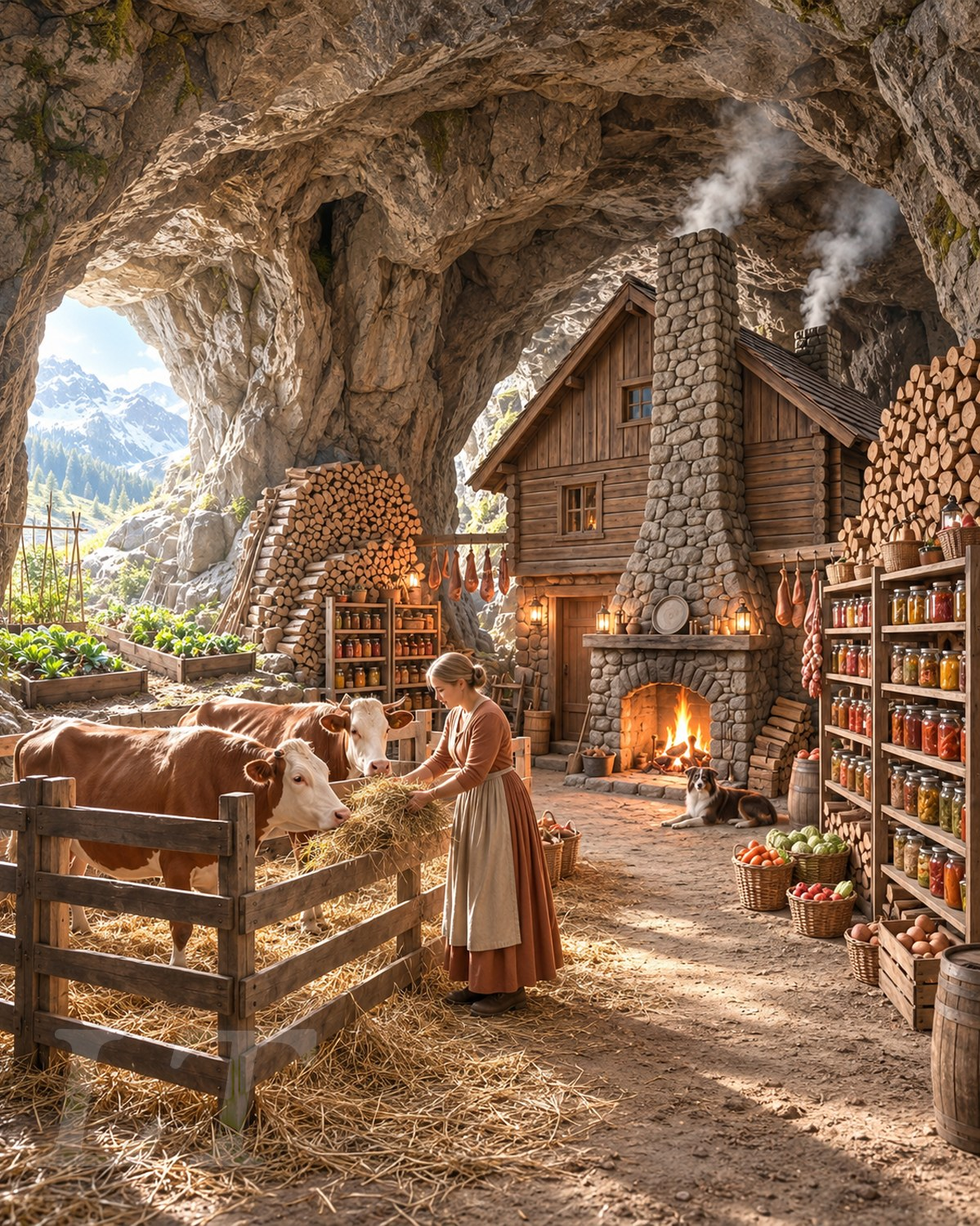
The firewood was arranged beneath a dry overhang near the entrance.
I had even found a way to keep the cooking area away from the bedding.
The only major problem remaining was the smoke.
I still needed to find a safe passage for a proper fireplace.
I examined the ceiling again.
Near the back of the cave, I noticed a narrow vertical fracture in the sandstone.
It was partially hidden behind a cluster of loose rocks.
I approached it with the lantern.
The crack was wider than I had first thought.
A faint current of air moved through it.
I held a small piece of dry grass near the opening.
The grass shifted.
I moved it closer.
It shifted again.
Air was passing through the stone.
I stared at the fracture.
Could it lead outside?
If it did, perhaps it could become part of a smoke passage.
I examined the surrounding rock carefully.
The opening was too narrow to see through.
I could not tell how deep it went.
But the movement of air was unmistakable.
For the first time, I felt that the mountain might offer me another answer.
I marked the spot with charcoal.
I would need to examine it more carefully before attempting anything.
I had no intention of digging into a ceiling I did not understand.
The last thing I needed was a collapse.
By late afternoon, the sky had darkened.
I carried another bundle of firewood inside and placed it near the entrance.
Then I checked the cows' feeding area.
There were no cows yet, of course. I had no animals of my own.
But I had already begun planning where an enclosure might eventually stand.
A place for livestock would require more room, more food, and a better entrance.
I did not know whether I would ever have the means to acquire animals.
Still, planning gave me something to look forward to.
I thought of the little homestead Emory and I had dreamed about.
He had once wanted two dairy cows.
He believed they would provide enough milk to make butter and cheese.
We had never managed to save enough money.
Now, strangely, I was imagining the possibility again.
I was not building a palace.
I was building a life.
The sun was nearly gone when I heard a horse returning.
Irene had promised to come back before sunset.
I stepped outside.
But the rider approaching the cave was not Irene.
It was a man.
He wore a dark coat and carried a leather case across his saddle.
He stopped several yards away.
"Mrs. Foxwell?"
I remained beside the wooden entrance.
"Yes."
"My name is Grover Crestwood."
I waited.
"I'm a homesteader from the western valley."
I had never met him.
"What do you want?"
He glanced at the wooden wall.
"Someone told me you were building a shelter here."
"Who?"
"A man in town."
"Which man?"
He hesitated.
"Does it matter?"
"It matters to me."
He gave a small nod.
"Fair enough."
He dismounted.
His horse looked tired, and his coat was covered with dust.
"I'm having trouble keeping my cabin warm," he said. "The roof is failing, and the wind gets through the walls. I heard you were using the stone to build a protected shelter."
I studied him.
"Who told you that?"
"People talk."
"People also lie."
He smiled faintly.
"That is true."
He opened the leather case attached to his saddle.
Inside were several folded papers.
"I brought something that may interest you."
I did not move.
"What is it?"
"An offer."
"What kind of offer?"
"Dry lumber. Good boards. Enough to finish the entrance and perhaps build an inner room."
I looked at the papers.
"What do you want in exchange?"
"A place to stay."
I stared at him.
"For how long?"
"Until I can repair my cabin."
"That could take weeks."
"Perhaps."
I shook my head.
"I cannot promise that."
Grover looked toward the cave.
"You have a large chamber. There is room."
"It is not ready for another person."
"I can help you finish it."
I studied his face.
He appeared to be in his late forties.
His hair was light brown, with gray near the temples.
He had the rough hands of a man accustomed to working outdoors.
There was nothing obviously threatening about him.
But I had learned that appearances meant very little when someone wanted something.
"Why come to me?" I asked.
He shrugged.
"Because I heard you were trying to survive the winter."
I looked at his horse.
The animal's saddle carried a heavy bundle of supplies.
He had clearly traveled some distance.
"How did you know my name?"
His eyes shifted briefly.
"I was told."
"By whom?"
He did not answer.
I felt the familiar uneasiness returning.
"Mr. Crestwood, I appreciate your offer, but I don't allow strangers to stay here."
"Then perhaps we should discuss it tomorrow."
He reached into his coat.
A folded paper appeared between his fingers.
I recognized the shape immediately.
Another document.
My stomach tightened.
"What's that?"
He looked at me.
"Something concerning the cliffs."
I held out my hand.
"Let me see it."
Grover hesitated.
For the first time, his expression changed.
He looked less like a tired homesteader and more like a man who had arrived with a purpose he had not yet explained.
"Before I give you this," he said, "there is something you should know."
I waited.
He glanced toward the valley.
Then he unfolded the paper.
I saw Lafayette's name.
But beneath it was another signature.
One I did not recognize.
And next to that signature was a date showing that the mineral application had already been transferred to a new owner.
Grover looked directly into my eyes.
"Mrs. Foxwell, I believe someone has been lying to your brother."
He placed the document in my hand.
I looked at the name of the new owner.
Then I noticed the final line.
The mineral rights had been purchased before Lafayette's removal notice was delivered.
And the man who had purchased them was standing right in front of me.
Rewrite the ending with a sharper cliffhanger Bring the chapter closer to 2,000 words






Comments 0