"Viola, I can explain why your husband never told you who I really was."
Grover stood beside the open door, holding his hat in both hands.
Nobody moved.
I looked at the brass key on the table.
Then I looked at him.
"Start talking."
He glanced toward Lafayette.
"Not in front of him."
My brother laughed.
"Don't pretend you're protecting her now, Crestwood. You've already signed the transfer."
Grover ignored him.
Instead, he reached inside his coat and removed a folded letter.
The paper was old.
The handwriting was unmistakable.
Emory's.
I recognized the first word immediately.
Viola.
My knees nearly weakened.
"Where did you get that?"
"Your husband gave it to me shortly before he died."
I took the letter.
My fingers trembled as I opened it.
If you are reading this, the western spring has probably become the center of a dispute. I hope you have found the shelter, and I hope Irene has kept her promise.
I stopped.
Grover lowered his head.
I continued.
There is something I never had the courage to explain. The man you know as Grover Crestwood is not simply a homesteader. His birth name is Grover Ashford. He is the grandson of Thomas Ashford, the original guardian of the western spring.
I looked up.
Grover nodded.
"My grandfather was Thomas Ashford."
I returned to the letter.
Thomas entrusted the spring to our families because he believed that water should serve the people living on the land. His agreement was never intended to create private wealth.
The next paragraph explained everything.
Grover's grandfather had disappeared from the valley decades earlier after refusing to sell the western water rights.
He had left behind a son, who later moved east and changed the family name.
Grover had grown up knowing very little about his grandfather.
Only after discovering an old family document had he learned about the Montana property.
He had come west to investigate.
He had found Emory.
And Emory had recognized the connection.
I looked at Grover.
"Why didn't you tell me?"
He lowered his eyes.
"Because Emory asked me to wait until the original claim was recovered."
"Did you purchase the rights?"
"Yes."
My heart tightened.
"Then Lafayette was telling the truth."
"Not entirely."
Grover placed another document on the table.
"This is the transfer I signed. But there is a second page."
Nathaniel immediately examined it.
The first page appeared to grant Grover ownership of the western mineral rights.
The second page contained the actual conditions.
Grover pointed to a paragraph.
"I agreed to purchase the rights only to prevent Silas Mercer from acquiring them. The transfer also contains a permanent restriction."
Nathaniel read it aloud.
"The purchaser accepts the property subject to the original winter refuge agreement and shall not extract minerals, divert the spring, or restrict public access to the protected water supply."
I stared at the document.
Grover continued.
"My grandfather's agreement gave his descendants the responsibility of protecting the spring. It never gave us the right to destroy it."
I looked toward Lafayette.
His expression had changed.
For the first time, he seemed unable to find an answer.
"You're telling me you bought the western rights to protect the refuge?"
Grover nodded.
"Yes."
"Then why did you hide it?"
"Because Silas had people watching the property. If he discovered my identity before the transfer was completed, he could have challenged the transaction."
I looked at the brass key.
"And the key?"
"Emory gave it to me. He said it would eventually open the original records cabinet."
Nathaniel examined the key.
"Where is the cabinet?"
Grover pointed toward the western map.
"Behind the lower spring chamber. There is a small storage room that has remained sealed since Thomas Ashford's time."
Irene stepped forward.
"Does it contain the original agreement?"
Grover nodded.
"And something else."
I looked at him.
"What?"
"The complete record of the original land transfers."
Nathaniel immediately understood.
"If those records confirm the family agreements, they could establish the legitimate ownership of the entire protected area."
"Exactly," Grover replied.
Lafayette suddenly stepped toward the table.
"Enough."
Nathaniel moved between him and the documents.
Lafayette pointed at Grover.
"You have no right to interfere with my property."
I looked at my brother.
"Your property?"
He turned toward me.
"Yes."
I placed Emory's original declaration in front of him.
"Read it."
He did not move.
"Read it, Lafayette."
His jaw tightened.
Finally, he looked down.
His eyes passed over the signatures.
My grandmother's.
My grandfather's.
Henry Underhill's.
Emory's.
Then the original conditions.
He knew what they meant.
His mineral transfer was no longer defensible.
His claim to the western spring was weaker still.
And the people he had tried to remove had a legal right to remain.
He stepped backward.
"This isn't finished."
I looked directly at him.
"Yes, Lafayette. It is."
The marshal arrived less than an hour later.
He entered with two deputies.
His expression was serious.
He looked at the documents.
Then at Lafayette.
"Mr. Foxwell, I need you to accompany me."
Lafayette laughed bitterly.
"On what grounds?"
"Forgery, fraudulent land transfer, and obstruction of the original property investigation."
Lafayette looked toward me.
"You arranged this."
I shook my head.
"No. You arranged it yourself."
He pointed at Grover.
"He has stolen the western claim."
Grover handed the marshal the signed transfer.
"The purchase was completed under the original family agreement. The restrictions are written here."
The marshal examined it.
Then he turned toward Nathaniel.
"Can you verify these documents?"
Nathaniel nodded.
"I can compare the signatures and the original survey records."
The marshal looked toward Irene.
"And you?"
"I never surrendered my claim."
She placed the forged agreement beside her genuine signature.
"I am prepared to testify."
Florentina stepped forward.
"I am prepared to testify too."
Lafayette turned toward her.
"You wouldn't."
Florentina looked at him.
For the first time, she did not lower her eyes.
"I watched you throw your own sister out of her home. I listened while you lied about Emory's death. I helped you hide documents because I was afraid of losing the life you promised me."
Her voice trembled.
"But I will not help you destroy another family."
Lafayette stared at her.
The marshal signaled to the deputies.
They approached.
My brother looked at me one last time.
"Viola, we're family."
I looked at the man who had watched me disappear into the freezing wilderness.
"Family does not leave someone to die so it can take what belongs to them."
He said nothing.
The deputies escorted him outside.
I watched until he disappeared down the trail.
I did not feel victorious.
I felt tired.
But for the first time, the truth was no longer hidden beneath the mountain.
The investigation lasted several weeks.
The original documents were examined by the territorial recorder.
Nathaniel's survey measurements matched the historical boundaries.
Grover's transfer was verified.
Irene's forged signature was exposed.
And Arthur Bell's written confession was accepted as supporting evidence, together with the physical damage found in the western passage and the marshal's testimony.
Ridgeway submitted a complete statement admitting that he had helped conceal the circumstances of Emory's death.
He resigned his position while the investigation continued.
He also agreed to testify against Lafayette and Silas Mercer.
Silas was eventually located in a nearby settlement.
He had been preparing to leave Montana when the authorities arrived.
His correspondence revealed that he had financed Lafayette's mineral scheme and arranged the fraudulent transfer documents.
The original refuge declaration was formally recognized.
The mineral agreements could not override the protected water rights.
Grover's purchase was accepted subject to the permanent restrictions.
And Irene and I were recognized as the lawful custodians of the winter refuge.
Lafayette faced legal consequences for his fraudulent dealings and his involvement in the obstruction of the western gate.
The evidence concerning Emory's death was also formally recorded.
The official account was corrected.
My husband was no longer remembered as a careless man who had wandered into a storm.
The record acknowledged that he had died while trying to protect the underground refuge.
That mattered more to me than I could explain.
For months, I had carried the feeling that the world had forgotten him.
Now his name stood beside the truth.
One morning in early spring, I returned to the old homestead.
The snow had begun to melt.
Water ran along the fence line.
The grass was slowly returning.
I stood outside the cabin for a long time.
The front door was still the same.
The wooden steps were still uneven.
The small window beside the kitchen had not changed.
I remembered the day Emory built it.
He had spent an entire afternoon adjusting the frame because he wanted the morning sunlight to fall across the kitchen table.
I opened the door.
The room smelled of old wood and ashes.
I walked toward the kitchen.
The table was still there.
The cupboard was still standing.
But the photograph of Emory and me was missing.
I looked around.
Then I noticed a small nail above the fireplace.
Something had once hung there.
Irene entered behind me.
"Looking for this?"
She held out a wooden frame.
Inside was the photograph of Emory and me.
The one Lafayette had removed.
I took it carefully.
"Where did you find it?"
"Florentina recovered it from a storage box."
I looked at the photograph.
Emory was smiling.
I was standing beside him, one hand resting on his shoulder.
We looked young.
We looked happy.
For a moment, I could almost hear his voice.
One piece at a time, Vi.
I placed the photograph above the fireplace.
Then I stood back.
It belonged there.
Florentina came to see me several days later.
She stood on the front steps holding a small suitcase.
I opened the door.
"Viola."
"Florentina."
She looked nervous.
"I wanted to speak with you."
I stepped aside.
She entered quietly.
For several minutes, she stood near the kitchen table without sitting.
Then she spoke.
"I don't expect you to forgive me."
I waited.
"I knew Lafayette was taking advantage of you. I knew you were grieving. I knew you believed the cabin was still your home."
Her eyes filled.
"And I helped him anyway."
I looked at her.
"Why?"
"Because I wanted security. I wanted a larger house. I wanted the approval of his family. I convinced myself that you would eventually find somewhere else to live."
She looked down.
"I was wrong."
I sat across from her.
"You cannot undo what happened."
"I know."
"But you can decide what kind of person you want to be now."
She nodded.
"I want to help repair the damage."
I considered her words.
Then I told her the truth.
"I am not ready to call you my friend."
She accepted that.
"But if you want to help the refuge, you may do so. The people who need shelter will not be turned away because of what happened between us."
She looked up.
"Thank you."
I shook my head.
"Don't thank me. Just do the work."
And for the first time, Florentina did not argue.
By the beginning of summer, the refuge had changed completely.
The damaged drainage gate was repaired.
Nathaniel supervised the reinforcement of the western supports.
Grover supplied lumber.
Irene organized the storage rooms.
Florentina helped prepare blankets and food supplies.
Several families from the valley volunteered their time.
The old chamber became a proper winter shelter.
We built additional sleeping platforms.
We improved the ventilation.
We created a separate room for children.
We repaired the water channel and protected the spring from contamination.
The work was difficult.
But every day, the place became stronger.
One afternoon, I found an old wooden box behind the workbench.
Inside were several small tools belonging to Emory.
His measuring rod.
His favorite hammer.
A leather pouch containing nails.
And a final letter.
I sat on the platform and opened it.
My dearest Viola,
If you have found this, then you have done something I always knew you could do.
You have survived.
I stopped reading.
My eyes filled.
I continued.
I never wanted the mountain to become a monument to me. I wanted it to become a place where people could begin again.
If the day comes when you no longer need to live here, I hope you will leave the door open for someone else.
And if you ever wonder whether our work mattered, remember that one warm room can change the course of an entire winter.
I love you, always.
Emory.
I pressed the letter against my chest.
Then I looked toward the wooden entrance.
I understood what he had wanted.
He had never been building a hiding place.
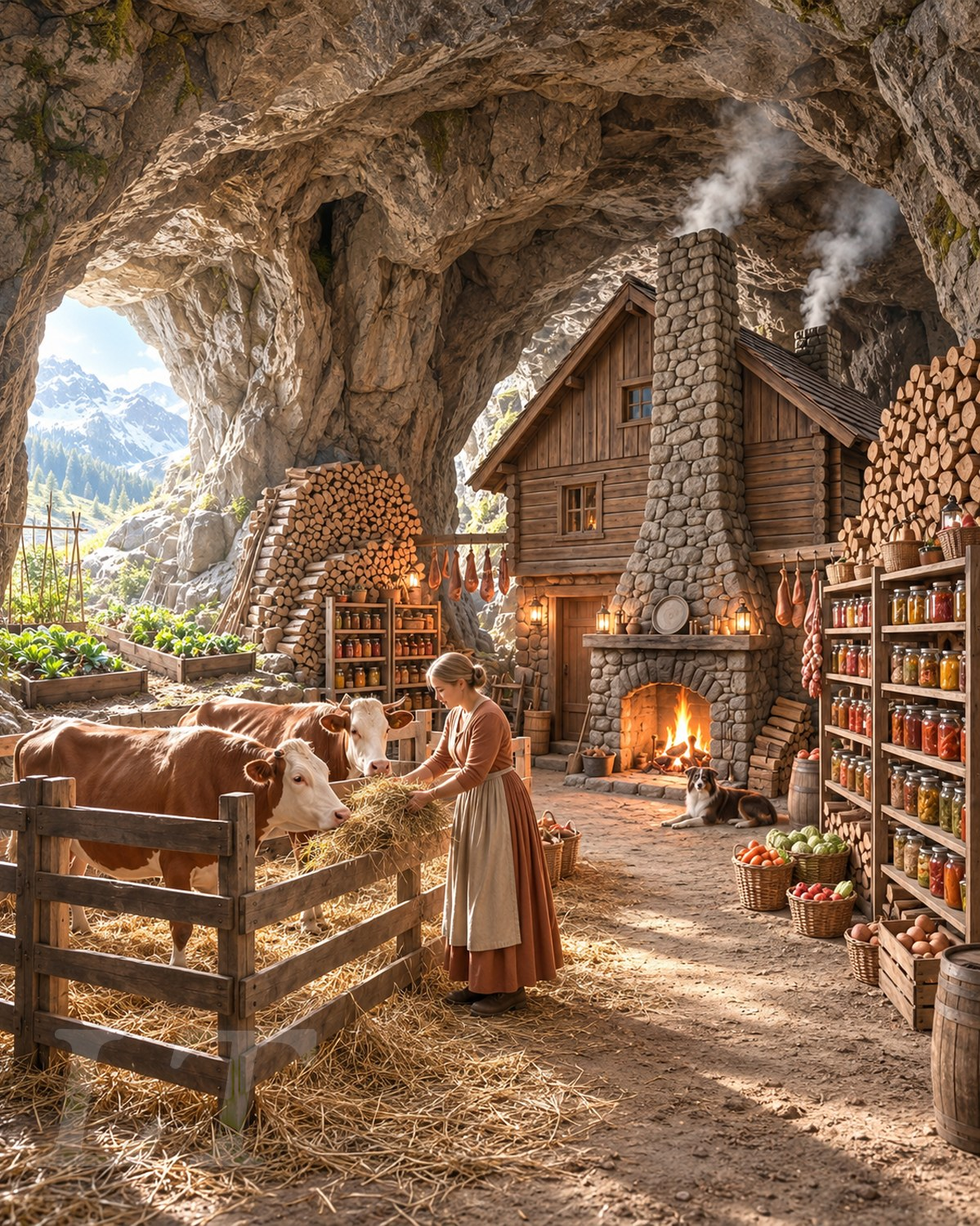
He had been building a home.
Summer passed.
Then autumn returned.
The first cold winds arrived in October.
This time, the people of the valley were prepared.
Families brought supplies.
The blacksmith repaired the stove.
Farmers stored grain.
Irene organized the food shelves.
Grover completed the final reinforcement of the western wall.
The refuge was ready.
And when the first serious snowstorm arrived, we opened the doors.
The first family to enter was a widow with two young children.
Their cabin had been damaged by the wind.
The mother stood at the entrance, embarrassed and exhausted.
"Are you certain we can stay?"
I smiled gently.
"Of course."
She looked around.
"How much will it cost?"
I shook my head.
"Nothing."
Her eyes filled.
I showed her the sleeping platform.
The children immediately ran toward the warm stove.
One of them turned around.
"Is this your house?"
I looked at the room.
Then at the people arriving behind them.
"It belongs to everyone who needs it."
The little girl smiled.
And suddenly, I understood that the refuge had finally become what Emory and my grandmother had imagined.
A place where nobody had to face winter alone.
That evening, I stood beside the entrance.
Snow fell outside.
The wind moved across the sandstone cliffs.
Inside, people were talking quietly.
Children were laughing.
A kettle was warming above the stove.
Irene came to stand beside me.
"Emory would have been proud."
I looked at the fire.
"I hope so."
She touched my shoulder.
"He would have been."
Grover entered carrying another load of firewood.
Nathaniel followed him with a box of supplies.
Florentina was helping the children arrange their blankets.
Everyone had a place.
Everyone had something to contribute.
I looked toward the wooden wall Emory had designed.
It was holding.
The stone retained its warmth.
The water continued flowing.
And the shelter stood firm against the storm.
I thought about the morning Lafayette had watched me leave the homestead.
I remembered the small cloth sack.
The eleven dollars and forty cents.
The frozen hillside.
The terrifying feeling that I had nowhere left to go.
I had believed that day marked the end of my life as I knew it.
But it had also been the beginning of something I could never have imagined.
I had lost a cabin.
I had uncovered a family betrayal.
I had learned the truth about my husband's death.
And I had found a purpose larger than the property anyone had tried to take from me.
The next morning, I walked outside alone.
The snow covered the valley in a clean white blanket.
I carried Emory's old handkerchief in my pocket.
At the edge of the cliff, I looked toward the distant homestead.
The cabin was no longer mine.
But I no longer needed it to be.
My home was here.
In the mountain.
In the warm rooms.
In the people who had found safety behind the wooden walls.
I took the handkerchief out and held it for a moment.
"One piece at a time, Emory," I whispered.
Then I returned inside.
The fire was burning.
The children were awake.
And the door remained open.
For the first time in many years, I no longer feared the winter.
Because the mountain had given me something no one could steal.
A home built on truth.
A family built on kindness.
And a future that belonged to me.






Comments 0