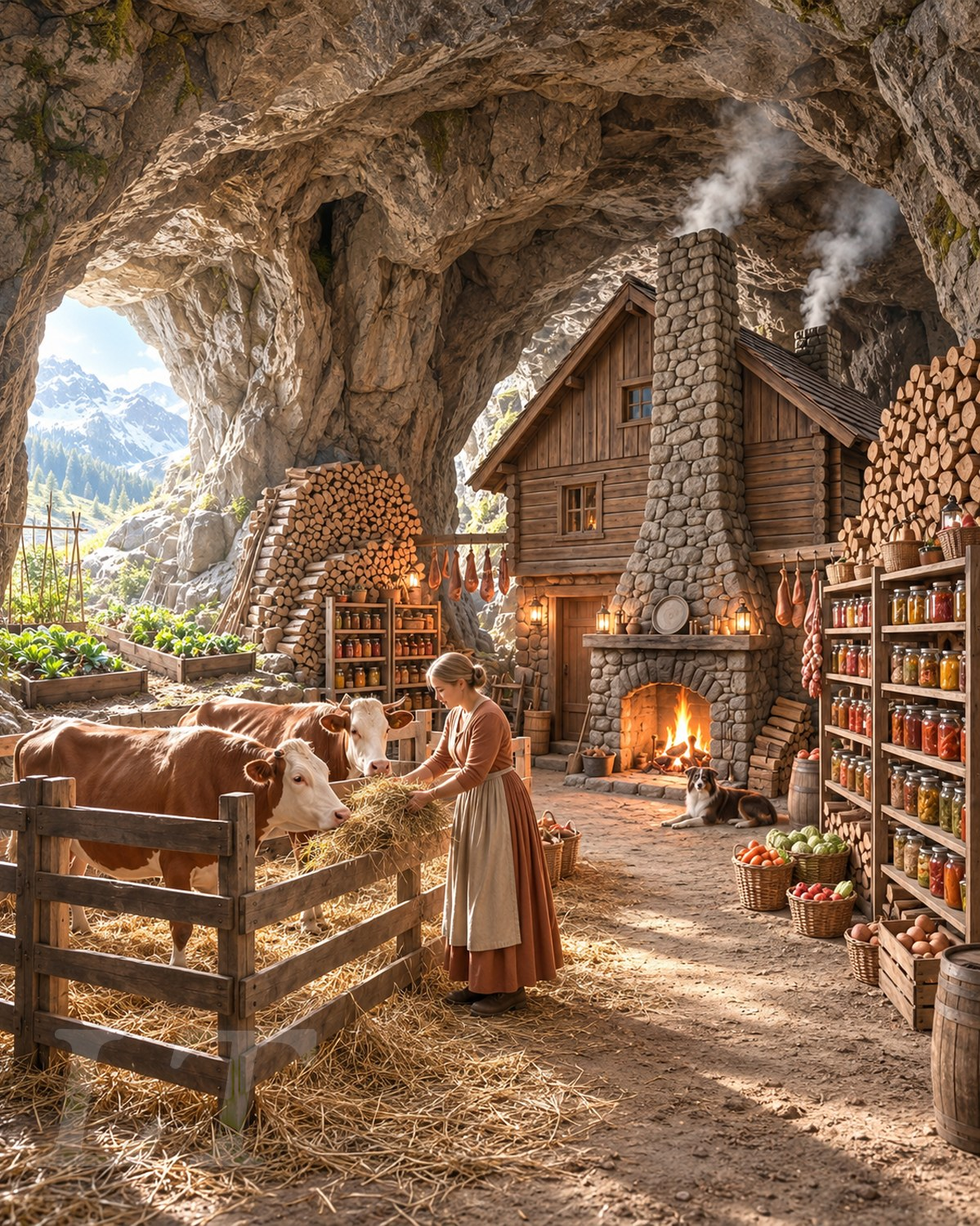
"Viola, don't let them open that journal!"
My brother's voice echoed through the cave.
I stood beside the wooden table, holding Emory's final letter in one hand and the leather-bound journal in the other.
Marshal Yoro Ridgeway was outside.
Lafayette was outside.
And both men seemed determined to stop me from reading what my husband had left behind.
I looked toward Irene.
She had reached the wooden entrance but had not opened it.
"Viola," Lafayette shouted again. "You don't understand what is inside that book!"
I looked down at the journal.
Its leather cover was cracked with age. A narrow strip of dark string held it closed, and a small metal clasp had been attached to the front.
Emory's initials were engraved near the bottom.
E.F.
I had never seen it before.
Not once during our marriage.
Not once during all the years we had lived together.
Yet somehow, my husband had left it inside a hidden compartment beneath the mountain.
Irene turned toward me.
"What do you want to do?"
I looked at the door.
Then at the journal.
"Read it."
She nodded.
I loosened the string.
The first page contained several dates and short observations about the sandstone formation.
The next pages described the underground water source, the natural air passages, and the temperature inside the southern chamber.
Then I reached a page with a different kind of writing.
It was not a survey.
It was a personal account.
At the top, Emory had written:
November 3, 1886.
My hands began trembling.
I started reading.
Today, I discovered that Lafayette has been meeting with Arthur Bell without telling me. I do not believe their arrangement concerns only the mineral survey.
I stopped.
Outside, someone struck the door again.
"Open this door!"
Marshal Ridgeway.
Irene approached the entrance.
"Marshal, give us a moment!"
"I need everyone inside to remain where they are!"
Lafayette shouted over him.
"She's holding property that belongs to me!"
I looked toward the door.
Then I continued reading.
I have asked Lafayette to explain the agreement he signed. He insists that he was protecting the family. But I have seen the documents. He has promised Bell access to the entire southern formation.
I swallowed.
The next sentence made my stomach tighten.
He has also agreed to remove Viola from the homestead if she discovers the original claim.
I lowered the journal.
For a moment, the cave seemed to tilt.
Irene stepped closer.
"What does it say?"
I looked at her.
"My husband knew."
"About what?"
"That Lafayette intended to remove me."
I turned toward Florentina.
She was standing near the fireplace.
Her face had become completely pale.
"Did you know about this?"
She shook her head.
"I swear I didn't."
I looked back at the journal.
Another line had been written beneath the paragraph.
I must find a way to protect her before they make their next move.
I pressed my lips together.
Emory had known something was coming.
And he had tried to protect me.
But he had died before he could finish.
Outside, the wind rose sharply.
The wooden frame creaked.
Then the marshal called again.
"Mrs. Foxwell, I need to speak with you immediately!"
Irene moved toward the entrance.
I placed the journal on the table.
"Let him in."
Marshal Ridgeway entered with snow covering his shoulders.
Two deputies followed him.
Lafayette came behind them.
His face was red with anger.
Silas Mercer was nowhere to be seen.
The marshal removed his gloves.
"Mrs. Foxwell, I apologize for the disturbance."
I nodded.
"What happened?"
He looked toward the table.
"Your brother filed a complaint claiming that you had taken confidential land documents."
I stared at Lafayette.
"Taken?"
Lafayette stepped forward.
"Those papers were never yours to possess."
I picked up the old agreement.
"Then explain this."
He looked at it.
His expression changed.
The marshal moved closer.
"Mr. Foxwell, I would like you to answer a few questions."
Lafayette ignored him.
He pointed toward the journal.
"Give me that."
I held it against my chest.
"No."
"You don't know what you're reading."
"Then explain it."
His jaw tightened.
"Emory was confused during his final months."
The words struck me.
"Don't."
He continued.
"He was dealing with grief, financial difficulties, and the pressure of the survey. Some of those papers may not represent his actual intentions."
I stared at him.
"You're saying my husband didn't know what he was signing?"
"I'm saying the circumstances were complicated."
Irene stepped forward.
"Convenient."
Lafayette turned toward her.
"Stay out of this."
Marshal Ridgeway raised one hand.
"Enough."
He looked at me.
"Mrs. Foxwell, may I examine the journal?"
I hesitated.
Then I handed it to him.
He opened it carefully.
His eyes moved across the pages.
He read several entries.
Then he looked toward Lafayette.
"Did you sign an agreement granting Arthur Bell access to the southern formation?"
Lafayette shifted his weight.
"I signed several preliminary documents."
"Without authorization from the original claimant?"
"I was acting on behalf of the family."
"That wasn't my question."
Silence.
The marshal closed the journal.
"Mr. Foxwell, I am placing a temporary hold on any further activity concerning the mineral survey until these documents can be authenticated."
Lafayette's expression darkened.
"You cannot do that."
"I can prevent an unlawful disturbance while the ownership dispute is examined."
"This is my property!"
The marshal looked at him.
"That is precisely what we are here to determine."
For the first time, my brother had no immediate answer.
But I knew he would not give up.
Not easily.
The weather worsened while the marshal examined the remaining papers.
Snow struck the entrance in thick, heavy sheets.
The wind made the wooden walls vibrate.
One of the deputies looked outside.
"Marshal, we should leave before the trail becomes impassable."
Ridgeway nodded.
He turned toward me.
"Mrs. Foxwell, I will take copies of these documents to the recorder's office. You should keep the originals somewhere secure."
I nodded.
"Can you stop my brother from returning?"
"I can issue a formal order concerning the disputed survey. But I cannot guarantee that he will obey it."
I looked at Lafayette.
He was standing near the entrance.
His expression was difficult to read.
The marshal continued.
"Until this matter is resolved, nobody has authority to remove you from this shelter solely on the basis of the mineral application."
I felt my shoulders relax.
"Thank you."
He put on his gloves.
Then he turned toward Lafayette.
"You will come with me."
My brother looked shocked.
"Why?"
"Because I have additional questions about the transfer documents."
Lafayette glanced toward Florentina.
She lowered her eyes.
He looked back at me.
"This isn't finished."
I did not answer.
The marshal led him outside.
The deputies followed.
Within minutes, their horses disappeared into the snowfall.
I stood at the entrance.
I watched until I could no longer distinguish them from the white landscape.
Then Irene closed the door.
"That could have gone worse."
I looked at her.
"It will."
She studied my face.
"Why do you say that?"
I pointed toward the journal.
"Because Emory wrote that Lafayette was only part of the problem."
Irene turned toward the table.
She opened the journal again.
We continued reading.
The remaining pages were filled with detailed observations.
Some described the geological structure.
Others contained names, dates, and financial transactions.
Emory had carefully recorded every meeting connected to the mineral survey.
He had also made several notes about Arthur Bell.
One entry caught my attention.
November 17, 1886.
Bell believes the southern chamber contains evidence of a natural underground water system. He wants exclusive control of the formation. I have refused.
I looked toward Irene.
"Why would anyone want exclusive control of a water source?"
"Because water is valuable."
"But there is a creek nearby."
"That creek may not be the only source."
I returned to the journal.
I have discovered that the underground spring continues beneath the western ridge. If the survey is correct, it may provide water throughout the winter, even when the surface streams freeze.
I stared at the words.
A winter water source.
That was what Emory had been studying.
The shelter was only one part of the discovery.
He had found a way for people to survive the winter without relying entirely on the frozen valley.
Irene leaned closer.
"Viola, look at the next page."
I turned it.
A rough map had been drawn in pencil.
It showed the cave entrance, the underground passage, and several points along the western ridge.
A small circle marked the location of a spring.
Another symbol identified a narrow opening farther beneath the mountain.
At the bottom, Emory had written:
The western chamber may connect to the old drainage passage.
I looked toward Nathaniel.
"Did you know about this?"
He shook his head.
"No. I knew about the survey, but I never saw the final map."
"Could there be another chamber?"
"Possibly."
I studied the drawing.
"Could someone reach it?"
Nathaniel examined the lines.
"If the passage is still open."
Irene folded her arms.
"Then we have another problem."
I looked at her.
"What?"
"If the spring is beneath the western ridge, and the mineral claim covers that area, someone may try to control the water as well as the land."
I looked down.
It was becoming clearer.
Lafayette had not simply wanted a place to build a larger home.
He had been trying to control something that could become valuable to the entire valley.
And my husband had tried to stop him.
By late afternoon, the snow had become so heavy that the cave entrance was nearly invisible.
The temperature continued falling.
I checked the wooden frame.
The outer wall was holding, but snow had accumulated against its lower section.
Grover helped clear it away.
Nathaniel examined the drainage channel.
Irene organized the food supplies.
Florentina sat near the table, staring at her hands.
I approached her.
"Have you heard from Lafayette?"
She shook her head.
"Not since the marshal took him."
"Do you believe he knew what Emory had discovered?"
She looked up.
"Yes."
"How much?"
"I don't know."
"Florentina, I need the truth."
She closed her eyes.
Then she spoke.
"Lafayette told me that Emory had discovered something valuable beneath the cliffs. He said the mineral rights would make the family wealthy."
"And you believed him?"
"Yes."
"Did he tell you that the southern chamber was supposed to remain protected?"
"No."
"Did he tell you that Emory had named me as his successor?"
She hesitated.
Then nodded.
I stared at her.
"Why did you help him?"
She looked down again.
"Because I wanted a better life."
I waited.
"My family in Ohio had struggled for years. Lafayette promised that the property would bring us security. He said the money would allow us to build something larger, something permanent."
"And I was in the way."
She nodded.
I felt a strange sadness.
Not because I felt sorry for her.
Because I had once believed that family meant something different.
"You could have asked me to leave peacefully," I said. "You could have told me about the agreement. You could have offered me another place to stay."
Florentina's voice trembled.
"Lafayette said you would never agree."
"Did you ask?"
She shook her head.
"No."
I looked toward the fire.
"Then you never gave me a choice."
She began crying.
I did not comfort her.
I was not ready.
Instead, I returned to the table.
There was still too much to understand.
The first serious warning came shortly after sunset.
A sharp cracking sound echoed through the valley.
Everyone stopped.
Grover moved toward the entrance.
"What was that?"
Nathaniel looked outside.
"Possibly a tree."
Then another sound followed.
Louder.
A deep rumble rolled across the mountain.
The wooden frame shuddered.
A shower of snow fell from the outer ledge.
Irene grabbed the table.
"Get away from the entrance!"
We moved toward the center of the chamber.
For several seconds, the cave seemed to vibrate.
Then everything went quiet.
I looked toward the entrance.
The snow was falling so heavily that I could barely see the rocks outside.
Nathaniel stepped forward.
"That sounded like a slope giving way."
"An avalanche?" Grover asked.
"Possibly a small one."
I felt my stomach tighten.
The mountain was beginning to move.
I had heard stories about entire hillsides collapsing beneath heavy snow.
Emory had once warned me never to underestimate a mountain during winter.
I looked toward the rear wall.
The stone was solid.
The shelter remained warm.
But the entrance was becoming increasingly difficult to access.
"We need to check the outer supports," I said.
Nathaniel shook his head.
"Not now."
"But if the snow blocks the entrance—"
"We will deal with that when the storm weakens."
Irene nodded.
"He is right. Nobody goes outside in this."
I looked toward the supplies.
We had food.
Water.
Firewood.
Blankets.
But not enough for an indefinite stay.
I began calculating.
If the entrance became blocked, we might be trapped for several days.
Perhaps longer.
I had built the shelter to survive winter.
I had never imagined that the mountain itself might become a threat.
That night, I slept beside the table.
I kept Emory's journal close.
The fire burned low.
The wind howled outside.
Every so often, the wooden frame creaked.
I woke several times.
At one point, I noticed Florentina sitting near the entrance.
She was awake.
Her hands were clasped together.
I approached quietly.
"Can't sleep?"
She shook her head.
"Neither can you."
I sat on the opposite side of the small fire.
For a while, neither of us spoke.
Then she looked at me.
"Did Emory ever tell you about the night he died?"
I stared at her.
"What do you mean?"
"Was he supposed to be checking his trap line that evening?"
"Yes."
She looked toward the floor.
I felt something tighten in my chest.
"What are you trying to say?"
She swallowed.
"Before he died, Lafayette received a letter."
I stared at her.
"What letter?"
"I don't know exactly. I only saw it once."
"Where?"
"At the cabin."
"When?"
"Several days before Emory died."
I felt the room grow colder.
"What was written on it?"
"I couldn't read everything. But I remember one sentence."
I leaned forward.
"What sentence?"
Florentina looked directly at me.
It took her several seconds to speak.
Tell Emory the western passage must be sealed before the first hard freeze.
I stared at her.
"Who wrote it?"
"I don't know."
"Did you tell Lafayette?"
She nodded.
"And what did he say?"
"He told me to forget I had seen it."
I looked toward the journal.
The western chamber.
The underground passage.
The spring beneath the mountain.
Everything was beginning to connect.
"Why are you telling me this now?"
Florentina's eyes filled.
"Because I think Emory went out that night to investigate the passage."
I stood abruptly.
"Why?"
She shook her head.
"I don't know."
I looked toward Nathaniel.
He had heard the conversation.
His face had changed.
"Did Emory ever mention the western entrance?" I asked him.
Nathaniel nodded slowly.
"He said he wanted to inspect it before winter."
"Did he go there?"
"I don't know."
I turned toward Florentina.
"Was Lafayette involved?"
She looked down.
Then she whispered:
"He was the last person I saw speaking to Emory before he left the cabin that night."
Morning came without sunlight.
The storm had become worse.
Snow covered the outer entrance, and the wind continued pushing against the wooden frame.
Grover checked the supplies.
Irene counted the food.
Nathaniel examined the journal.
I stood near the table, reading Emory's final entries.
The last dated page was from the week before his death.
The western passage is unstable. Water pressure appears to be increasing beneath the lower chamber. I must find a way to redirect the flow before the ground freezes.
Below that was another sentence.
Lafayette has refused to help.
I read it again.
Then I turned the page.
There was no further writing.
The final page had been torn out.
I looked at Nathaniel.
"Was this journal always missing a page?"
He examined the binding.
"I don't know."
I looked at the torn edge.
It was not an old tear.
The paper fibers were still relatively clean.
Someone had removed it recently.
I turned toward Florentina.
"Did you see anyone handle this journal?"
She shook her head.
Irene examined the binding.
"Someone may have taken it before the box was hidden."
Nathaniel nodded.
"That is possible."
I stared at the empty space.
The missing page might contain the answer to what happened the night Emory died.
It might also explain why Lafayette had become so determined to control the mountain.
I looked toward the rear passage.
"We need to find the western chamber."
Nathaniel looked at the weather.
"Not until the storm passes."
I wanted to argue.
But I knew he was right.
There was no point risking another life.
I returned to the table.
Then I noticed something.
A small mark had been drawn beneath the final entry.
It looked like a number.
Not seventeen.
Not a survey marker.
A date.
I leaned closer.
November 21, 1886.
The day Emory had died.
Beneath the date were four words.
The water remembers everything.
I looked up.
"What does that mean?"
Nathaniel approached.
He examined the writing.
Then he turned toward the rear wall.
"Viola, I think your husband discovered something in that passage."
"What?"
He did not answer immediately.
Instead, he walked toward the narrow fracture in the sandstone.
He placed his hand against the stone.
Then he crouched.
A faint sound came from behind the wall.
Not wind.
Not the movement of loose rocks.
Water.
Nathaniel pressed his ear against the sandstone.
His expression changed.
"Everyone, move away from the rear wall."
Irene stood.
"Why?"
He looked at me.
"Because the underground passage may be filling."
I felt my heart begin to race.
"Can it reach the cave?"
Nathaniel did not answer.
A second sound came.
This time, it was louder.
A deep rushing noise from somewhere beneath the floor.
Then a thin line of water appeared between two stones.
I stepped backward.
The line widened.
Cold water began seeping across the floor.
Grover grabbed the nearest wooden crate.
"Move the supplies!"
We rushed toward the shelves.
Irene lifted the food baskets.
Florentina grabbed the blankets.
I carried the documents and placed them on the raised sleeping platform.
The water continued spreading.
Nathaniel examined the crack.
"It's coming from the lower passage!"
I looked toward the rear wall.
The place where the hidden iron box had been found.
The place where Emory had concealed the original survey.
And suddenly, I understood why he had been so worried.
The mountain was not simply protecting us from the winter.
Something beneath it was changing.
By noon, the water had reached the center of the chamber.
We managed to move most of the supplies onto the raised platform and wooden shelves.
The fire was extinguished before the water reached it.
The shelter was becoming cold.
Irene wrapped a blanket around her shoulders.
"We cannot stay here if the water keeps rising."
Nathaniel examined the floor.
"There may be a drainage channel farther west."
"Can we reach it?"
"Not without clearing the passage."
I looked toward the rear wall.
The hidden opening was partially covered by loose stone.
If we could reach it, perhaps we could redirect the water.
But the structure might be unstable.
Nathaniel seemed to be considering the same thing.
"We need to find the original drainage route."
I looked at the old map.
The western chamber.
The underground spring.
The marked passage.
I placed the map beside him.
"Emory drew this."
Nathaniel studied it.
Then he pointed to a small symbol near the lower edge.
"This is a secondary outlet."
"Where does it lead?"
He traced the line with his finger.
"Toward the western slope."
I looked toward the water spreading across the floor.
"Then we need to open it."
Nathaniel nodded.
"But we need the correct entrance."
I examined the map.
The small symbol was beside a narrow section of sandstone.
I recognized the formation.
It was near the eastern side of the cave.
I had passed it many times.
A cluster of loose rocks sat beneath a natural ledge.
"Is that the place?" I asked.
Nathaniel looked.
His eyes widened slightly.
"Possibly."
Irene grabbed a lantern.
"Then let's go."
We moved toward the eastern wall.
The water was now ankle-deep.
I picked up a metal tool and began clearing the loose stones.
The first few came away easily.
Then we found a wooden panel hidden behind them.
It was old.
The surface was dark with age.
A small metal handle was attached to the center.
I looked at Nathaniel.
"Was this here before?"
He shook his head.
"I never saw it."
I touched the handle.
It moved slightly.
Then I noticed something carved into the wood.
A single sentence.
In Emory's handwriting.
Open only when the water rises.
I looked at Nathaniel.
He stared at the panel.
"Your husband knew this could happen."
I gripped the handle.
Behind us, the water continued rising.
And then, from somewhere inside the hidden passage, a voice called my name.
"Viola..."
I froze.
It was not Nathaniel.
It was not Grover.
It was not Irene.
The voice came from behind the wooden panel.
And it sounded exactly like my dead husband.






Comments 0