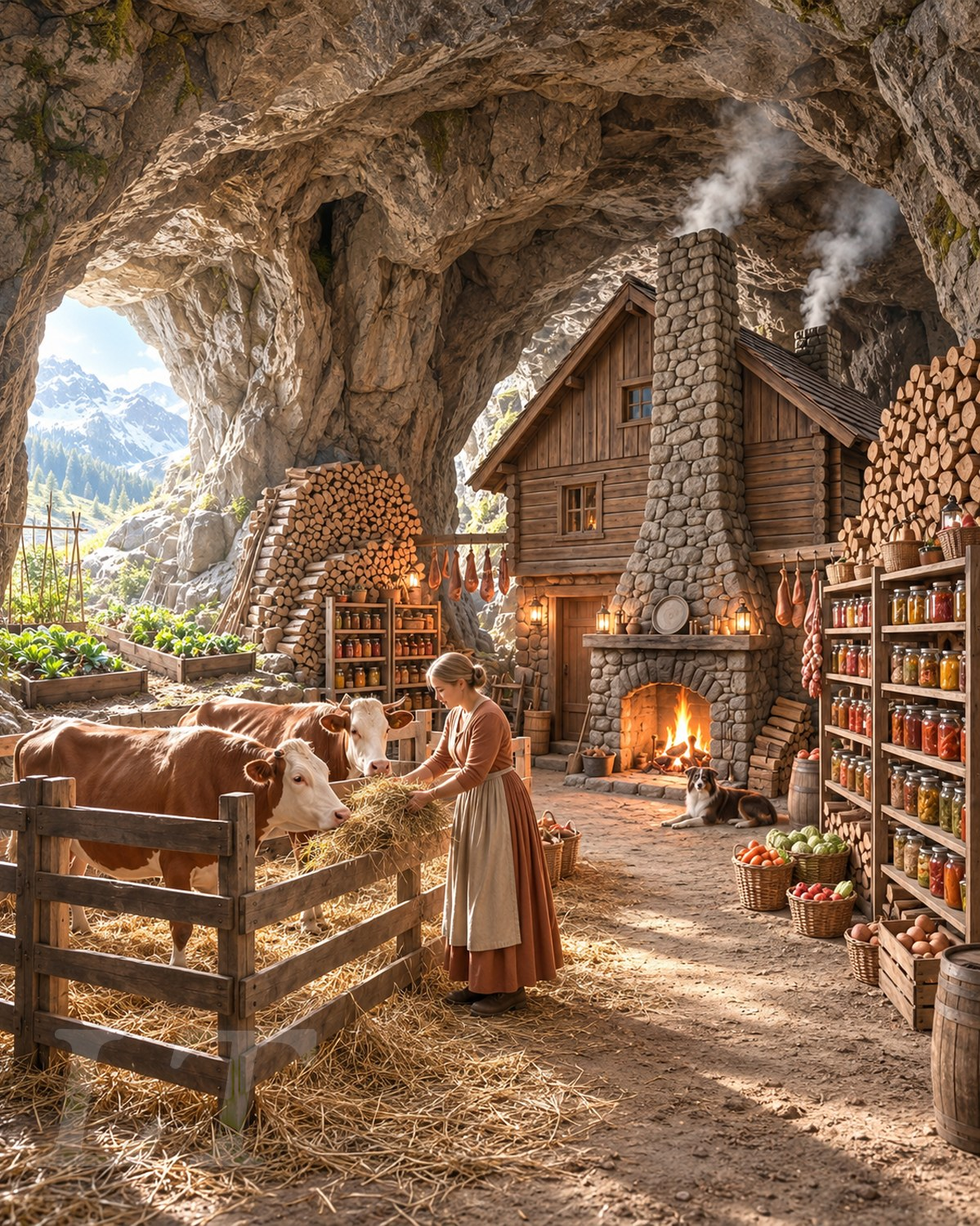
"Mrs. Foxwell, before we discuss your brother, I need you to tell me whether your late husband ever mentioned a man named Emory Crestwood."
For several seconds, I could not move.
The name sounded familiar.
Not because I had heard it from a stranger.
Because it belonged to my husband.
Emory Crestwood.
My husband's name had been Emory Foxwell.
I looked at Marshal Ridgeway, then at the document lying on the wooden table.
"Why are you asking me that?"
The marshal removed his hat.
"Because that name appears in a property record connected to these cliffs."
I shook my head.
"My husband never owned this land."
"Are you certain?"
"Yes. We lived on the homestead. The land was registered through my brother's claim."
The marshal studied me.
"That isn't exactly what the records suggest."
I felt the blood drain from my face.
"What records?"
He opened his leather case and removed another sheet.
It was older than the first document. The paper had yellowed along the edges, and the ink had faded in several places.
He placed it beside the mineral application.
"This is a historical land survey from several years ago. It identifies an earlier claim involving a man named Emory Crestwood."
I stared at the signature.
It was not my husband's usual handwriting.
But I recognized the shape of the letters.
The final stroke beneath the surname.
I had seen it on old receipts and letters.
My husband's handwriting.
"That's impossible," I whispered.
The marshal pulled a chair closer.
"Please sit down, Mrs. Foxwell."
I remained standing.
"Tell me what this means."
He glanced toward his two companions.
One of them stepped outside, leaving the door partially open.
The other remained near the entrance.
Marshal Ridgeway lowered his voice.
"The mineral application submitted by Lafayette Foxwell refers to an older claim. That claim was not originally registered under your brother's name."
"Then whose name was it registered under?"
"Emory Crestwood."
I looked down.
The cave seemed unusually quiet.
I could hear the faint crackling of the small fire near the entrance.
My husband had never told me about a mineral claim.
Not once.
We had spoken about land many times.
We had discussed fencing, water rights, livestock, and the possibility of expanding our homestead.
But he had never mentioned anything beneath the sandstone cliffs.
"How old is this document?" I asked.
"Six years."
"Six years?"
"Yes."
I shook my head.
"Emory was alive then."
The marshal nodded.
"That is correct."
I picked up the paper.
There was a description of the land, followed by several technical measurements.
A section near the bottom contained a handwritten note.
I leaned closer.
The words were faint.
But I could read them.
Protected access to the southern sandstone formation.
I looked at the marshal.
"What does that mean?"
"It may refer to a natural access point or a survey boundary. We need to examine the original file to understand it."
"Why was my husband's name changed?"
"That is one of the questions I am investigating."
I felt my hands begin to tremble.
For months, I had believed that Emory's death had left me with nothing but memories.
Now I was being told that there might have been an entire part of his life I had never known about.
I did not like the feeling.
I did not like it at all.
"Was my brother involved?"
The marshal looked at the document.
"His name appears on a later transfer."
I closed my eyes.
Of course it did.
Lafayette.
Always Lafayette.
"How?"
"According to the record, your husband authorized a temporary administrative arrangement involving the homestead claim. The exact terms are unclear."
"Emory trusted my brother."
"Apparently."
I placed the document on the table.
"Then why did Lafayette tell me the property belonged to him?"
The marshal did not answer.
I looked at him.
"Was he lying?"
"I cannot make that determination without reviewing the original documents."
I laughed bitterly.
"That is a very careful answer."
"It is the only honest answer I can give you."
For the first time, I respected him.
He was not trying to comfort me.
He was trying to establish what had actually happened.
And after everything I had experienced, I preferred that.
The marshal remained inside the cave for nearly an hour.
He examined the entrance walls and asked when I had begun constructing them.
I told him.
He wrote the dates in a small notebook.
He asked how I had discovered the cave.
I explained the hailstorm, the unusual warmth of the stone, and the sheltered entrance.
Then he asked whether anyone had helped me build the shelter.
I mentioned Irene.
He nodded.
"Mrs. Underhill has spoken with the recorder's office."
"She is helping me."
"She appears to be a sensible woman."
"She is."
The marshal examined the wooden frame again.
"Have you received any formal notice beyond the paper delivered last night?"
"No."
"Did anyone attempt to remove you?"
"Not yet."
He looked toward the entrance.
"Then I want you to understand something. The document you received does not give anyone immediate authority to destroy your shelter or force you off the land without proper process."
I felt a small amount of relief.
"Then I can stay?"
"For now, yes. But the underlying property dispute must be examined."
I looked toward the rear of the cave.
"How long will that take?"
"Several days. Possibly longer."
I nodded.
Several days.
I could manage that.
I had survived worse.
The marshal closed his leather case.
"One more question."
I turned toward him.
"Did your husband ever keep a separate box of papers? Letters, receipts, survey notes?"
I thought for a moment.
"Yes."
"Where is it?"
"At the old cabin."
He looked at me.
"Does Lafayette have access to it?"
I felt my stomach tighten.
"Yes."
"Then you should consider whether there may be documents there that could help establish what your husband intended."
I stared at the wooden table.
The old cabin.
The place where Emory had kept his papers.
The place where I had lived for years.
The place Lafayette and Florentina had taken from me.
I could almost picture the small wooden chest beneath the bedroom window.
Emory had kept it locked.
I had never thought much about it.
He said it contained old business records.
Nothing important.
I had believed him.
Now I wondered whether I had been wrong.
"Could I retrieve those papers?" I asked.
The marshal hesitated.
"That depends on the circumstances. If the documents are your personal property, we can discuss a lawful way to recover them."
I nodded.
"I want them."
"Then we will need to proceed carefully."
He stood and put on his hat.
Before leaving, he turned toward me.
"Mrs. Foxwell, I would advise you not to confront your brother until we understand these records."
I looked at him.
"I have no intention of speaking to him."
"Good."
He walked toward the entrance.
Then he stopped.
"There is something else."
I waited.
"The survey scheduled for tomorrow may not be the only reason people are interested in this mountain."
My throat tightened.
"What do you mean?"
He looked toward the sandstone ceiling.
"Someone has been making inquiries about an older geological report. The report was prepared several years ago, but the original copy appears to be missing."
"Does it mention Emory?"
"Possibly."
"Who has been looking for it?"
The marshal hesitated.
"That is what I am trying to establish."
Then he left.
I stood in the entrance for several minutes, watching the two men ride away.
When they disappeared, I returned to the table.
I picked up the old survey.
I looked at Emory's signature again.
There was something painful about seeing his name connected to a secret.
I wanted to be angry with him.
But I couldn't.
He was not here to explain himself.
And I had spent too many months speaking to an empty room.
Irene arrived shortly after noon.
She found me examining the survey document.
"What happened?"
I handed it to her.
She read the first paragraph.
Then she looked at the signature.
"Where did you get this?"
"Marshal Ridgeway."
She pulled a chair closer.
"What is it?"
"An old land survey. It mentions Emory."
Irene looked up.
"Your Emory?"
"Yes."
She read the document again.
Her eyebrows rose.
"Why would his name appear on a claim involving these cliffs?"
"I asked the marshal the same thing."
"And what did he say?"
"That Lafayette's later mineral application refers to an older claim registered under Emory's name."
Irene leaned back.
For a moment, she said nothing.
Then she looked at me carefully.
"Viola, did Emory ever take you to these cliffs?"
"No."
"Did he ever mention them?"
I thought about it.
There had been one occasion.
Several months before he died, Emory had returned home later than usual.
He had been carrying a small leather case.
I remembered him placing it on the table and asking me whether I had seen Lafayette recently.
I had told him that my brother had visited the previous week.
Emory had become unusually quiet.
Then he had said something about old business that needed to be settled.
I had assumed he meant the homestead paperwork.
I had not asked further questions.
Now the memory returned with uncomfortable clarity.
"He once mentioned that he had some unfinished business with Lafayette."
Irene leaned forward.
"What exactly did he say?"
"He said there were things he should have taken care of years earlier."
"Did he explain?"
"No."
"Did he seem worried?"
I closed my eyes.
"Yes."
Irene placed the survey on the table.
"That matters."
I looked at her.
"I wish I had asked him."
"You were his wife, not his investigator."
I looked down.
"I should have known."
"No, Viola. You should have been allowed to trust your husband."
Her words stayed with me.
Irene examined the document again.
"Can we see the original record?"
"The marshal is looking into it."
"Good."
She folded her hands.
"There is another thing you need to know."
I looked up.
"Lafayette has been telling people that you abandoned the homestead voluntarily."
I felt my jaw tighten.
"Of course he has."
"He says you refused to remain with family."
"That is a lie."
"I know."
"He watched me leave."
"I know."
I looked toward the entrance.
"Why does he keep doing this?"
Irene's voice became quieter.
"Because if people believe you left voluntarily, they may be less interested in questioning how he obtained the property."
I understood.
It was not enough for Lafayette to take the cabin.
He wanted everyone to believe I had no reason to complain.
He wanted my absence to look like a choice.
And now, with the mineral application, he might be trying to turn an old family arrangement into something far more profitable.
Irene stood.
"We need to speak with the marshal again."
"Not yet."
She looked surprised.
I pointed toward the rear of the cave.
"I want to finish the shelter first."
"Viola—"
"If I leave to fight about paperwork, I lose another day. If the weather turns, I may lose everything."
Irene studied me.
Then she nodded.
"All right. But we will not ignore this."
The following two days were difficult.
The temperature dropped sharply.
The wind became stronger, and clouds gathered over the mountains.
I worked on the inner wall while Irene helped organize the supplies.
We placed the preserved food on higher shelves.
We arranged the firewood by size and dryness.
Irene also helped me prepare a small storage area for tools.
The shelter was beginning to resemble a proper homestead.
But the problem of the fireplace remained.
I showed Irene the narrow crack in the rear wall.
She examined it carefully.
"Air is moving through here."
"I know."
"Do not widen it yet."
"I won't."
She held a small strip of cloth near the opening.
It moved gently.
"There may be a natural passage above this section."
I looked at her.
"Could we use it for smoke?"
"Possibly. But we need to understand where it leads."
We agreed to wait until the marshal could examine the structure.
That evening, I sat near the entrance with my notebook.
I wrote down everything I remembered about Emory's final months.
The leather case.
His questions about Lafayette.
The unusual business he said needed to be settled.
I wrote the date of his death.
Then I stopped.
There was something else.
Three days before Emory died, he had asked me whether I knew where his old survey papers were.
I had told him they were in the wooden chest.
He had thanked me.
Then he had said:
"If anything happens to me, make sure you never let anyone tell you that you have no right to what we built."
At the time, I had thought he was speaking about the homestead.
Now I was not so certain.
I wrote the sentence in the notebook.
Then I underlined it twice.
On the third morning, Grover Crestwood returned.
This time, he brought a wagon.
It was loaded with timber.
Several long boards were tied securely across the back, along with smaller pieces and a bundle of tools.
He stopped near the entrance.
"Morning, Mrs. Foxwell."
I stepped outside.
"Good morning."
He looked toward the wagon.
"I brought what I promised."
I examined the lumber.
It was better than anything I had salvaged from the old surveying shack.
The boards were straight and dry.
There were enough to complete the inner wall and build a proper sleeping partition.
"Where did you get these?"
"My own supply."
"Why are you giving them to me?"
"Because I still want to make an arrangement."
I looked at him.
"About staying here?"
"Yes."
I shook my head.
"I haven't changed my mind."
He nodded.
"Then perhaps we can discuss another arrangement."
"What kind?"
"I can help you finish the shelter without staying here permanently."
I considered that.
It was a reasonable offer.
But I still did not trust him.
"Why are you so interested in helping me?"
He looked toward the cliffs.
"Because I made a purchase that may not be as straightforward as I was told."
I waited.
"And because I believe your husband may have known something about this mountain."
I felt my stomach tighten.
"Why?"
Grover reached into his coat.
He removed a small folded paper.
"I found this in the file that came with the mineral transfer."
He handed it to me.
The paper contained a short handwritten note.
The writing was faint, but the signature was clear.
Emory Foxwell.
I read the message.
The southern chamber must remain undisturbed until the original survey is recovered.
I looked up.
"What southern chamber?"
Grover shook his head.
"I don't know."
"Where did you find this?"
"Inside the transfer file."
"Why wasn't it included with the official papers?"
"Because it was not part of the registered application."
I stared at the note.
Emory had known about the cave.
Perhaps not this exact chamber.
But he had known something about the mountain.
I looked toward the rear of the shelter.
The narrow fracture in the sandstone seemed darker than before.
"Did you show this to Lafayette?"
"No."
"Why not?"
"Because I don't trust him."
I looked at Grover.
For the first time, I wondered whether he was telling the truth.
He placed the remaining tools beside the wagon.
"I'll leave the lumber here. You can decide what you want to do."
Then he turned toward his horse.
Before he mounted, he looked back.
"One more thing, Mrs. Foxwell."
I waited.
"The man who sold me the claim wasn't acting alone."
My fingers tightened around the note.
"Who else was involved?"
Grover lowered his voice.
"Someone who had access to your husband's original records."
I stared at him.
"Who?"
He looked toward the valley.
Then he said a name.
"Florentina."
I could not speak.
For a moment, I thought I had misunderstood him.
"Florentina?"
Grover nodded.
"She was present when the original mineral application was discussed."
"When?"
"Several years ago."
I shook my head.
"That cannot be right."
"Why not?"
"Florentina was not married to Lafayette then."
Grover looked uncomfortable.
"I don't know the details. I only know her name appears in the correspondence."
I stepped closer.
"Show me."
He shook his head.
"I don't have the full file with me."
"Then where is it?"
"In town."
"Who has it?"
Grover hesitated.
"Silas Mercer."
The same man who had questioned me about occupying the cave.
I felt a chill move through my body.
"Why does he have my husband's records?"
"Because he represents another interested party."
"Who?"
Grover looked at me.
"I don't know his employer's full name."
I was beginning to lose patience.
"Everyone seems to know something except me."
He lowered his eyes.
"That may be why I came here."
He climbed onto his horse.
"I will return tomorrow with more information."
Then he rode away.
I stood beside the wagon, holding Emory's note.
Florentina had known something about the mineral claim.
Perhaps she had known about it before she married my brother.
Perhaps she had known about it before Emory died.
I could not make sense of it.
I returned to the cave and placed the note beside the old survey.
Two documents.
Both connected to my husband.
Both suggesting that he had been involved in something beneath these cliffs.
I looked toward the rear wall.
The narrow fracture was still there.
A faint current of cold air moved through it.
I approached slowly.
Then I noticed something I had missed before.
Near the bottom of the crack, beneath a loose piece of sandstone, there was a small metal object.
I crouched.
It was partially buried in dust.
I reached toward it and brushed away the loose dirt.
A corner of an old iron box appeared.
I stopped breathing.
The box was embedded inside the stone.
And on its rusted lid, someone had carved two initials.
E.F.
I reached for the small hammer.
But before I could touch the metal, I heard three sharp knocks against the outer wooden door.
Then a woman's voice called from outside.
"Viola! Don't open that box!"
I froze.
I knew the voice.
It belonged to Florentina.
Expand Chapter 5 to 2,000 words Preserve the cliffhanger while tightening pacing






Comments 0