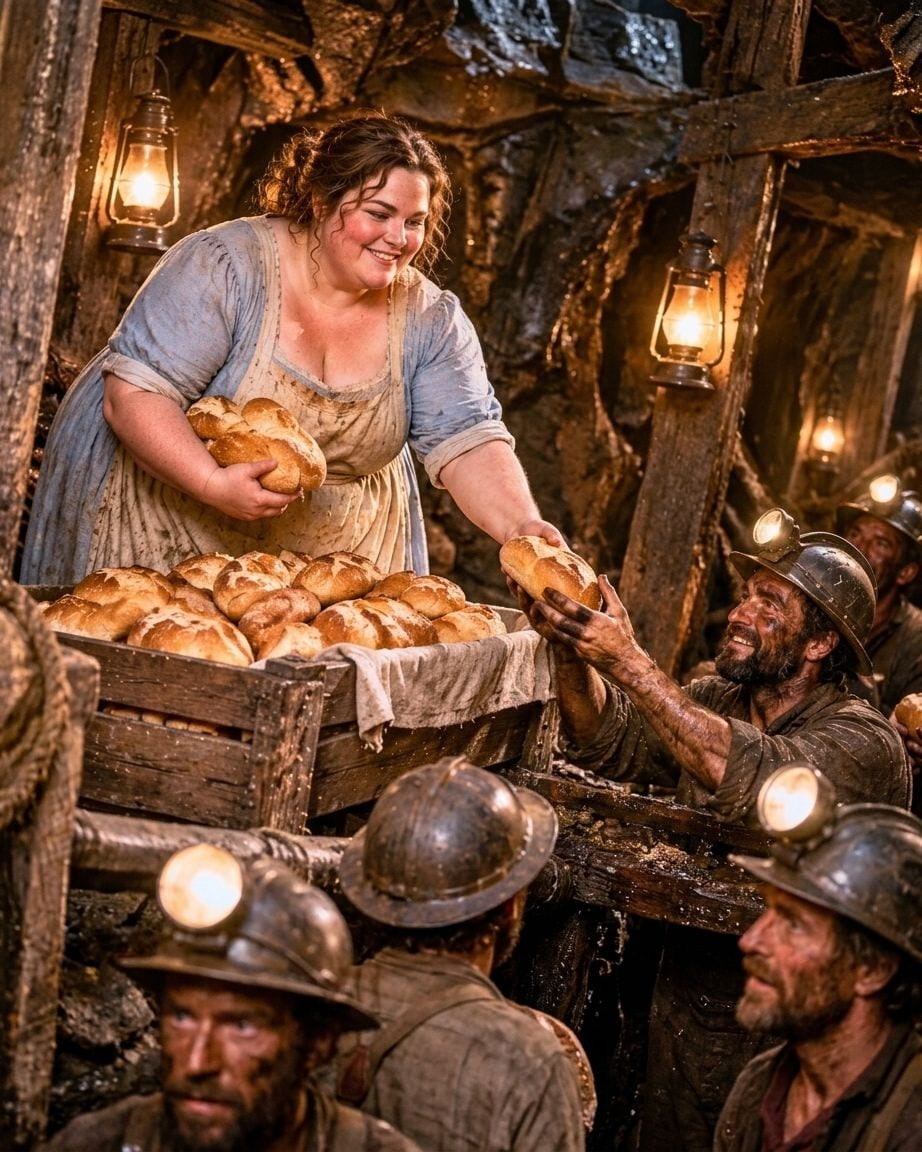
"Six dollars for that rotten flour? Woman, have you lost your mind?"
Dub Creswell slammed his hand against the wooden counter and pointed at the six silver coins Maggie Whitmore had just placed in front of Frank Alcott.
Frank, the most established general merchant in Red Hollow, Colorado, held a damaged freight receipt between his fingers.
Across its bottom, written in dark ink, were three words:
TOTAL LOSS: 600 LB.
Maggie looked at the receipt.
Then she looked at the laughing cowboys.
They thought they were watching a foolish woman throw away her last chance.
They were wrong.
"Miss Whitmore," Frank Alcott said carefully, "I don't believe you understand what you're purchasing."
Maggie stood on the other side of his counter, her broad shoulders squared beneath a faded brown cotton dress. Her thick dark hair had been pinned into a practical bun that morning, although several curls had already escaped around her face.
She was thirty-five years old, weighed close to two hundred and seventy pounds, and had spent most of her adult life being underestimated by men who had never worked half as hard as she did.
"I understand perfectly, Mr. Alcott."
Frank adjusted his spectacles.
"Six hundred pounds of flour."
"That's right."
"Damaged in a wagon accident."
"I saw the wagon."
"Soaked through with river water."
"I inspected the sacks."
"Some of it isn't fit for anything except feeding hogs."
Maggie folded her hands.
"Then it's fortunate I'm not planning to cook with the part that isn't fit to eat."
A brief silence followed.
Frank stared at her.
Behind Maggie, Dub Creswell let out a loud laugh.
"Well, listen to that! She's already got a plan!"
The other cowboys joined him.
Maggie didn't turn around.
She had learned long ago that a man's laughter could be louder than his intelligence.
And Dub Creswell had never been particularly quiet.
Frank leaned closer.
"Miss Whitmore, I'm trying to do right by you. That flour was worth considerably more yesterday morning, but after what happened on the river road, I can't promise there's a single usable sack left."
"You're an honest man, Frank."
"I try to be."
"Then let me make an honest purchase."
She pushed the six silver dollars closer.
"All of it. Cash today."
Frank looked at the money.
Then at Maggie.
Then toward the open doorway, where the damaged freight wagon could still be seen beside the muddy road.
He rubbed the back of his neck.
"Six dollars?"
"Six dollars."
"For everything?"
"Every sack."
Dub whistled.
"Lord Almighty. Frank, take the money before she comes to her senses."
Maggie heard him.
Of course she heard him.
She heard everything.
The whispers that followed her down Main Street.
The snickering when she entered a boarding house.
The uncomfortable pauses when she asked whether a kitchen needed a cook.
And the words men thought she couldn't hear simply because she refused to answer them.
She had been in Red Hollow for three days.
Three days had been enough to learn that a woman could arrive with twelve years of professional experience, a glowing reference from a respected mine foreman, and hands capable of preparing breakfast for forty working men before sunrise—and still be judged by nothing more than the size of her waist.
Frank finally reached for the coins.
"All right," he said. "Six dollars."
Maggie nodded once.
"Thank you."
He began gathering the money.
One coin.
Two.
Three.
By the sixth, Dub was laughing so hard he had to lean against the doorframe.
"What's she going to do with it?" he asked. "Eat it?"
Another cowboy slapped his knee.
"Maybe she's building herself a flour castle!"
"Better build a big one!"
Their laughter filled the store.
Maggie picked up her empty canvas bag.
She looked at Dub.
Not angrily.
Not tearfully.
She simply looked at him.
Her brown eyes remained steady.
For a moment, Dub continued grinning.
Then something in her expression made his smile falter.
"What?" he demanded.
Maggie said nothing.
"Got something to say?"
She held his gaze another second.
Then she turned back to Frank.
"Would you mind helping me get the first sacks off the road?"
Frank blinked.
"You mean now?"
"Before the sun gets any higher."
He glanced toward the window.
"You'll need a wagon."
"I'll manage."
"Maggie, six hundred pounds isn't something you can just carry away."
"I know."
"Then perhaps we ought to arrange—"
"I'll manage, Frank."
There was no irritation in her voice.
Only certainty.
And that, somehow, seemed to confuse him more than anger would have.
The Alcott freight wagon had overturned shortly after dawn.
Its left wheel had struck a deep rut where spring runoff had washed away part of the river road.
The axle snapped.
The wagon lurched sideways.
And two hundred small sacks of milling flour spilled into the shallow water and muddy bank.
By the time help arrived, the damage was done.
Some sacks had burst completely.
Others had absorbed water through their seams.
A few remained tightly sealed, although their outer surfaces were stained with river mud.
Frank had already calculated the loss.
He had also decided that salvaging the shipment would cost more than it was worth.
That was why Maggie had found the sacks still lying beside the road.
And that was why nobody else wanted them.
She reached the wreck just before noon.
The cowboys followed at a distance, eager to see what fresh embarrassment she might provide.
Maggie ignored them.
She knelt beside the nearest sack.
The burlap was damp.
Its lower corner had been dragged through mud.
She untied the cord, opened the top, and examined the flour inside.
Her fingers moved carefully.
She pressed a small amount between her thumb and forefinger.
Then she brought it close enough to smell.
Not sour.
Not musty.
Just wet.
She reached deeper.
The flour near the center was dry.
A small, satisfied breath escaped her.
She closed the sack.
Then she opened another.
And another.
By the fifth, she had begun separating them into different piles.
Frank watched from beside the wagon.
"What are you doing?"
"Sorting."
"Sorting what?"
"The sacks worth opening from the sacks that aren't."
Dub laughed again.
"Well, that narrows it down to none!"
Maggie continued working.
She had cooked in mining camps for twelve years.
She had seen grain stored badly, flour contaminated by damp, bread ruined by careless handling, and entire kitchens brought to a standstill because someone failed to distinguish a damaged container from spoiled food.
She knew the difference.
She also knew something Frank and the cowboys did not.
A wet sack did not necessarily mean every ounce inside had been destroyed.
But flour touched by dirty river water could not simply be dried and served.
Anything contaminated, sour, moldy, or doubtful would have to be discarded.
Only flour protected within intact, dry interiors could be considered for cooking.
And even then, she would inspect it carefully.
She had no intention of poisoning anyone to prove a point.
Maggie pulled another sack toward her.
The cord was tight.
The top was damp.
She opened it.
Inside, the upper layer was dry and powdery.
She pressed her fingers deeper.
Still dry.
She checked the lower corner.
Then she smiled.
Not broadly.
Just enough to acknowledge what she had suspected.
There was something worth saving here.
Perhaps not all six hundred pounds.
Perhaps not even half.
But enough.
Enough to begin.
By early afternoon, Maggie had separated the sacks into three groups.
The first contained flour that was visibly contaminated or spoiled.
She would not use it for food.
The second required closer inspection.
The third contained tightly sealed sacks whose interiors appeared to have escaped the water.
Those were the ones she intended to save.
Her arms ached.
Her back was damp with sweat.
Dust clung to the front of her dress.
But she continued.
Frank eventually returned with a small handcart.
He stood beside her awkwardly.
"I thought you might need this."
Maggie looked up.
"That's kind of you."
He cleared his throat.
"Wouldn't be right to take your money and leave you stranded with the load."
She smiled.
"Then I suppose there's hope for this town after all."
Frank looked embarrassed.
He helped her load the first sacks.
When they had secured the cart, he asked where she intended to take them.
"There's an old feed barn near the mine road."
Frank's expression changed.
"The one beyond the blacksmith's yard?"
"That's the one."
"That building's been empty for years."
"I noticed."
"Roof leaks in the back."
"Not over the stove."
"Door doesn't lock properly."
"I can fix a door."
"Nobody knows who rightly owns it."
"I'll find out before I claim anything."
Frank shook his head.
"You're determined."
Maggie tightened the rope around the sacks.
"I've been called worse."
He hesitated.
"Miss Whitmore..."
She looked at him.
"Yes?"
"Why stay here?"
The question was simple.
The answer was not.
Maggie glanced toward the distant rooftops of Red Hollow.
She thought of Chester Pool at the Alcott Grand, folding her reference letter as though twelve years of experience could be dismissed with a polite smile.
She thought of the Red Hollow Hotel, where the manager had looked at her body before he looked at her credentials.
She thought of the boarding-house owner who had gestured vaguely at her waist and declared that his kitchen wasn't built for "this."
She remembered standing outside the final establishment on Main Street, knowing there were no more doors left to knock on.
She had eleven dollars and forty cents when she arrived.
Now she had five dollars and forty cents.
And a mountain of damaged flour.
Most people would have called that a disaster.
Maggie called it a beginning.
"Because I'm tired of leaving places just because somebody decides I don't belong."
Frank studied her face.
For once, he had nothing to say.
The first trip to the abandoned barn took nearly forty minutes.
The cart's wheels sank into soft patches of earth.
Twice Maggie had to stop and adjust the load.
By the time she reached the building, sweat had soaked the collar of her dress.
She stood outside for a moment.
The barn was larger than it appeared from the road.
Its walls were weathered but standing.
The roof sagged slightly along the rear corner.
The windows were dirty.
The front door hung crookedly on its hinges.
But the structure was solid.
And inside stood the one thing that mattered most.
An old cast-iron cooking stove.
Maggie had noticed it on her first day in Red Hollow.
She had also noticed the chimney.
The wide wooden worktable.
The shelves.
The water barrel outside.
And the fact that the building stood only two blocks from the main mine shaft.
A good cook noticed things.
A good cook noticed where hungry men worked.
She pushed the door open.
It creaked loudly.
Dust drifted through the sunlight.
The room smelled of old wood, cold iron, and years of neglect.
Maggie wheeled the cart inside.
Then she stood still.
For a long moment, she simply looked around.
She could imagine the place clean.
She could imagine a fire burning in the stove.
She could imagine bread cooling on the table.
She could imagine men coming through the door with coal dust on their faces and hunger in their eyes.
She could imagine something she had never been allowed to have.
A kitchen of her own.
Her throat tightened.
She swallowed.
Then she rolled up her sleeves.
"Well," she said quietly, "we'd better get to work."
By sunset, Maggie had cleared enough space to stack the first load.
She swept the floor.
Removed broken boards.
Scrubbed the worktable.
Checked the stove for obvious damage.
And made a list of everything she would need before lighting a fire.
Water.
Fuel.
A chimney inspection.
Clean storage.
A proper lock.
Permission to occupy the building.
She had no intention of building her future on another person's property without making an honest arrangement.
But for the moment, she needed a dry place to keep the sacks.
She covered them carefully.
Then she sat on an overturned crate.
Her hands trembled slightly from exhaustion.
She looked at her palms.
Red.
Scraped.
Strong.
She remembered being twenty-three, standing in a mining-camp kitchen east of Pueblo after the regular cook had broken his wrist.
Forty hungry miners.
One broken stove latch.
A pantry in complete disorder.
And a foreman who had looked at her as though she were a child volunteering to move a mountain.
"You can't feed forty men by yourself," he had said.
She had answered, "Then you'd better stop talking and bring me more firewood."
By sunrise, every man had eaten.
By the end of the week, the foreman had offered her wages.
For twelve years, she had worked.
Fourteen-hour days.
Scalded hands.
Winter mornings when the water froze in the buckets.
Summer afternoons when the kitchen felt hotter than the furnaces.
She had cooked for men who thanked her.
Men who ignored her.
Men who laughed at her.
And men who remembered her only when supper was late.
She had endured all of it because she loved the work.
Not the humiliation.
Not the loneliness.
The work.
The simple, honest miracle of taking ordinary ingredients and making something that allowed exhausted people to face another day.
Now, sitting in an abandoned barn with six hundred pounds of damaged flour, Maggie wondered whether she had finally gone too far.
She had spent more than half her remaining money.
She had no employer.
No customers.
No legal right yet to operate a kitchen in the building.
And no guarantee that enough of the flour could be saved.
For the first time that day, fear crept into her chest.
She pressed her hands together.
"Lord," she whispered, "I hope I know what I'm doing."
Outside, a horse passed along the road.
Then another.
Maggie waited until the sound faded.
She stood and checked the sacks one last time.
As she lifted the corner of a tightly sealed bag, something slipped from beneath the folded burlap.
A small piece of paper.
She frowned.
It was not part of the flour sack's printed marking.
It had been folded twice and tucked beneath the cord.
Maggie picked it up.
The paper was damp around the edges, but the writing remained legible.
At the top was a date.
Below it, a shipment number.
And beneath that, written in hurried pencil, was a short instruction.
HOLD FOR RED HOLLOW MINE.
Maggie stared at the words.
She turned the paper over.
On the back was a second notation.
KITCHEN SUPPLY—28 MEN.
Her brow furrowed.
Frank had told her the flour belonged to his general supply shipment.
He had said nothing about a mine order.
Nothing about twenty-eight men.
Nothing about a kitchen expecting delivery.
Perhaps the note was old.
Perhaps the sacks had been repurposed.
Perhaps the mine had canceled an order.
There could be a perfectly ordinary explanation.
But Maggie had worked in enough mining camps to know that a kitchen supply order was rarely written without a reason.
And twenty-eight men were not a number someone casually forgot.
She carefully folded the paper.
Then she heard footsteps outside.
Not horses.
Boots.
Several pairs.
They stopped directly in front of the barn.
Maggie froze.
A shadow crossed the narrow gap beneath the door.
Then a man's voice spoke from the other side.
"Miss Whitmore?"
She did not recognize it.
"Who's asking?"
A pause.
Then the man said something that made her blood run cold.
"We know you bought the flour. And we need to talk about the twenty-eight men it was supposed to feed."
The door handle began to turn.
Someone outside was holding the missing half of the story.
And he had come looking for her.






Comments 0