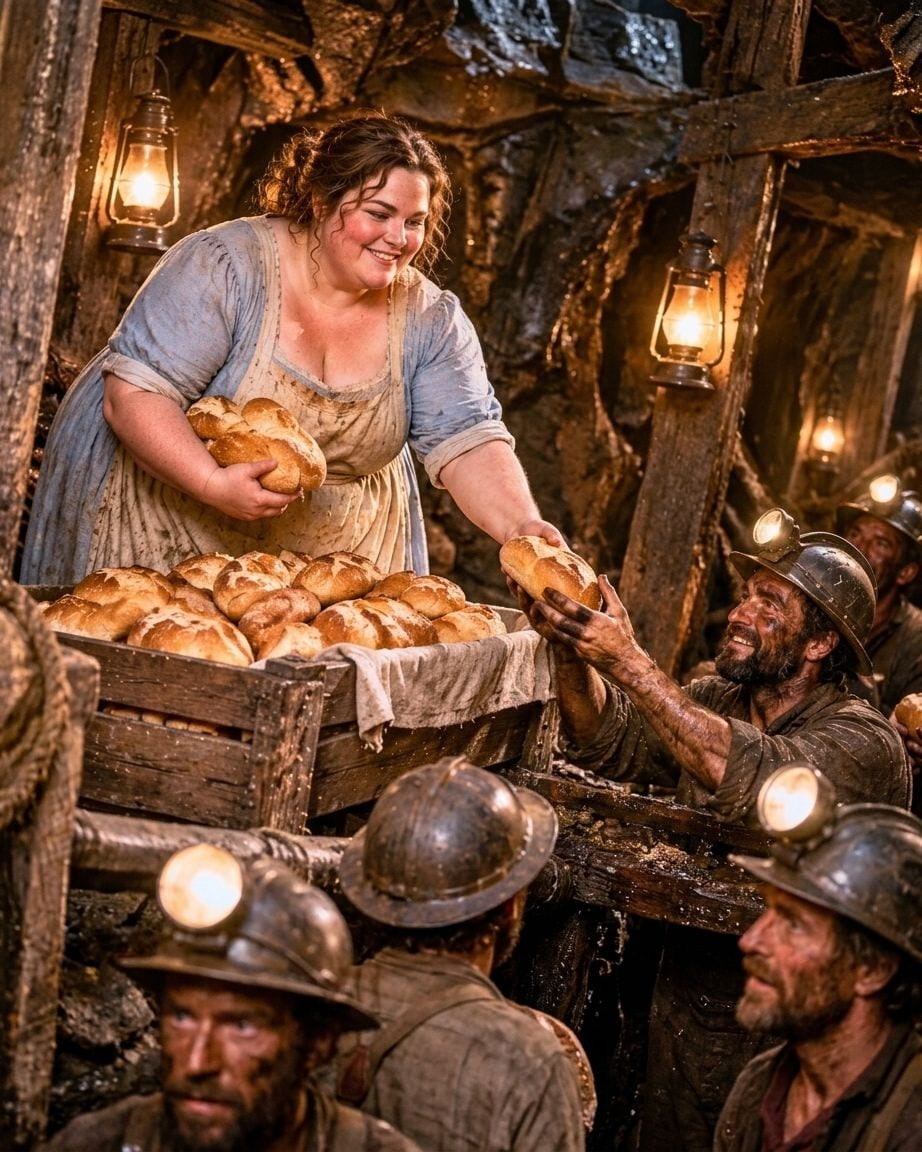
"FRANK ALCOTT! DON'T TRUST HIM!"
The frightened woman outside the rear window whispered the name just as a tall shadow moved across the glass.
Maggie Whitmore's hand froze on the latch.
Frank Alcott?
The merchant who had sold her six hundred pounds of ruined flour?
The man whose wife had sent potatoes and beans for the starving miners?
The same man who had warned her to be careful around Chester Pool?
Before Maggie could ask a question, the stranger ducked beneath the window.
A man's voice sounded from the darkness.
"Who's back there?"
The woman pressed one finger against her lips.
Maggie understood.
She stepped away from the window, grabbed a flour sack from the table, and deliberately knocked a wooden bucket onto the floor.
The crash echoed through the barn.
"Who's there?" she called toward the front door.
Footsteps moved around the building.
A moment later, someone knocked.
Three hard blows.
Maggie slipped the small metal box into a hollow beneath the worktable and covered it with a folded cloth.
Then she approached the door.
"Who is it?"
"Frank Alcott."
Her heart began pounding.
She glanced toward the rear window.
The woman had disappeared.
Frank knocked again.
"Maggie? You awake?"
She took a slow breath.
Then she opened the door.
Frank stood beneath the moonlight, holding his hat in one hand and a lantern in the other.
His face looked troubled.
Behind him, his horse waited beside the road.
"Sorry to disturb you so late," he said.
Maggie studied him.
His shirt was dusty.
His boots were muddy.
He looked like a man who had come directly from work.
But there was something else.
His eyes kept moving toward the barn.
"Everything all right?" she asked.
Frank nodded.
"Far as I know."
"Then what brings you here?"
He hesitated.
"Clara wanted me to check on you."
"At this hour?"
"She heard about Pool coming by."
Maggie folded her arms.
"News travels quickly."
"In Red Hollow, bad news travels faster."
Frank gave a tired smile.
Maggie didn't return it.
She remembered the woman's warning.
Don't trust him.
Frank noticed her expression.
"Something wrong?"
"That depends."
"On what?"
"Whether you're here because your wife sent you or because somebody else did."
Frank's smile vanished.
For several seconds, he said nothing.
Then he lowered his lantern.
"Maggie, what happened?"
She watched him carefully.
"Why do you ask?"
"Because you're looking at me like I'm holding a snake behind my back."
"Are you?"
Frank frowned.
"No."
"Then perhaps you'd better tell me why Chester Pool signed for a shipment that never reached the mine."
His face changed.
It was subtle.
A tightening around the mouth.
A quick movement of the eyes.
But Maggie saw it.
"Where did you hear that?"
"From the paperwork."
"What paperwork?"
"The delivery records."
Frank looked toward the stacked flour.
Then back at her.
"Those records were supposed to be with the company."
"They were inside the sacks you sold me."
He stared at her.
"Inside the flour?"
"Yes."
Frank rubbed his forehead.
"Lord help us."
Maggie waited.
He looked down the road before speaking again.
"Miss Whitmore, there's something you need to understand."
"I'm listening."
"Pool's been handling the mine accounts for years. I deliver supplies. He signs the receipts. The company settles the invoices."
"And?"
"And sometimes the paperwork doesn't match what actually gets delivered."
Maggie's stomach tightened.
"How long have you known?"
Frank looked ashamed.
"I knew there were discrepancies."
"How long?"
He swallowed.
"Several months."
Maggie stared at him.
"Several months?"
"I thought it was a bookkeeping problem."
"And the miners?"
"I didn't know they were going hungry."
She searched his face.
He looked genuinely distressed.
But that did not erase the warning.
"Frank, did you know there was something hidden in one of those sacks?"
He went completely still.
For one long moment, the only sound was the wind moving through the grass.
Then Frank whispered, "What did you find?"
Maggie did not answer.
His eyes widened.
"Was it a metal box?"
Her blood ran cold.
Maggie stepped backward.
Frank noticed immediately.
"Wait."
"How do you know about the box?"
He raised his empty hand.
"Please. Let me explain."
"You'd better."
Frank looked toward the road again.
Then he spoke in a low voice.
"Three nights ago, a woman came to my store after closing."
Maggie said nothing.
"Her name is Evelyn Price. She works as a bookkeeper for the mining company."
The name meant nothing to Maggie.
But the description did.
A woman.
A frightened woman.
Someone who knew about the records.
"Go on," Maggie said.
Frank continued.
"She told me Pool had been falsifying supply accounts. Said he was charging the miners for goods they never received and sending altered reports to the owners back east."
"Did she show you proof?"
"Some."
"What happened?"
"She asked me to keep something safe."
Maggie's eyes narrowed.
"The box."
Frank nodded.
"She said it contained copies of records Pool couldn't explain away."
"Why hide it in flour?"
"Because Pool's men had started watching her."
Maggie looked toward the worktable.
Frank followed her gaze.
"She was supposed to leave town with the evidence. But when she learned Pool had ordered the freight inspected, she asked me to conceal the box inside a sealed sack going toward the mine. She planned to recover it before the delivery was completed."
"And you agreed?"
"I did."
"Without telling anyone?"
"I was afraid."
Maggie stared at him.
Frank lowered his head.
"I've got a wife, Maggie. Two daughters. A store that took me twenty years to build."
His voice cracked slightly.
"Pool controls half the business in this town. If he decides to ruin a man, he can make it happen."
Maggie understood fear.
She understood the terrible calculations people made when their families depended on them.
But she also understood that silence could become its own kind of cruelty.
"Twenty-eight men have been going hungry," she said quietly.
Frank closed his eyes.
"I know."
"Do you?"
He looked at her.
"I do now."
Maggie studied him for another moment.
Then she asked, "Why didn't you tell the sheriff?"
Frank's expression darkened.
"Because Evelyn begged me not to."
"Why?"
"She said Pool had someone helping him."
"Who?"
Frank shook his head.
"She didn't know."
Maggie remembered the shadow outside the window.
The warning.
The frightened eyes.
"Where is Evelyn now?"
Frank looked confused.
"I thought she'd come here."
Maggie's heart skipped.
"Why?"
"Because she sent word this afternoon that she'd found the key."
Maggie said nothing.
Frank watched her.
Then he asked the question she had been dreading.
"Was she here?"
Maggie looked toward the darkness.
She could lie.
She could pretend she knew nothing.
But Frank already knew too much.
"She came to the rear window."
"When?"
"Just before you arrived."
Frank's face drained of color.
"Did she leave?"
"She disappeared when she heard someone approaching."
He turned sharply toward the road.
"Which direction?"
"I couldn't see."
Frank muttered a curse.
Then he looked at Maggie.
"We need to find her."
"Why?"
"Because if Pool knows she's been helping us, she isn't safe."
Maggie thought about the woman's frightened expression.
The small brass key.
The way she had whispered Frank's name.
"She told me not to trust you."
Frank stared at her.
Then he gave a bitter laugh.
"I don't blame her."
"Why would she say that?"
"Because I told her yesterday I wanted out."
Maggie frowned.
"Out of what?"
"Helping her."
He looked ashamed.
"I told her I couldn't risk my family anymore."
"And what did she say?"
"She said the miners couldn't afford for me to be afraid."
Maggie looked at him for a long moment.
Then she stepped aside.
"Come in."
Frank entered.
She closed the door.
And for the next hour, they examined everything they knew.
The damaged shipment.
The false delivery receipts.
The miners' unexplained debts.
The missing supplies.
The metal box.
The mysterious woman who had hidden it.
By the time Frank left, Maggie understood one thing clearly.
The flour was no longer merely a bargain.
It had become evidence.
And somebody was willing to frighten, threaten, and perhaps hurt people to get that evidence back.
The next morning, Maggie woke to shouting.
Not angry shouting.
Desperate shouting.
She sat upright on the narrow cot she had assembled beside the stove.
For a moment, she couldn't remember where she was.
Then she heard a man's voice.
"Miss Whitmore!"
Another voice answered.
"She's got to be here!"
Maggie pulled on her boots.
She crossed the room and opened the front door.
What she saw stopped her cold.
Men stood along the mine road.
Not three.
Not six.
A crowd.
Their clothes were covered in coal dust.
Their faces were drawn.
Some leaned against the fence.
Others stood with their hats in their hands.
One older man sat on an overturned bucket, breathing heavily.
Maggie counted quickly.
Twenty-eight.
Every miner Samuel had mentioned.
And at the front stood Samuel Reed himself.
His face was pale.
His eyes were bloodshot.
Beside him, Thomas Bell looked barely able to stand.
Maggie stepped outside.
"Samuel?"
He removed his hat.
"Morning, Miss Whitmore."
She stared at the men.
"What happened?"
Samuel swallowed.
"Pool closed the commissary."
Maggie's stomach dropped.
"When?"
"Last night."
"Why?"
"Said there'd be no more food advances until our debts were settled."
Walter Briggs stepped forward.
"Some of the men haven't eaten properly in four days."
Maggie looked toward Thomas.
His hands were trembling.
She approached him.
"Thomas?"
He tried to smile.
"Morning, ma'am."
"When did you last eat?"
He looked embarrassed.
"Yesterday."
"What?"
"A little broth."
"Before that?"
He didn't answer.
Maggie turned toward Samuel.
"How long have you been working?"
"Night shift."
"All of you?"
"Most."
She looked down the line.
Men who spent their days underground.
Men who lifted ore.
Men who worked beside unstable rock and heavy machinery.
Men whose bodies needed food to survive.
And now they were standing outside an abandoned barn, hoping a woman they barely knew might have something to give them.
Samuel stepped closer.
"Miss Whitmore, I know you said you weren't ready."
Maggie said nothing.
"I know you haven't got permission to open."
Still she said nothing.
"But we heard you managed to bake some bread."
His voice became quieter.
"And we didn't know where else to go."
Maggie looked at the twenty-eight men.
Then she looked at the old stove behind her.
She had one small loaf.
Some beans.
A basket of potatoes.
A little salt.
And several sacks of flour she believed were safe to use after careful inspection.
It wasn't enough for twenty-eight full meals.
Not yet.
But it was something.
She stepped aside.
"Come in."
Samuel stared.
"Ma'am?"
"I said come in."
The men hesitated.
Maggie raised her voice.
"Anybody who can stand can help. Anybody who can't can sit. And nobody's going back underground on an empty stomach if I can do something about it."
For several seconds, nobody moved.
Then Walter Briggs removed his hat.
"God bless you, Miss Whitmore."
Maggie shook her head.
"Save your blessings until you've tasted the food."
A few men laughed.
It was a weak sound.
But it was laughter.
The kind Maggie wanted to hear.
Not cruel.
Not mocking.
Human.
Samuel entered first.
Then Thomas.
Then Walter.
The others followed.
The barn filled with the scrape of boots and the murmur of exhausted voices.
Maggie immediately began giving instructions.
"Samuel, fetch clean water."
"Yes, ma'am."
"Walter, bring in those benches."
"Right away."
"Thomas, sit down."
"I can help."
"You can help by not falling over."
Thomas obeyed.
Maggie pointed toward two younger miners.
"You two. Wash your hands and scrub those potatoes."
They moved immediately.
Another man offered to chop wood.
Someone else carried buckets.
Within minutes, the abandoned barn had become a working kitchen.
Not a proper one.
Not yet.
But a kitchen nonetheless.
Maggie stood before the stove and felt something settle inside her.
This was familiar.
This was work she knew.
And for the first time since arriving in Red Hollow, nobody was asking whether she belonged.
She began with the beans.
They needed time.
Too much time for men who were already hungry.
So she set them to cook for later, using clean water and the stove's steady heat.
Then she turned to the potatoes.
She sliced them thinly so they would cook quickly.
She used a little saved cooking fat, salt, and the cleanest pan she could find.
The smell began filling the room.
Men lifted their heads.
Thomas closed his eyes.
Maggie noticed.
"Don't you dare faint before breakfast," she told him.
He managed a smile.
"I'll try, ma'am."
She took the small loaf she'd baked the night before and cut it into thin pieces.
Twenty-eight portions would be tiny.
She knew that.
But she also knew that even a small amount of food could steady a man long enough to wait for more.
She handed the first piece to Thomas.
He stared at it.
"Go on."
He took a bite.
His eyes filled with tears.
Maggie looked away.
Not because she was embarrassed.
Because she understood what it meant to be hungry enough that a piece of bread felt like kindness.
She returned to the stove.
The potatoes sizzled.
The room grew warmer.
Men began talking.
Quietly at first.
Then more freely.
One told a story about his daughter learning to read.
Another complained about a stubborn mule.
Walter argued with Samuel about the best way to repair the barn's back wall.
For a few precious minutes, they sounded like ordinary men again.
Not debtors.
Not desperate workers.
Just people waiting for breakfast.
Maggie listened while she cooked.
And she realized something.
The Copper Lantern Kitchen was already beginning to exist.
Not because of a sign.
Not because of a lease.
Not because of a polished stove or matching chairs.
Because twenty-eight hungry men had come through her door.
And she had refused to turn them away.
By midmorning, the first potatoes were ready.
Maggie divided them carefully.
No man received a large portion.
But every man received something.
She explained that the beans would take longer and that she was working on a proper meal.
Nobody complained.
Nobody demanded more.
Instead, several men offered to contribute what they could.
A handful of onions.
A small piece of smoked meat.
A jar of preserved vegetables.
A few eggs from a miner who kept chickens behind his rented room.
Maggie accepted each contribution with gratitude.
She kept track of everything.
She intended to repay kindness when she could.
Samuel watched her from beside the stove.
"You've done more for these men in two hours than Pool's done in two months."
Maggie shook her head.
"I've fed them scraps."
"You've fed them hope."
She looked at him.
"Hope won't fill a stomach."
"No," Samuel said. "But it's a start."
Maggie smiled faintly.
Then she noticed Thomas standing near the doorway.
He was staring outside.
His expression had changed.
"Thomas?"
He didn't answer.
She approached him.
"What is it?"
He pointed toward the road.
A black carriage was approaching.
Maggie recognized it immediately.
Chester Pool.
Samuel came to stand beside her.
The carriage stopped.
Pool stepped down.
He looked at the crowd of miners gathered inside the barn.
Then at the smoke rising from the chimney.
Then at Maggie.
His face turned red.
"What is the meaning of this?"
Maggie stepped into the doorway.
"Good morning, Mr. Pool."
"These men are supposed to be working!"
"They've finished the night shift."
"They have obligations!"
"They also have stomachs."
Pool's eyes narrowed.
"You have no authority to operate a business here."
"I'm not charging anyone for this meal."
"You're interfering with company discipline."
Maggie folded her arms.
"I'm feeding hungry men."
Pool stepped closer.
"You think you're clever, don't you?"
"No, sir."
"Then perhaps you don't understand what you're doing."
Maggie looked at the miners behind her.
Then back at Pool.
"I understand exactly what I'm doing."
Pool's voice dropped.
"You're making enemies."
Maggie held his gaze.
"I've noticed."
For a moment, neither spoke.
Then Pool smiled.
It was a terrible smile.
"Very well."
He turned toward his carriage.
"Enjoy your little breakfast."
Maggie watched him.
Something in his tone made her uneasy.
Pool climbed inside.
Before the driver moved, he leaned toward the window.
"Oh, Miss Whitmore?"
She looked at him.
"Yes?"
"Ask Samuel Reed what happened to the last man who questioned the commissary accounts."
Samuel went completely still.
Pool smiled again.
Then the carriage rolled away.
Maggie turned toward Samuel.
His face had lost all color.
"Samuel?"
He looked away.
"What was he talking about?"
"Nothing."
"Don't lie to me."
Samuel rubbed his hands together.
The other miners had fallen silent.
Walter stared at the floor.
Thomas looked frightened.
Maggie felt the room changing.
The warmth.
The conversation.
The fragile comfort.
All of it seemed to drain away.
"Samuel," she said quietly, "what happened to the last man?"
He swallowed.
For several seconds, he couldn't speak.
Then he said, "His name was Peter Harlan."
Maggie waited.
"He worked the supply records before Evelyn Price."
"What happened to him?"
Samuel looked toward the road.
"He found discrepancies."
"And?"
"He tried to report them."
Maggie's chest tightened.
"Then what?"
Samuel's voice became barely audible.
"Three days later, he disappeared."
The room went silent.
Maggie stared at him.
"Disappeared?"
Samuel nodded.
"Left his room. Never came back."
"Was there an investigation?"
"The company said he stole money and ran."
"Did you believe that?"
Samuel shook his head.
"No."
"Why not?"
He looked at her.
"Because he left his wife and little boy behind."
Maggie felt a chill.
She thought of Evelyn Price.
The metal box.
The frightened woman at the window.
And the warning about Frank Alcott.
"Where is Peter's family now?" she asked.
Samuel hesitated.
"His wife moved to Denver."
"And the boy?"
"With her."
Maggie nodded slowly.
Then she looked toward the worktable.
The metal box was still hidden beneath it.
Inside might be evidence powerful enough to expose what had happened to the miners' wages.
Perhaps even what had happened to Peter Harlan.
She needed to find Evelyn.
She needed to understand the records.
And she needed to protect the men who had trusted her.
But first, she had to finish feeding them.
She turned toward the stove.
"Everybody sit down."
Samuel stared.
"Maggie—"
"Sit down."
Her voice was firm.
"The beans aren't ready yet, and I'm not letting Chester Pool frighten twenty-eight men out of the first decent meal they've had in days."
Slowly, the miners returned to their seats.
Maggie stirred the pot.
Her hands were steady.
Her mind was not.
She had come to Red Hollow looking for work.
She had bought ruined flour because she saw something worth saving.
Now she was standing in a barn full of hungry miners, holding a secret that might be dangerous enough to get someone killed.
And still, she had never felt more certain that she was exactly where she needed to be.
Late that afternoon, after the men had eaten what they could and returned to their homes, Maggie remained alone in the kitchen.
She cleaned the pots.
Washed the table.
Counted the remaining supplies.
Then she retrieved the metal box.
The initials stared back at her.
C. A. P.
She turned it over.
The lock was small.
The keyhole narrow.
Evelyn had carried the key.
But Evelyn had vanished.
Maggie placed the box beneath the lantern.
She examined the scratches around the clasp.
Then she noticed a small folded corner of paper protruding from beneath the lid.
She pulled gently.
The paper slid free.
It was a receipt.
Old.
Yellowed.
Stamped with the mining company's seal.
At the bottom was a signature.
Peter Harlan.
Maggie's breath caught.
She turned the paper over.
On the back, written in hurried pencil, were six words:
THE MONEY NEVER LEFT RED HOLLOW.
Maggie stared at the message.
Then came a knock.
Soft.
Three times.
She looked toward the door.
"Who's there?"
No answer.
Another knock.
Maggie slipped the receipt into her pocket.
She approached the entrance.
"Who's there?"
A woman's voice answered.
Weak.
Breathless.
"Maggie... please."
Maggie's heart jumped.
"Evelyn?"
"Open the door."
Maggie lifted the latch.
The door swung inward.
Evelyn Price stood on the threshold, pale and trembling, one hand pressed against her side.
Her dress was torn.
Her hair had come loose.
And in her other hand, she held the small brass key.
Maggie reached toward her.
"Evelyn, what happened?"
Evelyn stumbled forward.
Maggie caught her before she fell.
The woman gripped Maggie's sleeve with surprising strength.
"Don't give the box to the sheriff," she whispered.
Maggie froze.
"Why?"
Evelyn looked up.
Her eyes were filled with terror.
"Because Peter Harlan didn't disappear."
Maggie's breath stopped.
Evelyn struggled to speak.
"He was taken."
"By whom?"
Evelyn opened her mouth.
Then footsteps sounded outside.
Heavy.
Deliberate.
Coming straight toward the door.
Evelyn's fingers tightened around Maggie's arm.
"He's here," she whispered.
Maggie turned toward the entrance.
A shadow filled the doorway.
Then a familiar voice spoke from the darkness.
"Maggie Whitmore. Step away from that woman."
It was Sheriff Daniel Mercer.
And he was holding a pair of handcuffs.






Comments 0