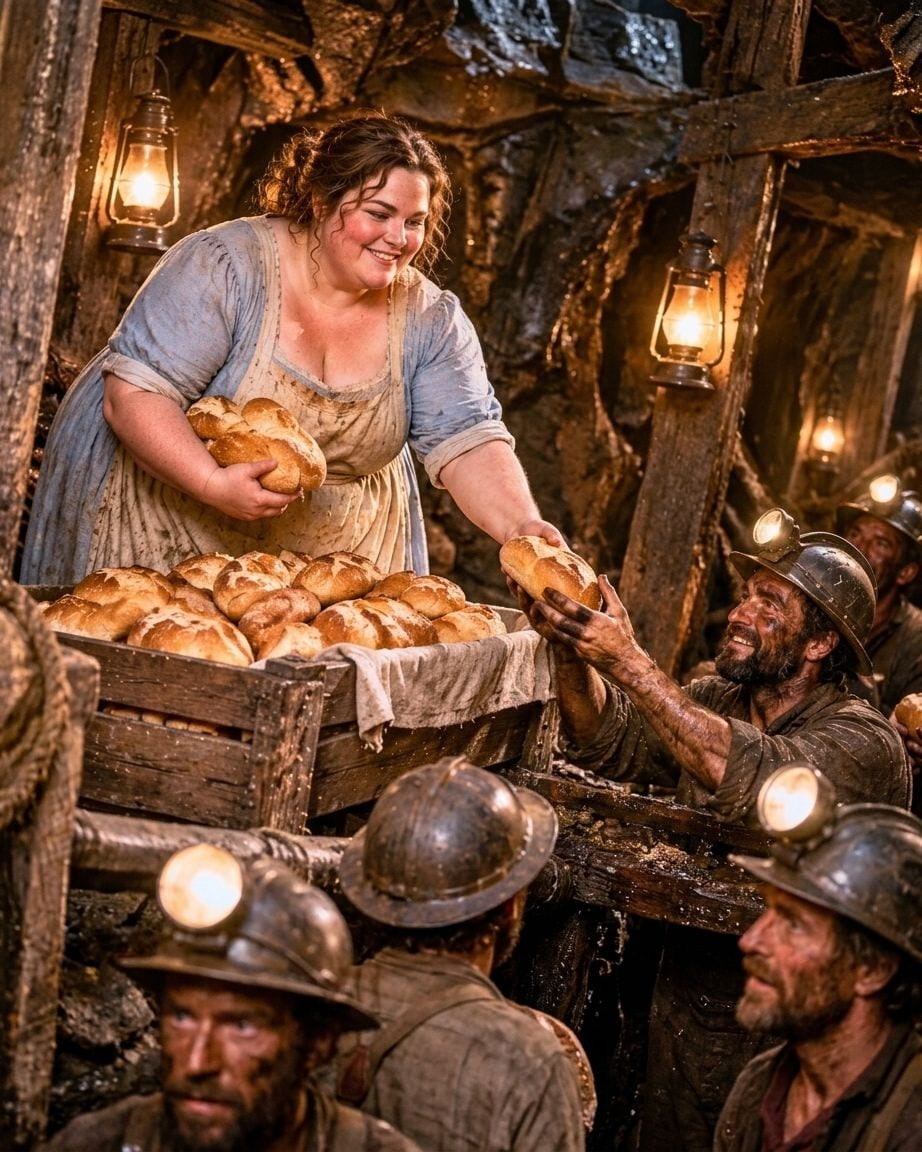
"THAT BOY IS THE TRUE OWNER OF THE EASTERN MINE!"
Maggie Whitmore stood beside the kitchen table, staring at the little boy holding the silver whistle.
Samuel Price had returned.
His mother, Evelyn, was holding him so tightly that he could barely move, while Peter stood beside them with tears running down his face.
But Maggie's attention remained fixed on the document Arthur had placed before her.
The original signature.
The final piece of evidence her father had hidden.
Arthur examined it carefully.
Then he looked at the second deed.
"I recognize this handwriting," he said.
Maggie turned.
"Whose?"
Arthur swallowed.
"Your father's."
Thomas Bell nodded.
"Elias prepared that document shortly before he died. He wanted the eastern mine protected from anyone who intended to exploit it."
Maggie looked at the little boy.
"Why did he choose Samuel?"
Thomas smiled.
"Because Elias believed the next generation deserved something better than the greed of the last."
Peter placed his hand on his son's shoulder.
"Samuel's grandfather was one of the miners who helped Elias establish the original operation. He trusted the Price family."
Evelyn wiped her tears.
"But we're not wealthy people. We don't know anything about running a mine."
Thomas shook his head.
"You won't have to run it alone. The agreement establishes a trust. Maggie becomes the temporary trustee, and the miners receive their rightful share."
Arthur pointed toward the final paragraph.
"And the original deed prevents Edward Whitmore or anyone acting on his behalf from claiming ownership."
Maggie looked at the document.
For weeks, she had fought to save a kitchen.
She had never imagined that her father's forgotten property would become the foundation of an entirely different future.
But she understood what mattered now.
The boy had to be protected.
The miners had to be paid.
And nobody would ever again be allowed to steal the work of ordinary people while hiding behind expensive clothes and important titles.
She looked at Samuel.
"Would you like to help us protect this place?"
The boy nodded.
Then he held up his silver whistle.
"Grandpa said I should keep this safe."
Maggie smiled.
"Then you've already done your part."
The following morning, Sheriff Mercer summoned the town council.
The meeting took place inside the courthouse.
Nearly every miner in Red Hollow attended.
Frank Alcott arrived with Clara.
Samuel Reed stood beside Walter Briggs.
Evelyn and Peter sat together with their son between them.
Arthur brought the original documents.
Thomas Bell carried the confession he had kept hidden for fifteen years.
And Maggie entered carrying the trust agreement.
Judge Whitcomb was no longer on the bench.
He had been formally suspended pending trial.
Edward Whitmore and Chester Pool remained in custody.
The room grew quiet when Mercer stood.
"People of Red Hollow, we've spent years believing that the missing wages were the result of poor accounting and dishonest employees."
He placed the bank records on the table.
"We now know they were stolen deliberately."
He explained how the money had been transferred through false accounts, how the original payroll records had been hidden, and how Peter Harlan had been imprisoned to prevent him from exposing the scheme.
Then Arthur presented his father's confession.
He admitted that Thomas Bell had altered the birth record under threat, but that the original document proved Maggie's legitimate inheritance.
Thomas stood.
"I made a terrible mistake," he said. "I allowed fear to silence me. I cannot undo those years, but I can tell the truth now."
Nobody interrupted him.
He placed his signature beneath the original statement.
Then Peter stepped forward.
"I was accused of stealing company money. I never stole a dollar. I kept records because I believed the miners deserved to know what was happening to their wages."
He opened the old ledger.
"Every payment is documented. Every missing dollar can be traced."
Maggie watched the miners exchange looks.
Some were angry.
Others were crying.
Samuel Reed finally stood.
"I worked in that mine for seventeen years. I watched good men lose their homes because their wages disappeared. I watched families leave town because they couldn't afford food."
He turned toward Maggie.
"Then a woman bought six hundred pounds of ruined flour for six dollars."
A few people laughed softly.
Samuel continued.
"Everyone thought she was foolish. I thought she was the first person in this town who understood what we needed."
Maggie lowered her eyes.
She hadn't expected anyone to remember that morning so clearly.
Samuel looked toward the miners.
"She gave us a place to eat when nobody else wanted us. She gave us work when nobody else would hire us. And now she's giving us back something we thought was gone forever."
The room erupted in applause.
For the first time, Maggie didn't feel the need to defend herself.
She simply stood there and allowed the people around her to recognize what she had built.
The legal proceedings lasted several weeks.
The evidence was overwhelming.
The bank records confirmed the stolen transfers.
Peter's original accounting books established the true payroll amounts.
Thomas's confession proved the birth record had been deliberately altered.
And Elias Whitmore's trust agreement established the rightful ownership of the eastern mine.
Edward attempted to deny everything.
He claimed that the documents were fabricated and that Peter had invented his imprisonment to escape responsibility for the missing money.
But Elias's original signatures matched the county archives.
The bank's records confirmed the transactions.
And several former employees agreed to testify.
One of them was Caleb Finch.
He had been found hiding in a boardinghouse outside Denver.
At first, he refused to speak.
But when he learned that Edward intended to blame him for the entire scheme, he finally confessed.
He admitted delivering secret instructions, transferring false records, and helping Edward conceal the stolen wages.
His testimony connected Edward, Pool, and Whitcomb to the conspiracy.
The court also confirmed that Thomas Bell had been falsely reported dead.
His death certificate was canceled, and his testimony became part of the official record.
Edward Whitmore was convicted of fraud, unlawful imprisonment, conspiracy, and theft.
Chester Pool received a separate conviction for his involvement in the false documents and Peter's detention.
Judge Whitcomb lost his position and was sentenced for corruption.
Caleb Finch cooperated with investigators and received a reduced sentence.
The stolen money was recovered from the private bank accounts.
And the original payroll records became the foundation for calculating every miner's unpaid wages.
For the first time in years, Red Hollow had a chance to begin again.
The day the miners received their money was one Maggie would remember for the rest of her life.
The courthouse doors opened shortly after nine.
A clerk called each name.
Samuel Reed.
Walter Briggs.
Joseph Turner.
Henry Collins.
One by one, the men stepped forward.
Some had been waiting nearly four years.
Others had lost homes, savings, and family members because of the stolen wages.
When Samuel received his payment, he stared at the envelope for a long time.
Then he turned toward Maggie.
"That's a lot of flour," he said.
Maggie laughed.
"Enough for several kitchens."
He shook his head.
"No. Enough for a whole town."
The recovered money was distributed according to the original payroll records.
The trust also established a permanent fund for miners' families, including medical assistance and support for children whose fathers had died working underground.
Maggie insisted that the money be administered publicly.
No secret accounts.
No private arrangements.
No single person controlling everything.
Arthur helped establish the records office.
Thomas supervised the verification of old property documents.
Peter was appointed as the independent bookkeeper for the mining trust.
And Samuel Price, still a little boy, became the legal beneficiary of the eastern mine's trust.
Maggie accepted the position of trustee.
But she added one condition.
The Copper Lantern would remain open to everyone.
No miner would ever be turned away because he couldn't afford a meal.
No woman would be denied work because someone considered her appearance unsuitable.
And no child would have to watch a parent go hungry because a powerful man had decided that their labor wasn't worth paying for.
The town council approved every condition.
The inheritance dispute was finally resolved three months later.
The court recognized Maggie as the legitimate daughter and sole heir to the original Copper Lantern property.
Edward's fraudulent transfer was declared invalid.
The eastern mining land was placed under the trust established by Elias Whitmore.
Maggie retained ownership of the building.
Samuel Price received the legal beneficiary rights.
And the twenty-eight miners became the first members of the permanent workers' trust.
Thomas Bell personally signed the corrected county records.
When he finished, he placed the pen on the desk and looked at Maggie.
"Your father would have liked this."
Maggie smiled.
"I wish he could have seen it."
Thomas nodded.
"He did his best to leave something good behind."
Arthur approached his father.
"There's something I've been meaning to ask you."
Thomas turned.
"What is it?"
"Would you come live with me?"
Thomas looked surprised.
Arthur continued.
"I've spent fifteen years thinking I had no father. I don't want to waste whatever time we have left."
Thomas's eyes filled.
He placed one hand on his son's shoulder.
"I would like that very much."
Arthur embraced him.
And for the first time in many years, neither man had to say goodbye.
The Copper Lantern reopened with a new sign above the entrance.
Maggie had chosen the words herself.
THE COPPER LANTERN KITCHEN — GOOD FOOD. HONEST WORK. EVERYONE WELCOME.
The old feed barn had been repaired.
The roof no longer leaked.
The windows had been replaced.
A second stove had been installed, along with larger tables and a proper pantry.
Frank supplied the kitchen at fair prices.
Clara managed the accounts.
Evelyn helped with the daily cooking.
Peter handled the books for the miners' trust in a small office at the back.
Samuel Reed supervised deliveries and repairs.
Walter Briggs became responsible for hiring workers from the surrounding camps.
Arthur and Thomas visited regularly, usually bringing fresh documents that needed filing.
Even Sheriff Mercer stopped by for breakfast whenever his duties allowed.
The kitchen became the busiest place in Red Hollow.
Miners arrived before sunrise.
Ranchers came for lunch.
Families gathered on Sundays.
Travelers stopped because they had heard that a woman named Maggie served the best bread in Colorado.
But Maggie never forgot the first twenty-eight men.
She kept a small photograph of them near the stove.
Whenever someone asked about it, she told them how those men had helped her build something from nothing.
She never mentioned the cowboys who had laughed.
She didn't need to.
The town remembered.
One autumn morning, Maggie stood outside the kitchen watching Samuel Price chase a small wooden wagon across the yard.
The boy had grown taller.
His face was healthier.
His laugh was louder.
Peter was repairing a fence nearby while Evelyn hung clean towels on the line.
The family had moved into a modest house near the mine road.
They were no longer afraid of footsteps outside their door.
Maggie smiled when Samuel ran toward her.
"Miss Maggie!"
She bent slightly.
"What is it?"
He held up the silver whistle.
"I found something."
"What?"
He turned it over.
A small engraving had been hidden beneath the metal clasp.
It showed a miner holding a lantern.
Samuel traced the image with his finger.
"Did my grandfather make this?"
Maggie examined it.
"Perhaps."
"Can I keep it?"
"Of course."
He put the whistle around his neck.
Then he looked toward the kitchen.
"Mom says there's bread ready."
"She's right."
"Can I have two pieces?"
Maggie laughed.
"Only two?"
Samuel grinned.
Then he ran back toward his mother.
Maggie watched him go.
She thought about Elias Whitmore.
About the letter in the wall.
About the flour scattered along the river road.
And about the six silver dollars she had placed in Frank Alcott's hand.
That purchase had seemed ridiculous to everyone who watched it.
But Maggie had never bought the flour because she believed it was worthless.
She bought it because she knew what could still be made from something other people had abandoned.
That evening, the kitchen was full.
Frank and Clara sat with Arthur and Thomas.
Peter and Evelyn occupied their usual table.
Samuel Reed was telling a story that made Walter laugh so hard he nearly dropped his cup.
Sheriff Mercer stood near the stove, arguing with Frank about the price of coffee.
Maggie moved between the tables, checking plates and refilling cups.
Nobody cared how much space she took up.
Nobody questioned whether she belonged.
She was simply Maggie Whitmore.
The woman who had built a kitchen when the town had refused to give her a job.
The woman who had refused to let powerful men decide whose lives mattered.
When the last meal had been served, Samuel Reed approached her.
He placed six silver dollars on the counter.
Maggie stared.
"What's this?"
He smiled.
"Payment."
"For what?"
"For the first meal I ever ate here."
Maggie shook her head.
"You paid for that meal years ago."
"I know."
"Then take your money back."
Samuel pushed the coins toward her.
"Keep them."
She looked at him.
He continued.
"Put them in a frame. So nobody forgets where this started."
Maggie picked up the coins.
For a moment, she couldn't speak.
Then she smiled.
"All right."
She placed them inside the small wooden frame above the stove.
Beneath them, she added a handwritten sentence:
SIX DOLLARS FOR SIX HUNDRED POUNDS OF FLOUR. AND A FUTURE NOBODY COULD TAKE AWAY.
The next morning, sunlight poured through the kitchen windows.
The stove was warm.
Fresh bread filled the room with its familiar smell.
Outside, miners walked toward the eastern mine knowing their wages were protected.
Inside, families gathered around tables knowing there would always be a place for them.
Maggie stood beside the counter and watched the town wake up.
She had arrived in Red Hollow with eleven dollars and forty cents, no job, and nowhere to belong.
She now had a thriving kitchen, a community that trusted her, and a future built on the very ground someone had tried so desperately to steal.
She had not needed to become thinner, richer, or more important to deserve respect.
She had simply needed the chance to show what she could do.
And when the first customer entered that morning, Maggie reached for a fresh loaf of bread, smiled, and welcomed him home.
The Copper Lantern would remain open.
The miners would never again lose their wages.
Samuel Price would grow up with a future his family had once been denied.
And Maggie Whitmore finally had the one thing she had been searching for since arriving in Red Hollow.
A place where she belonged.






Comments 0