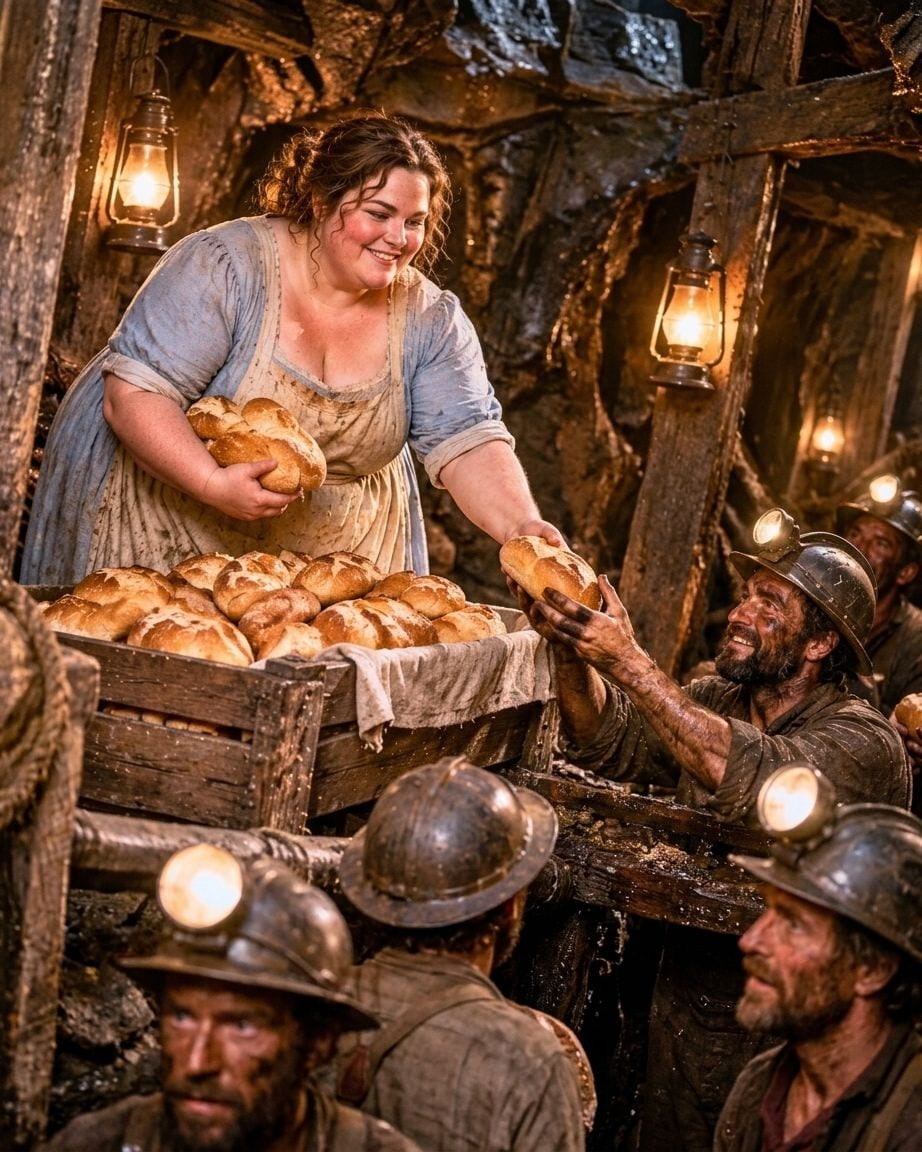
"Don't open that door until you tell me who sent you!"
Maggie Whitmore stood beside the stacked flour sacks, one hand gripping the folded shipping note and the other resting on the heavy wooden worktable.
Outside, the footsteps stopped.
For several seconds, nobody answered.
Then a man's voice came through the cracked door.
"My name's Samuel Reed. I work the lower shaft at Red Hollow Mine."
Maggie didn't move.
"That doesn't explain why you're here."
"No, ma'am. It doesn't."
Something about his voice caught her attention.
He sounded exhausted.
Not merely tired from a day's labor, but worn down in a way Maggie recognized from twelve years of feeding miners. She had heard that same strain in men who had worked double shifts, men who had gone too long without sleep, and men who were trying to hide hunger because admitting it felt too much like admitting defeat.
"How many men are out there?" she asked.
"Three."
"Armed?"
A pause.
"We've got our work knives. Nothing drawn."
Maggie considered that answer.
At least he hadn't lied about carrying knives.
She approached the door and lifted the crooked wooden latch.
When she opened it, three miners stood beneath the fading evening light.
The man in front was perhaps forty-two, tall and broad through the shoulders, with a dark beard streaked gray and deep lines around his eyes. Coal dust had settled into every crease of his face. His shirt was patched at both elbows, and one hand was wrapped in a dirty bandage.
The younger man beside him couldn't have been more than twenty. He was painfully thin, with hollow cheeks and a nervous habit of twisting his cap between his fingers.
The third man was older, his back slightly bent, his expression guarded.
Samuel Reed removed his hat.
"Evening, Miss Whitmore."
"Evening."
His eyes moved past her shoulder.
He saw the sacks.
Something changed in his face.
"Lord," he whispered. "You really did buy them."
Maggie held up the shipping note.
"Perhaps you'd better tell me why this was tucked into one of my sacks."
Samuel stared at the paper.
The younger miner took an involuntary step forward.
"That's our kitchen order," he said.
Samuel raised a hand, stopping him.
Maggie noticed.
She noticed everything when men were nervous.
"Your kitchen order?" she repeated.
Samuel nodded.
"Those sacks were supposed to reach the mine commissary yesterday."
"Frank Alcott told me they were part of his general freight."
"They were. He was delivering them under contract."
"Then why didn't somebody from the mine come claim what was left?"
The older miner gave a bitter laugh.
"Because the company said the whole shipment was ruined."
Maggie looked toward the flour.
"Some of it is."
"That's what they told us," Samuel said. "Every last pound."
"And now?"
Samuel swallowed.
"Now the company says there won't be another delivery until the accounts are settled."
Maggie studied him.
"What accounts?"
Samuel looked at the other two men.
Neither answered.
Finally, he said, "That's what we're trying to find out."
Maggie stepped aside.
"You'd better come in."
The men entered cautiously, as though the abandoned barn belonged to someone important.
The youngest miner looked around at the dusty shelves, broken crates, and cold iron stove.
"You're opening a kitchen here?"
"I'm considering it."
"By yourself?"
Maggie gave him a look.
"Do you see anybody else?"
His cheeks reddened.
"No, ma'am."
"Then I suppose that answers your question."
Samuel almost smiled.
Almost.
Maggie gestured toward the worktable.
"Sit down."
The older miner remained standing.
Samuel pulled out a chair, but the youngest man hesitated before taking his seat.
Maggie noticed the way his eyes kept drifting toward a small parcel on the table.
It contained the last two biscuits she'd bought that morning.
She pushed the parcel toward him.
"Go ahead."
He shook his head.
"Couldn't."
"You can."
"Those are yours."
"And I'm offering."
He looked at Samuel.
Samuel nodded.
The young man took one biscuit and broke it carefully in half, offering the larger piece to the older miner.
That small gesture told Maggie more than a dozen explanations could have.
These men weren't merely worried about food.
They were already dividing scraps.
"What's your name?" she asked the young miner.
"Thomas Bell, ma'am."
"How old are you, Thomas?"
"Nineteen."
"How long since you ate a proper meal?"
Thomas stared at the biscuit.
"Depends what you mean by proper."
Maggie's stomach tightened.
Samuel answered for him.
"Three days."
The room went quiet.
Maggie looked from one face to another.
"Three days?"
"We've had something," Samuel said quickly. "A little cornmeal. Some beans. But the commissary's been cutting portions."
"Why?"
Samuel leaned forward.
"That's why we're here."
He placed a folded piece of paper on the table.
Maggie unfolded it.
It was a notice bearing the Red Hollow Mining Company's printed heading.
The writing announced a temporary suspension of food advances until outstanding employee debts could be reconciled.
At the bottom was the signature of the company's local administrator.
Chester Pool.
Maggie stared at the name.
She knew that signature.
She had seen it three days earlier.
On the rejection letter from the Alcott Grand.
Three mornings earlier, Maggie Whitmore had walked into the finest hotel in Red Hollow carrying twelve years of experience and a letter of recommendation.
She had worn her cleanest brown dress.
Her hair had been pinned neatly.
Her boots had been polished with the last of the wax she'd brought from Pueblo.
She remembered the way the hotel's dining room smelled.
Fresh coffee.
Butter.
Roasted meat.
Warm bread.
It had been nearly impossible not to smile.
A good kitchen had a particular sound.
Pans moving.
Knives working.
Water heating.
People calling instructions over the steady rhythm of preparation.
Maggie had recognized that sound immediately.
It was the sound of work she understood.
She approached the front desk.
"I'm here about the kitchen position."
The clerk looked up.
Then down.
Then up again.
His expression changed so quickly that Maggie almost laughed.
Almost.
"Kitchen position?"
"Yes, sir."
"You're applying?"
"That's generally why people come asking about employment."
He cleared his throat.
"One moment."
He disappeared through a side door.
Maggie waited.
Behind her, two well-dressed women sat near the window drinking tea.
One whispered something.
The other glanced toward Maggie.
Then both looked away.
Maggie pretended not to notice.
She had become exceptionally skilled at pretending.
A few minutes later, Chester Pool appeared.
He was a narrow man with carefully combed hair, polished shoes, and a stiff collar that seemed determined to keep his chin elevated.
He smiled.
It was a practiced smile.
The kind men used when they wanted to appear generous without actually giving anything.
"Miss Whitmore?"
"Yes, sir."
"I'm Chester Pool."
"A pleasure."
He held out his hand.
She shook it firmly.
His smile tightened.
"Well. You have quite a grip."
"Twelve years in working kitchens will do that."
"Indeed."
She handed him her letter.
He read it.
Or appeared to.
His eyes moved across the page, but Maggie noticed how often they returned to her figure.
Finally, he folded the paper.
"Your references are impressive."
"Thank you."
"However, our kitchen is a demanding environment."
"I understand."
"The hours are long."
"I'm accustomed to fourteen-hour days."
"The work requires considerable stamina."
"I've fed forty miners before sunrise with one assistant and a stove that barely drew."
Pool's smile became thinner.
"Yes, well..."
He glanced toward the dining room.
Maggie waited.
"The position may not be suitable."
"May not?"
"We have certain expectations."
"About cooking?"
"About presentation."
There it was.
The word men used when they didn't want to say what they meant.
Presentation.
Maggie looked at him steadily.
"Mr. Pool, are you hiring a cook or a centerpiece?"
His cheeks colored.
"There's no need to be unpleasant."
"I'm asking a reasonable question."
"And I'm giving you a reasonable answer."
He returned her letter.
"I appreciate your interest, Miss Whitmore."
She looked at the paper in his hand.
Then she took it.
"Have you tasted my cooking?"
"No."
"Spoken to my former employer?"
"No."
"Asked me to prepare anything?"
"Miss Whitmore—"
"Then you haven't evaluated a cook."
Pool's expression hardened.
"You may leave now."
Maggie stood perfectly still.
For one foolish moment, she had wanted to argue.
She had wanted to tell him about the winter in Pueblo when she kept a kitchen running through a blizzard.
About the time she fed thirty-six men after a cave-in delayed their relief crew.
About the sick miner who couldn't stomach anything until she made him broth from the last chicken in camp.
But she knew that look.
She had seen it before.
A man who had already decided what she was worth would not be persuaded by evidence.
She turned and walked out.
Behind her, the dining room continued its cheerful clatter.
And the smell of fresh bread followed her all the way into the street.
The Red Hollow Hotel rejected her that afternoon.
The manager barely glanced at her reference.
"We need someone who can move quickly."
"I can."
"Our kitchen is narrow."
"I've worked in narrower."
"We're not hiring."
"Your notice says otherwise."
He removed the notice from the window while she watched.
At the first boarding house, the owner looked her over and said, "My kitchen isn't built for this."
He made a vague gesture toward her body.
Maggie stared at him.
"Your kitchen has a stove, doesn't it?"
"Of course."
"A table?"
"Yes."
"Then what's missing?"
He opened his mouth.
Closed it.
Then said, "Good day, ma'am."
At the second boarding house, the owner didn't bother with an explanation.
He simply shook his head.
By the third day, Maggie had visited every establishment in Red Hollow that might employ a cook.
Not one had offered her a chance.
She had walked until her feet hurt.
Smiled until her cheeks ached.
Answered questions that had nothing to do with her abilities.
And endured the particular humiliation of watching men examine her body as though it were an inconvenience they had been asked to purchase.
That afternoon, she sat beside a water trough at the end of Main Street.
She counted her remaining money.
Eleven dollars and forty cents.
She counted it again.
The number didn't change.
She could afford to leave.
Barely.
A ticket toward Pueblo would consume most of what remained.
She could return to the camps where somebody might remember her.
Somebody might hire her.
Somebody might once again allow her to work fourteen hours a day proving that she deserved the same wages as a man who worked ten.
She stared at the coins.
Then she heard the crash.
It came from the river road.
A tremendous wooden crack followed by shouting.
Men began running toward the sound.
Maggie stood.
She hadn't decided to follow them.
Not consciously.
But something in her moved before her thoughts caught up.
An accident meant injured people.
Broken equipment.
Damaged supplies.
And sometimes, for a person who knew how to look, an opportunity.
That was how she came upon Frank Alcott's overturned wagon.
That was how she found the flour.
And that was how six silver dollars changed hands while half the town laughed.
Now, standing inside the abandoned barn, Maggie looked again at Chester Pool's signature.
"He's involved with the mine?"
Samuel nodded.
"Runs the company's boarding arrangements and supply accounts. Hotel business is only part of what he does."
Maggie lowered the paper.
"Does he own the mine?"
"No. The company owners are out east. Pool handles things here."
"And he's stopped your food advances?"
"That's what the notice says."
"What does he claim you owe?"
Samuel's jaw tightened.
"More than any of us can explain."
The older miner finally spoke.
"My name's Walter Briggs. I've worked that mine seventeen years. Never missed a shift I was fit enough to stand through."
He tapped the notice.
"Last month, they said I owed eight dollars for supplies. This month, it's twenty-three."
"Did you purchase fifteen dollars' worth?"
"No, ma'am."
"Did you sign for it?"
"No."
Maggie turned toward Thomas.
"What about you?"
The young miner looked embarrassed.
"I've only been here six months."
"That wasn't my question."
He swallowed.
"They say I owe twelve dollars."
"How much do you earn?"
"Depends on the ore."
"And after deductions?"
Thomas looked down.
"Last payday, I got forty cents."
Maggie felt a cold anger begin to spread through her chest.
She had seen mining-company accounts before.
Some were fair.
Others were designed to keep workers permanently indebted.
A man could labor underground from dawn until darkness and still discover that he owed the company more money than he'd earned.
But there was something especially cruel about taking away food.
"What happened to your regular cook?" she asked.
Samuel's expression darkened.
"Left two weeks ago."
"Why?"
"He wasn't being paid."
"Who feeds you now?"
"Whoever can manage."
Maggie glanced at the cold stove.
She could almost hear the sounds of a working kitchen again.
The scrape of a knife.
The hiss of a kettle.
The steady thump of dough against a wooden board.
Twenty-eight men.
Three days without a proper meal.
And a shipment of flour that had somehow ended up in her hands.
She looked at Samuel.
"How did you know I bought the sacks?"
"Frank told one of the men."
"Why were you looking for them?"
"We thought maybe the company would let us salvage what was safe."
Maggie nodded.
"Some of it may be usable. Much of it isn't."
Samuel looked disappointed.
She raised a finger.
"And I won't feed anyone flour that's been contaminated by river water. I don't care how hungry they are."
"I understand."
"But the sealed sacks are worth inspecting."
Hope flickered across Thomas's face.
"Could you make bread?"
Maggie looked at the boy.
He was nineteen.
Nineteen years old, and he was asking about bread as though it were a luxury.
"I could," she said.
Thomas swallowed hard.
Samuel leaned forward.
"Miss Whitmore, we aren't asking for charity."
"I didn't say you were."
"We can pay something."
"How much?"
Samuel hesitated.
"Not much."
"Then we'll discuss what you can afford when I know what I can safely cook."
Walter shook his head slowly.
"You'd do that?"
Maggie glanced around the barn.
At the dusty shelves.
The broken chairs.
The old stove.
The sacks she had dragged through the mud while cowboys laughed behind her.
"I didn't buy six hundred pounds of damaged flour because I wanted something pretty to look at."
For the first time that evening, Thomas smiled.
It was a small smile.
But it changed his whole face.
Samuel and the others stayed long enough to help Maggie move the dry sacks onto raised boards.
Walter examined the chimney and warned her that the flue needed cleaning before she could safely light the stove.
Thomas carried broken timber outside.
Samuel checked the front door.
"The lower hinge is pulling loose."
"I noticed."
"I can bring tools tomorrow."
Maggie looked at him.
"You're already working full shifts."
"That doesn't mean I can't fix a hinge."
She smiled.
"Then I'll be grateful."
Before leaving, Samuel paused beside the doorway.
"Miss Whitmore?"
"Yes?"
"There's something else."
She waited.
He glanced toward the road.
"Pool doesn't like people interfering with company business."
Maggie's expression remained calm.
"I'm not interfering with company business."
"That's not how he'll see it."
"I'm buying flour and considering opening a kitchen."
"To feed his workers."
"To feed hungry men."
Samuel held her gaze.
"Those are the same men."
Maggie said nothing.
He put on his hat.
"Just be careful."
Then he and the others disappeared into the gathering darkness.
Maggie closed the door.
For several minutes, she stood beside the worktable, thinking.
Chester Pool.
The hotel.
The mine accounts.
The missing food.
The rejected job.
She didn't know whether those things were connected beyond the man's name.
But she intended to find out.
First, however, she needed a kitchen that worked.
And food she could serve without making anyone sick.
She placed the shipping note beside the company notice.
Then she began sorting the sacks again.
One at a time.
Carefully.
Methodically.
Just as she had done all her life.
Near midnight, she discovered another folded paper beneath the cord of a sealed sack.
This one was thicker.
Dry.
Protected by the tightly wrapped burlap.
Maggie unfolded it beneath the lantern.
It was a delivery record.
The heading read:
RED HOLLOW MINING COMPANY — COMMISSARY SUPPLY ACCOUNT.
Below it were several entries.
Flour.
Beans.
Salt pork.
Coffee.
Sugar.
Maggie frowned.
Only flour had been on the overturned wagon.
Yet beside every item, someone had written the same notation.
RECEIVED IN FULL.
She turned the page.
At the bottom was a signature.
Not Frank Alcott's.
Not Samuel Reed's.
Chester Pool's.
Maggie stared at it.
Then she noticed the date.
The receipt had been signed the day before the wagon overturned.
A cold feeling settled in her stomach.
Someone had acknowledged receiving supplies that apparently had not reached the miners.
Perhaps there was an innocent accounting explanation.
Perhaps other wagons had delivered the remaining goods.
But if the record was accurate, why were twenty-eight men going hungry?
And why had Pool signed for the flour before it arrived?
Maggie held the paper closer to the lantern.
There was a second sheet folded inside.
Smaller.
Covered in figures.
She began reading.
Halfway down, her breath caught.
The figures weren't merely delivery totals.
They were deductions.
Names.
Amounts.
Charges assigned to individual miners.
Walter Briggs.
Thomas Bell.
Samuel Reed.
Twenty-eight names in all.
Maggie recognized the pattern immediately.
Every man had been charged for supplies listed as delivered.
Even though Samuel claimed those supplies had never reached them.
She placed the papers flat on the table.
Then came a sound from outside.
A wagon.
Slow-moving.
Its wheels creaked along the mine road.
Maggie extinguished the lantern instinctively.
The wagon stopped directly in front of the barn.
A man's voice spoke.
"She's in there."
Another answered.
"Pool said to get the papers."
Maggie went still.
A boot struck the front step.
Then someone tested the door.
The crooked latch shifted.
A second voice came through the darkness.
"Miss Whitmore, open up. We know what you found."
Maggie backed toward the worktable.
Her fingers closed around the delivery records.
Outside, metal scraped against wood.
Someone was forcing the lock.
Then a third man spoke, and Maggie recognized his voice immediately.
It was Dub Creswell.
"Stand aside," he said. "I'll get her out."
The door shuddered beneath a heavy blow.
Maggie grabbed the papers and turned toward the rear of the barn.
The back entrance was supposed to be blocked.
But now its handle was moving.
Someone was already opening it from the other side.






Comments 0