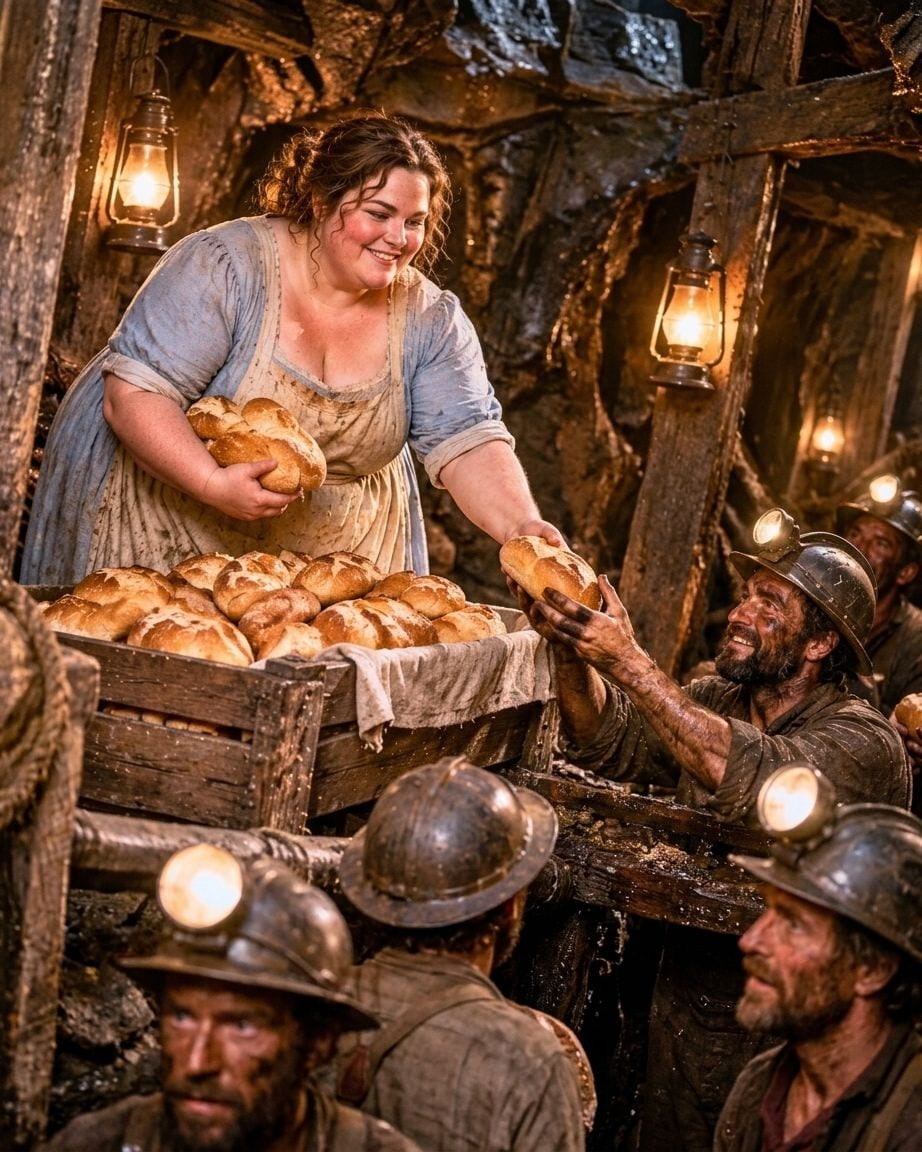
"GET AWAY FROM THAT DOOR!"
Maggie Whitmore shouted into the darkness as the rear entrance of the abandoned barn began to swing inward.
The front door shook beneath another violent blow.
Outside, Dub Creswell cursed.
"Open up, woman! You're making this harder than it needs to be!"
Maggie stood between the two entrances, clutching the folded mining-company records against her chest.
She had spent her last six dollars on ruined flour.
She had endured an entire town laughing at her.
And now, before she had baked a single loaf of bread, three men had come in the middle of the night to take something they believed she had no right to possess.
But the person entering through the back door wasn't carrying a weapon.
He was carrying a lantern.
And when the light reached his face, Maggie recognized Samuel Reed.
"Don't scream," he whispered. "It's me."
Maggie's heart hammered.
"Samuel?"
"Come on. We haven't got much time."
Another blow struck the front door.
The upper hinge groaned.
Samuel glanced toward the sound.
"Whatever papers you found, bring them."
Maggie stared at him.
"How did you know?"
Samuel's expression tightened.
"Because Chester Pool sent those men to make sure you never got the chance to read them."
Maggie had never considered herself a frightened woman.
She had been frightened plenty of times, of course.
When a stove exploded in a Pueblo mining camp.
When a wagon overturned on an icy mountain road.
When a miner collapsed at her kitchen table and stopped breathing until another man managed to revive him.
Fear was part of living.
But Maggie had learned that being afraid and allowing fear to make her decisions were two different things.
She folded the papers tightly and slipped them into the deep pocket of her brown work dress.
"Where are we going?"
Samuel pointed toward the rear yard.
"There's a narrow trail behind the blacksmith's shed. It leads to the creek."
"And my flour?"
"We'll come back for it."
Maggie didn't move.
Samuel stared at her.
"Miss Whitmore, those men are breaking down your door."
"I can hear them."
"Then let's go."
She looked toward the stacked sacks.
Some were still damp.
Others had been carefully separated and raised off the floor.
Six hundred pounds of damaged flour, purchased with money she could scarcely afford to lose.
She had spent hours dragging it here.
Hours sorting it.
Hours imagining what the abandoned barn might become.
And now she was supposed to abandon everything because a man with polished shoes and a hotel business had decided she was inconvenient.
"No," she said.
Samuel blinked.
"No?"
"I'm not leaving my property for those men to destroy."
"Maggie—"
"You came through that back door. Can they?"
Samuel hesitated.
"Not easily. I moved the old boards."
"Then put them back."
"What?"
"Block the entrance."
A tremendous crash sounded from the front.
Dust fell from the doorframe.
Samuel looked as though he might argue.
Then he saw Maggie's expression.
He set down the lantern.
"All right."
Together they dragged a heavy wooden feed trough across the rear entrance.
Samuel wedged a broken support beam beneath the handle.
Maggie pulled an old iron poker from beside the stove.
Samuel stared at it.
"You planning to fight three men with that?"
"No," she said. "I'm planning to make them think twice about fighting me."
He almost laughed.
Then the front door gave way.
Dub Creswell entered first.
His hat was pulled low over his eyes, and his face was flushed with anger.
Two other men followed him.
One carried a lantern.
The other held a short wooden club.
They stopped when they saw Maggie standing beside the worktable.
Samuel stood several feet behind her.
Dub's eyes narrowed.
"Well, look who decided to join the party."
Samuel said nothing.
Dub looked at Maggie.
"Hand over the papers."
"Which papers?"
"Don't play games."
"I'm asking a question."
Dub stepped closer.
"The ones you found in the flour sacks."
Maggie tilted her head.
"Funny. Earlier today, you told everyone those sacks weren't worth a penny."
"That was before."
"Before what?"
His jaw tightened.
"Before you started causing trouble."
Maggie glanced at the broken door.
"Seems to me you're the one causing trouble."
One of the men behind Dub shifted uneasily.
Dub ignored him.
"Mr. Pool wants the company documents returned."
"Then Mr. Pool can come ask for them himself."
"He's a busy man."
"So am I."
Dub gave a sharp laugh.
"Busy doing what? Making mud pies?"
Maggie didn't answer.
She looked directly at the man holding the club.
"What's your name?"
He appeared startled.
"Why?"
"Because when I report three men breaking into my building, I'd like to know who they are."
Dub stepped between them.
"You don't own this building."
"Neither do you."
"Then you have no business being here."
Maggie raised the iron poker slightly.
"Funny. I was about to say the same thing."
For several seconds, nobody moved.
Samuel took one slow step forward.
"Dub, this isn't worth it."
Dub turned.
"Stay out of it, Reed."
"She's done nothing wrong."
"She's got papers that don't belong to her."
"Then let the sheriff decide."
That changed the room.
The man with the club lowered it.
Dub's expression darkened.
"You want to involve the sheriff?"
Samuel held his gaze.
"If we have to."
Dub looked toward Maggie.
Then toward the sacks.
His eyes settled on the pocket of her dress.
For one terrible moment, Maggie thought he might rush her.
Instead, he spat onto the floor.
"Keep your precious papers."
He turned toward the broken doorway.
"But don't think this is finished."
Maggie said nothing.
Dub stopped at the threshold.
"And one more thing, sweetheart."
She looked at him.
"That stove won't save you when Pool decides you're done."
Then he disappeared into the darkness.
The other men followed.
Their footsteps faded toward the waiting wagon.
Maggie stood perfectly still until she heard the wheels begin to move.
Only then did she lower the poker.
Samuel released a long breath.
"Lord Almighty."
Maggie looked at the broken door.
"Well," she said, "that's another thing I'll have to fix."
Samuel stared at her.
Then he began laughing.
Not cruelly.
Not loudly.
It was the exhausted laughter of a man who had expected disaster and somehow survived it.
Maggie looked at him.
"What's funny?"
"You."
"That seems to be a popular opinion in this town."
"No, ma'am. Not like that."
He wiped a hand across his face.
"I've seen grown men back down from Dub Creswell with a rifle in their hands. You just stood there holding a stove poker."
Maggie set it aside.
"I've dealt with worse than Dub Creswell."
Samuel shook his head.
"I believe you."
He helped her drag a crate against the broken front door.
Then he examined the damage.
"The hinges are gone."
"Can you repair it?"
"Not tonight."
"Tomorrow?"
"I'll bring Walter. He's good with timber."
Maggie nodded.
"Thank you."
Samuel turned toward the table.
"Now let's see what Pool was so worried about."
Maggie took the papers from her pocket.
She spread them beneath the lantern.
The two examined the delivery record.
Samuel recognized several names immediately.
"That's Walter."
He pointed.
"Thomas. Me. Daniel Mercer. Isaac Boone."
Twenty-eight miners.
Twenty-eight accounts.
Twenty-eight men being charged for food they claimed they had never received.
Maggie traced one column with her finger.
"These charges don't match the quantities."
Samuel leaned closer.
"What do you mean?"
"Look here."
She pointed to the flour entry.
"Six hundred pounds."
"That's what we ordered."
"Then look at the amount charged to the men."
Samuel studied the figures.
His brow furrowed.
Maggie continued.
"According to this sheet, the company charged the workers for the entire delivery."
"Yes."
"But the shipment never reached the mine."
Samuel looked at her.
"Because of the wagon accident."
"Exactly."
He frowned.
"Then why would Pool sign for it?"
"That's the question."
Maggie turned the page.
"And here's another."
She pointed to a separate entry.
"Coffee. Sugar. Salt pork. Beans."
Samuel nodded.
"Those were supposed to arrive with the flour."
"Did they?"
"No."
"Are you certain?"
"I helped unload the last supply wagon myself. Nothing like that came in."
Maggie sat back.
"Then somebody recorded goods as delivered when they weren't."
Samuel stared at the papers.
"You're saying Pool stole our food?"
"I'm saying these records don't match what you've told me."
She looked at him firmly.
"And before we accuse anybody, we need to know whether there were other deliveries or corrections."
Samuel nodded slowly.
Maggie had spent enough years in camp kitchens to understand how quickly a careless accusation could destroy a working person's reputation.
She wasn't going to become the kind of person who ruined another life simply because she disliked the man involved.
But she also wasn't going to ignore twenty-eight hungry miners.
"Can you get copies of your pay statements?" she asked.
Samuel nodded.
"Some of the men keep them."
"Good."
"And the commissary ledger?"
"That would be better."
Samuel gave a humorless smile.
"Pool keeps that locked in his office."
Maggie looked at the documents.
"Then we'll start with what we can obtain honestly."
Samuel studied her.
"You really mean to help us?"
Maggie met his eyes.
"I mean to open a kitchen."
He smiled faintly.
"That wasn't what I asked."
"No," she said. "But it's the answer I can give you tonight."
Samuel left shortly before dawn.
He promised to return after his shift with Walter, tools, and whatever pay records the miners were willing to share.
Maggie remained awake.
She secured the damaged door as best she could.
Then she sat at the worktable and made two lists.
The first concerned the building.
Repair the front door.
Inspect the chimney.
Patch the roof.
Clean the stove.
Secure the windows.
Find the legal owner.
The second concerned the food.
Inspect every sack.
Discard anything contaminated.
Keep dry flour separate.
Purchase clean water.
Find yeast or a reliable starter.
Acquire salt.
Find something to serve with bread.
She studied the second list.
Bread alone would not be enough to sustain twenty-eight men doing hard physical labor.
They needed beans.
Vegetables.
Meat when possible.
Broth.
Something warm and filling.
She knew exactly how to feed working men on a small budget.
She had done it for twelve years.
The problem was that her budget had never been quite this small.
Five dollars and forty cents.
She counted the money again.
Then she looked at the flour.
There was a possibility.
Not a certainty.
But a possibility.
If enough of the sealed sacks contained clean, dry flour, she could begin baking.
She would need to purchase the remaining ingredients carefully.
She would need customers who could pay something, even if only a few cents.
And she would need a place where the men could sit without feeling like beggars.
Maggie looked around the abandoned barn.
Its roof sagged.
Its windows were filthy.
Its walls needed repair.
But she could imagine it.
A long table.
Benches.
A stove burning steadily.
A kettle of soup.
Bread cooling on shelves.
And a lantern hanging above the doorway.
A copper lantern.
She remembered seeing one in the back room of the barn.
It had been left behind among rusted tools and broken harnesses.
She rose and searched until she found it.
The lantern was dented.
Its glass was cloudy.
The copper had darkened with age.
But the frame was intact.
Maggie carried it to the worktable.
She rubbed one corner with a rag.
A warm reddish shine appeared beneath the grime.
She smiled.
"The Copper Lantern Kitchen," she whispered.
It sounded like a place where a person could come in cold and leave warm.
It sounded like a place that might belong to her.
By morning, Maggie had slept less than an hour.
She washed her face with cold water, pinned her hair, and walked into town.
The broken door would have to wait.
There were more urgent matters.
She needed to learn who owned the barn.
And she needed supplies.
Frank Alcott was arranging crates outside his store when she arrived.
He looked surprised.
"Miss Whitmore."
"Morning, Frank."
He glanced at the flour dust on her dress.
"How's the investment?"
"Still being evaluated."
He chuckled.
"Fair enough."
Maggie stepped closer.
"I need to ask you something."
"Go ahead."
"Did the mine company order the flour that overturned yesterday?"
Frank's smile disappeared.
"Why?"
"Because I found a shipping note."
He looked toward the street.
Maggie noticed.
"Frank?"
He sighed.
"Yes. The mine had ordered part of that shipment."
"Part?"
"Six hundred pounds."
"All of it, then."
He nodded.
"And the other supplies listed on the paperwork?"
Frank frowned.
"What other supplies?"
Maggie described the items.
Beans.
Coffee.
Sugar.
Salt pork.
Frank shook his head.
"Those weren't on my wagon."
"Are you certain?"
"Absolutely."
"Did you deliver them separately?"
"No."
Maggie studied his face.
"Did Pool pay you for the flour?"
Frank hesitated.
"That's between me and the company."
"Frank, twenty-eight miners are being charged for food they haven't received."
His expression changed.
"What?"
She explained what Samuel had told her.
Frank listened without interrupting.
When she finished, he leaned against the counter.
"That doesn't sound right."
"No."
He rubbed his chin.
"I sent the invoice to Pool's office last week. The wagon was supposed to deliver the flour yesterday."
"And payment?"
"Still pending."
Maggie frowned.
"Then why would the company record the goods as received?"
Frank looked troubled.
"I don't know."
She waited.
Finally, he said, "Maggie, I need you to be careful."
"You're the second person to tell me that."
"Pool has friends."
"So do I."
Frank raised an eyebrow.
"Do you?"
Maggie thought of Samuel.
Walter.
Thomas.
Three exhausted miners who had come looking for flour and found a woman willing to listen.
"Perhaps I'm beginning to."
Frank nodded slowly.
Then he reached beneath the counter.
"Here."
He placed a small packet on the wood.
Maggie looked at it.
"What is that?"
"Salt."
"I didn't ask for charity."
"And I didn't offer any."
He pushed the packet closer.
"Consider it part of the bargain. I sold you the flour, and I forgot to mention that a decent cook needs salt."
Maggie smiled.
"You're a terrible businessman."
"That's what my wife says."
For the first time since arriving in Red Hollow, Maggie laughed without worrying who might hear.
Her next stop was the county clerk's office.
It occupied a narrow room beside the sheriff's building.
The clerk, a bespectacled man named Edwin Marsh, looked up from a stack of records.
"Can I help you?"
"I'm trying to locate the owner of the old feed barn on Mine Road."
Marsh frowned.
"The abandoned one?"
"Yes."
"Why?"
"I'd like to rent it."
He looked her over.
"For what purpose?"
"A kitchen."
Marsh blinked.
Then, to Maggie's relief, he simply reached for a ledger.
"Well, let's see."
He turned several pages.
"The property belonged to Nathaniel Voss."
"Belonged?"
"Passed away four years ago."
"Who inherited it?"
"That's where things become complicated."
Maggie leaned forward.
Marsh adjusted his spectacles.
"Two heirs. A niece in Denver and a nephew who went east. The estate has been disputed for years."
"Can either of them authorize a lease?"
"Possibly. But we'd need written consent from the lawful representative."
Maggie sighed.
"How long would that take?"
"Depends on whether the parties can be reached."
She looked at the ledger.
"Is there any way to secure temporary permission?"
Marsh considered.
"You could submit a written request. I can make an inquiry."
"Would that allow me to operate immediately?"
"No. Not until someone with authority approves it."
Maggie nodded.
"Then I'll submit the request."
Marsh looked mildly surprised.
"You will?"
"I don't intend to build something just to have it taken away because I skipped the paperwork."
He smiled.
"That's sensible."
Maggie spent the next twenty minutes explaining her plans.
Marsh wrote down her name.
Her intended use.
The condition of the property.
And the repairs she hoped to make.
When she finished, he promised to send inquiries to the estate representatives.
As she rose to leave, he called after her.
"Miss Whitmore?"
She turned.
"Yes?"
"If you're serious about opening a kitchen, you may want to speak with the sheriff."
"Why?"
Marsh hesitated.
"Someone was asking about that barn yesterday."
Maggie's stomach tightened.
"Who?"
"Chester Pool."
By the time Maggie returned to Mine Road, the sun was high.
She found Samuel and Walter waiting outside the barn.
Thomas stood beside them carrying a bundle of tools.
Samuel looked relieved.
"We were beginning to worry."
"I had errands."
Walter glanced at the broken door.
"Well, we've got work."
They spent the afternoon repairing the front entrance.
Walter replaced the damaged hinges.
Samuel reinforced the frame.
Thomas cleaned the windows.
Maggie scrubbed the stove, inspected the remaining flour, and prepared a clean storage area.
They worked without much conversation.
But the silence was comfortable.
Maggie had forgotten how pleasant it could be to work beside people who judged her by what she accomplished.
By late afternoon, the door closed properly.
The chimney had been cleared and checked.
The stove was ready for a cautious first fire.
And the barn looked a little less abandoned.
Thomas stood beside the worktable.
"Miss Whitmore?"
"Yes?"
"Do you think you'll really open?"
Maggie looked around.
"I intend to."
"When?"
"As soon as I can do it safely and legally."
Thomas nodded.
Then he asked, almost shyly, "Would you make biscuits?"
Maggie smiled.
"I've been known to."
"My mother used to make them."
Something in his voice softened.
"Before she died."
Maggie stopped wiping the table.
"I'm sorry, Thomas."
He shrugged.
"It was a long time ago."
But his eyes told another story.
Maggie reached out and touched his shoulder.
"Then when this kitchen opens, I'll make sure you get a proper biscuit."
Thomas smiled.
"Thank you, ma'am."
Outside, a horse approached.
Samuel looked toward the window.
His expression changed.
"That's strange."
Maggie followed his gaze.
A black carriage was coming down Mine Road.
Its polished wheels looked out of place among the muddy ruts.
The driver wore a dark coat.
The carriage stopped directly in front of the barn.
Walter muttered something under his breath.
Maggie stepped toward the window.
The carriage door opened.
A polished black shoe touched the ground.
Then another.
A man emerged wearing a perfectly pressed suit and a stiff white collar.
Chester Pool.
He looked at the repaired door.
The cleaned windows.
The stacked flour.
Then his eyes settled on Maggie.
He smiled.
It was the same smile he had worn when rejecting her application at the Alcott Grand.
Only now, there was no pretense of politeness.
He approached the entrance carrying a folded legal document.
"Miss Whitmore," he said smoothly. "I believe you've made a rather serious mistake."
Maggie stood in the doorway.
"What mistake would that be?"
Pool unfolded the document.
At the bottom was an official-looking seal.
He held it up.
"This property is no longer available for your use."
Maggie stared at the paper.
Then she saw the name printed beneath the seal.
Her heart gave a hard, sudden beat.
The document claimed that the abandoned barn had been transferred to a new owner that very morning.
And the name of that owner was—






Comments 0