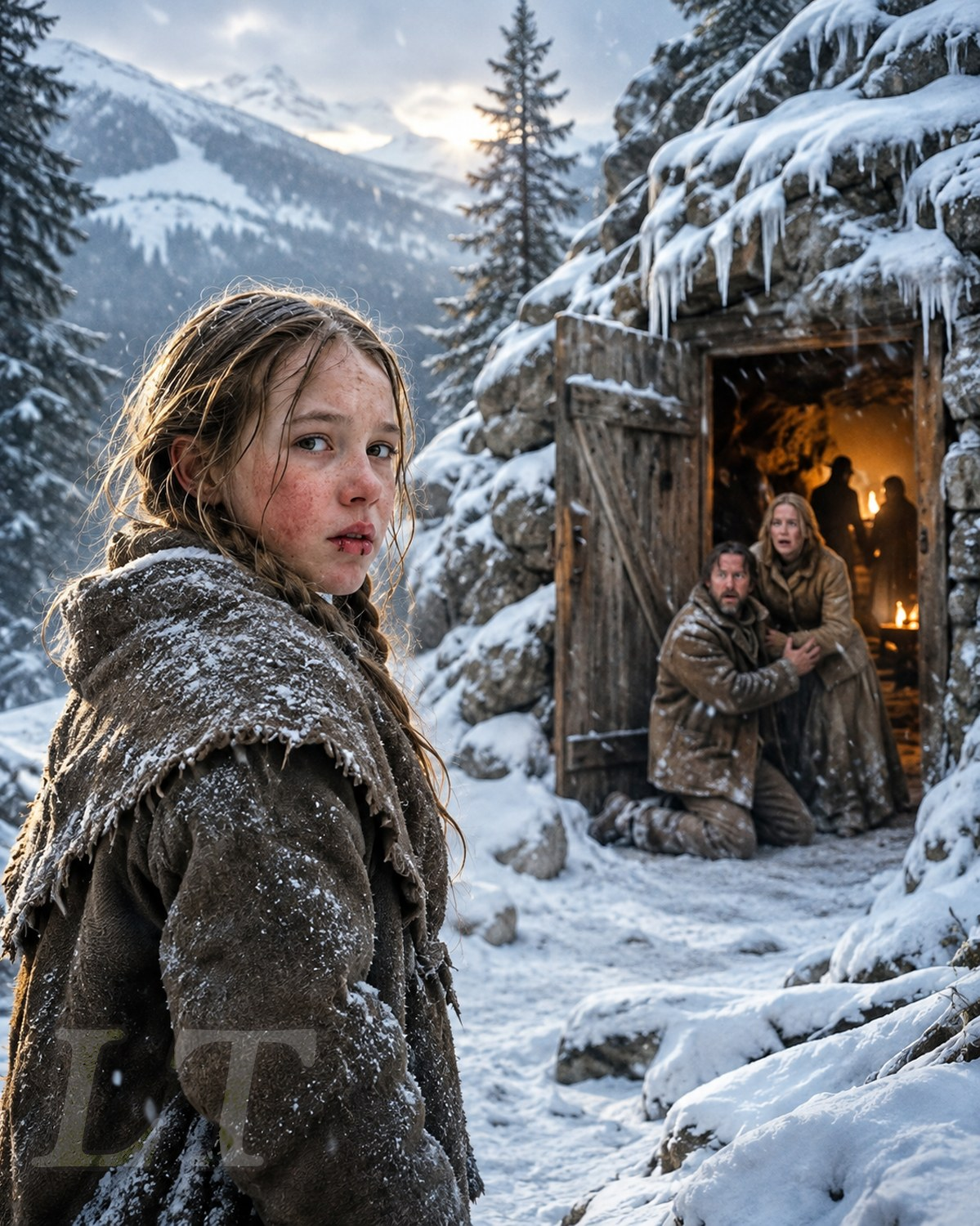
"Alma..."
The voice came from beneath the stone floor.
She stumbled backward, nearly dropping the burning branch.
For several seconds, she could not move.
The rectangular stone remained partially open. Cold air drifted through the narrow gap, carrying the smell of wet earth and something unfamiliar.
Alma stared into the darkness.
"Who's there?"
Her voice trembled despite her efforts to control it.
No answer.
Then came another sound.
Three short knocks.
One long scrape.
She looked at the folded paper in her hand.
Her father's warning was still visible.
Do not open the lower door until the water falls.
Alma swallowed.
She wanted to believe someone was hiding beneath the mountain. She wanted to believe her father had discovered a secret room and left someone there.
But that made no sense.
Silas had been dead for two years.
And nobody knew she had come to this valley.
She lowered the burning branch toward the opening.
The flame flickered violently.
A sudden current of air rushed upward.
Then the voice came again.
This time, Alma understood what she was hearing.
It was not a person.
It was the wind.
The narrow opening beneath the stone created an unusual echo. As the air moved through the passage, it produced a sound resembling a whispered name.
Alma listened carefully.
The sound rose and fell.
Almost like breathing.
She slowly released the breath she had been holding.
Her father had warned her about the mountain.
He had never told her it would be haunted.
She stepped closer but did not touch the stone again.
Whatever lay beneath it would have to wait.
The water was still moving.
And she had no intention of flooding the only shelter she had managed to find.
Alma spent the rest of the morning studying the lower opening.
She placed several small stones around its edges, marking their positions so she could tell whether the slab moved again.
Then she examined the drainage channel.
A thin stream of water traveled through the sandstone beneath the eastern wall.
It was not a large amount, but the current was steady.
Her father had clearly known about it.
The instructions on his paper were probably written to prevent someone from opening the lower passage while the water level was high.
Perhaps the hidden chamber filled during heavy rain or snowmelt.
Perhaps the opening connected to a natural underground stream.
Alma could not know without investigating.
But she understood enough to be cautious.
She returned to the outer chamber and checked her supplies.
Her food was becoming a concern.
The cornmeal sack was nearly half empty.
The rabbit meat would last only a few more days.
The rose hips and roots provided additional food, but she could not depend on them alone.
She needed to establish a reliable routine.
The first priority was gathering enough firewood.
The second was expanding the living space.
The third was finding a way to preserve food before winter made hunting more difficult.
She looked toward the entrance.
The snowfall had stopped temporarily.
A pale morning sun illuminated the valley.
She had a short window of good weather.
She would use it.
During the following days, Alma worked harder than she ever had in Brierwood.
She woke before sunrise.
She checked the spring.
She examined the cliff.
Then she gathered food and wood before returning to the cave.
Her routine became increasingly organized.
She placed stones beside the entrance to mark the level of snow.
She kept a small record of the weather on a piece of paper.
Each evening, she noted the wind direction, temperature, and condition of the surrounding trees.
She had no instruments.
But she had her observations.
One morning, she noticed that the surface of the spring had become covered with a thin layer of ice.
By afternoon, the ice had disappeared.
The water was still flowing.
She marked the change.
The next day, she observed that the wind came from the north for most of the morning.
By evening, it shifted toward the west.
She marked that too.
Her father had taught her that small details became useful when recorded together.
A person might forget what the weather had done three days earlier.
But written observations could reveal patterns.
Alma began to understand the mountain more clearly.
The valley received sunlight for only part of the day.
The western cliff protected the lower ground from some of the strongest winds.
The pine trees offered shelter from drifting snow.
The spring remained accessible even when the surface began freezing.
And the sandstone cave maintained a more stable temperature than the open air.
These were advantages.
But they would not be enough unless she prepared properly.
On the fifth day after discovering the hidden chamber, Alma returned to the fallen aspen.
The log remained where she had left it.
Snow had collected along its upper surface.
She examined the trunk.
Most of the wood beneath the bark was still dry.
She could use it to build a door.
But she needed to move it closer to the cave.
She remembered her father's lesson about leverage.
Instead of trying to lift the entire trunk, she gathered two smaller branches and placed them beneath it.
She pushed.
The log shifted.
She adjusted the branches and pushed again.
This time, it rolled several inches.
Alma continued.
She worked slowly, stopping whenever her arms became tired.
By midday, she had moved the trunk halfway down the slope.
Her hands were sore.
A small blister had opened beneath her thumb.
She wrapped it with cloth and continued.
Then she heard something behind her.
A sharp rustling.
She turned.
A small group of squirrels scattered through the branches.
One climbed a pine tree and disappeared into a hollow.
Alma watched them.
Their activity reminded her of the signs she had observed before leaving Brierwood.
They were still gathering food.
Still preparing.
The urgency had not disappeared.
If anything, it seemed greater.
She looked toward the mountains.
The higher peaks were almost completely white now.
It was only the beginning of October.
The winter would arrive sooner than most people expected.
She pushed the log again.
This time, it rolled far enough to reach a flatter section of ground.
Alma stopped.
She needed to rest before continuing.
As she sat beneath the pine tree, she noticed something caught between two branches.
A strip of dark fabric.
She reached up and pulled it free.
It was a piece of wool.
Old.
Weathered.
And marked with a familiar pattern of stitching.
Her father's coat had been repaired in exactly the same way.
Alma stared at it.
She looked around the trees.
Then she examined the fabric more closely.
There was a small tear near one edge.
The material had been exposed to the weather for a long time.
She placed it inside her coat.
Another piece of her father's past had appeared in the valley.
And she was beginning to suspect that his final journey had taken him much farther into these mountains than he had ever told her.
That afternoon, Alma returned to the cave.
She placed the fabric beside the leather and the folded paper.
Then she studied the symbols again.
Three short cuts.
One long cut.
Seven.
Three.
And the drawing of the northern entrance.
She arranged the objects in front of her.
The marks were not random.
Her father had used the same pattern repeatedly.
Perhaps it was a way of identifying important places.
Perhaps the numbers referred to distances.
She examined the folded paper again.
There were faint lines beneath the drawing.
She held it closer to the firelight.
A small symbol appeared.
It looked like a tree beside a stream.
Underneath it were two letters.
S.W.
Alma considered the possibilities.
Sweetwater?
Silas had often hunted in the canyon above Sweetwater.
Perhaps the letters referred to the direction from which he had entered the valley.
She could not be certain.
She folded the paper and put it away.
There would be time to investigate later.
For now, she needed a door.
Building the door proved more difficult than she had expected.
The entrance was not perfectly rectangular.
The sandstone narrowed toward the top and widened near the bottom.
A flat wooden panel would leave large gaps.
Alma considered using several branches arranged vertically.
She could connect them with strips of rawhide and place a crosspiece behind them.
The arrangement would be flexible enough to follow the shape of the opening.
She selected the straightest pieces of aspen and began cutting them.
Her father's knife was not designed for heavy woodworking.
Still, it worked.
She removed the rough bark and trimmed the ends.
Then she tied the pieces together.
The first attempt collapsed when she lifted it.
The cord had not been tight enough.
Alma stared at the fallen branches.
For a moment, frustration overcame her.
She wanted to throw the knife against the wall.
She wanted to sit down and stop working.
But she remembered how Silas had reacted when something failed.
He never became angry with the tool.
He examined the mistake.
Then he tried again.
Alma picked up the branches.
She replaced the loose knots with tighter bindings.
She added two crosspieces.
Then she tested the frame.
It held.
She carried it to the entrance and leaned it against the sandstone.
The fit was not perfect.
But it covered most of the opening.
She added smaller branches along the edges.
Then she placed flat stones at the bottom to hold it in position.
When she stepped back, the entrance looked different.
For the first time, the cave had something resembling a door.
Alma touched the wooden frame.
It was rough.
Uneven.
And beautiful to her.
She had made it herself.
The next problem was the fire.
The small fire near the entrance warmed her hands, but it did little for the inner chamber.
She needed a hearth.
Her father had written about the natural ventilation passage.
If she could position the fire beneath the correct opening, smoke might travel upward.
But she had to test it carefully.
Alma gathered several small stones and arranged them into a circle in the larger chamber.
She left enough space for air to move around the fire.
Then she brought a small amount of dry wood.
She placed a few thin branches inside the circle.
Before lighting them, she examined the natural opening above.
The passage was narrow.
But the air current was steady.
She held a strip of cloth beneath it.
The fabric moved upward.
That was encouraging.
She lit the smallest pieces of wood.
A flame appeared.
Smoke rose.
For a moment, it drifted toward the ceiling.
Then the current changed.
The smoke spread across the chamber.
Alma immediately moved away.
She pulled the wooden door open and allowed fresh air to enter.
She did not try to force the fire to continue.
Instead, she waited until the smoke cleared.
The first test had failed.
But she had learned something.
The natural opening was not directly above the hearth.
The smoke needed a clearer route.
She examined the ceiling.
There was another narrow groove in the sandstone.
Perhaps it connected to the ventilation crack.
She marked the area with a small stone.
Then she returned to the outer chamber.
She would need to investigate it before trying again.
The days passed.
The first week of October became the second.
Alma's shelter continued improving.
She cleared the inner chamber and arranged the sleeping area against the driest wall.
She stacked firewood near the entrance.
She placed food on the natural sandstone shelf.
She also began storing water in several containers.
The cave was becoming organized.
But the weather was becoming increasingly unpredictable.
One afternoon, she noticed a sudden drop in temperature.
The wind shifted.
The clouds gathered over the northern ridge.
By evening, snow began falling again.
This time, it did not stop after a few hours.
It continued throughout the night.
Alma sat beside the entrance and watched the flakes collect against the wooden door.
She thought of Brierwood.
She imagined the people lighting their fireplaces and preparing their usual meals.
Perhaps they had finally noticed the cold.
Perhaps they had begun gathering extra wood.
She hoped they had.
Even after everything, she did not want anyone to suffer.
She remembered the Harrigan children.
The youngest boy had once given her half an apple when he thought nobody was watching.
She remembered the woman who had allowed her to sleep near the kitchen during a difficult winter.
And she remembered the children who had listened when she described the mountains.
They had not all been cruel.
Some had simply been afraid to disagree with the adults.
Alma looked down at the snow.
If the winter became as severe as she feared, those children would need help.
She could not forget them.
The following morning, she discovered that the spring had changed.
A thin layer of ice covered most of the surface.
Only a narrow section remained open.
Alma knelt and cleared the ice with a small branch.
The water beneath was moving more slowly.
She filled her containers and carried them inside.
Then she examined the surrounding rocks.
There was a faint line of moisture near the eastern wall.
The drainage channel was still working, but the water level seemed higher.
She remembered the lower door.
The hidden passage beneath the chamber.
Her father's warning.
Do not open the lower door until the water falls.
Alma approached the rectangular stone.
The small markers she had placed were still in position.
But there was something new.
A thin line of water had appeared along the bottom edge.
She crouched.
The water was moving toward the opening.
She watched it carefully.
It was not enough to flood the chamber.
But it suggested that the underground stream was rising.
Alma backed away.
She would not touch the stone.
Instead, she concentrated on protecting the upper chambers.
She moved the food supplies to a higher shelf.
She lifted the firewood off the ground.
Then she placed additional stones along the drainage channel.
The work took several hours.
By the time she finished, her arms were trembling.
She sat beside the fireless hearth and ate a small portion of cornmeal.
Her supplies were becoming limited.
She needed to hunt again.
But the storm made it dangerous to travel far.
She would have to wait for better weather.
On the third morning of continuous snowfall, Alma woke to a sound near the entrance.
Something was scratching the wooden door.
She sat up immediately.
The sound came again.
Slow.
Deliberate.
She reached for her father's knife.
Then she moved toward the entrance.
She did not open it.
Instead, she looked through a small gap between the branches.
A pale brown animal stood outside.
A young mustang.
Its coat was covered in snow.
Its mane hung in tangled strands around its neck.
It lowered its head and pushed against the wooden frame.
Alma recognized it.
She had seen the mare near the valley before.
Whisper.
The animal had once followed her and Silas during their hunting trips.
She remembered her father laughing when the horse refused to leave their camp.
"Some animals choose their own company," he had said.
Alma opened the door slightly.
The mare lifted her head.
For several seconds, they looked at one another.
Then Whisper stepped closer.
Alma extended her hand.
The horse sniffed her fingers.
Her breath came out in a cloud of white vapor.
"You remember me," Alma whispered.
Whisper moved her head gently against the girl's shoulder.
Alma looked toward the valley.
The snow was deep.
The mare had no shelter nearby.
There was little food beneath the frozen ground.
If she remained outside, she might not survive the storm.
Alma stepped aside.
"Come on."
The horse hesitated.
Then she lowered her head and walked through the opening.
Whisper was too large for the inner chamber.
Alma knew that immediately.
The passage was too narrow, and the ceiling became lower near the back.
She guided the mare into the outer shelter beneath the overhang.
It was not ideal.
But it offered protection from the wind.
Alma brought several branches and placed them on the ground.
Then she searched her remaining supplies for something the animal could eat.
She had gathered some dried grasses and roots.
They were not enough for a horse.
But they would help.
Whisper ate slowly.
Alma examined the animal's legs.
There were no obvious injuries.
Her coat was thick, and she seemed healthy despite the cold.
But her ribs were slightly visible.
She had probably been struggling to find food.
Alma brushed snow from her mane.
For the first time in several days, she felt less alone.
Whisper remained near the entrance while Alma worked.
Whenever the girl moved away, the mare followed her with her eyes.
That evening, Alma sat beside the wooden door.
The horse stood nearby.
Outside, the snowfall continued.
Alma looked at the mare.
"We'll have to find more food for both of us."
Whisper flicked one ear.
Alma almost smiled.
Then she heard a deep rumbling beneath the floor.
She stood.
The sound came from the direction of the lower passage.
A small vibration traveled through the stone.
Whisper immediately lifted her head.
Her ears pointed toward the inner chamber.
The mare took one step backward.
Then another.
Alma looked toward the rectangular stone.
The markers had moved.
One small stone had fallen into the opening.
She approached carefully.
A thin stream of water now flowed beneath the lower slab.
The underground passage was filling.
Alma remembered her father's warning.
The lower door must remain closed until the water fell.
But the stone was no longer completely closed.
Something beneath it was pushing upward.
The following morning, Alma inspected the damage.
The lower opening had widened slightly.
Water continued moving beneath the slab.
She placed additional stones around the edge, trying to redirect the flow.
It helped temporarily.
But she could see that the water was rising.
She needed to find another drainage route.
Perhaps the natural passage behind the eastern wall could carry the excess water away.
She returned to the hidden chamber and examined the groove.
The current was stronger now.
She placed a small branch near the opening.
It moved rapidly.
The water was flowing toward the lower section.
Alma followed the channel.
At the far end, she found a narrow gap between two large rocks.
It was partly blocked by loose stone.
She crouched and examined it.
If she cleared the obstruction, the water might escape through the natural drainage passage.
But removing the wrong stone could cause a collapse.
She remembered Silas's warning.
Never take away more than you understand.
She studied the arrangement.
The largest stone appeared to support the upper section.
She would not touch it.
Instead, she began removing smaller fragments around its edge.
One at a time.
Slowly.
A little water began moving through the gap.
Alma watched.
Then she removed another fragment.
The flow increased.
She continued until a narrow channel opened.
The water began draining away from the lower chamber.
For several minutes, she felt relieved.
Then a deep crack echoed through the mountain.
Alma froze.
The floor trembled.
Whisper whinnied from the outer shelter.
A section of sandstone broke loose near the far wall.
Alma stepped backward.
Dust filled the chamber.
She covered her mouth and waited.
When the dust settled, she saw that the narrow drainage opening had become wider.
But something else had appeared behind it.
A wooden object.
It was partially buried beneath the stones.
Alma approached carefully.
She brushed away the dust.
A corner of an old wooden case emerged.
The wood was dark and weathered.
A strip of leather wrapped around its center.
And carved into the leather were three short cuts and one long cut.
The same symbol her father had left everywhere.
Alma reached toward it.
Then she noticed something scratched into the wooden lid.
A name.
She leaned closer.
The letters were worn, but still readable.
SILAS JESÚS.
Alma's hand stopped inches above the case.
Then, from somewhere behind the newly opened wall, a second wooden object slid forward.
It struck the stone floor.
And the lid slowly began to open...






Comments 0