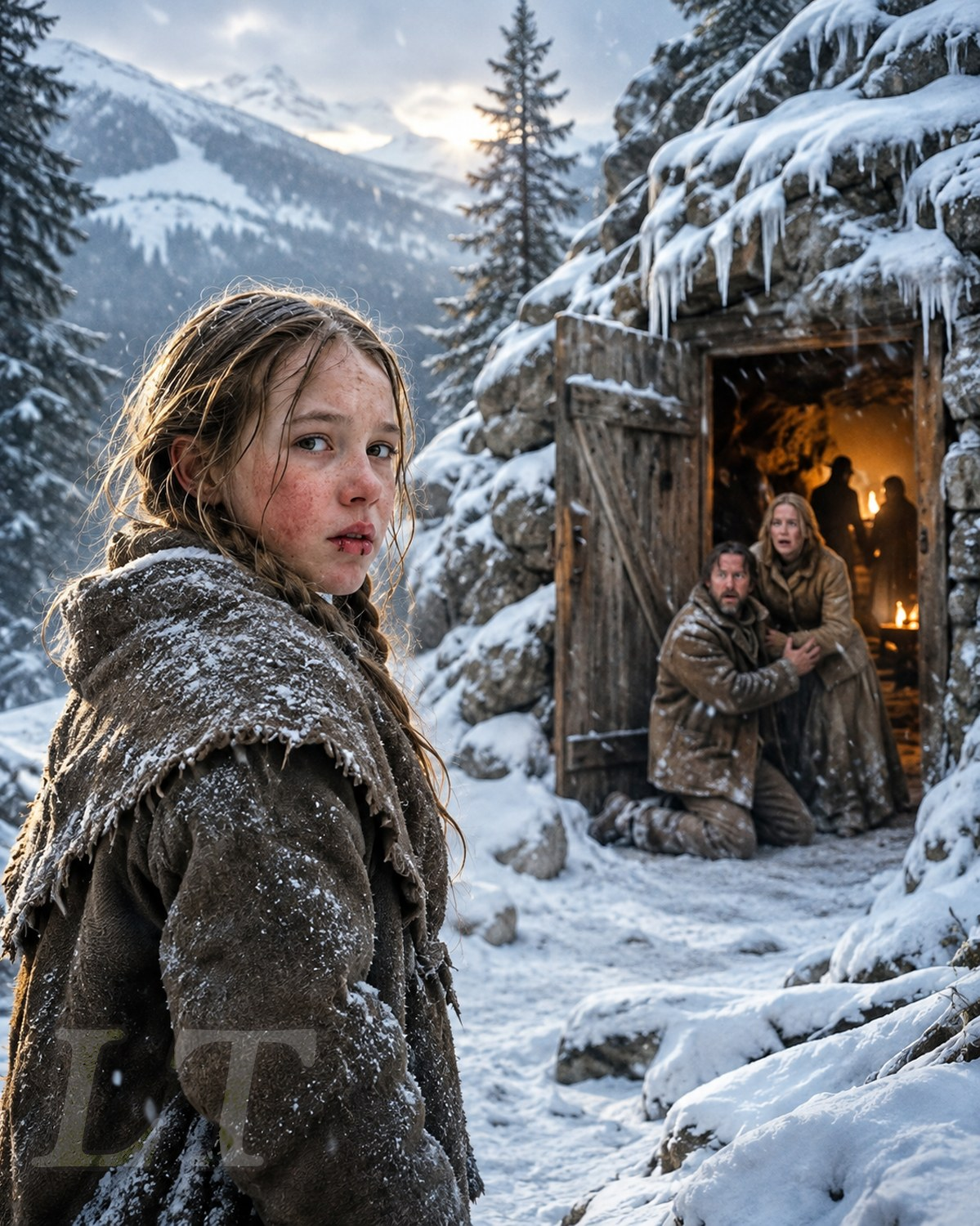
The wooden lid opened another inch.
Alma stepped backward.
A cloud of dust rose from the old case, spreading across the stone floor. The leather strap slipped loose, and the lid fell against the side with a dull crack.
She stood motionless.
The name SILAS JESÚS remained visible on the second wooden object.
For several seconds, she could only stare at it.
Her father had been dead for two years. She had buried him herself in the canyon above Sweetwater. She remembered the cold earth, the ravens circling overhead, and the terrible silence that followed.
Yet here, beneath a mountain hundreds of miles from the settlement where she had found refuge, she was discovering things he had deliberately hidden.
Alma lowered herself onto her knees.
Inside the wooden case lay several folded sheets of paper, a small compass, a piece of charcoal, and a narrow leather pouch.
She picked up the compass first.
Its brass surface was tarnished. The glass covering the needle was scratched, but the instrument remained intact.
She turned it in her hands.
Her father had owned a similar compass.
She remembered watching him use it during their hunting trips. He had always insisted that knowing the direction was more important than knowing how far they had traveled.
"Distance can be misleading," he had told her. "A mountain can make a short journey dangerous. A valley can make a long journey safe."
Alma placed the compass beside her.
Then she unfolded the first sheet of paper.
It was a drawing of the valley.
Her breath caught.
The sandstone cliff was clearly marked. So was the spring, the pine grove, and the narrow trail leading toward the northern ridge.
But there was something else.
A series of small circles had been drawn across the surrounding mountains.
Beside each circle were numbers.
Alma studied them carefully.
Some appeared to mark water sources.
Others seemed to indicate sheltered places where a person could survive during severe weather.
At the bottom of the page, her father had written:
Safe ground. Winter shelter. Reliable water.
She read the words again.
Then she unfolded the second sheet.
This one contained a rough map of the cave.
The chambers were marked separately.
The outer hollow.
The middle passage.
The larger sleeping chamber.
And beneath them, the lower level she had recently discovered.
Her father had drawn a line connecting the lower chamber to a narrow drainage route farther east.
Beside it was a warning.
Never block the eastern channel. The water must have somewhere to go.
Alma immediately looked toward the passage she had cleared the previous day.
She understood why the water had risen.
The channel had been partly blocked by fallen stone.
Her father had known that the entire cave depended on the drainage system.
She folded the map carefully.
Then she opened the leather pouch.
Inside were several small objects wrapped in cloth.
A flint striker.
Two pieces of metal.
A small needle.
And a narrow strip of paper.
Alma unfolded it.
There were only four words.
Watch the animals first.
She stared at the handwriting.
Her father had written the sentence many times during her childhood.
It had become almost a family saying.
She pressed the paper against her chest.
For a moment, she allowed herself to remember his voice.
Then Whisper whinnied outside.
Alma looked toward the entrance.
The mare had been restless since the water began rising.
She needed to check on her.
But before leaving, Alma noticed another object at the bottom of the case.
A small notebook.
Its leather cover was damaged, but the pages inside appeared mostly intact.
She opened it.
The first entry was dated July 1884.
Silas had been in the valley nearly two years before his death.
Alma began reading.
And the first sentence made her sit perfectly still.
The winter of 1886 may be worse than anything these mountains have seen in living memory.
She read the sentence again.
Then she turned the page.
The notebook contained observations about animal movement, water levels, cloud patterns, and changes in the vegetation.
Her father had been recording everything.
Some entries described the beavers.
Others mentioned elk moving toward lower ground.
Several pages discussed unusual behavior among small animals.
The final entries were more urgent.
August 3. Beavers have reinforced the upper dams.
August 9. Elk leaving the high country earlier than expected.
August 14. Unusual movement among squirrels.
August 19. Several streams are running lower despite recent rainfall.
August 23. The mountain slopes are changing. Prepare shelter before October.
Alma's fingers trembled.
She turned to the last written page.
The date was September 2, 1884.
The handwriting was hurried.
If these signs continue, the winter may become dangerous for anyone living above the lower valley.
Below that was another sentence.
The town will not believe it until the snow reaches their doors.
Alma closed the notebook.
Her father had seen the warning long before she did.
He had understood the danger.
And he had tried to prepare.
She looked toward the entrance.
Brierwood was still far away.
But the same winter her father had feared was now approaching.
She could almost imagine the people in the general store laughing at her again.
Only this time, the consequences would be much worse.
The next morning, Alma began examining the eastern drainage channel.
She carried a small bundle of tools into the hidden chamber and studied the water.
The stream had risen during the night.
It now flowed through the lower passage with enough force to move small stones.
She examined the opening carefully.
The large supporting rock remained in place.
Several smaller stones had shifted.
She removed the loose pieces one at a time.
Then she cleared a narrow channel leading toward the eastern wall.
Water began moving through it.
At first, the flow was weak.
Then a small stream emerged from beneath the rock shelf.
Alma watched it carefully.
The water traveled away from the lower door instead of collecting beneath it.
She felt relieved.
Her father had designed the drainage system to protect the shelter.
She only needed to keep it clear.
She marked the channel with several flat stones so she could inspect it each morning.
Then she returned to the outer chamber.
Whisper was waiting near the entrance.
The mare lowered her head when Alma approached.
"You're hungry, aren't you?"
Alma rubbed the animal's neck.
She had very little food to offer.
But she could gather grasses beneath the pine trees and look for dried vegetation near the lower slope.
She would have to travel farther than before.
The snow had already made the search more difficult.
Still, the mare needed food.
And Alma needed the companionship.
She gathered her blanket and hunting knife.
Then she opened the wooden door.
A cold wind rushed inside.
Outside, the valley looked completely different.
The snow had covered the sagebrush.
The stream was narrower.
The branches of the pine trees bent beneath the growing weight.
Alma stepped carefully across the frozen ground.
She followed the trail toward the lower grove, looking for exposed grasses and edible roots.
Whisper walked behind her.
The mare seemed calmer now.
Alma stopped beside a cluster of shrubs and began collecting dried vegetation.
She filled a small bundle.
Then she noticed tracks.
Elk.
Several animals had passed through during the night.
Their prints led toward the southern end of the valley.
Alma crouched.
The tracks were fresh.
She followed them with her eyes.
The animals were moving lower again.
That was another warning.
She remembered her father's notebook.
The elk had been leaving the highlands weeks earlier than usual.
Now they were descending farther.
She stood and looked toward the mountains.
The snow was accumulating quickly.
Perhaps the animals knew something she did not.
She decided to return to the cave.
As she turned, Whisper suddenly lifted her head.
Her ears pointed toward the ridge.
Alma followed her gaze.
Something was moving between the trees.
A dark shape appeared briefly.
Then disappeared.
Alma tightened her grip on the knife.
She waited.
Nothing happened.
The shape did not return.
She guided Whisper back toward the shelter.
They reached the entrance shortly before midday.
Alma placed the collected grass beneath the overhang and gave the mare a small portion.
Then she examined the wooden door.
The structure was still holding.
Snow had accumulated along its lower edge, but the stones prevented it from shifting.
She needed to reinforce the upper section.
If the wind became stronger, the door might fail.
She added two more branches.
Then she returned to the inner chamber.
There was still much to do.
During the following week, Alma began transforming the cave into a permanent shelter.
She worked methodically.
The sleeping chamber was cleared and organized.
She used flat stones to create a raised sleeping platform.
The food supplies were stored above the ground.
The firewood was arranged near the entrance, protected from direct snowfall.
She also created a small area where she could dry meat.
The larger chamber became the heart of the shelter.
She improved the stone hearth, carefully testing the airflow.
The first few attempts produced too much smoke.
She stopped immediately whenever the air became uncomfortable.
Eventually, she discovered that a narrow section of the ceiling connected to the upper ventilation passage.
By clearing loose material from the opening, she improved the airflow.
The smoke began moving upward more consistently.
She tested the fire with small branches before adding larger pieces.
It was still not perfect.
But it worked well enough to warm the chamber.
Whisper remained in the outer shelter.
Alma built a low barrier from fallen aspen branches to prevent the mare from wandering into the forest during the night.
She also gathered more dry grass and stored it beneath the overhang.
The cave was no longer just a place where she could hide.
It was becoming a home.
And every improvement made the approaching winter seem slightly less frightening.
But Alma was beginning to understand that surviving alone would require more than shelter.
She needed food.
A great deal of it.
The small animals were becoming harder to find.
The rabbits had moved deeper into the trees.
The roots were difficult to dig from the frozen ground.
And the cornmeal was nearly gone.
She began using her snares more carefully.
Each morning, she checked the trails.
Some days she found nothing.
On others, she caught a rabbit or discovered signs of larger animals.
She dried the meat whenever possible.
The hides were cleaned and stretched.
Her father had taught her how to preserve food without wasting anything.
She followed his instructions.
She also collected pine nuts, rose hips, and edible roots.
Every supply had a purpose.
Every portion was measured.
One evening, she counted what remained.
The food would last several weeks if she was careful.
But winter could last much longer.
She needed to find a larger source of food.
Perhaps the lower valley contained game.
Perhaps she could establish another hunting area.
She examined her father's map.
A small circle appeared three miles east of the cave.
Beside it were two words.
Protected valley.
She studied the markings.
The area was surrounded by cliffs.
It might receive less snowfall than the open slopes.
Her father had drawn several animal tracks leading toward it.
Alma looked toward the northern entrance.
The weather was worsening.
Traveling three miles through the mountains would be dangerous.
But remaining in the cave without enough food would be dangerous too.
She needed to choose carefully.
On October 20, the first serious storm arrived.
It began with a sudden drop in temperature.
The wind shifted toward the north.
Dark clouds gathered over the mountains.
By afternoon, snow was falling so heavily that the far end of the valley disappeared.
Alma secured the wooden door.
She brought Whisper farther beneath the overhang and placed extra grass near the animal.
Then she checked the fire.
The flames were burning steadily.
The smoke escaped through the upper passage.
She had finally managed to establish a reliable airflow.
For the first time, the inner chamber felt warm.
Alma sat beside the hearth and opened her father's notebook.
She continued reading the entries.
Several pages contained descriptions of previous winters.
One described a storm that had blocked the mountain trails for twelve days.
Another mentioned a period of extreme cold that had killed several cattle.
But the entries for 1886 were different.
Her father had written about unusual changes in the mountains.
The animals were moving earlier.
The water levels were behaving strangely.
The weather was becoming harder to predict.
Then she found an entry dated September 17, 1884.
The shelter must be ready before the first major snowfall. Once the upper passes close, movement will become difficult.
Alma looked at the fire.
She remembered the people of Brierwood.
They had believed they had weeks to prepare.
They had laughed when she warned them.
But her father had been concerned two years earlier.
If the same signs were appearing again, the winter might be far worse than anything they had experienced.
She turned the page.
A sentence had been written near the bottom.
If the snow arrives before November, the lower settlements may become isolated.
Alma stopped reading.
The first snow had arrived.
And it was only October.
The storm continued for three days.
Alma barely left the shelter.
She checked the entrance whenever the wind weakened.
She cleared snow from the drainage channel.
She fed Whisper.
She kept the fire burning.
And she rationed her food.
The temperature dropped sharply.
The water near the entrance began freezing.
The spring remained accessible, but only through a narrow opening.
On the third evening, Alma noticed that the cave had become unusually quiet.
The wind outside had stopped.
Even the falling snow seemed softer.
She stepped toward the entrance and listened.
Nothing.
Then she heard a distant cracking sound.
It came from the upper ridge.
A second crack followed.
Alma looked toward the ceiling.
The sound echoed through the mountain.
She remembered the old warning about shifting stone.
She moved Whisper farther from the outer entrance.
Then she inspected the upper chamber.
A thin line had appeared along the wall.
It was not there the previous morning.
Alma touched it.
A small fragment fell.
She stepped back.
The crack extended toward the ventilation passage.
If the ceiling weakened, the hearth might become dangerous.
She would need to inspect it carefully.
But she could not do that in the darkness.
She waited until morning.
When daylight returned, the snow had stopped.
Alma climbed onto a flat rock outside the cave and examined the upper cliff.
The snowfall had transformed the valley.
The trees were buried beneath thick white layers.
The ridge was almost invisible.
She looked toward the north.
The mountains appeared enormous and distant.
Then she noticed something near the upper slope.
A line of dark movement.
At first, she thought it was a group of elk.
But the shapes were too small.
They moved together through the trees.
Alma counted them.
One.
Two.
Three.
Four.
Five.
She lowered her head and watched.
They were wolves.
The animals moved along the edge of the valley.
Their coats were thick.
Their bodies appeared lean.
They were searching.
Alma knew wolves were part of the mountain.
Her father had taught her to respect them.
They were not evil.
They were hungry animals trying to survive.
But Whisper was vulnerable.
The mare stood near the entrance.
Alma quickly guided her farther beneath the overhang.
She closed the wooden barrier and reinforced it with several branches.
Then she gathered the remaining food scraps.
She did not want to leave anything that might attract predators.
The wolves continued moving.
One stopped.
It looked toward the cave.
Alma remained perfectly still.
The animal's ears moved.
Then it continued along the slope.
The group disappeared behind the trees.
Alma waited several minutes before moving again.
She looked at Whisper.
The mare was trembling slightly.
"It's all right," Alma whispered.
But she knew the valley had become more dangerous.
Winter was not simply approaching.
It was changing the behavior of every living thing around her.
The following afternoon, Alma returned to the protected valley marked on her father's map.
She did not travel far.
The snow was too deep.
But she wanted to identify the route before conditions became worse.
She carried her knife, a small food pouch, and a length of cord.
Whisper remained at the cave.
Alma followed the eastern slope.
The cliffs gradually narrowed.
The trees became thicker.
The wind weakened as she moved farther into the sheltered area.
Her father's map had been accurate.
The valley was protected from the strongest northern winds.
She found several animal tracks near a stream.
Rabbit.
Elk.
And something larger.
She crouched to examine the marks.
The larger animal had passed recently.
Its tracks were deep.
Perhaps a deer.
She followed them for several yards until she reached a small clearing.
There, beneath the trees, she discovered a natural shelter formed by two enormous boulders.
The space between them was dry.
The snow had barely reached the ground.
Alma examined the surrounding area.
There were signs of animal activity everywhere.
This could become an important hunting location.
She marked the nearest tree with a small cut.
Then she continued toward the center of the valley.
A faint sound reached her.
Water.
She followed it.
Behind a cluster of rocks, she discovered a second spring.
It was smaller than the one near her cave, but the water was moving.
She knelt and tasted it.
Fresh.
Alma smiled faintly.
Another source of water.
Another possible refuge.
Then she noticed something beside the spring.
A piece of wood.
It was partially buried beneath the snow.
She pulled it free.
The surface was weathered.
There were several old cuts along one edge.
Three short cuts.
One long cut.
Her father's mark.
Alma looked around.
This was not an ordinary hunting trail.
Silas had been here.
And he had left another sign.
She searched the area for several minutes.
Near the base of a boulder, she found a narrow opening.
It was partly concealed by branches.
She pushed them aside.
Behind them was a small hollow.
The entrance was too narrow for a person to stand comfortably, but it was large enough to crawl inside.
Alma examined the ceiling.
It appeared stable.
The ground was dry.
There were old ashes near the back wall.
Someone had made a fire here.
She touched the ashes.
They were cold and compacted.
They could have been there for years.
Near them lay a small strip of leather.
Alma picked it up.
There was another mark.
S.
Silas had used this shelter too.
She sat quietly.
Her father had not simply discovered the main cave.
He had mapped the surrounding valley.
He had identified water sources, animal routes, and places where someone could survive if the weather became severe.
Perhaps he had planned to build a permanent shelter.
Perhaps he had intended to return.
Alma looked toward the narrow opening.
A thought entered her mind.
What if her father had been preparing for the same winter she was now facing?
She remembered the date in the notebook.
July 1884.
Two years before the disaster.
He had been concerned even then.
What had happened during his final journey?
Why had he been in the canyon?
And why had he never told her about this place?
She placed the leather strip inside her coat.
Then she turned toward the cave.
The sky had darkened again.
She needed to return before another storm arrived.
When Alma reached the main shelter, Whisper was waiting near the entrance.
The mare immediately approached her.
Alma checked the animal's food and water.
Then she secured the wooden door.
The wind was growing stronger.
She looked toward the upper ridge.
A fresh line of clouds had appeared.
This time, they were moving much faster.
She went inside and examined the fire.
It was burning low.
She added several pieces of dry wood.
Then she placed her father's notebook beside her.
She wanted to read more.
Perhaps the remaining pages contained information about the approaching winter.
Perhaps there was another map.
She opened the notebook near the final entries.
Several pages were blank.
Then she noticed a folded section hidden inside the back cover.
She carefully pulled it free.
It was a small letter.
The paper had been folded several times.
The handwriting was unmistakably her father's.
But the date was different.
September 28, 1886.
Only one day before the town had sent her away.
Alma stared at the date.
Her father had been dead for two years.
The letter could not have been written by him.
Unless someone had copied his handwriting.
She unfolded it.
There were only a few lines.
If Alma ever reaches this shelter, tell her the northern passage is not the safest route.
The old trail is already closing.
And the winter will not wait.
Alma read the words again.
Her fingers went cold.
Someone had written a message using her father's handwriting.
And it had been dated the day before she was expelled.
She looked toward the wooden case.
Then toward the dark passage behind the inner chamber.
A sudden gust of wind struck the entrance.
The wooden door shook.
Whisper cried out.
Alma stood.
She moved toward the opening and placed one hand against the frame.
Then she heard another sound.
Not the wind.
Not the storm.
Hooves.
Several horses were moving somewhere beyond the snow-covered ridge.
Alma extinguished the unnecessary light and approached the narrow gap beside the wooden door.
Through it, she saw several dark figures moving across the distant slope.
One rider stopped.
He turned toward the sandstone cliff.
Then he raised an arm and pointed directly at her cave.
Alma stepped backward.
The riders had found the valley.
And one of them was carrying something that caught the fading light.
A long rifle.






Comments 0