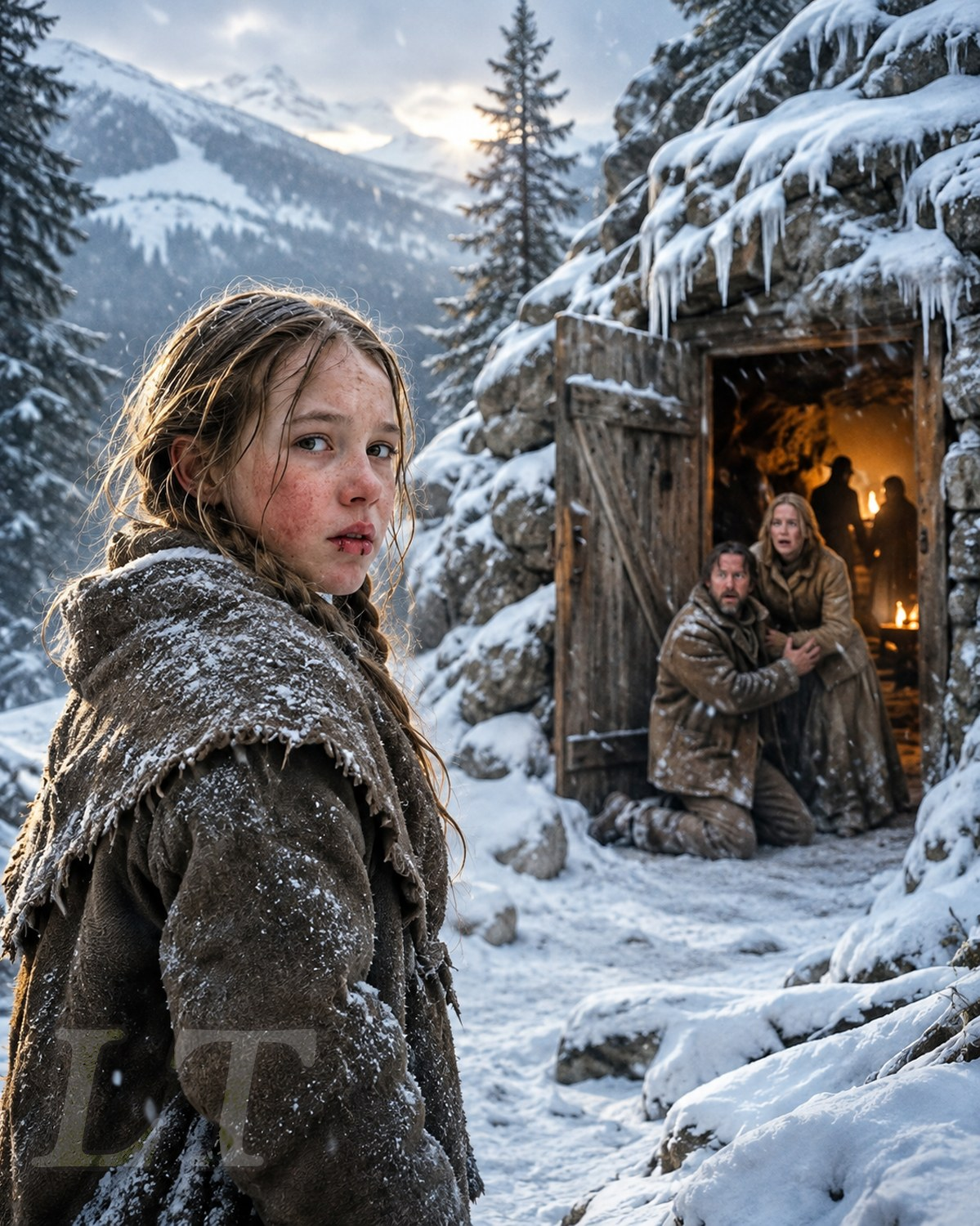
The grizzly charged.
Alma stumbled backward.
Snow scattered beneath her boots as the enormous animal came down the slope, its heavy paws striking the frozen ground.
She could hear its breathing.
She could see the dark fur around its shoulders.
For one terrifying moment, she was no longer standing in the valley.
She was nine years old again.
She was following the ravens through a canyon.
And she was about to find her father.
"Father..." she whispered.
The bear kept coming.
Alma tightened her fingers around the hunting knife.
But she remembered something Silas had told her.
A knife was not a weapon against a grizzly.
It was a tool.
And tools were only useful when people understood their limitations.
She forced herself not to run.
The animal continued forward.
Then, suddenly, it stopped.
Its enormous head swung toward the fallen aspen.
Alma noticed the change.
The bear was no longer looking directly at her.
It was sniffing the air.
Perhaps it had caught the scent of the rabbit she had carried earlier. Perhaps it had noticed something beneath the fallen branches.
Whatever the reason, its attention had shifted.
Alma used those few seconds.
She slowly moved toward the open ground, keeping a wide distance between herself and the animal.
Her boots made small sounds against the snow.
She stopped.
The bear lifted its head.
She stopped again.
For several long moments, neither moved.
Then the animal lowered its head and began investigating the fallen tree.
Alma continued backing away.
She did not turn around until the trees partially concealed the grizzly.
Only then did she walk faster.
Her injured knee hurt with every step.
But she kept moving.
When she finally reached the sandstone cliff, she looked back.
The bear was no longer visible.
Alma entered the narrow shelter and pulled her blanket around herself.
Her hands were trembling.
She sat against the stone wall and closed her eyes.
For the first time since arriving in the valley, she understood that the mountain could be as dangerous as the town she had left behind.
There would be no one to rescue her if she made a mistake.
There would be no neighbor to open a door.
No family to share a meal.
No doctor to examine an injury.
She was responsible for every decision.
And the winter was still coming.
Alma remained inside until the light began fading.
She examined her injured knee.
The skin was bruised, and a small cut had appeared where it had struck the rock.
She cleaned it with water from the spring and wrapped it with a narrow strip of cloth.
Then she checked her supplies.
The cornmeal remained dry.
The rose hips were untouched.
A small portion of rabbit meat had been set aside.
She had lost no food during the encounter.
That was fortunate.
But the incident had cost her most of the afternoon.
She needed a better plan.
The cave was too small.
The entrance was too narrow.
And the shelter offered no protection if a large animal decided to investigate.
Alma looked at the opening.
Her father had once shown her how to recognize places where animals were likely to pass.
They followed familiar paths.
They moved toward water.
They searched for shelter when the weather became severe.
The valley contained all three.
That meant animals would continue visiting.
She needed a door.
Not a complicated one.
Just something strong enough to discourage unwanted visitors and keep the wind from entering.
She also needed to enlarge the cavity.
The little hollow was barely large enough for her to sleep.
If she wanted to survive several months, she would need a proper living space.
Alma took her father's knife and examined the sandstone wall.
The surface was rough.
There were natural layers where the stone seemed softer.
She pressed the blade against one of them.
A small fragment broke away.
She tried again.
Another piece fell.
She looked at the growing pile beside her.
It would take weeks.
Perhaps months.
But she had nowhere else to go.
She began again.
The following morning, Alma woke to the sound of water dripping.
She opened her eyes.
A small patch of moisture had appeared near the ceiling.
She sat up and examined it.
The stone above the entrance was wet.
Melted snow had begun running into the natural cracks.
That was another problem.
If the weather became warmer during the day and colder at night, water could freeze inside the sandstone.
The expanding ice might weaken the rock.
She remembered her father warning her about this.
"Water finds every weakness," Silas had said.
"Even in mountains?"
"Especially in mountains."
He had shown her how streams slowly changed the shape of stone.
"People think mountains are permanent because they look so strong. But water works patiently. It never needs to hurry."
Alma touched the damp surface.
She needed to understand where the water was coming from.
She crawled outside and examined the cliff.
The overhang protected most of the entrance, but the upper rock formation collected snow.
When the snow melted, water traveled along a shallow groove and reached the crack above her shelter.
She followed the groove with her eyes.
It extended toward the ridge.
There might be a way to redirect the water.
She gathered small stones and pieces of fallen wood.
Using her knife and a flat rock, she cleared a narrow channel beside the entrance.
She placed the smaller stones along its edge.
The work was slow.
Her knee hurt.
Her fingers were sore.
But when she poured a little water into the channel, it followed the new path instead of running toward the cave.
Alma watched it reach the ground.
Then she nodded.
One problem solved.
Not permanently.
But enough for now.
Over the next several days, she began treating the cave as a project rather than an emergency shelter.
Every morning, she inspected the entrance.
She checked the ceiling for loose fragments.
She examined the ground for moisture.
She collected wood and food before returning to the rock.
Her work followed a routine.
Food first.
Water second.
Shelter third.
She had learned from her father that a person who ignored basic needs while working on a larger task could quickly become too weak to finish it.
The cave slowly changed.
Alma cleared the floor.
She moved loose stones toward the entrance and arranged them into a small pile.
She selected a dry section for sleeping.
Another area became a storage place for food.
The narrowest part of the entrance was widened slightly.
She also began examining the natural crack above the cave.
It seemed to carry air upward.
That could become useful if she managed to create a small hearth near the entrance.
She would need to work carefully.
Smoke trapped inside a small cavity could kill her.
She remembered how Silas had built temporary shelters during their hunting trips.
He always considered the direction of the wind.
He never placed a fire where smoke could collect around the sleeping area.
Alma planned to follow the same principle.
She did not have the tools her father had owned.
But she had his knife.
And she had time.
At least she hoped she did.
On the sixth morning, she discovered something that changed her plans.
While clearing loose stones near the back wall, her flat rock struck a surface that sounded different.
Instead of the dull sound of solid sandstone, it produced a hollow knock.
Alma stopped.
She struck the same place again.
The sound repeated.
She leaned closer.
There was a narrow line running vertically along the wall.
It was difficult to see beneath the dust.
She brushed it with her sleeve.
A faint outline appeared.
It looked almost like the edge of another opening.
Alma's heart began beating faster.
She examined the line from top to bottom.
The rock was not uniform.
There was a small section where the sandstone appeared to have separated naturally.
Perhaps the cavity extended farther than she had realized.
She pressed her hand against the surface.
Cold air moved faintly across her fingers.
Alma leaned closer.
There was definitely a draft.
She remembered the narrow crack near the entrance.
Perhaps the two openings were connected.
She took the flat stone and began clearing the loose material.
Small fragments fell away.
Then a larger piece broke free.
Behind it was darkness.
Alma stepped back.
She waited.
Nothing happened.
She returned with a small burning branch and held it near the opening.
The flame leaned slightly toward the darkness.
There was air moving inside.
She placed the branch on a flat rock and examined the gap.
It was too narrow for her shoulders.
But she could see that the stone behind it was not packed with earth.
There was space.
A larger space.
Alma felt a sudden rush of hope.
If the cave extended farther, she might be able to create separate areas for sleeping, storing food, and keeping firewood.
She could also protect the entrance more effectively.
But she needed to know whether the space was safe.
She would not risk a collapse just because she wanted more room.
Silas had warned her never to trust a hollow in the mountain without examining the ceiling and walls.
Alma studied the stone.
She checked the upper edge.
Then the sides.
There were no obvious cracks spreading through the surrounding rock.
Still, she decided to proceed slowly.
She removed only the loose material.
By midday, the opening was wide enough for her to look inside.
A faint beam of daylight reached several feet into the darkness.
The cavity continued beyond it.
Alma could not see the end.
She sat beside the opening.
For the first time, she began to imagine a real home.
Not a place to hide until the storm passed.
A place where she could live.
That evening, Alma prepared a small meal.
She cooked a little rabbit meat and added several rose hips.
The food was simple, but she ate slowly.
She had begun rationing the cornmeal more carefully.
The sack had to last until she could establish a reliable supply of food.
After eating, she wrapped the remaining meat and placed it in a sheltered section of the cave.
Then she took out her father's folded paper.
She read the familiar words again.
Water.
Wood.
Shelter.
Food.
Below them was the sentence about the mountain.
Alma turned the paper over.
There was another mark on the back.
She had seen it before but never understood what it meant.
A rough drawing.
Three lines.
One long line and two shorter ones.
At first, she thought it was a sketch of the canyon where her father had hunted.
But now she noticed something else.
The shape resembled the outline of the sandstone cliff.
She held the paper closer to the firelight.
There was a small mark near the bottom.
It might have been a spring.
Another mark appeared near the upper edge.
A narrow opening.
Alma looked toward the newly discovered hollow.
Then she looked at the drawing again.
Could her father have known about this place?
She remembered their last hunting trip to the valley.
Silas had spent a long time examining the cliff.
He had touched the stone in several places.
He had told her that the mountain contained more spaces than people could see.
At the time, she thought he was simply explaining how caves formed.
Now she was not certain.
She folded the paper carefully.
There was still too much she did not understand.
The next day, Alma began working on the hidden opening.
She removed small fragments with her knife.
Whenever she found a loose section, she cleared it.
Whenever the rock seemed solid, she stopped.
Her progress was slow.
But by afternoon, the gap was large enough for her to squeeze through sideways.
She placed a burning branch on a flat stone and held it ahead of her.
Then she entered.
The passage was narrow at first.
She had to crawl.
The ceiling was low, and the walls pressed close to her shoulders.
But after several feet, the passage widened.
Alma stopped.
The light from the entrance barely reached the floor.
She raised the burning branch.
The flames illuminated a chamber beyond the passage.
It was larger than the first hollow.
Much larger.
The ceiling rose above her head.
The floor was uneven but mostly dry.
A long natural shelf ran along one wall.
The air felt cooler here.
Alma turned slowly.
She could hardly believe what she had found.
The mountain had been hiding another room.
She moved carefully toward the far wall.
There were marks in the sandstone.
Not fresh scratches.
Old marks.
Some were thin and shallow.
Others looked as though water had carved them over many years.
She touched one with her fingertips.
The stone was smooth.
Then she noticed something near the floor.
A small pile of dry branches.
Alma crouched.
The branches were old.
Their bark had partly separated.
But they had not been placed there by the wind.
Someone had brought them.
She looked around.
There was another small object beneath them.
A piece of leather.
Alma picked it up.
It was stiff and cracked.
She brushed away the dust.
A familiar pattern appeared along its edge.
Three short cuts.
One long cut.
Her father's way of marking his hunting equipment.
Alma froze.
She turned the leather over.
There was a small initial carved into it.
An S.
Silas.
Her father had been here.
She was certain of it.
For several moments, she could not move.
She looked toward the darkness beyond the chamber.
How far did this place extend?
Why had her father never told her about it?
And why had he left something behind?
She picked up the leather and placed it inside her coat.
Then she examined the floor more carefully.
Near the far wall, a line of stones formed a rough semicircle.
They looked like the remains of an old fire ring.
Alma knelt beside it.
There was black residue between the stones.
Old charcoal.
Someone had made a fire here long ago.
Perhaps Silas.
Perhaps another hunter.
She looked at the ceiling.
The natural crack above the chamber seemed to continue upward.
A faint current of air passed through the room.
Alma held the burning branch near it.
The flame bent toward the opening.
A natural ventilation passage.
Her excitement grew.
This chamber could become the main living space.
The smaller cavity near the entrance could hold supplies.
The natural passage might help carry smoke outside.
For the first time, she could see how the pieces might fit together.
She had found more than shelter.
She had found the beginning of a home.
But the discovery also brought new questions.
Alma returned to the first chamber and placed the leather beside her father's paper.
She compared the marks.
The pattern on the leather matched one of the symbols on the drawing.
She leaned closer.
There were three small cuts beside the larger mark.
Exactly the same.
Her father had left some kind of sign.
But why?
Perhaps he had intended to return.
Perhaps he had used the chamber during an earlier hunting trip.
Or perhaps he had discovered something about the mountain that he never had time to explain.
Alma remembered the last time she had seen him alive.
He had been preparing to leave for the canyon.
He had checked his hunting knife, packed food, and tied his coat.
Before leaving, he had placed a hand on her shoulder.
"Stay close to the settlement until I return."
She had asked why.
"Because the mountains are changing."
He had looked toward the northern ridge.
There had been concern in his eyes.
She remembered asking whether winter would come early.
He had paused.
"Maybe."
Then he had added something she had not understood.
"Sometimes the land gives us more warning than people deserve."
He had never returned.
Alma stared at the leather.
A sudden thought came to her.
What if her father had discovered this shelter before his final journey?
What if he had planned to use it again?
She pushed the thought away.
There was no way to know.
And there was no point trying to answer questions when she still had so much work to do.
The following morning, Alma began preparing the entrance for a wooden door.
She had found several fallen branches, but she needed thicker pieces.
The aspen trunk she had moved earlier was still near the slope.
She would have to return for it.
She also needed rawhide or strong cord to hold the wooden pieces together.
She could make strips from animal hides, but that would take time.
For now, she could begin with smaller sections.
She measured the opening using the length of her forearm.
Then she marked the sandstone with a small scratch.
She wanted the door to fit tightly enough to block the wind.
But it could not be so heavy that she would be unable to move it alone.
She studied the shape of the entrance.
The natural rock already formed a partial frame.
She could build a wooden panel and secure it against the sides.
A small gap near the top would allow controlled ventilation.
The idea seemed possible.
She returned to the trees and collected several straight branches.
The work took most of the morning.
By the time she returned, clouds had begun gathering again.
She looked toward the mountains.
The weather was changing faster than she liked.
The wind had become sharper.
A thin layer of ice covered the edges of the spring.
Alma hurried.
She placed the wood beneath the overhang.
Then she examined the hidden chamber once more.
Everything appeared normal.
The air was moving through the natural crack.
The stone remained dry.
She placed the burning branch near the passage and watched the flame.
It leaned gently upward.
Good.
She could use the chamber for warmth later.
But before she could begin building the hearth, she needed to finish the entrance.
She picked up her knife and began cutting the branches to length.
By afternoon, she had created a rough wooden frame.
It was not beautiful.
The pieces were uneven.
But they fitted together.
She tied the branches with strips of cord and tested the structure.
It held.
Alma carried it toward the entrance.
Then she stopped.
There was something wrong.
A faint sound came from the hidden chamber.
She turned.
At first, she thought it was the wind.
But the sound came again.
A soft scraping.
Then silence.
Alma placed the wooden frame against the wall.
She took her father's knife.
The chamber was darker now because the clouds had covered the sun.
She approached the narrow passage.
The small flame beside it flickered.
She held it forward.
Nothing moved.
She listened.
A faint sound came from deeper inside.
Three short taps.
Then one long scrape.
Alma's fingers tightened around the knife.
She remembered the three marks on the leather.
Three short cuts.
One long cut.
She stepped into the passage.
Her boots touched the cold stone.
The air seemed different.
Not merely moving.
Disturbed.
She crawled forward.
When she reached the larger chamber, she stopped.
The fire ring remained undisturbed.
The old branches were still where she had found them.
But something near the far wall had changed.
A narrow section of sandstone had shifted.
A dark gap appeared behind it.
Alma raised the burning branch.
The flame bent sharply toward the opening.
There was another passage.
One she had not seen before.
She approached carefully.
Then she noticed a line scratched into the stone beside it.
A mark she recognized immediately.
Her father's mark.
She reached out and touched it.
The stone beneath her fingers moved.
A small fragment broke loose and fell.
From somewhere behind the wall came a sound.
Not the wind.
Not falling stone.
A deep, deliberate knock.
Alma stepped backward.
The sound came again.
Three short knocks.
Then one long one.
She stared into the darkness.
And suddenly, from somewhere deep inside the mountain, something knocked back.






Comments 0