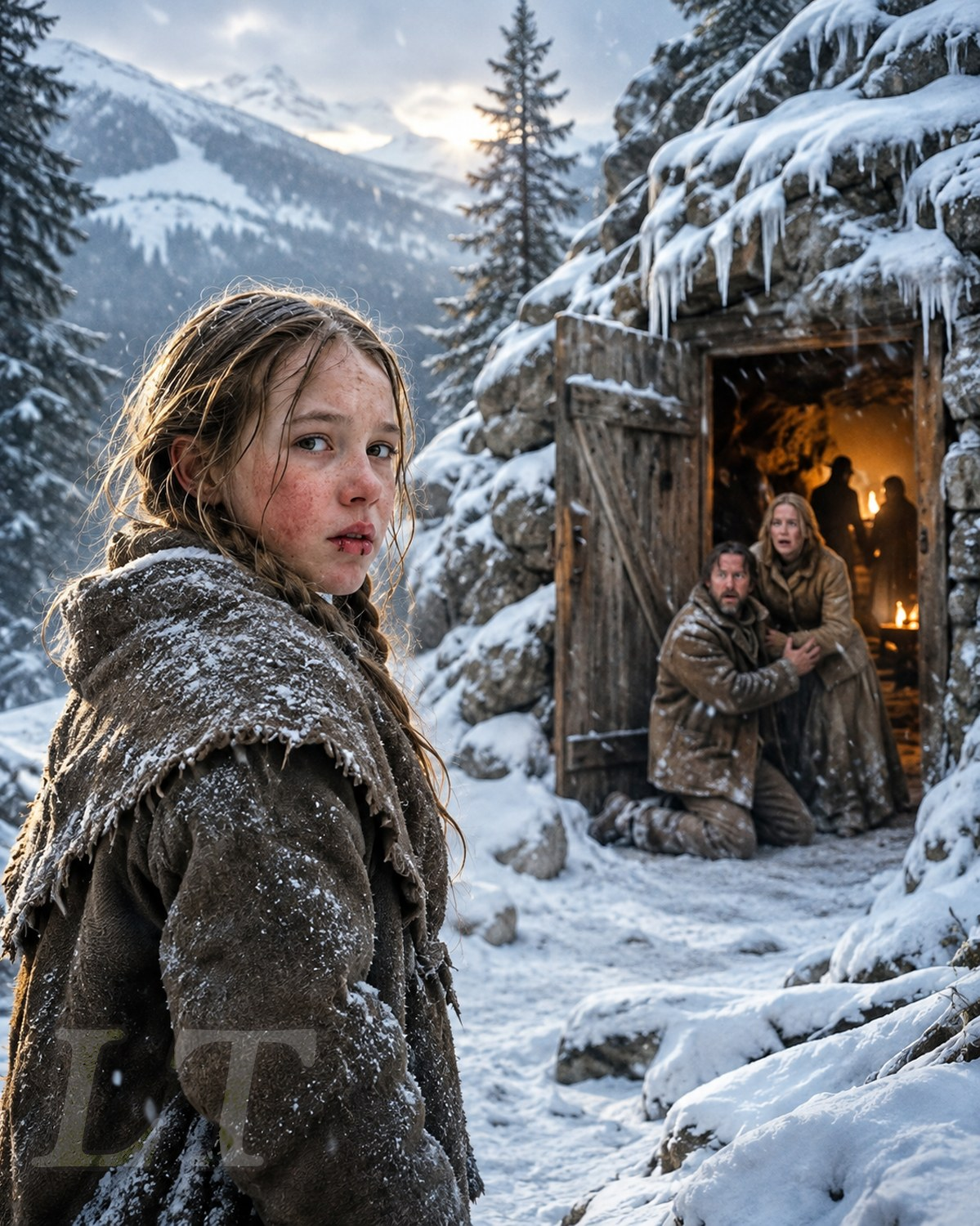
Alma Jesús tightened her fingers around the wool blanket as Reverend Josia Woodmore pointed toward the northern road.
"Keep walking. Brierwood has no place for you anymore."
The eleven-year-old girl stood beside a sack of cornmeal.
A small tear near its bottom leaked a thin trail of white dust into the road.
Behind Reverend Woodmore, the church doors remained open.
Nobody stepped forward.
Not one person asked where she would sleep that night.
Alma looked at the people gathered along the street. She recognized nearly every face. Some had given her work. Some had allowed her to sleep beside their fireplaces. Others had taken her father's tools, his hunting equipment, and the few belongings he had left behind.
Now they watched her leave as if she were a stranger.
She was eleven years old.
And she was being sent into the Wyoming wilderness alone.
"Do you understand what I told you?" Reverend Woodmore demanded.
Alma looked at him.
"Yes, Reverend."
"Then go."
She bent down, picked up the sack, and placed it over her shoulder.
The weight pulled against her small frame. Her boots were worn, and the hem of her brown wool dress had been repaired so many times that the original stitching was almost impossible to recognize.
A cold wind moved through the street.
Alma adjusted the blanket.
Then she started walking.
She did not look back.
Three days earlier, the same girl had stood inside Brierwood's general store and warned the townspeople about the coming winter.
She had not raised her voice.
She had not demanded that anyone believe her.
She had simply explained what she had observed.
The beavers were building unusually high dams. Elk were leaving the highlands weeks earlier than expected. Squirrels were gathering food with an urgency she had never seen before.
Even the woolly bear caterpillars seemed different.
Almost entirely black.
Her father had taught her that nature sometimes offered warnings long before people noticed the danger.
Alma had spent years watching those signs.
Now she believed they were telling her something terrible.
"Winter is coming early," she had said.
The grocer, Mr. Harlan, stopped arranging canned goods and looked down at her.
"Winter comes every year, child."
"Not like this."
A rancher near the counter laughed.
"What makes you an expert?"
Alma swallowed.
"My father taught me."
That answer made the laughter louder.
Her father, Silas Jesús, had been dead for two years. Some people remembered him as a skilled hunter. Others remembered him as a quiet man who knew the mountains better than anyone in Brierwood.
But his knowledge had never made him popular.
He preferred watching the land to discussing it with people.
And Alma had inherited that habit.
"Your father was a hunter," the rancher said. "Not a weather prophet."
"He taught me to watch the animals."
"Animals don't predict the weather."
"They know when the mountains become dangerous."
Mr. Harlan leaned against the counter.
"Little girl, you're frightening people for no reason."
"I'm trying to help."
The store fell quiet.
Then Reverend Josia Woodmore stepped forward.
He had heard enough to decide that the conversation needed to end.
"Alma, you are spreading fear among hardworking families."
She looked up at him.
"I don't want anyone to die."
"Then stop telling lies."
"They aren't lies."
The Reverend's expression hardened.
"You have no proof."
Alma wanted to explain everything her father had taught her.
She wanted to describe the way elk moved before severe storms, how beavers reinforced their shelters, and how certain changes in the forest could reveal what was happening in the higher mountains.
But she understood something as she looked around the store.
Nobody wanted an explanation.
They wanted her to stop talking.
Alma had learned long before that day that being right did not always make people listen.
After Silas died, she had discovered that adults could be cruel without raising their voices.
Her father had been mauled by a grizzly in a canyon above Sweetwater.
He had gone hunting and never returned.
When several days passed without any sign of him, Alma went looking.
She followed the ravens.
She found his body near a rocky slope.
For a long time, she stood beside him without moving.
She was nine years old.
There was no one else with her.
She buried him as best she could and kept his hunting knife.
Then she walked toward Brierwood.
The town took her in, but no family truly wanted the responsibility of raising another person's child.
She was passed from one household to another.
In one home, she scrubbed floors.
In another, she washed clothes.
At the Harrigan ranch, she cleaned animal stalls and helped feed the horses.
She never complained.
She had learned to make herself useful because usefulness was the closest thing to security she could find.
But people often mistook her silence for strangeness.
She noticed things others ignored.
She remembered small details.
She could tell when a horse was sick before it stopped eating. She knew which streams became dangerous after heavy rain. She could recognize animal tracks and distinguish between old footprints and fresh ones.
Some adults appreciated her abilities.
Others found them unsettling.
Then came the August frost.
Alma had warned the Harrigan family that an unusually cold night was coming.
They laughed.
They left their orchard uncovered.
By morning, several trees had been damaged.
Before that, she had warned about a sudden rise in the creek.
Three horses drowned when the water flooded the lower pasture.
Each time, people found a reason not to believe her.
She was only lucky.
She was only guessing.
She was only a strange child who wanted attention.
But Alma had never wanted attention.
She wanted people to survive.
By the time the town decided to expel her, the argument had become bigger than one conversation in the general store.
People were frightened.
The ranchers were worried about their animals.
The storekeeper feared that families would begin purchasing supplies they could not afford.
Reverend Woodmore believed that the town needed order.
And Alma's warning threatened the confidence they had placed in their familiar routines.
So they made her the problem.
On September 29, they gathered near the church.
The Reverend announced that Alma had been given enough chances.
He claimed her warnings were harmful and that the town could no longer allow her to spread panic.
Nobody challenged him.
Not even the people who had once accepted her help.
A woman who had given Alma a place to sleep during the previous winter lowered her eyes.
The grocer folded his arms.
The rancher who had laughed in the general store stood near the back.
Alma waited for someone to speak.
She thought perhaps one person would remember the flood.
Perhaps someone would remember the orchard.
Perhaps somebody would ask what would happen if she was right.
But nobody did.
Reverend Woodmore held out the small sack of cornmeal.
"You have enough food to reach the next settlement."
Alma looked at the sack.
"How far is it?"
"Far enough."
"Which road should I take?"
The Reverend pointed north.
"Follow the old hunting trail. You will find your way."
Alma knew the trail.
Her father had taken her there when she was younger.
But knowing the trail did not make the journey safe.
There were mountain passes, hidden ravines, predators, and streams that could become impassable.
Still, she accepted the food.
She did not ask for more.
The first mile beyond Brierwood was the hardest.
Not because the ground was difficult.
Because she could still hear the town behind her.
A door closed.
A horse neighed.
Someone laughed.
Then the sounds slowly disappeared.
Alma walked until the settlement was no longer visible.
Only then did she stop.
She placed the sack on the ground and sat beneath a small pine tree.
Her fingers were cold.
Her stomach hurt.
She took a little cornmeal from the sack and mixed it with water in a small wooden cup.
It was not much of a meal.
But it was food.
She ate slowly.
Then she removed her father's hunting knife from beneath her coat.
The handle was worn smooth from years of use.
Silas had carried it through forests, across rivers, and into the mountains.
Alma ran her thumb over the familiar wooden grip.
She remembered his voice.
"Never let fear make your decisions for you."
He had said it many times.
Sometimes when they crossed a narrow ridge.
Sometimes when they tracked an injured animal.
Sometimes when she became frustrated because she could not understand why a particular stream had changed direction.
He had taught her that survival was not about being fearless.
It was about paying attention.
She closed her fingers around the knife.
"I'm still watching, Father," she whispered.
Then she stood and continued north.
The next morning, the land began to change.
The sagebrush plains gave way to rougher ground.
The wind became stronger.
The distant mountains appeared larger.
Alma watched the clouds gather above the higher peaks.
She recognized the signs.
The air felt heavier.
The animals were moving differently.
Even the birds seemed to be disappearing from the exposed ridges.
She found tracks near a stream.
Elk.
Several animals had passed through during the night.
Their direction confirmed what she had already suspected.
They were moving toward lower ground.
Alma crouched beside the tracks and studied them.
Her father had once shown her how to estimate the freshness of footprints by looking at the edges of the soil.
These were recent.
Very recent.
She stood and looked toward the mountains.
If the elk were already leaving, the upper country might become dangerous sooner than anyone in Brierwood imagined.
She tightened her blanket around her shoulders.
There was no reason to hurry blindly.
She needed shelter.
Water.
Food.
A place where she could survive when the snow arrived.
Most importantly, she needed somewhere protected from the wind.
She remembered a place her father had once shown her.
A sheltered valley beneath a sandstone cliff.
There had been a spring there.
The rock formation had created a natural overhang.
Silas had told her that a person could stay dry beneath it during heavy rain.
At the time, Alma had thought it was simply another place to rest during a hunting trip.
Now it might become her only chance.
She turned toward the northern foothills.
On the second day, her boots began to hurt.
The leather had separated slightly near one heel, and snow slipped inside.
She stopped twice to warm her feet.
Each time, she used the same method her father had taught her: keep moving, keep dry when possible, and never allow discomfort to become an excuse for careless decisions.
By afternoon, she reached a narrow ridge.
From there, she could see a valley below.
The sandstone cliffs rose along one side.
Pine trees covered the opposite slope.
A small stream cut through the center.
Alma recognized the place.
She had been there with Silas years earlier.
She remembered sitting beside the spring while he showed her how to identify edible roots.
She remembered Whisper, the pale brown mustang mare that had once followed them along the trail.
The memory made her stop.
For the first time since leaving Brierwood, she felt that she might not be entirely alone.
She descended carefully.
The ground was uneven, and loose stones shifted beneath her boots.
When she reached the valley floor, she found the spring.
Water emerged from beneath the sandstone and flowed into a shallow pool.
It was clear.
It was moving.
And it had not frozen.
Alma knelt and drank.
Then she followed the water toward the cliff.
There, beneath a broad overhang, she discovered a narrow crack in the sandstone.
At first, she thought it was too small to be useful.
But when she leaned closer, she felt a faint current of air coming from inside.
She brushed away loose snow and examined the opening.
The stone was dry around the edges.
There were no obvious signs of recent collapse.
She placed one hand against the rock.
It was cold, but solid.
Alma looked toward the valley.
Then she looked at the narrow opening.
Her father had always told her that the land provided possibilities to those who paid attention.
She took a breath.
And began removing the loose stones.
By sunset, Alma had cleared enough space to squeeze inside.
She pushed her blanket through first.
Then the sack of cornmeal.
Finally, she lowered herself into the darkness.
The opening was barely wide enough for her shoulders.
Inside, the cavity expanded slightly.
It was still small.
A grown person might have found it uncomfortable.
But Alma could lie down without touching the damp ground.
The ceiling was solid sandstone.
The walls offered protection from the wind.
And the spring was only a short distance away.
She sat quietly.
For the first time since Brierwood had sent her away, she allowed herself to think about the future.
She had a shelter.
She had a knife.
She had a little food.
She knew how to find water.
But winter was coming.
And she was still only eleven years old.
Alma pulled the blanket around herself and examined the rock wall.
The cavity was too narrow for a proper bed.
There was no room to store enough wood.
There was no safe place for a fire.
The entrance was exposed to drifting snow.
If she stayed there without making improvements, the cave could become a trap.
She needed to change it.
She needed to make it bigger.
She needed to build something the mountain had not provided naturally.
Her eyes moved toward the hunting knife beside her.
Then she looked at the sandstone.
Outside, the last light disappeared behind the mountains.
Alma picked up the knife.
She pressed its edge against the rock.
A small piece broke loose.
She studied the mark.
Then she struck again.
She would not wait for Brierwood to change its mind.
She would build a place where she could survive without anyone's permission.
And as the first small fragments of sandstone fell beside her knees, a distant rumble rolled across the mountains.
Alma stopped.
She listened.
The sound came again.
Far above the valley, something heavy was moving through the high country.
She crawled toward the entrance and looked outside.
A dark line of clouds had appeared beyond the ridge.
Then the wind changed.
And the first snowflake landed on her hand.
Hoàn thành phần 1: TITLE, HOOK, danh sách đầy đủ 15 chương và Chapter 1. Chapter 1 kết thúc bằng cliffhanger dẫn trực tiếp sang Chapter 2. Các chương tiếp theo sẽ tiếp tục đúng thứ tự, mỗi chương hướng tới độ dài 2.000 từ, không tóm tắt hoặc viết lại chương trước.






Comments 0