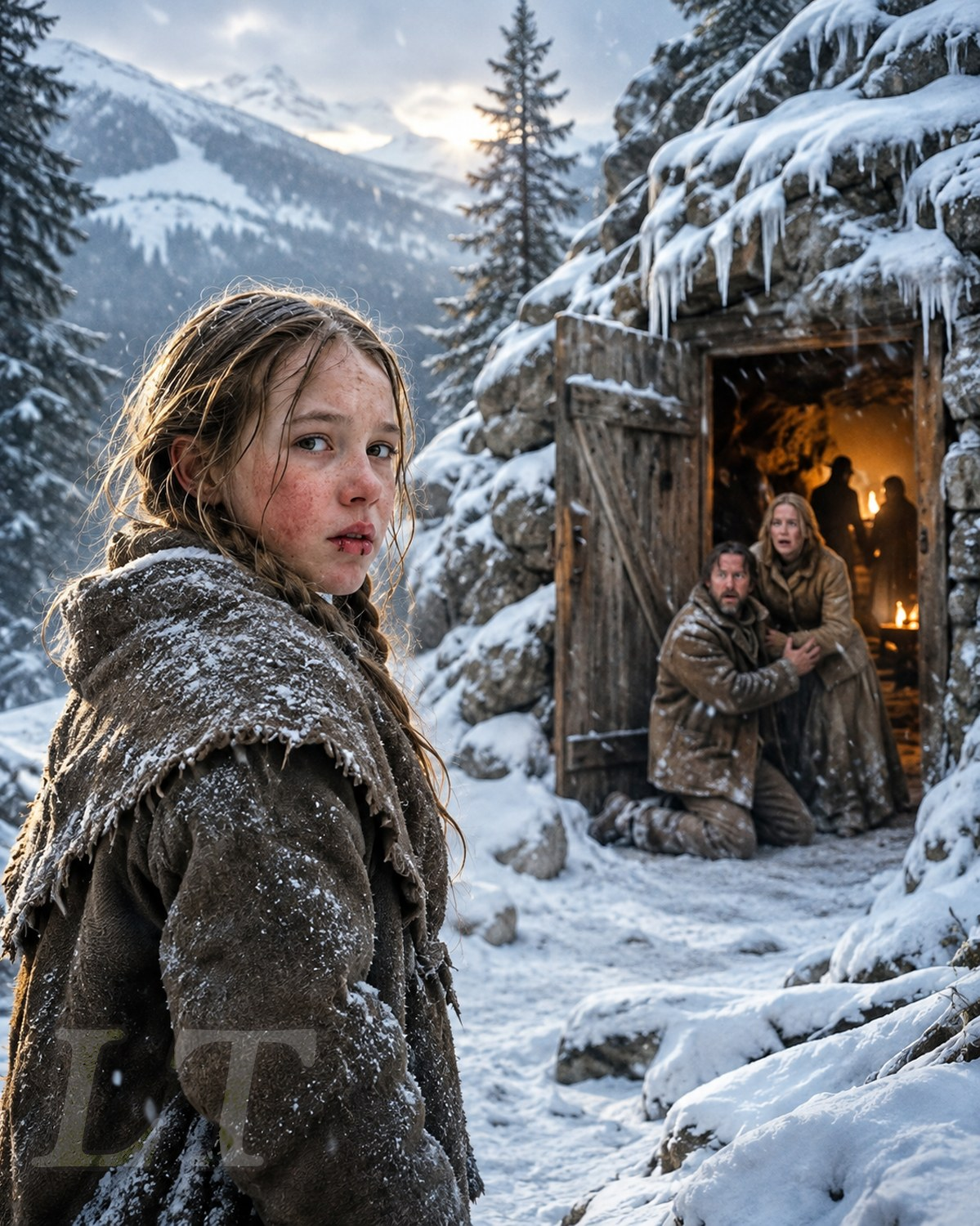
The first snowflake landed on Alma's hand.
Then another struck her cheek.
She remained crouched near the cave entrance, watching the dark clouds gather above the mountains. The distant rumbling continued, rolling through the valley like something enormous moving beneath the earth.
Her father had taught her never to ignore a change in the weather.
He had also taught her that the first sign of danger was rarely the most important one.
It was what happened afterward that mattered.
Alma pulled her blanket tighter and looked toward the ridge.
The clouds were moving unusually fast.
That troubled her more than the snow.
A storm could arrive suddenly in the mountains. But the animals usually sensed it before people did. Their behavior changed. Their movements became purposeful. Even the smallest creatures seemed to understand when the familiar world was about to become dangerous.
Alma remembered something Silas had told her during one of their hunting trips.
"Never watch only the sky, little one. The sky can deceive you. Watch what the creatures beneath it are doing."
She had been eight years old then.
They had been sitting beside a stream, watching a family of beavers drag branches toward their lodge.
Alma had asked why the animals were working so hard.
Silas had pointed toward the water.
"Look at the dam."
She had noticed that the structure was taller than the previous one they had passed.
"Does that mean they're expecting rain?"
"Maybe. Or perhaps they expect the water to rise. Sometimes the animals prepare for things we haven't noticed yet."
He had smiled at her curiosity.
"People often believe they're smarter because they can build houses and read books. But the land has been teaching lessons much longer than any of us have been alive."
Alma had never forgotten those words.
Now, standing alone beneath the sandstone overhang, she wondered what the land was trying to tell her.
She returned inside the cave.
The opening was narrow, and she had to turn sideways to squeeze through. Once inside, she placed the cornmeal sack against the driest section of the wall.
Her fingers were stiff.
She rubbed them together and examined the small scratches left by the sandstone.
The cave offered protection from the wind, but it was not yet a proper shelter.
She could not build a large fire inside.
There was nowhere to store enough wood.
And the opening remained exposed.
If the snowfall became heavy, the entrance could disappear beneath a drift.
Alma took out her father's knife.
Its blade was still sharp enough to cut branches and scrape animal hides, but she knew it would take considerable effort to shape the sandstone.
She needed another tool.
Outside, she found several loose rocks near the spring. She selected a flat piece of hard stone and carried it back.
Then she began working.
She struck the edge of the cave opening.
A small fragment broke away.
She tried again.
Another piece fell.
The sound was unpleasantly sharp in the confined space.
She stopped to listen.
Nothing.
Only the distant wind.
She continued.
For the next hour, Alma worked carefully, removing loose pieces and clearing the narrowest part of the entrance.
She did not attempt to widen the entire cavity.
Her father had taught her that changing a mountain without understanding its structure could be dangerous.
"Stone has a memory," he once told her. "You can see where water has traveled, where frost has pushed, and where pressure has settled. Never take away more than you understand."
Alma examined the ceiling.
There were thin natural lines in the sandstone.
Some were harmless mineral marks.
Others might indicate weaknesses.
She avoided those sections.
By the time she finished, the entrance was only slightly wider, but she could move through it more easily.
She placed the flat stone beside the wall.
Then she looked outside.
The snowfall had become heavier.
The mountains were disappearing behind a grey curtain.
The following morning, Alma woke before sunrise.
She had slept badly.
The cave was cold, and the hard ground had made her shoulders ache.
But she was alive.
That was enough reason to continue.
She crawled outside and examined the valley.
A thin layer of snow covered the grass.
The stream still flowed beneath the rocks, although small patches of ice had formed along its edges.
She walked toward the spring with a wooden cup.
As she knelt to drink, she noticed something near the water.
Tracks.
Several small animals had passed during the night.
She recognized squirrel prints.
They led toward the base of a pine tree, where the animal had apparently been gathering food.
Alma followed the trail with her eyes.
A squirrel appeared on a low branch.
It carried something in its mouth.
Then it disappeared into a hollow.
Alma watched it for several minutes.
Her father had once explained that squirrels did not simply collect food randomly. They often prepared multiple hiding places, storing enough supplies to survive periods when the ground became inaccessible.
But this squirrel was behaving differently.
It returned repeatedly.
Each time, it carried another mouthful.
Alma looked toward the surrounding trees.
There were more tracks than she expected.
The animals were gathering food with unusual urgency.
She crouched beside the tree and examined the snow.
Some of the prints were fresh.
Others were several hours old.
She remembered August.
She remembered the beavers building higher dams.
She remembered the elk leaving the highlands.
And she remembered the black caterpillars.
Her father had shown her those caterpillars when she was young.
They were small and covered with bands of hair.
Silas had explained that people sometimes used their markings as a traditional clue when judging the coming winter, although no single creature could guarantee what the weather would bring.
"One sign is a question," he had said. "Several signs together become a warning."
Alma looked toward the mountains.
She had seen several warnings already.
Now the snowfall had begun before October had even arrived.
She felt a knot tighten in her stomach.
Perhaps Brierwood had only a few weeks left to prepare.
Perhaps less.
She spent the morning searching for food.
Near the edge of the valley, she found rose hips beneath a cluster of thorny branches.
Some were still firm.
Others had begun to soften.
She collected the best ones and placed them in a cloth pouch.
Farther along the slope, she discovered a patch of edible roots.
She dug carefully, avoiding the frozen ground where possible.
By midday, she had gathered enough to make a small meal.
It was not much.
But she had learned that food gathered today could become the difference between life and death weeks later.
She returned to the cave and arranged her supplies.
The cornmeal went into the driest corner.
The rose hips were placed in a separate cloth.
The roots were cleaned and set aside.
Then she counted what remained.
The sack of cornmeal would not last long.
She needed to find more food.
She needed wood.
And she needed a way to keep warm without filling the cave with smoke.
Her eyes moved toward the entrance.
There was a natural crack in the sandstone above it.
A narrow opening extended upward through the rock.
She could not see where it led.
But when she held her hand beneath it, she felt a faint movement of air.
Her father had once shown her how smoke behaved inside a hunting shelter.
It followed the warm air upward.
A properly positioned opening could help carry smoke outside.
Alma studied the crack.
She was not certain whether it was wide enough.
She would have to test it carefully.
But first, she needed firewood.
That afternoon, she found a fallen aspen tree near the stream.
Its branches had broken during an earlier storm.
The wood was dry beneath the bark.
Alma gathered the smaller pieces and carried them toward the cave.
She made several trips.
Each load was heavier than the last.
Her shoulders began to ache, and her hands developed painful blisters.
She stopped beside a rock and examined them.
The skin had opened in two places.
She wrapped a strip of cloth around her fingers.
Then she continued.
By sunset, she had gathered a modest pile.
She arranged the branches beneath the overhang, keeping them away from the wet ground.
Next, she searched for dry grass and small twigs.
The fire would need to begin with something that caught easily.
Her father had taught her to build a fire in layers.
Small material first.
Then thin branches.
Then thicker wood.
Never rush the flame.
Alma collected the materials and placed them near the entrance.
When darkness settled over the valley, she began.
Her first attempt failed.
The spark disappeared in the damp grass.
She tried again.
This time, a tiny flame appeared.
Alma bent close, protecting it from the wind with both hands.
The flame flickered.
For several seconds, she thought it would disappear.
Then a thin strand of smoke rose.
She fed it another small twig.
The fire strengthened.
Warmth slowly spread across her fingers.
Alma watched the flames.
She had not realized how badly she needed that warmth until it touched her skin.
For a moment, she almost imagined her father sitting beside her.
He would have examined the fire and told her she had used too much wood.
She almost heard his quiet laugh.
The memory made her look down.
She blinked once and reached for another branch.
There would be time to remember him later.
Right now, she had work to do.
The next two days were filled with small discoveries.
Alma found a narrow trail leading toward a grove of pine trees.
The ground beneath them was sheltered from the wind.
There were pine nuts, fallen branches, and signs of small animals.
She collected what she could.
She also discovered several places where rabbits had passed through the snow.
Her father had taught her how to set simple snares.
He had never encouraged her to waste an animal.
If they caught something, they used as much as possible.
The meat became food.
The hide became protection.
Even the smaller bones could be useful.
Alma found a place along a rabbit trail and prepared a snare.
She checked it later that afternoon.
Nothing.
She adjusted the position.
Then she waited.
The following morning, she found a rabbit.
She approached carefully.
The animal had stopped moving.
Alma crouched beside it.
She felt sorry for its life ending, but she also understood what it meant.
She would eat.
She would preserve the hide.
And she would waste nothing.
That evening, she prepared the meat over a small fire.
She divided it into portions and placed some aside for drying.
The cave slowly began to look less like a hole in the mountain and more like a place where someone could live.
But Alma knew she was still far from safe.
The roof was unfinished.
The entrance remained vulnerable.
And the winter had not truly begun.
On the fourth morning, Alma climbed a small ridge above the valley.
She wanted to see the surrounding landscape.
From the top, she could observe the mountains, the tree line, and the narrow passage leading toward the open plains.
The view was beautiful.
It was also troubling.
The upper peaks were almost completely covered by clouds.
Snow drifted across the distant slopes.
The wind was stronger than it had been the previous day.
Alma crouched behind a rock and watched the valley below.
Then she noticed movement.
A herd of elk was crossing the lower slope.
There were at least a dozen.
They were moving quickly.
Not grazing.
Not stopping.
Simply moving toward lower ground.
Alma followed their direction.
She remembered the same behavior in August.
The animals had begun leaving the high country long before the first serious cold arrived.
Now they were moving even faster.
She looked at their coats.
Thick.
Much thicker than she expected for September.
Then she noticed something else.
The herd was not following its usual route.
Instead of crossing the exposed ridge, the animals were taking a lower path beside the trees.
They were avoiding the open ground.
Alma's father had once told her that animals often chose routes based on shelter and safety rather than distance.
If they were avoiding the ridge, the wind might become dangerous there.
She stood slowly.
The cold had begun to settle into her clothes.
She turned toward the cave.
On the way down, she stopped near a cluster of bushes.
A dark shape moved beneath the branches.
A small fox emerged.
It paused.
Its ears turned toward the mountain.
Then it disappeared into the trees.
Alma watched the place where it had vanished.
Everything seemed to be moving.
Everything seemed to be preparing.
Except the people in Brierwood.
That evening, she sat beside the small fire and opened the cloth pouch containing her father's belongings.
There were only a few things inside.
A small piece of flint.
A length of cord.
A folded strip of leather.
And a piece of paper that Silas had once used to mark measurements during their hunting trips.
The paper had become soft at the edges.
His handwriting was uneven but familiar.
Alma unfolded it carefully.
There were several notes.
Water.
Wood.
Shelter.
Food.
Below them, he had written a sentence.
The mountain does not forgive carelessness.
Alma read it twice.
Then she placed the paper beside her.
She remembered another lesson.
They had once been caught in a storm near a narrow canyon.
Silas had refused to let them continue.
He had found a sheltered place beneath a rock formation and made them wait.
Alma had been impatient.
She wanted to reach their camp before nightfall.
"Why are we stopping?" she had asked.
"Because the mountain is telling us to stop."
"But we can still walk."
"We can. But that doesn't mean we should."
He had looked at the darkening sky.
"Being brave is not the same as being foolish."
Alma had not understood the full meaning then.
Now she did.
She would not try to finish the shelter in one day.
She would not waste energy.
She would not take unnecessary risks.
She would work carefully, even if it meant progress would be slow.
Outside, the wind rose.
A small shower of snow moved past the entrance.
Alma fed another branch into the fire.
Then she noticed something unusual.
The smoke was not rising through the natural crack.
Instead, it drifted downward.
She moved closer.
The air inside the cave felt different.
There was a faint pressure near the entrance.
She held her hand toward the opening.
The current had changed direction.
Alma frowned.
If the wind was pushing air into the cave, smoke could collect inside.
That would make the shelter dangerous.
She needed another way to direct it.
She looked toward the narrow crack above her.
Then she examined the sandstone around it.
Perhaps she could widen the passage.
But she needed to know where it led.
She picked up a small burning branch and held it near the crack.
The flame bent.
Not toward the cave.
Away from it.
Alma watched closely.
There was an upward draft.
A possible solution.
She carefully moved the fire farther from the entrance and allowed the smoke to drift toward the natural opening.
Some escaped.
Not enough.
She would need to improve it.
By the next morning, the weather had changed again.
The valley was covered in fresh snow.
The stream had begun freezing along its edges.
Alma stepped outside and examined the ground.
She noticed a line of small tracks leading toward the cave.
At first, she thought they belonged to a rabbit.
But they were different.
The marks were closer together.
The animal had moved slowly.
She followed them around the side of the sandstone.
There, beneath a low rock shelf, she found a small collection of pine needles.
Something had been sleeping there.
Alma crouched.
A faint movement came from the darkness.
She stepped back.
A young animal emerged.
It was a rabbit.
Its fur was grey-brown, and one of its ears had a small tear.
It looked at her.
Then it disappeared beneath the rocks.
Alma smiled faintly in recognition of its stubbornness, though she did not try to catch it.
She had learned that the valley contained more life than she had first realized.
That was encouraging.
But the increasing snow was not.
She returned to the cave and examined her supplies.
She had enough food for several days.
Perhaps a little longer if she rationed carefully.
She had collected a small amount of firewood.
But she needed far more.
She needed to make the cave larger before the storms became severe.
And she needed a proper door.
The wooden pieces she had found near the stream were not large enough.
She would have to search for fallen logs.
She looked toward the trees.
The wind was growing stronger.
She knew the search would be difficult.
Still, she could not remain inside and hope the weather improved.
She took her father's knife.
She wrapped the blanket around her shoulders.
Then she stepped into the snow.
The first hour went well.
Alma found several fallen branches beneath the pine trees.
She gathered the smaller pieces and carried them toward the cave.
Then she discovered a large aspen log near the edge of the valley.
It had fallen during an earlier storm.
The trunk was thick enough to provide several useful sections.
She examined the wood.
It was partly dry.
She could cut it into smaller pieces.
But moving it alone would be difficult.
Alma studied the slope.
If she could roll the log downhill, she might be able to move it closer to the cave.
Her father had taught her to use leverage.
A heavy object did not always require greater strength.
Sometimes it required a better position.
She found a smaller branch and placed it beneath one end of the trunk.
Then she pushed.
Nothing happened.
She adjusted the branch.
Pushed again.
The log moved slightly.
She continued, stopping whenever her hands became too tired.
After several attempts, the trunk began rolling.
Slowly, it moved down the slope.
Alma followed it.
For a moment, she felt proud.
Then the ground beneath her boot shifted.
She slipped.
Her knee struck a rock.
The pain was sharp enough to make her gasp.
She remained on the ground for several seconds.
Then she examined her leg.
The skin was bruised, but she could still move.
She stood carefully.
The log had stopped against a cluster of rocks.
Alma looked at it.
Then at the darkening sky.
She had spent too much time outside.
She needed to return.
She would finish the work tomorrow.
As she turned toward the cave, she heard a sound from the trees.
A low, unfamiliar growl.
Alma stopped.
The sound came again.
Closer this time.
She slowly turned her head.
Between two snow-covered pines, something moved.
A large shape.
Dark.
Heavy.
Almost impossible to distinguish from the shadows.
Alma's fingers tightened around her father's knife.
She remembered his warning about the grizzly country.
And then she noticed the tracks in the fresh snow.
They were enormous.
Far larger than the ones she had seen near the stream.
The animal was coming toward her.
And it was no longer hiding.
Alma backed away slowly.
She knew that running could make things worse.
She also knew that a knife would be almost useless against a full-grown grizzly.
Her father had taught her to respect wild animals.
Never approach them carelessly.
Never corner them.
And never mistake their silence for weakness.
The dark shape moved again.
A branch cracked.
Alma's heart began pounding.
She searched the surrounding ground.
To her left was a steep slope.
To her right, the fallen aspen.
Behind her, the narrow trail leading toward the cave.
She needed distance.
Slowly, she stepped toward the open ground.
The growling stopped.
For a moment, the valley became strangely quiet.
Even the wind seemed to disappear.
Then a sudden gust swept snow from the trees.
Alma blinked.
When she looked again, the shape had moved closer.
She could now see its broad shoulders.
Its dark fur.
And the unmistakable outline of its head.
It was a grizzly.
Alma's breath caught.
She remembered the canyon where her father had died.
She remembered the ravens.
She remembered the terrible silence after she had found him.
For one brief moment, the past threatened to overwhelm her.
Then she heard his voice in her memory.
Never let fear make your decisions for you.
Alma tightened her grip on the knife.
She did not run.
She slowly backed toward the fallen log, keeping the animal in sight.
But the grizzly suddenly lifted its head.
Its nostrils moved.
It had caught her scent.
The animal took one heavy step forward.
Then another.
Alma looked toward the narrow trail.
The cave was still several hundred yards away.
And the grizzly had just begun to move faster.






Comments 0