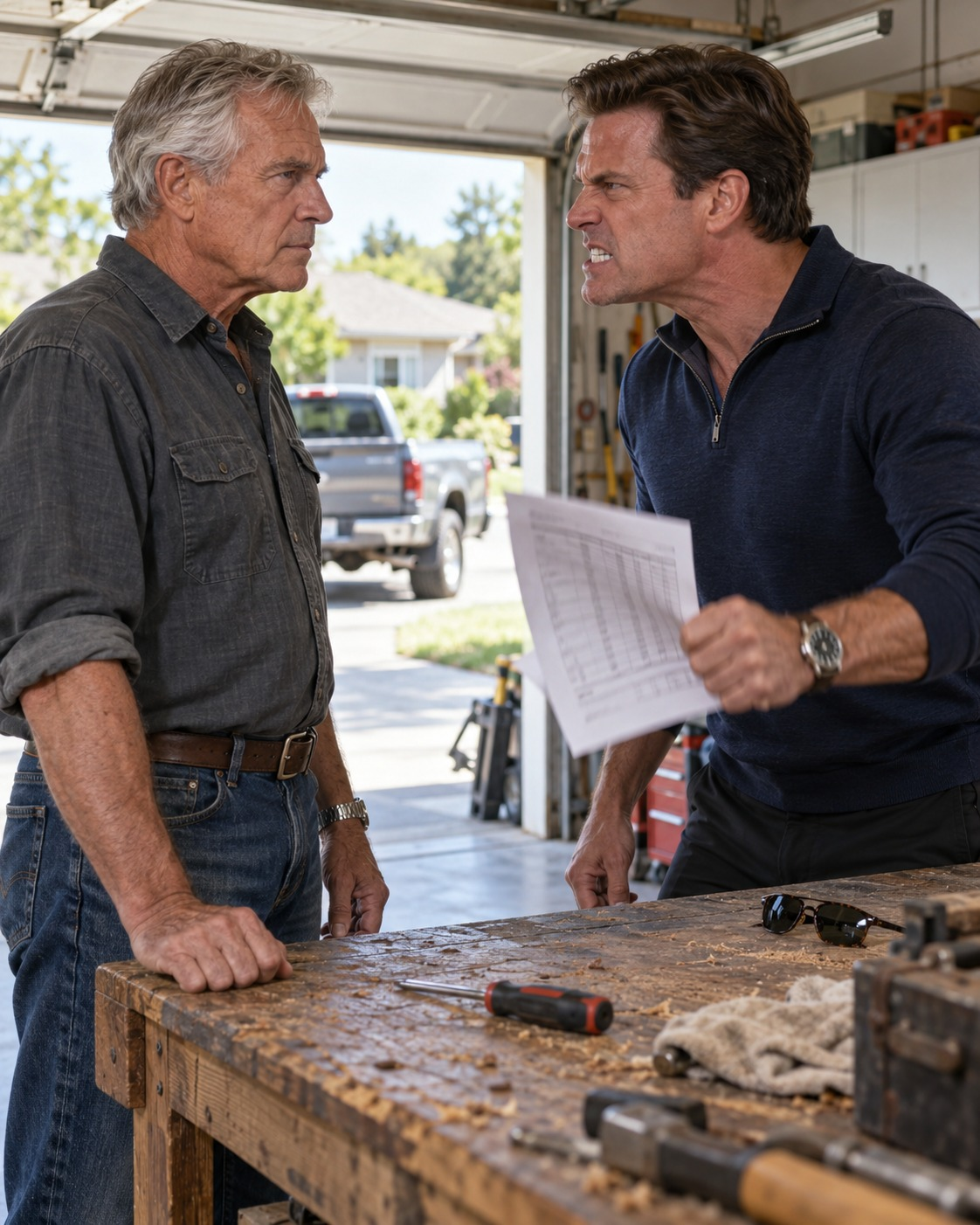
Mark slammed a sheet of paper onto my garage workbench and shouted, "What the hell is this supposed to mean?"
I looked at the financial statement beneath his shaking hand.
At the bottom, one number was circled in red.
$180,000.
That was when I knew this wasn't about a mortgage anymore.
My son-in-law stood across from me, breathing like he'd just sprinted up a flight of stairs. His expensive watch caught the afternoon sunlight coming through the open garage door. His face was flushed, his jaw was tight, and his eyes kept darting between me and the paper.
I had seen that look before.
Thirty-one years managing construction sites around Columbus, Ohio, had taught me to recognize a man who was losing control.
Some men got quiet.
Some men started bargaining.
And some men, like Mark, got louder because they thought volume could change the facts.
"What is this, Richard?" he demanded again.
I set my screwdriver on the workbench.
"It means I finally added it up."
He stared at me.
"Added what up?"
"Everything."
He gave a short, humorless laugh.
"Everything? What the hell does that mean?"
I turned the paper around so he could read it properly.
"Down payment on your house. Mortgage payments. Roof repairs. Furnace replacement. Property taxes. Car repairs. School expenses. Medical bills. Every check, every transfer, every emergency you brought to my doorstep."
His eyes moved down the columns.
I watched his expression change.
At first, he looked irritated.
Then confused.
Then something else appeared.
Something he couldn't hide quickly enough.
Fear.
"You're keeping a record of money you gave your own daughter?" he asked.
"I kept the bank statements."
"That's disgusting."
"Is it?"
"Family doesn't keep score, Richard."
I looked at him for a moment.
"Funny. You didn't seem too concerned about family three nights ago."
His face hardened.
"Oh, here we go."
I didn't answer.
He dragged a hand through his sandy-blond hair.
"You're still upset about the birthday dinner?"
I rested both hands on the workbench.
"Wouldn't you be?"
"It was a joke."
"A joke."
"Yes. A joke. Jesus, Richard, everybody knew I was kidding."
"Emily didn't laugh."
He opened his mouth, then closed it.
"Neither did the kids," I continued.
"You're making this into something it wasn't."
"Then tell me what it was."
He looked away.
Outside, a car passed slowly along our street.
A neighbor's dog barked somewhere behind the houses.
The ordinary sounds made the silence between us feel even heavier.
Three nights earlier, my family had gathered at a private steakhouse for my sixty-fifth birthday.
My daughter Emily had arranged the dinner.
My grandchildren had made cards.
I had worn the one decent sport coat I still owned, the same one Carol had bought me before she passed away.
For most of the evening, I had been happy.
Then Mark decided to entertain the table.
He leaned back in his chair, raised his glass, and smiled.
"Tell me something, Richard," he said. "How does it feel to be a failure after sixty-five years?"
The words had landed so unexpectedly that, for a moment, I thought I had misunderstood him.
A few people laughed nervously.
Emily went pale.
My oldest grandson stopped cutting his steak.
And Mark sat there smiling like he'd just delivered the funniest line of the evening.
I remember looking at him.
Really looking at him.
The expensive shirt.
The carefully styled hair.
The watch I suspected cost more than my first truck.
The confident smile of a man who believed he had earned everything he possessed.
And I remember thinking about the checks I had written.
The late-night phone calls.
The emergency transfers.
The years of financial help that had somehow become an expectation.
I put down my fork.
"How does it feel knowing this 'failure' won't be paying your bills anymore?"
The table went silent.
Mark stopped smiling.
Emily looked down.
And I knew, even before I left the restaurant, that something fundamental had changed.
Now, three days later, he was standing in my garage, demanding that I explain myself.
"You embarrassed me in front of my children," he said.
I almost laughed.
Almost.
Instead, I asked, "What did you think you were doing to me?"
He waved a hand dismissively.
"You're too sensitive."
"No, Mark. I've been too generous."
He leaned forward.
"Careful."
That one word told me more about our relationship than years of family dinners ever had.
Careful.
As though I were an employee he could discipline.
As though he were the man with the authority.
I looked him straight in the eye.
"Or what?"
His mouth tightened.
"Don't start."
"I'm not starting anything."
"You're threatening my family's financial stability."
I let that sentence sit between us.
Then I asked him a question.
"Whose responsibility is your mortgage?"
He blinked.
"What?"
"Your mortgage. Whose responsibility is it?"
"Mine and Emily's."
"Then why are you standing in my garage acting like it's mine?"
He looked at the financial statement again.
"You know Emily's been having a hard time finding steady work."
"I know."
"You know how expensive everything is."
"I do."
"You know we've got children."
"I love those children."
"Then how can you just abandon us?"
There it was.
The word I had been waiting for.
Abandon.
Not decline.
Not stop lending.
Not set a boundary.
Abandon.
As though every dollar I had ever earned belonged to him until he decided otherwise.
I reached for the old coffee mug beside my toolbox.
The coffee had gone cold an hour earlier.
I took a sip anyway.
Mark stared at me like my calmness was an insult.
"Are you even listening?"
"Every word."
"Then say something!"
I set the mug down.
"I spent thirty-one years working construction. I started before sunrise more mornings than I can count. I missed birthdays, ball games, holidays, and dinners because somebody needed to make sure a building was safe."
He folded his arms.
"I know your life story."
"No. You know the parts you find useful."
His expression darkened.
I continued.
"I drove the same pickup for eleven years. I fixed my own appliances. I packed lunches instead of buying them. Carol and I saved because we didn't want to become a burden to our daughter."
"What's your point?"
"My point is that I didn't work all those years so you could call me a failure while I paid for your success."
He stared at me.
For the first time since arriving, he didn't immediately have an answer.
I could see him calculating.
Not the money on the page.
The consequences.
He had built his life around assumptions.
That I would always help.
That Emily could always call.
That the mortgage would somehow get covered.
That emergencies would become my emergencies.
And most importantly, that I would never say no.
I had spent years reinforcing those assumptions.
I couldn't blame him for believing them.
But I could stop making them true.
Mark picked up the financial statement again.
He studied the columns.
"Some of these payments were gifts."
"Yes."
"Then you can't ask for them back."
"I'm not asking for them back."
He looked surprised.
"You're not?"
"No."
His shoulders relaxed slightly.
I watched hope return to his face.
It lasted about two seconds.
"Then what's the point of all this?"
"The point is that I'm finished."
"Finished with what?"
"Paying your bills."
He laughed.
It was the kind of laugh a man gives when he expects someone to reveal they're joking.
I didn't.
"You're serious?"
"Completely."
He stared at me.
"You're really going to punish Emily because you're angry with me?"
"I'm not punishing Emily."
"That's exactly what you're doing."
"I'm allowing two adults to become responsible for their own household."
He shook his head.
"You make it sound so simple."
"It isn't simple."
"Then you understand we could lose the house."
I looked at him carefully.
"How far behind are you?"
He hesitated.
"That's not the point."
"How far, Mark?"
He glanced toward the driveway.
Then back at me.
"We're handling it."
"Are you?"
"Yes."
"Then why did you text me about the mortgage?"
His jaw tightened.
Three days after the birthday dinner, the only message I had received from him was six words.
We need to talk about the mortgage.
No apology.
No acknowledgment.
No concern about how I felt.
Just the mortgage.
I had read that message sitting at my kitchen table, beside the framed photograph of Carol that had stood there for seven years.
And for the first time, I had not felt the familiar urge to rescue anyone.
I had felt tired.
Not physically tired.
I knew physical exhaustion. I'd spent decades carrying it home in my shoulders.
This was different.
I was tired of being useful instead of loved.
Tired of confusing generosity with obligation.
Tired of watching a man enjoy the benefits of my work while mocking the life that made those benefits possible.
So I had made a decision.
And unlike Mark, I didn't announce decisions before I acted on them.
I acted first.
He crumpled the corner of the statement.
"You're trying to humiliate me."
"No."
"Yes, you are."
"You humiliated yourself when you insulted the man you still needed financially."
He slammed his palm onto the workbench.
The screwdriver jumped.
"Stop talking to me like I'm a child!"
"Then stop behaving like one."
His face turned red.
For a moment, I thought he might throw the paper at me.
Instead, he leaned closer.
"What exactly are you trying to do?"
I looked at him.
"I'm done financing disrespect."
He stared at me.
Then he gave another short laugh.
"You think you can just turn everything off?"
"I know I can."
"Emily won't let you."
"Emily doesn't control my bank account."
"She'll never forgive you."
That hurt.
More than I wanted him to know.
Because Emily was my only child.
Because I still remembered carrying her into the house from the hospital.
Because Carol had loved that girl with every ounce of herself.
Because after Carol died, Emily and the grandchildren were the closest thing I had to the family life I'd once known.
Mark knew all of that.
He knew exactly where to press.
But there comes a point when loving someone cannot mean surrendering every boundary you possess.
I kept my voice steady.
"That's between Emily and me."
He looked down at the statement.
His fingers loosened.
Then he noticed something.
A small notation beside the most recent mortgage transfer.
He frowned.
"What's this?"
I didn't answer immediately.
He brought the paper closer to his face.
"Richard."
I watched him read.
His eyes narrowed.
"What does 'final scheduled payment' mean?"
"It means exactly what it says."
He stared at me.
"You canceled the automatic transfer?"
"Yes."
"When?"
"Yesterday morning."
His expression changed.
"You can't do that."
"I already did."
"No, you don't understand."
"I understand perfectly."
He began breathing faster.
"That payment was supposed to go out next week."
"I know."
"We were counting on that money."
"I know."
"Then you have to put it back!"
"No."
The word seemed to strike him harder than any shouted insult could have.
He looked at me as though I'd started speaking a language he didn't understand.
Then he pulled his phone from his pocket.
His thumb moved quickly across the screen.
I assumed he was calling Emily.
But when the call connected, his voice changed.
It became strained.
Almost pleading.
"Listen," he said. "I need you to tell me exactly how much time we have."
I watched him.
His face lost color.
He turned away from me.
"No. No, that's not what I was told."
A pause.
Then he looked over his shoulder.
Straight at me.
"What do you mean the notice has already been issued?"
He went completely still.
And then I heard him say the one name I never expected to hear during a conversation about my daughter's mortgage.
"Who told you to contact Carol Hayes's attorney?"






Comments 0