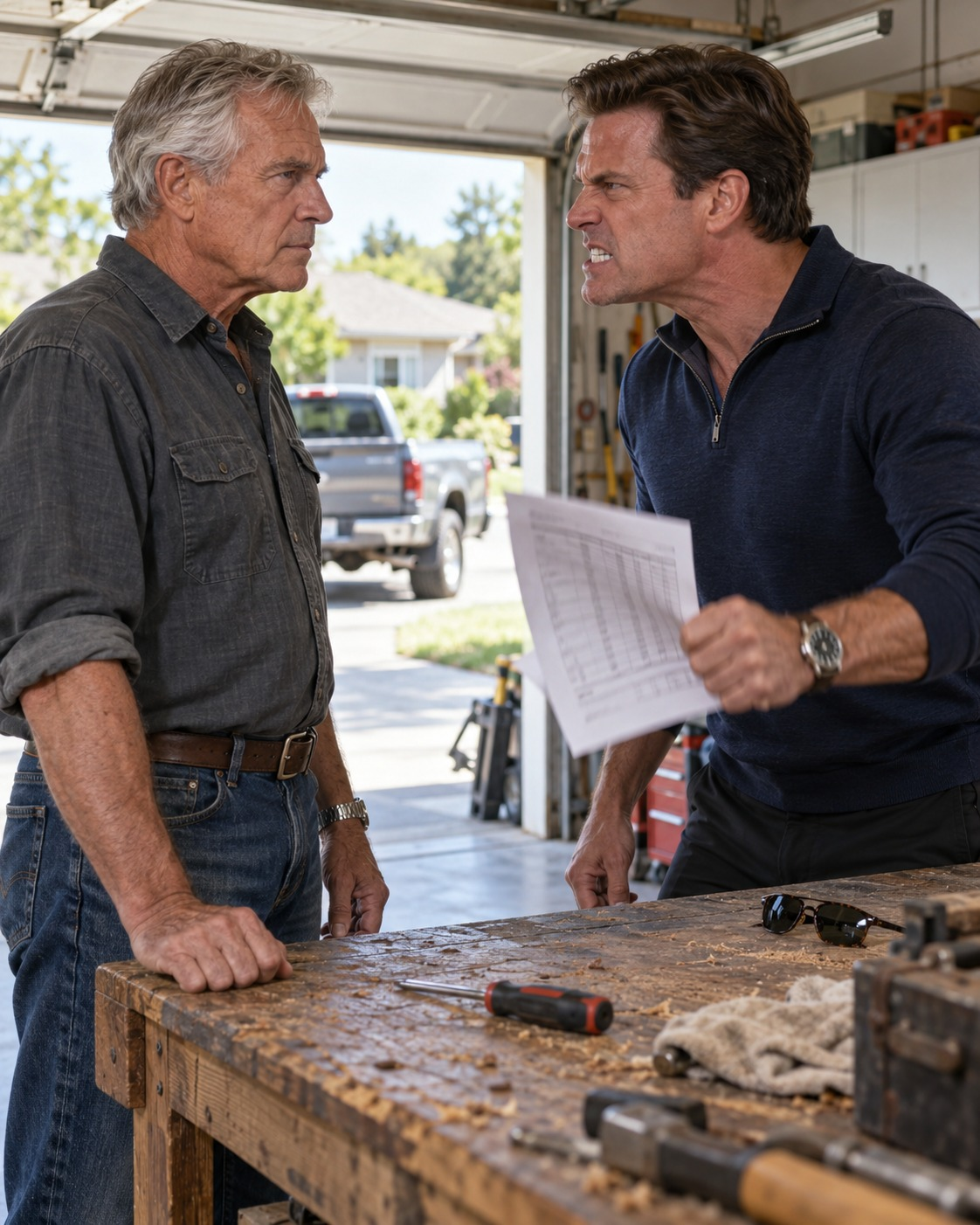
"Who told you to contact Carol Hayes's attorney?"
Mark's voice cracked on the last word.
I stood behind my garage workbench, watching my son-in-law grip his phone so tightly that his knuckles turned white.
He had spent the last twenty minutes trying to intimidate me.
Now he looked like a man who had just discovered that the ground beneath his feet wasn't nearly as solid as he'd believed.
"Mark," I said quietly, "who are you talking to?"
He held up one finger.
Not because he wanted me to wait politely.
Because he was desperate to hear whatever the person on the other end was saying.
"No," he said into the phone. "You listen to me. That account has nothing to do with this. Nothing."
A pause.
His eyes flicked toward me.
"What do you mean you need written confirmation?"
He turned away, lowering his voice.
I couldn't hear the response, but I could see what it did to him.
His shoulders stiffened.
His free hand closed into a fist.
Then he said something that made my stomach tighten.
"Emily doesn't know about that."
He ended the call.
For several seconds, neither of us spoke.
Outside, the silver pickup I'd driven for more than a decade sat in the driveway. The afternoon sun reflected off its windshield. Somewhere down the street, a lawn mower started.
Everything looked ordinary.
But there was nothing ordinary about the expression on Mark's face.
"Who was that?" I asked.
"Nobody."
"Nobody doesn't call about my late wife's attorney."
He slipped the phone into his pocket.
"Stay out of it, Richard."
I looked at him for a long moment.
"You're standing in my garage."
He didn't answer.
"You're holding a statement showing how much money I've given your family."
Still nothing.
"And you're telling me to stay out of it?"
His jaw tightened.
"You're twisting everything."
"No. I'm asking a question."
He grabbed the financial statement from the workbench.
The paper had become badly wrinkled where he'd crushed it in his fist.
"I came here to talk about the mortgage."
"And we've talked."
"We haven't solved anything."
"That's because you don't like my answer."
He stared at me.
For a moment, I thought he might say something else about Carol.
Instead, he folded the statement and shoved it under his arm.
"This isn't over."
I looked him straight in the eye.
"I know."
He walked toward the open garage door.
At the driveway, he stopped.
Without turning around, he said, "You have no idea what you're doing to your daughter."
Then he got into his car and drove away.
I watched until his taillights disappeared around the corner.
Only then did I sit down.
Not because I was afraid of Mark.
Because hearing Carol's name had reached into a part of me I had spent seven years learning to live with.
My wife had been gone since Emily was thirty.
Seven years.
Some mornings, that still didn't seem possible.
I could remember the sound of her slippers moving across the kitchen floor. The way she hummed while making coffee. The little notes she used to leave inside my lunchbox when I worked particularly long shifts.
And I remembered the last serious conversation we'd had about money.
It had taken place at our kitchen table, with a stack of bills between us.
Carol had looked at me and said, "Richard, helping someone and carrying someone are two different things."
I'd laughed.
"What's that supposed to mean?"
She'd pointed at the checkbook.
"It means you need to learn the difference before somebody teaches it to you the hard way."
At the time, I thought she was being overly cautious.
Now I wondered how much she'd understood before I did.
I stayed in the garage another ten minutes, staring at the empty driveway.
Then I picked up my coffee mug, carried it inside, and placed it in the sink.
On the refrigerator was a photograph of my grandchildren.
My grandson, fourteen now, grinning in his baseball uniform.
My granddaughter, eleven, holding a science fair ribbon.
I touched the edge of the picture.
Whatever happened between Mark and me, those children were not responsible.
I needed to remember that.
Because the truth was, I hadn't stopped loving my family.
I'd stopped believing that love required an unlimited checking account.
And the difference mattered more than Mark could possibly understand.
Three nights earlier, I had walked into the steakhouse believing we were celebrating my birthday.
By the time I walked out, I understood that something in my family had been broken for a long time.
I just hadn't wanted to see it.
Emily had chosen the restaurant.
It was one of those upscale steakhouses north of Columbus where the servers described the cuts of beef as though they were introducing rare works of art.
Dark wood.
White tablecloths.
Soft lighting.
Prices that made me grateful I wasn't paying for everybody.
At least, that was what I'd thought.
Emily had called me two weeks earlier.
"Dad, we're taking you somewhere special for your sixty-fifth."
"You don't have to do that, sweetheart."
"I know. That's why I want to."
I could hear the smile in her voice.
"Mom would have wanted us to celebrate."
That settled it.
There were certain things I couldn't argue with when Carol's memory was involved.
So I agreed.
I even bought a new shirt.
Nothing expensive.
A light blue button-down from a department store.
Carol would have approved.
She always said blue made me look less like a man who'd spent his life arguing with concrete subcontractors.
When I arrived at the restaurant, Emily was waiting near the entrance.
She hugged me tightly.
"Happy birthday, Dad."
"Thank you, sweetheart."
She stepped back and looked at me.
"You look nice."
"Don't sound so surprised."
She laughed.
For a few seconds, she looked like the little girl who used to wait for me at the front window when I came home from work.
Then I noticed the dark circles beneath her eyes.
"Everything okay?" I asked.
"Of course."
"You look tired."
"Just busy."
I knew better than to push her in the restaurant lobby.
But I noticed something else.
She glanced toward the dining room before answering.
As though checking whether someone was watching.
Mark appeared a moment later.
He wore a fitted shirt, expensive shoes, and the kind of smile that never quite reached his eyes.
"There's the birthday boy."
He shook my hand.
Harder than necessary.
"Sixty-five, huh? Officially an old man."
"Been one for years," I said.
He laughed.
"Well, at least you admit it."
It was harmless enough.
Or it would have been, if the rest of the evening hadn't followed.
We were seated at a large table in a private dining area.
The grandchildren had made me birthday cards.
My granddaughter's had a drawing of me standing beside my pickup truck.
Underneath, she'd written:
Grandpa can fix anything.
I laughed when I read it.
"That's a dangerous reputation to have."
My grandson grinned.
"Mom says you fixed the furnace when nobody else could."
"I helped the repairman find the problem."
"She said you saved Christmas."
Emily smiled.
"You did."
I looked around the table.
For a moment, I felt the kind of happiness that doesn't need anything added to it.
My daughter.
My grandchildren.
A birthday dinner.
The people Carol and I had worked so hard to give a good life.
Then Mark ordered a bottle of wine that cost more than my monthly grocery bill.
I noticed the price when the server presented the list.
Mark didn't seem concerned.
"Only the best," he announced.
I said nothing.
He ordered appetizers for the table.
Then steaks.
Then additional sides.
He talked about business opportunities, investments, and people he knew who were making serious money.
Every few minutes, he checked his phone.
I had heard these conversations before.
Mark was always on the verge of something.
A partnership.
A deal.
A promotion.
A new opportunity that would change everything.
But somehow, despite all those opportunities, he still needed help with his mortgage.
Emily remained quiet.
When Mark mentioned buying a newer vehicle, she looked down at her plate.
I caught her eye.
She gave me a small smile.
It disappeared almost immediately.
"How's work?" I asked her.
"Fine."
"Any luck with that position you interviewed for?"
She hesitated.
"Not yet."
Mark answered before she could continue.
"She's being selective."
Emily looked at him.
"I'm applying, Mark."
"I didn't say you weren't."
He turned to me.
"We're just trying to make smart moves instead of taking whatever comes along."
I nodded.
"Nothing wrong with being careful."
"Exactly," Mark said.
Then he smiled.
"Of course, not everybody thinks big."
I didn't respond.
He leaned back.
"Some people are happy doing the same thing for thirty years."
The remark hung there.
I took a sip of water.
"Some people are."
He chuckled.
"I mean, no offense, Richard. Construction management is honest work."
"Never thought otherwise."
"Sure. Sure. I'm just saying there are different levels of ambition."
My grandson stopped eating.
Emily shifted in her chair.
I could feel the evening beginning to change.
But I didn't want an argument.
Not on my birthday.
Not in front of the children.
So I let it go.
That had been my habit for years.
Let it go.
Keep the peace.
Don't make Emily choose sides.
Don't upset the grandchildren.
Don't turn a family dinner into a confrontation.
I had become very good at swallowing things I should have addressed.
Mark had become very good at counting on it.
When the main course arrived, the conversation moved to safer subjects.
Baseball.
School.
A neighbor's new dog.
My granddaughter told me about a science project involving homemade batteries.
I promised to help her build a better display board.
She beamed.
Then Mark's phone buzzed.
He looked at the screen.
His smile disappeared.
He turned the phone facedown.
Emily noticed.
"Everything okay?"
"Business."
"Is it important?"
"I said it's business."
She looked away.
I watched him for a moment.
He reached for his wine.
Then another glass.
His mood grew sharper as the meal continued.
By the time dessert menus arrived, he had interrupted Emily three times.
He'd corrected my grandson over a baseball statistic that didn't matter.
And he'd made two more comments about people who worked hard without getting rich.
I understood something then.
Mark wasn't simply arrogant.
He needed everyone around him to believe he was more successful than they were.
And for some reason, my ordinary life offended him.
Maybe it was my old pickup.
Maybe it was my work clothes.
Maybe it was the fact that I owned my house outright and didn't seem particularly impressed by his expensive possessions.
Or maybe it was something simpler.
I knew what he owed.
And he hated that.
The server brought out a small chocolate cake with a candle.
Everyone sang.
My granddaughter leaned against my shoulder.
I closed my eyes and made a wish.
I wished Carol could have been there.
When I opened my eyes, Emily was smiling.
She looked happy for the first time all evening.
I blew out the candle.
Everyone clapped.
Then Mark raised his wineglass.
"Well," he said, "I guess somebody should make a speech."
Emily touched his arm.
"Mark, we already did the birthday song."
"Relax. I'm just having fun."
He stood.
I remember that detail clearly.
He stood as though he were addressing a room full of investors.
He adjusted his sleeves.
Smiled.
And looked directly at me.
"Richard Hayes," he began, "sixty-five years old. Thirty-one years in construction. Same old truck. Same old house. Same old routine."
A few people smiled uncertainly.
He continued.
"Some guys spend their whole lives playing it safe."
I felt Emily go still beside me.
"Mark," she said quietly.
He ignored her.
"Some guys never really take a shot at becoming somebody."
My grandson looked confused.
I set my fork down.
Mark raised his glass a little higher.
Then he asked the question.
"How does it feel to be a failure after sixty-five years?"
For a second, nobody moved.
Then someone gave a nervous laugh.
Another person shifted in their chair.
My granddaughter looked from Mark to me.
"Dad?" Emily whispered.
But Mark was still smiling.
He thought he'd won.
I looked at him across the table.
And something inside me became very quiet.
Not angry.
Not explosive.
Just clear.
I thought about the $180,000.
The number I had calculated months earlier at my kitchen table.
I thought about the checks I'd written.
The mortgage payments.
The property taxes.
The roof.
The furnace.
The medical bills.
The times Emily had called crying because something else had gone wrong.
I thought about how often Mark had thanked me.
Not many.
I thought about how often he'd told other people that he was providing a wonderful life for his family.
Far more.
Then I remembered something Carol used to say.
You can be generous without making yourself available for abuse.
I placed my napkin beside my plate.
Looked Mark directly in the eye.
And said, "How does it feel knowing this 'failure' won't be paying your bills anymore?"
His smile vanished.
The silence that followed was so complete I could hear a server setting down a glass outside the private dining room.
Mark lowered his wineglass.
"What?"
"You heard me."
Emily stared at me.
"Dad..."
I turned toward her.
"Sweetheart, I love you. And I love those children."
My voice remained steady.
"But something has to change."
Mark laughed sharply.
"Oh, come on. You can't be serious."
I looked back at him.
"Try me."
He sat down.
For the first time all evening, he seemed unsure of what to say.
The server appeared with the check.
Mark reached for it automatically.
Then stopped.
He glanced at Emily.
Emily glanced at me.
I understood the look.
I had seen it before.
The silent question.
Would Dad take care of this one too?
I reached for my wallet.
Mark's shoulders relaxed.
Then I placed enough cash on the table to cover my meal, tax, and a generous tip.
I stood.
"Thank you for dinner," I said.
Nobody answered.
I kissed my granddaughter on the forehead.
Squeezed my grandson's shoulder.
And hugged Emily.
She held on longer than usual.
"Dad," she whispered, "please don't leave like this."
I looked at her.
There were tears in her eyes.
That almost changed my mind.
Almost.
But then Mark spoke.
"Unbelievable. You're really going to make a scene over a joke?"
I stepped back from Emily.
"No, Mark."
I picked up my coat.
"You already made the scene."
I walked out.
The parking lot was nearly empty.
I sat in my pickup for several minutes before starting the engine.
My hands were steady.
My heart wasn't.
I had spent years believing that if I remained patient enough, generous enough, and understanding enough, Mark would eventually respect me.
That night, I finally accepted that respect couldn't be purchased.
Not even for $180,000.
When I got home, I hung my sport coat in the closet.
Then I went into the kitchen.
Carol's photograph sat beside the small lamp on the counter.
I picked it up.
"You were right," I whispered.
I stood there for a long time.
Then I opened the drawer where I kept important papers.
Inside were the bank statements I'd already collected, a notebook filled with figures, and an envelope containing documents Carol had insisted I keep after we updated our estate plans.
I hadn't looked inside that envelope in years.
I remembered her handing it to me.
"Keep this somewhere safe," she'd said.
"What is it?"
"Something I want you to understand when the time comes."
I'd teased her about being mysterious.
She hadn't laughed.
Now, standing alone in my kitchen after the worst birthday dinner of my life, I remembered the seriousness in her eyes.
I took out the envelope.
Her handwriting was still visible across the front.
For Richard. Read when you need to protect what we built.
I sat down.
For several seconds, I simply stared at those words.
Then I slid my finger beneath the flap.
Before I could open it, my phone rang.
Emily.
I answered immediately.
"Sweetheart?"
She was crying.
"Dad, I'm sorry."
I closed my eyes.
"Emily, you don't have to apologize for what your husband said."
"That's not why I'm calling."
Something in her voice made me sit straighter.
"What happened?"
She took a shaky breath.
"Mark came home after dropping us off. He was furious."
"Did he hurt you?"
"No. Nothing like that."
I exhaled.
"Then tell me what's wrong."
She hesitated.
"Dad, he said something about Mom."
My eyes moved toward the envelope.
"What about your mother?"
"He said she left behind something that could solve our money problems."
I stopped breathing for a moment.
"Emily, what exactly did he say?"
She began to answer.
Then I heard a door slam on her end of the phone.
Her voice dropped to a whisper.
"Dad, I have to go."
"Emily—"
"Please don't tell Mark I called."
The line went dead.
I sat motionless.
Then I looked down at the envelope.
Carol's handwriting seemed suddenly different.
Not sentimental.
Not reassuring.
Urgent.
I turned it over.
There was a second line written across the back.
A line I had never noticed before.
If Mark ever asks about the money, call Daniel Whitmore before you tell him anything.
My fingers tightened around the envelope.
Daniel Whitmore had been Carol's attorney.
And beneath his name was a date.
The date was three months before Carol died.
I reached for my phone.
Before I could dial, a new message appeared.
It came from an unfamiliar number.
The message contained only seven words.
"Richard, do not open Carol's envelope yet."
A second message arrived immediately.
It was a photograph.
I tapped the screen.
The picture showed my kitchen table.
My coffee mug.
Carol's framed photograph.
And the envelope sitting directly in front of me.
Someone had taken it from inside my house.
Just moments earlier.






Comments 0