The photograph on Daniel Whitmore's tablet showed a man standing at the entrance of a financial services office.
He wore a dark jacket, sunglasses, and a baseball cap pulled low over his forehead.
But I recognized him immediately.
Mark.
My son-in-law.
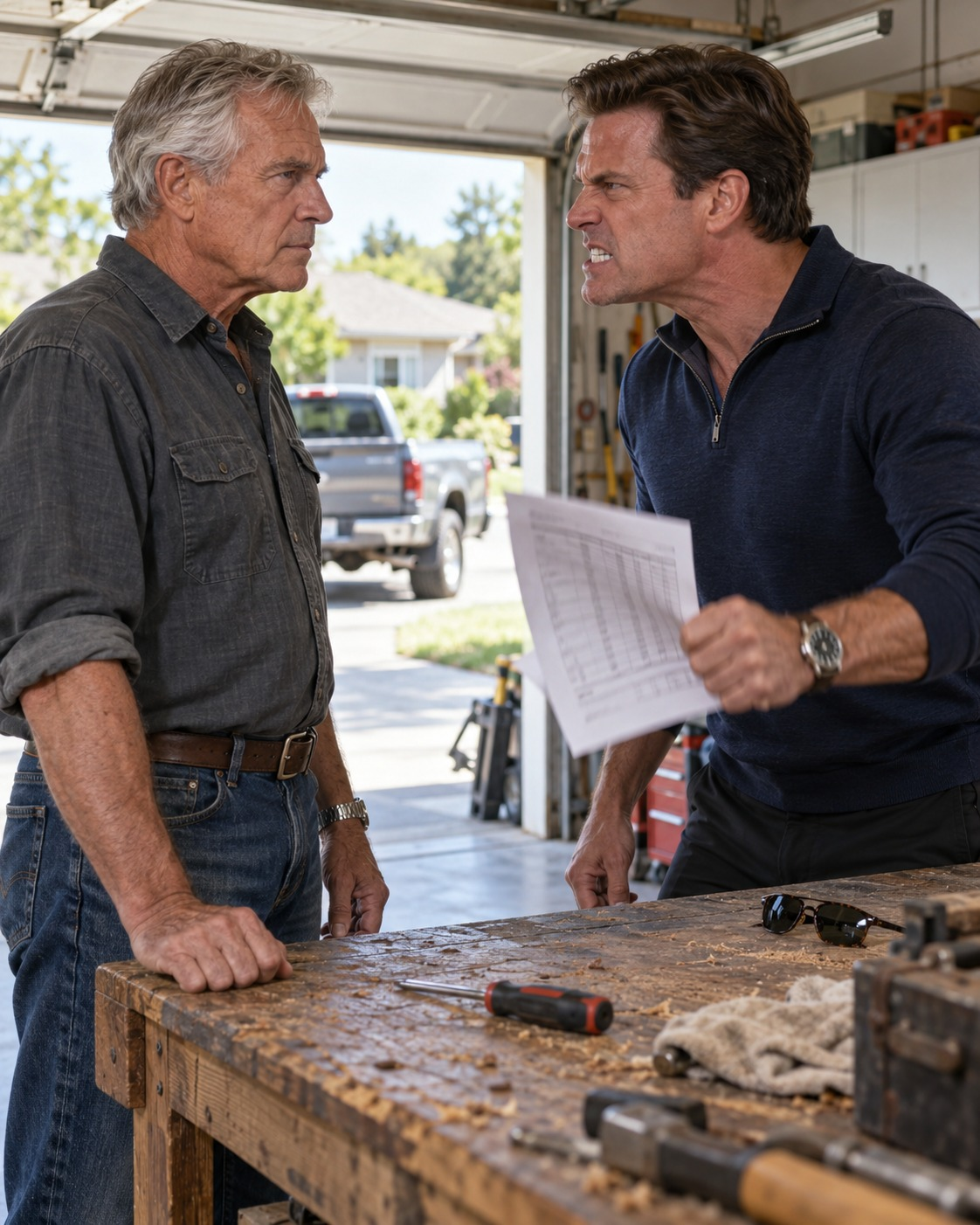
The same man who had stood in my garage earlier that afternoon, waving a $180,000 financial statement and accusing me of humiliating him.
The same man who had called me a failure at my own birthday dinner.
And now, apparently, the same man who had submitted paperwork bearing my signature.
A signature I had never written.
Emily leaned closer to the screen.
"Oh my God."
Daniel looked at her.
"Are you certain that's your husband?"
She nodded.
"That's Mark. That's his jacket. He wore it last weekend."
I stared at the photograph.
There was something deeply unsettling about seeing a familiar face attached to an unfamiliar act.
I'd known Mark for eight years.
I'd eaten Thanksgiving dinner with him.
I'd watched him hold my grandchildren when they were babies.
I'd helped him move furniture, repair his roof, and pay bills he couldn't afford.
And now I was looking at evidence suggesting he had tried to use my identity to gain access to money Carol had protected for our grandchildren.
I looked at Daniel.
"Tell me exactly what I'm looking at."
He placed the tablet flat on the kitchen table.
"The photograph came from an identification record attached to an authorization request. The request was submitted through an outside financial services intermediary. My office was contacted because the documents claimed to authorize changes involving the children's education fund."
"Changes?"
"An attempted withdrawal arrangement."
Emily covered her mouth.
"No."
Daniel continued carefully.
"The request was flagged for verification. Nothing has been released."
I felt a small measure of relief.
"How much were they trying to withdraw?"
Daniel hesitated.
"Forty-eight thousand dollars."
Emily began crying.
I looked at the screen again.
Forty-eight thousand dollars.
Money Carol had set aside for the grandchildren's education.
Money she had wanted protected from the ordinary financial mistakes adults sometimes made.
I thought about my grandson's interest in engineering.
My granddaughter's science projects.
The college visits that would come sooner than any of us expected.
And I thought about Mark standing at a counter, presenting paperwork with my name on it.
I felt anger rise in my chest.
But I had learned something important during thirty-one years of construction management.
Anger could tell you something was wrong.
It couldn't tell you how to fix it.
"Is that enough to prove he forged my signature?" I asked.
Daniel shook his head.
"Not by itself. The identification record connects him to the submission, but we need the original documents, the intermediary's records, and a proper examination of the signatures."
I nodded.
"Then that's what we get."
Emily looked at me.
"Dad, what if he really did this?"
I didn't answer immediately.
Because I knew what she was asking.
Not what would happen to the money.
Not what the attorney would do.
She wanted to know what would happen to her marriage.
To her children's father.
To the life she'd spent years trying to hold together.
I reached across the table and took her hand.
"Then we'll deal with the truth, sweetheart. One piece at a time."
She squeezed my fingers.
"I don't know how everything got so bad."
I looked at the stack of financial statements beside Carol's photograph.
"I think I do."
Daniel closed the tablet.
"We should preserve the records and contact the appropriate authorities if the submission is confirmed as fraudulent."
"Agreed," I said.
He glanced at his watch.
"I'll coordinate with the institution first thing in the morning. For tonight, I suggest neither of you confront Mark about the document."
Emily looked frightened.
"The children are still at home."
"Then let's make sure they're safe," I said.
She reached for her phone.
This time, my grandson answered.
"Hey, Mom."
Emily's entire body relaxed.
"Sweetheart, are you and your sister okay?"
"Yeah. We're watching a movie."
"Where's Dad?"
"Upstairs, I think."
She closed her eyes.
"Okay. Listen, I'm coming home soon. Keep your phone nearby."
"Is everything okay?"
She looked at me.
"Yes, honey. I just wanted to check on you."
After she hung up, she sat quietly for a long moment.
Then she whispered, "I can't believe he would risk their future."
I wanted to tell her I couldn't believe it either.
But the truth was more complicated.
For months, I'd been watching Mark make decisions that placed his image above his family's security.
I had simply refused to imagine how far he might go.
And that refusal had cost me more than money.
It had cost me judgment.
Trust.
And years of peace.
I stood and walked to the kitchen drawer where I kept my financial records.
Inside was the notebook I'd used to calculate the money I'd given Emily and Mark.
I carried it back to the table.
The cover was worn.
The pages were filled with dates, amounts, and brief descriptions.
Nothing fancy.
Just an old construction manager's habit of keeping track of expenses.
I opened it.
"Emily," I said, "there's something I need you to understand."
She looked up.
"Your mother and I didn't become financially comfortable because we earned extraordinary money."
I turned the notebook toward her.
"We became comfortable because we paid attention to ordinary money."
I pointed to the first entry.
Thirty thousand dollars.
The down payment on their house.
I remembered writing that check as clearly as if it had happened yesterday.
Carol had been sitting beside me.
Emily had been so excited she could barely stop talking.
Mark had assured us that the house was a smart investment.
He'd shown us projected income, expected raises, and a budget that looked reasonable at first glance.
I had asked him whether he had included maintenance.
He said yes.
I asked about property taxes.
He said yes.
I asked whether they could handle a temporary loss of income.
He smiled.
"Richard, you're worrying about problems that haven't happened."
Carol had looked at me.
I should have listened to that look.
Instead, I wrote the check.
Emily touched the notebook.
"I remember that day."
"So do I."
"You told us you wanted us to have a good start."
"I did."
She looked down.
"We were so grateful."
"I know you were."
And I meant it.
I wasn't rewriting every happy memory into something ugly.
Emily had been grateful.
She had hugged both of us.
She had cried.
She had promised to make us proud.
The problem wasn't that first gift.
The problem was everything that came after.
I turned the page.
Eight thousand four hundred dollars.
Mortgage payments during a period when Emily's work hours had been reduced.
Then another entry.
Six thousand two hundred dollars.
A furnace replacement.
Then another.
Four thousand eight hundred dollars.
Property taxes.
Then three thousand seven hundred dollars for a roof repair.
Then two thousand dollars for an emergency vehicle expense.
The list continued.
Some payments were small.
Four hundred dollars.
Seven hundred.
Nine hundred fifty.
Others were large enough to make me uncomfortable even now.
I had written them because each request sounded urgent.
Each one came with a story.
And every story ended the same way.
"We just need a little help until things turn around."
I looked at Emily.
"Do you remember when the furnace broke?"
She nodded.
"It was freezing."
"Mark called me at six in the morning."
"I remember."
"He said the repair company needed payment immediately."
She frowned.
"That's not what he told me."
I looked up.
"What did he tell you?"
"He said he'd covered it with his emergency savings."
For a moment, neither of us spoke.
Then I turned to another page.
"The roof repair?"
She looked at the amount.
"Mark said insurance paid most of that."
"Insurance didn't pay what I covered."
Her eyes filled again.
I closed the notebook.
"Sweetheart, I don't want to spend the whole night showing you every time your husband told a different version of the same story."
She shook her head.
"No, Dad. I need to know."
I studied her face.
There was pain there.
But something else too.
Determination.
For years, Emily had avoided uncomfortable questions because she wanted her marriage to work.
Now she was beginning to ask them.
And I wasn't going to stop her.
I opened the notebook again.
We went through the entries slowly.
Not every payment involved deception.
Some were genuine emergencies.
My grandson's medical procedure had been real.
The insurance shortfall had been real.
The fear in Emily's voice when she called me from the hospital had been real.
I would have paid that bill again without hesitation.
There were expenses connected to school.
Clothing.
Dental work.
A broken water heater.
Things families sometimes needed help with.
I didn't regret protecting my grandchildren.
I regretted allowing Mark to turn that protection into an excuse for avoiding responsibility.
The distinction mattered.
Because if I started treating every dollar as a betrayal, I would end up punishing the people I had wanted to help.
And I wasn't going to let Mark turn me into that kind of man.
Emily studied the numbers.
"Did you really pay all of this?"
"Every amount listed is backed by a record."
She pressed her fingers against her forehead.
"I thought we were getting ahead."
I looked at her.
"What made you think that?"
"Mark kept telling me his business was growing."
"Did he show you the accounts?"
"No."
"Did you see the contracts?"
"Sometimes."
"Did you know what the business owed?"
She shook her head.
"He said I didn't understand that side of things."
I felt my jaw tighten.
Emily had completed college.
She was intelligent, organized, and perfectly capable of understanding a household budget.
But Mark had spent years convincing her that his financial world was too complicated for her to question.
He'd made ignorance sound like trust.
And he'd made questions sound like disloyalty.
I had seen that kind of behavior on construction sites.
A subcontractor would insist everything was under control while refusing to show invoices.
A supplier would promise delivery while avoiding written confirmation.
A project manager would claim the numbers were fine until the bills arrived.
The language changed.
The pattern didn't.
When somebody repeatedly discouraged reasonable questions, I learned to ask more.
But with Mark, I hadn't.
Because he was family.
That word had become the excuse for nearly every mistake I'd made.
Daniel rose from the table.
"I need to make a few calls before morning. Richard, may I photograph these records?"
"Of course."
He documented the notebook pages relevant to the financial assistance.
Then he asked me to preserve the original bank statements and electronic transfers.
"Don't alter anything," he said.
"I won't."
"And don't give Mark the originals."
I almost smiled.
"That won't be a problem."
Daniel looked toward Emily.
"Would you like me to arrange a neutral location for you and the children tonight?"
She hesitated.
"I don't want to frighten them."
"You don't have to explain everything tonight," he said. "But you should have a plan."
I looked at my daughter.
"You can stay here."
Her eyes filled.
"Dad, I don't want to bring all this into your house."
I shook my head.
"Emily, there's a difference between helping you get safe and paying for Mark's lifestyle."
She looked at me.
"You'd really let us stay?"
"Of course."
"But you said you were done helping."
"I'm done financing disrespect. I didn't say I was done being your father."
She started crying again.
I moved around the table and held her.
For a moment, she was my little girl.
The same child who used to climb into my lap after a bad dream.
The same teenager who cried when she didn't make the volleyball team.
The same young woman who stood beside me at Carol's funeral, holding my hand because she knew I couldn't stand alone.
I loved her.
That hadn't changed.
But I was finally beginning to understand that loving her didn't mean protecting her from every difficult truth.
Sometimes it meant helping her face one.
After Daniel left, Emily and I sat together in the kitchen.
The coffee had gone cold.
The clock above the stove read eleven forty.
She looked exhausted.
"Dad?"
"Yeah, sweetheart?"
"Did Mom ever say anything about Mark?"
I thought about Carol's notes.
Her concerns.
Her warnings.
The conversations I'd dismissed.
"She worried about him."
Emily looked down.
"I wish she'd told me."
"Maybe she tried."
She looked at me.
I continued carefully.
"Your mother didn't like interfering in your marriage. She believed you needed to make your own decisions."
Emily nodded.
"She always said that."
"But she also believed a marriage should make both people stronger."
My daughter wiped her cheeks.
"Mark used to make me feel strong."
I waited.
"At first," she added.
She stared at her wedding ring.
"He was confident. He had plans. He talked about building a future together."
"What changed?"
She took a long breath.
"I don't know exactly."
Then she looked at me.
"Maybe I just stopped asking questions."
I didn't argue.
Because I knew what it felt like to stop asking questions.
I'd done the same thing.
Only my questions had been about money.
Hers had been about her marriage.
We sat quietly.
Then she said, "I need to go get the kids."
"I'll come with you."
She shook her head.
"Mark will make a scene if you show up."
"Then we'll ask for help if we need it. We don't have to turn this into a confrontation."
She thought for a moment.
Finally, she nodded.
We called Daniel and discussed a plan.
Emily would contact Mark and tell him she was coming to collect some things for herself and the children.
I would remain nearby.
If he became threatening or refused to let the children leave safely, we would seek assistance rather than argue.
It wasn't the kind of plan I wanted to make for my daughter.
But it was the plan we needed.
Before leaving, I went to my bedroom.
I opened the safe and looked at Carol's sealed envelope.
For seven years, I'd kept it untouched.
I'd told myself I was preserving something personal.
Something I wasn't ready to face.
Now I wondered whether avoiding it had allowed problems to grow.
I picked it up.
The handwriting on the front was unmistakably Carol's.
For Richard. Read when you need to protect what we built.
I turned it over.
The warning about Mark and Daniel Whitmore was still there.
I thought about the messages from the unknown number.
The security camera.
The attempted authorization request.
And the $180,000 I'd spent without asking enough questions.
I put the envelope back in the safe.
Not because I intended to ignore it.
Because Daniel had asked me to wait until we could review it together.
For once, I was going to follow careful advice before acting.
When I returned to the kitchen, Emily was standing beside the refrigerator.
She was looking at a photograph of Carol.
"Mom would be so disappointed in me," she whispered.
I walked over.
"No."
She shook her head.
"Dad, I let him make you feel like you weren't worth anything."
I placed a hand on her shoulder.
"Your mother would want you to tell the truth and take care of yourself and those children."
Emily looked at me.
"Even if it means leaving Mark?"
I didn't answer immediately.
Because that decision wasn't mine.
And I had spent enough years making decisions for other adults.
"Your mother would want you to be safe, respected, and honest with yourself," I said. "What you do next has to be your choice."
She nodded slowly.
Then her phone vibrated.
A message from Mark.
Where are you?
She typed:
I'm coming to get the kids. We need some space tonight.
His reply came almost immediately.
You are not taking my children anywhere.
Emily showed me the screen.
I felt my chest tighten.
But I kept my voice steady.
"Save that message."
She did.
Then another arrived.
Tell your father to stop interfering.
A third followed.
He thinks he knows what I've done. He doesn't know half of it.
Emily stared at the words.
So did I.
For several seconds, neither of us moved.
Then I said, "Forward those to Daniel."
She did.
I picked up my truck keys.
We were about to leave when my phone rang.
The caller ID showed my bank.
I answered.
"Richard Hayes speaking."
A woman's voice came through.
"Mr. Hayes, this is Patricia from the fraud prevention department. I'm sorry to call so late, but we have an urgent security concern involving your account."
I looked at Emily.
"What kind of concern?"
"We've identified an attempted transaction that requires your immediate verification."
My stomach tightened.
"How much?"
There was a brief pause.
"Seventy-five thousand dollars."
I gripped the phone.
"From which account?"
"Your primary retirement-linked savings account."
I felt the room become very still.
"That account isn't used for family expenses."
"I understand, sir. That's why the transaction was flagged."
"Where was the money going?"
"I can't confirm the receiving party until we complete verification, but the request included documentation claiming you had authorized the transfer."
I looked toward the hallway.
Toward the bedroom.
Toward the safe containing Carol's envelope.
"Was my signature on it?"
"Yes, sir."
I closed my eyes.
"Do not release anything."
"The transaction is currently on hold."
"Keep it that way."
"We will. But there's another reason I'm calling."
I opened my eyes.
"What reason?"
"The request was accompanied by a document indicating a change in your financial authorization arrangements."
I stared at the kitchen wall.
"What kind of change?"
She hesitated.
"Mr. Hayes, according to the document, you appointed another individual to act on your behalf."
My voice became very quiet.
"Who?"
She began reading from the record.
And when she reached the name, Emily suddenly grabbed my arm.
Because the person listed wasn't Mark.
It was someone I had trusted with my life.
Someone who had been inside my house countless times.
Someone who knew exactly where I kept my financial records.
The bank representative took a breath.
"Mr. Hayes, the person named on the authorization is—"






Comments 0