The signature belonged to Daniel Whitmore.
I stared at the page, hoping I had misunderstood what I was seeing.
Daniel had been my attorney for nearly twenty years. He had helped Carol and me prepare our wills, reviewed the paperwork for our house, and guided us through every major financial decision we had made together.
He had stood beside me at Carol's funeral.
He had promised to protect her wishes.
And now his signature appeared beneath a document claiming I had authorized a $310,000 property investment.
I looked at Rebecca.
"Tell me I'm reading this wrong."
She shook her head.
"I'm afraid you're not."
Emily covered her mouth.
"Daniel?"
Rebecca nodded.
"The preliminary evidence suggests he witnessed or facilitated several documents connected to the disputed transactions. We need to establish his exact involvement, but his signature is authentic according to the initial examination."
I leaned back.
For a moment, I couldn't speak.
Then I remembered something Carol had told me shortly before she died.
She had been holding my hand in the hospital, her voice barely stronger than a whisper.
"Richard, promise me you'll never let anybody make you feel foolish for asking questions."
I'd laughed and kissed her forehead.
"I promise."
She had smiled.
"Good. Because sometimes the people who know us best are the ones who know exactly which questions we won't ask."
I had thought she was talking about ordinary family disagreements.
Now I understood.
I looked at Rebecca.
"What happens next?"
She closed the folder.
"We turn everything over to the investigators. We preserve the originals, cooperate fully, and let the evidence establish responsibility."
I nodded.
"Do it."
For the first time, I wasn't afraid of what the documents might reveal.
I wanted every page examined.
Every transfer traced.
Every signature verified.
I wanted the truth, even if it hurt.
Especially if it hurt.
The investigation moved quickly after that.
Patricia provided the original records, including emails, bank statements, and copies of the applications submitted under my name.
She also provided messages showing that Mark had repeatedly asked her to move money between accounts.
The records revealed that Daniel had helped prepare several financial documents that were later presented as legitimate authorizations.
Some transactions had been described as estate administration expenses.
Others had been labeled family investments.
Neither description accurately reflected what Carol had authorized.
The $25,000 transfer had been made without her permission.
The $240,000 business guarantee had been submitted using my identity.
The proposed $310,000 property investment had never received my approval.
The investigation also established that Emily's hospital signature had been taken from a simple receipt and later reproduced in documents that suggested she had authorized broader financial arrangements.
She hadn't.
The evidence showed that Mark had used those documents to create the appearance of family consent.
But Daniel's involvement was more complicated.
He initially claimed that he had only provided routine legal assistance and hadn't known the documents would be altered or misused.
The investigators found emails contradicting parts of his account.
One message showed that he had been warned that Carol refused to authorize the transfer.
Another showed that he had been asked to prepare a revised document after her death.
Daniel eventually admitted that he had failed to stop the paperwork from being used after Carol's refusal.
He also acknowledged that he had not properly disclosed the conflict when he continued representing me.
His professional conduct was referred for disciplinary review, and he was removed from any further role in our family's affairs.
Mark's situation was worse.
The financial records established that he had knowingly submitted false information to obtain credit and had misrepresented the source of business funds.
The authorities pursued the matter through the appropriate criminal and financial proceedings.
He eventually entered a plea agreement involving financial fraud and identity misuse.
He was ordered to make restitution where possible and received a sentence that included incarceration and supervised financial restrictions after his release.
Patricia cooperated fully, returned records she had retained, and agreed to provide testimony.
She also admitted that she should have questioned the transactions sooner.
I didn't excuse her mistakes.
But I appreciated that she finally stopped protecting the wrong people.
The money was another matter.
Not all of it could be recovered.
Some had been spent.
Some had disappeared through business obligations.
Some had gone toward debts that could no longer be reversed.
After the accounts were traced, the investigators established that more than $180,000 of my financial assistance had been improperly redirected, misrepresented, or used in ways I had never agreed to.
The exact amount varied depending on which transfers were included.
I didn't care about arguing over a few dollars anymore.
I wanted my name cleared.
I wanted my daughter protected.
And I wanted my grandchildren to grow up without believing that dishonesty was simply how successful people operated.
The first thing I did after the legal proceedings began was hire a new attorney to review my financial affairs.
The second thing was change every password.
The third was move my important documents into a secure location.
I also placed a fraud alert with the relevant credit agencies and disputed every account connected to the false applications.
The disputed guarantee was removed from my financial record after the investigation established that I hadn't authorized it.
The lender withdrew its claim against me.
My retirement savings remained protected.
My house remained mine.
And the old pickup in my driveway continued starting every morning, although it still made a noise that suggested it was personally offended by winter.
I laughed the first time it refused to start.
Carol would have laughed too.
She used to tell me that the truck and I were the two most stubborn things in Ohio.
I missed her.
I still did.
But I no longer felt that grief had to mean standing still.
For seven years, I'd lived with the idea that the worst part of losing Carol was the silence she left behind.
Now I understood that part of honoring her was finishing what she had tried to protect.
Her wishes.
Her name.
Her family.
I made sure her estate records were corrected.
The disputed transactions were formally documented.
The false company filings connected to her name were challenged.
And the remaining legitimate estate assets were placed under proper independent administration.
For the first time since her death, I felt that her affairs were finally in order.
Emily's life changed too.
She filed for divorce and obtained an independent legal agreement concerning the children.
The court approved a parenting arrangement that protected their routine and allowed contact with their father according to the children's needs and the applicable restrictions.
She did not use the investigation to punish Mark through the children.
She didn't tell them that their father was a monster.
She simply explained that adults sometimes made serious mistakes and that those mistakes had consequences.
The house remained a difficult issue.
The second mortgage had to be reviewed, and the lender eventually agreed to a restructuring arrangement after Emily provided complete financial information.
She sold some of the furniture and personal items that had been purchased on credit.
She traded the expensive lifestyle for something smaller.
She also returned to work.
Her first paycheck wasn't enormous.
But when she showed it to me, she smiled as though she'd won the lottery.
"I earned every dollar," she said.
I nodded.
"That's a good feeling."
She laughed.
"Especially when nobody can tell me how I should spend it."
I helped her build a monthly budget.
We listed the mortgage, utilities, groceries, school expenses, insurance, and savings.
She wanted to include a payment toward the money I'd given her over the years.
I told her we could discuss that later.
She insisted.
So we agreed on a modest amount that she could afford without putting the children's needs at risk.
It wasn't a repayment plan for the entire $180,000.
It was simply a way for her to begin rebuilding her independence.
I respected that.
One Saturday morning, she came into my garage carrying two cups of coffee.
She handed me one.
Then she looked at the workbench.
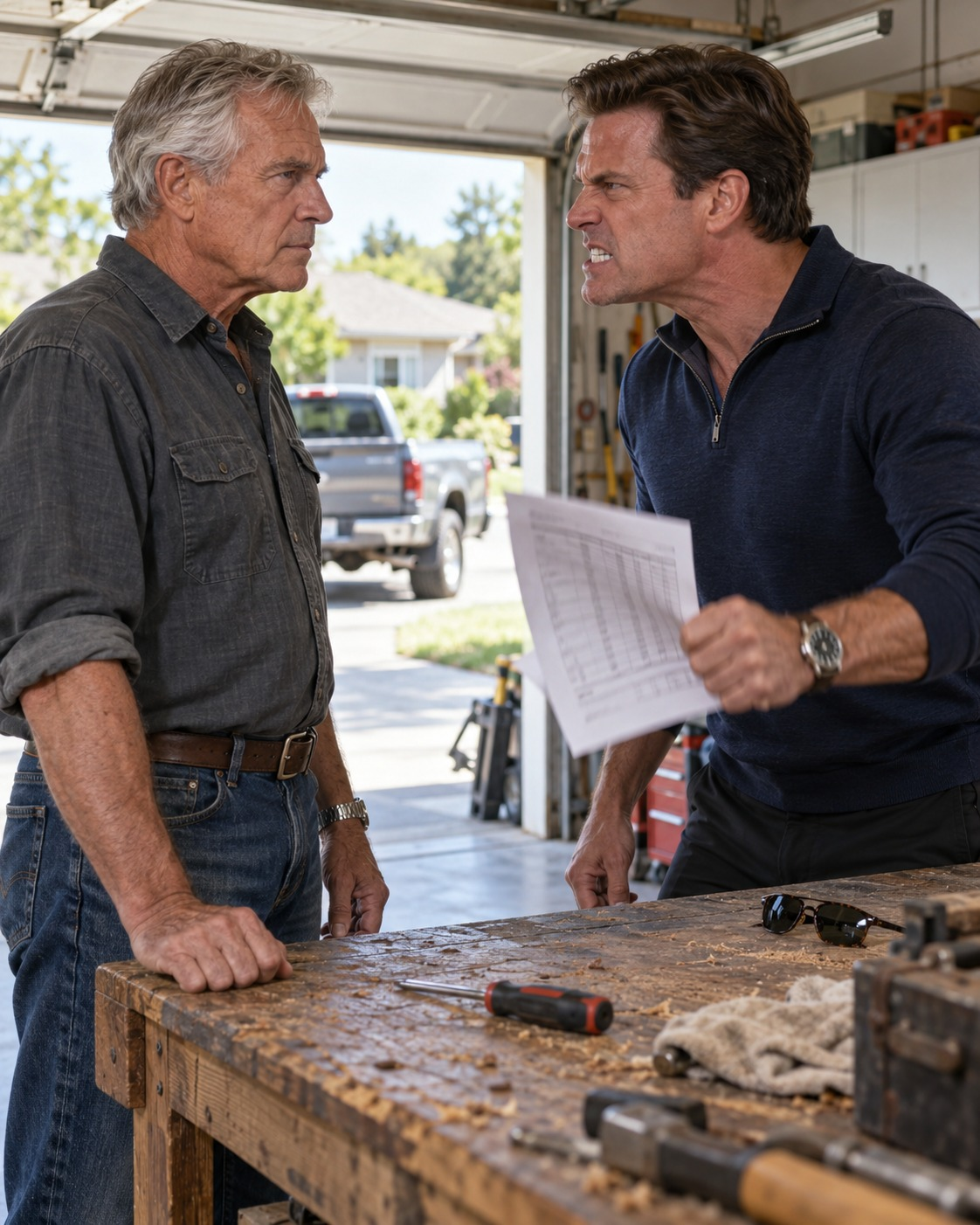
"Remember when Mark slammed that paper down here?"
I nodded.
"Hard to forget."
She smiled sadly.
"I used to think this place was embarrassing."
I raised an eyebrow.
"That's because you grew up around expensive kitchens."
She laughed.
"Maybe."
Then she looked around.
The shelves.
The old tools.
The photographs.
The workbench Carol had given me.
"I think I understand it now."
I took a sip of coffee.
"Understand what?"
"Why you liked it here."
I smiled.
"Everything has a place. And when something breaks, you can usually fix it."
She looked at me.
"Not everything."
"No," I agreed. "Not everything."
Then she placed her coffee down and picked up a screwdriver.
"Show me how to fix the loose hinge on the cabinet."
I stared at her.
"You're serious?"
"Absolutely."
I handed her the screwdriver.
"All right. First lesson. Never force a screw that doesn't want to turn."
She laughed.
"That sounds suspiciously like advice about marriage."
I chuckled.
"Maybe it is."
The grandchildren were the best part of the new routine.
My grandson started playing baseball again.
I attended every game I could.
Sometimes Emily came.
Sometimes her sister joined us.
The first time my grandson hit a home run, he ran past his teammates and pointed directly toward the bleachers.
I stood up so quickly that I nearly spilled my coffee.
He was grinning.
I was grinning.
And for a few minutes, there were no bank statements, no lawyers, and no disputed signatures.
There was only a baseball field and a boy who wanted his grandfather to see what he'd done.
My granddaughter became interested in photography.
She borrowed my old digital camera and started taking pictures of ordinary things.
The kitchen table.
The garden.
The pickup truck.
My hands holding a coffee mug.
One afternoon, she showed me a photograph of the garage.
The sunlight came through the small window above my workbench.
Dust floated in the air.
The old tools hung neatly on the wall.
I stared at it.
"That's actually pretty good."
She smiled.
"I'm entering it in the school photography competition."
"Then I expect a trophy."
She laughed.
"You can't demand a trophy."
"I can demand that you try."
She hugged me.
"I will."
Several months later, I visited Carol's grave.
I brought a small bouquet of white roses.
The cemetery was quiet.
I stood there for a long time before speaking.
"Well, sweetheart, we finally got through it."
I told her about the investigation.
About Daniel.
About Patricia.
About Mark.
I told her the house was secure and Emily was working again.
I told her the children were doing well.
I told her our grandson had hit a home run.
And I told her our granddaughter had become a photographer.
Then I sat on the nearby bench.
For a while, I simply looked at her name.
Carol Hayes.
Beloved wife.
Mother.
Grandmother.
She had been right about so many things.
She'd been right about saving money.
Right about asking questions.
Right about not confusing appearances with character.
But the thing I remembered most was something she'd said during our first year of marriage.
We'd been sitting in our tiny apartment after a long day.
The roof leaked.
The refrigerator made a terrible noise.
We had barely enough money to cover rent.
I had apologized for not being able to give her more.
She'd taken my hand and said:
"Richard, I don't need a rich life. I need an honest one."
I looked at her grave.
And I finally smiled.
"We had one, Carol. We really did."
My sixty-sixth birthday arrived quietly.
Emily insisted on organizing dinner.
This time, there was no private steakhouse.
No expensive reservations.
No rented room designed to impress people.
We ate at my house.
Emily cooked roast chicken.
My grandson made mashed potatoes.
My granddaughter decorated the dining table with flowers from the garden.
There were a few neighbors, two old friends from my construction days, and a former coworker who brought a homemade apple pie.
The food wasn't perfect.
The gravy was too thick.
The potatoes needed more salt.
And somebody forgot to put the rolls in the oven until dinner was almost over.
It was wonderful.
Halfway through the meal, my grandson stood up.
"Can I say something?"
Everyone turned toward him.
He looked embarrassed.
Then he cleared his throat.
"Grandpa, Mom says you've worked really hard your whole life."
I smiled.
"That's true."
He continued.
"She says you helped us when we needed it. And you never made us feel bad about asking."
Emily looked down.
My granddaughter took his hand.
He continued.
"I just wanted to say thank you."
I felt my eyes sting.
"You're welcome, son."
He sat down.
Then my granddaughter added, "And you're not a failure."
Everyone laughed.
I looked at her.
"Who told you that?"
She smiled.
"Nobody. I figured it out."
I looked around the table.
At Emily.
At the children.
At the friends who had known me long before Mark entered our family.
Then I thought about that birthday dinner a year earlier.
The cruel joke.
The nervous laughter.
My daughter's pale face.
My fork resting on the table.
And the answer I'd given Mark.
How does it feel knowing this failure won't be paying your bills anymore?
Back then, I'd thought I was simply defending myself.
Now I understood that I had been doing something more important.
I had finally stopped confusing love with unlimited financial support.
I could love Emily without financing every decision.
I could love my grandchildren without giving them everything they wanted.
And I could wish Mark well without allowing him to use my identity again.
After dinner, Emily helped me clear the plates.
She stood beside the sink.
Then she looked at me.
"Dad?"
"Yeah?"
"Do you ever wish you hadn't helped us?"
I considered the question.
"No."
She seemed surprised.
"Even after everything?"
I nodded.
"Helping you wasn't the mistake."
She waited.
"Trusting people without checking what they were doing with that help was the mistake."
She lowered her eyes.
"I wish I could give all that money back."
I smiled gently.
"You can't change the past."
She nodded.
"But you can decide what you do with the future."
She dried her hands.
Then hugged me.
"Thank you for not giving up on me."
I held her close.
"You're my daughter. I was never giving up on you."
She began crying.
I let her.
Sometimes people needed to cry without being told to stop.
After a moment, she stepped back.
"Mom would be proud."
I looked toward Carol's photograph on the shelf.
"I think she would."
Later that night, after everyone had gone home, I sat alone in the garage.
The old workbench stood in front of me.
The same place where Mark had once slammed down the statement showing $180,000.
I remembered how his hand had shaken.
How he'd demanded to know what the number meant.
I'd told him I'd finally added it up.
That had been the beginning.
Not the beginning of the money problems.
Not the beginning of the lies.
The beginning of my refusal to pretend I hadn't seen them.
I opened the drawer and took out Carol's old notebook.
On the first page, she had written our names.
Richard and Carol.
Underneath was a simple list of everything we'd wanted when we first got married.
A house.
A family.
A little savings.
A comfortable retirement.
And enough money to help our children when they needed it.
We hadn't achieved everything perfectly.
But we'd achieved most of it.
I closed the notebook.
Then I placed it beside her photograph.
My phone vibrated.
It was a message from Emily.
Thank you for tonight, Dad. The kids had a wonderful time. I did too. Love you.
I smiled and typed back.
Love you too. Get some rest.
Then I switched off the garage light.
For years, I'd believed that being a good father meant making sure my family never struggled.
I finally understood that being a good father also meant allowing them to stand on their own.
I hadn't recovered every dollar.
I hadn't erased every lie.
I couldn't bring Carol back.
But I had reclaimed my name.
I had protected my home.
I had given my daughter the chance to rebuild her life.
And I had shown my grandchildren that success wasn't measured by the car in the driveway or the size of the house.
It was measured by the promises you kept, the people you treated honestly, and the life you could look at without pretending.
The next morning, I planned to drive my old pickup to the hardware store.
I needed a new hinge for the cabinet Emily had started repairing.
After that, I would meet my grandson for baseball practice.
Nothing expensive.
Nothing impressive.
Just another ordinary day.
And for the first time in a very long while, ordinary felt like the greatest fortune a man could have.
I locked the garage, walked into my house, and looked once more at Carol's photograph.
"Good night, sweetheart."
Then I turned off the light.
I was sixty-six years old.
I had lost money, trust, and seven years of believing I understood what had happened to my family.
But I hadn't lost the things that mattered most.
My daughter was home.
My grandchildren were safe.
And I could finally say, without hesitation, that the life Carol and I had built was still standing.






Comments 0