"Richard, if you're watching this, you need to know what happened the day I found out about the money."
Carol's voice came through Emily's phone, thin and tired but unmistakably hers.
I gripped the edge of the kitchen table.
For seven years, I had kept her photograph beside the coffee maker. I had listened to old birthday messages just to hear her laugh. Sometimes, late at night, I could almost remember the exact sound of her footsteps coming down the hallway.
But I hadn't heard her speak a new sentence in seven years.
And now there she was.
On a hospital bed.
Wearing the pale blue gown I remembered from her final week.
Her hair had grown thin. Her cheeks were hollow. Yet her eyes were steady.
I recognized the expression.
It was the one she wore when she had made up her mind about something.
"Mark told me the payment was necessary," she continued. "He said Emily and the children could lose everything if I refused."
The camera shifted slightly.
I saw Mark standing beside the bed.
And behind him, near the doorway, stood Patricia Wells.
I looked at Emily.
She had both hands over her mouth.
On the screen, Carol turned toward Mark.
"Tell Richard what you told me."
Mark's voice came from somewhere behind the camera.
"Carol, this isn't necessary."
"Tell him."
"You're tired. We should do this another day."
Carol looked directly into the camera.
"That's what he keeps saying. Another day."
My throat tightened.
I remembered those final weeks.
There had always been another appointment, another test, another conversation we were too exhausted to have.
I had spent so much time trying to keep Carol comfortable that I hadn't noticed how often Mark appeared at the hospital when I wasn't there.
The recording continued.
Carol lifted a folded document.
"This is the authorization he brought me."
I recognized it immediately.
The twenty-five-thousand-dollar transfer.
The same document that later appeared with her signature and an impossible date.
"I refused to sign it," she said.
Mark moved closer.
"Carol, please."
She ignored him.
"I want Richard to know that I refused."
The camera shifted again.
Patricia stepped into view.
"Mrs. Hayes, perhaps we should stop recording."
Carol looked at her.
"Why?"
Patricia didn't answer.
Carol held up the paper.
"Because I won't sign something I don't understand?"
"No, ma'am."
"Then let him see it."
I felt my eyes fill.
Even near the end, Carol had been trying to protect us.
Not by shouting.
Not by threatening anyone.
By making a record.
She looked toward the camera again.
"Richard, there's something else."
Mark stepped forward.
The picture jolted.
"That's enough."
Carol's voice rose.
"Mark, don't touch that phone."
There was a scraping sound.
Then the camera pointed toward the ceiling.
I heard Carol say, "You can't keep using Emily's name without telling her."
A sharp noise followed.
Someone said, "Stop."
Then the recording ended.
The screen went black.
I sat motionless.
Emily was crying.
Neither of us spoke for a long time.
Finally, she whispered, "He knew."
I looked at her.
"He knew Mom was trying to warn us."
I nodded.
She stared at the phone.
"And he kept the recording."
That was what disturbed me most.
Mark had possessed evidence of Carol's refusal.
Evidence that contradicted the documents he'd been using.
Yet he'd sent us only fragments, apparently believing the recording would frighten us into backing down.
He'd been so certain he could control the story that he hadn't considered what the story actually showed.
I reached for my phone.
"We need Daniel."
Emily nodded.
I called him.
He answered on the second ring.
"Richard?"
"We have a video."
I explained what we'd seen.
Daniel listened without interrupting.
Then he said, "Preserve the original message and the file exactly as received. Don't edit it or circulate it."
"I won't."
"Can you forward the message and its attachment to me?"
"Yes."
"And Richard?"
"Yeah?"
"Don't assume the recording proves everything. We need to establish when it was made, whether it's complete, and whether it's authentic."
I looked at Carol's photograph.
"I understand."
But there was one thing I didn't need an expert to establish.
I knew my wife's voice.
And I knew what she'd said.
She had refused.
By nine the following morning, Daniel had arranged an urgent meeting with the attorney handling Mark's petition.
Her name was Rebecca Stone.
She was a practical woman in her fifties who wore dark suits and asked direct questions.
I liked her immediately.
She reviewed the petition, the bank records, and the disputed authorizations.
Then she watched the hospital video twice.
When it ended, she folded her hands.
"Mr. Hayes, your son-in-law has made serious allegations about your ability to manage your finances."
I nodded.
"He has."
"Those allegations are not evidence simply because he wrote them in a petition."
"Good."
"But we need to respond carefully."
She pointed to my financial notebook.
"Can you explain these payments?"
"Every one."
"Can you identify the accounts you control?"
"Yes."
"Do you understand the nature of the financial decisions you've made?"
I looked at her.
"Ms. Stone, I understand them better now than I did when I made them."
She gave the smallest smile.
"That's a useful answer."
She asked about my retirement.
My health.
My daily routine.
My ability to pay bills.
My reasons for ending the mortgage assistance.
I answered everything.
When she finished, she closed the notebook.
"Based on what you've shown me, I see no reason to assume your decision to stop supporting another household indicates incapacity."
I exhaled.
For days, Mark had been trying to turn my independence into evidence of decline.
Hearing someone say plainly that I was allowed to control my own money felt like stepping out of a room I'd been locked inside.
Rebecca continued.
"We'll contest the petition and request the appropriate records. We should also avoid discussing the details with Mark directly."
I nodded.
"That's fine."
She looked at Daniel.
"And the disputed financial documents should be referred for proper investigation."
Daniel agreed.
I looked down at my hands.
They were rough.
Scarred.
The hands of a man who had worked with tools and concrete and steel for most of his life.
Mark had called them the hands of a failure.
Now I wondered whether he had ever understood what those hands had built.
Not just houses.
A retirement.
A family home.
A future for my daughter.
A college fund for my grandchildren.
He had treated all of it as money waiting to be spent.
I was finally treating it as something worth protecting.
Emily joined us after lunch.
She looked exhausted.
But there was a new steadiness in her voice.
"I spoke to the mortgage company again," she said.
I looked at her.
"And?"
"They sent the complete payment history."
She placed a folder on the table.
"Mark hasn't made a full scheduled payment in three months. Before that, several payments were late."
I nodded.
We'd suspected as much.
But seeing the records made it real.
She continued.
"The lender also confirmed that a second loan was recorded against the house."
My stomach tightened.
"How much?"
"Seventy-eight thousand dollars."
I stared at her.
"Seventy-eight thousand?"
She nodded.
"I didn't know about it."
Rebecca leaned forward.
"Was your name on the loan documents?"
"Yes."
"Did you sign them?"
Emily hesitated.
"I signed refinancing papers last spring. I don't know whether these were included."
Rebecca nodded.
"We'll need the originals and the closing records."
Emily looked at me.
"Dad, he told me we were refinancing to lower the monthly payment."
I closed my eyes.
The yellow tabs.
The rushed signatures.
The documents she hadn't read.
It was all coming back to that afternoon at her kitchen counter.
I looked at her.
"We'll find out what you actually signed."
She nodded.
Then she took another paper from the folder.
"There's more."
I almost smiled.
That phrase again.
There was always more.
She slid the paper toward me.
It was a notice from the mortgage servicer.
The account was in default.
The lender had requested a complete financial disclosure before considering further repayment options.
Mark had apparently been promising money that never arrived.
Money from Carol's estate.
Money from his business.
Money from me.
The lender was no longer accepting promises.
I studied the notice.
"When did he receive this?"
"Six weeks ago."
"And he didn't tell you?"
She shook her head.
"He told me everything was under control."
I looked at Rebecca.
"What happens now?"
She answered carefully.
"Emily needs independent advice about the mortgage and her obligations. There may be options, but they depend on the actual loan documents, the payment history, and the lender's procedures."
Emily nodded.
"I've already asked for a meeting."
I looked at her.
"Good."
She looked at me.
"Dad, I'm not asking you to pay it."
I held her gaze.
"I know."
"I mean it."
"I believe you."
She took a breath.
"For years, every time something went wrong, Mark told me you could fix it."
I nodded.
"He told me the same thing."
She looked down.
"And I let him."
I reached across the table.
"You're changing that now."
She squeezed my hand.
Then she said something that surprised me.
"I've decided to separate from him."
The room went quiet.
I looked at my daughter.
"Are you sure?"
She nodded.
"I can't keep living with someone who hides debts, uses my name, and lies about our children’s future."
I took a breath.
"Have you spoken to an attorney?"
"Yes. I made an appointment."
I nodded.
"Good."
She looked almost surprised.
"You're not going to tell me what to do?"
I shook my head.
"No."
She began crying.
"I thought you'd be angry that I waited so long."
I looked at her.
"Emily, I spent years waiting to stop writing checks. I'm not in a position to criticize somebody for taking time to face a difficult truth."
She laughed through her tears.
For the first time in days, it sounded like my daughter.
At four that afternoon, Mark called.
I let it ring.
He called again.
Then again.
Finally, a text appeared.
We need to talk.
I didn't answer.
Another message followed.
You have no idea what you're doing.
Then another.
You're destroying my family.
I stared at the screen.
For years, he'd used that accusation whenever I questioned him.
If I refused money, I was hurting Emily.
If I asked for receipts, I was humiliating him.
If I wanted the truth, I was interfering.
Now I understood the pattern.
He made his decisions.
Then he made other people responsible for the consequences.
I forwarded the messages to Daniel.
Then I turned off the phone's sound.
I was sitting in my garage when Emily came outside.
She stood beside my workbench.
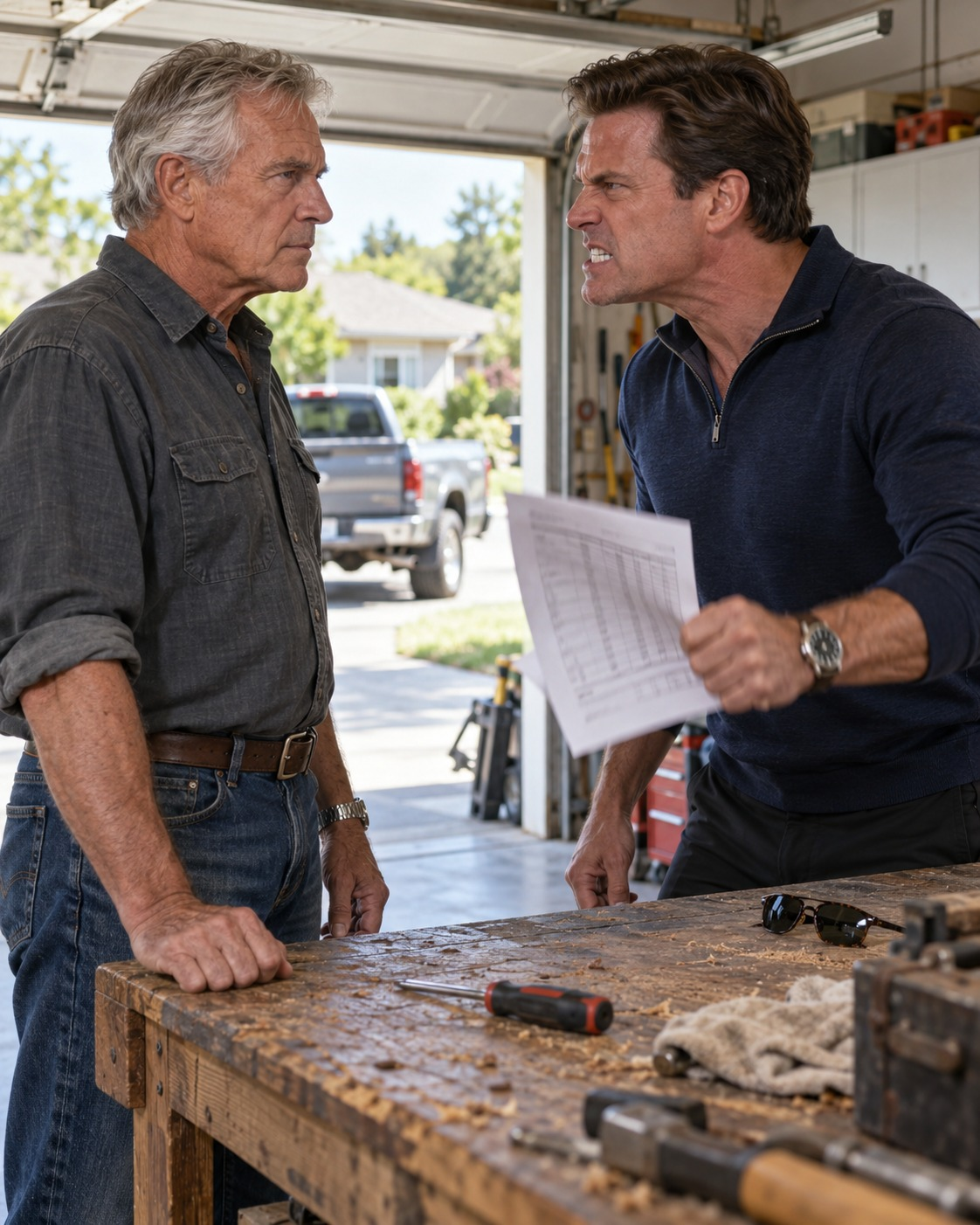
The same workbench where Mark had slammed the $180,000 statement.
The same place where he'd demanded that I keep paying his bills.
She looked at the old tools hanging on the wall.
"Mom used to say this was your favorite room."
I smiled.
"She was right."
Emily touched the handle of an old hammer.
"Remember when you built my bookshelf?"
"Of course."
"It was crooked."
I laughed.
"It was not crooked."
She smiled.
"Dad, it leaned."
"Only because your floor wasn't level."
She laughed again.
Then her expression grew serious.
"Mark used to make fun of this garage."
I nodded.
"I know."
"He said you were stuck in the past."
I looked around.
At the tools I'd cared for.
At the shelves I'd built.
At the old photographs of construction crews.
At the workbench Carol had given me for my fiftieth birthday.
"Maybe I was," I said.
Emily shook her head.
"No. You were taking care of what you had."
I looked at her.
She continued.
"Mark always needed something newer. A bigger car. A better phone. A more expensive dinner."
She swallowed.
"And I thought that meant we were moving forward."
I nodded.
"Sometimes it just means you're spending faster."
She smiled sadly.
Then she reached into her bag.
"I brought something."
She handed me a small envelope.
Inside was a check.
Two hundred dollars.
I stared at it.
"What's this?"
"The first payment."
I looked at her.
"Emily—"
"I know you said you don't want me to repay you."
She took a breath.
"But I want to start taking responsibility for my own life."
I looked at the check.
Two hundred dollars.
After more than $180,000.
It wasn't the amount that mattered.
It was the intention.
I handed it back.
"Keep it."
Her face fell.
"Dad—"
"Use it for the kids."
She shook her head.
"I don't want you thinking I'm asking for more."
"I don't."
I placed the check in her hand.
"Then put it in an account you control. Start building something that's yours."
She stared at me.
Then nodded.
"Okay."
I smiled.
"And when you're ready, I'll help you make a budget."
She laughed.
"A real one?"
"A very boring one."
She smiled.
"Mom would love that."
I looked at the photograph of Carol hanging above my workbench.
"She would."
At six thirty, Daniel called.
His voice was serious.
"Richard, are you sitting down?"
I looked at Emily.
"Yes."
"I've received confirmation that several lenders have begun reviewing Mark's business accounts."
I felt my stomach tighten.
"Because of the disputed documents?"
"Partly. There are also concerns about the company's financial representations and outstanding obligations."
I nodded.
"What happens next?"
"That depends on the lenders and the evidence. But Mark may face immediate restrictions on some business accounts."
I looked at Emily.
She was listening.
Daniel continued.
"One lender has demanded repayment or additional verified security. Another has suspended access to a line of credit pending review."
I closed my eyes.
Mark's business had depended on borrowed money.
Borrowed money had depended on appearances.
And appearances had depended on people believing he had resources he didn't possess.
Now the people holding the loans were asking for proof.
And Mark didn't have enough.
"Daniel," I said, "does he know?"
"I expect he does."
I nodded.
After the call, Emily sat quietly.
Then she whispered, "He's going to blame you."
I looked at her.
"He already does."
She shook her head.
"No. I mean really blame you."
I studied her face.
She looked frightened.
I reached across the table.
"Then we'll handle it carefully."
She nodded.
But I could tell she was worried.
So was I.
Not because I thought Mark could convince me to pay again.
Because desperate people sometimes made decisions that frightened even themselves.
At eight fifteen, my phone began vibrating.
Mark.
I ignored it.
Then a message arrived.
They froze the account.
Another.
My business is finished if you don't help me.
Then another.
Richard, please.
I stared at the last message.
Please.
I couldn't remember the last time Mark had used that word without attaching a demand.
I thought about calling him.
For a moment, I almost did.
Then I remembered Carol's letter.
Helping someone and carrying someone were different things.
Mark had spent years confusing the two.
I wasn't going to make that mistake again.
I sent one reply.
Speak with your attorney and your lenders. I will not authorize any further payments or financial guarantees.
Then I put the phone down.
Emily sat across from me.
She read the message.
Then nodded.
"Good."
We were quiet for a while.
Then her phone rang.
She looked at the screen.
Mark.
She hesitated.
Then answered.
"Hello?"
I watched her face.
At first, she looked tired.
Then confused.
Then frightened.
"Mark, slow down."
A pause.
"What do you mean they took it?"
Another pause.
She covered her mouth.
"Your car?"
I looked at her.
She listened.
Then whispered, "And the office?"
My stomach tightened.
She closed her eyes.
"Mark, I can't fix this."
A long silence.
Then she said, "No. Dad isn't paying."
She ended the call.
I waited.
Finally, she looked at me.
"The leasing company repossessed the SUV."
I nodded slowly.
"And the landlord changed the locks on his office after an eviction order."
I stared at her.
Mark's expensive car.
His impressive office.
The symbols he used to prove he was successful.
Gone.
Emily began crying.
Not because she wanted those things back.
Because she was finally seeing how little of their life had actually belonged to them.
"He says everyone is turning against him."
I looked at her.
"What do you think?"
She wiped her cheeks.
"I think the bills finally caught up."
I nodded.
There wasn't much else to say.
At nine thirty, I heard a vehicle pull into my driveway.
I looked through the kitchen window.
A small rental car.
Mark stepped out.
He looked different.
No expensive jacket.
No polished shoes.
No confident smile.
He wore an old sweatshirt and jeans.
His hair was messy.
He stood beside the car for a moment, staring at my house.
Then he walked toward the front door.
Emily appeared beside me.
"Dad, don't open it."
I nodded.
Mark knocked.
"Richard."
I remained still.
He knocked again.
"Richard, I know you're in there."
I looked at Emily.
She was trembling.
I picked up my phone.
Then Mark spoke.
His voice was different.
Lower.
Almost broken.
"Please."
I closed my eyes.
For years, he'd shouted.
Demanded.
Threatened.
Now he was standing outside my house asking for help.
I walked toward the door.
Emily followed.
I opened the inner door but kept the storm door locked.
Mark stood on the porch.
His face was pale.
"Richard."
"What do you want?"
He looked past me.
At Emily.
Then back at me.
"I need to talk."
"Then talk."
He swallowed.
"They took everything."
I said nothing.
"The car. The office. The accounts."
I watched him.
He looked exhausted.
But I wasn't going to confuse exhaustion with honesty.
"What do you want me to do?"
He stared at me.
"I need money."
There it was.
Even now.
After everything.
After the forged documents.
After the lies.
After the petition.
After the attempts to access Carol's money.
He still believed the solution was another check.
I shook my head.
"No."
His face changed.
"Richard, please."
"No."
He stepped closer.
"You don't understand. If I don't pay them, I'm finished."
I looked at him.
"Then you need to tell your creditors the truth."
He laughed bitterly.
"You think it's that simple?"
"No. I think it's overdue."
His expression hardened.
For a moment, I saw the old Mark.
The man who'd insulted me at dinner.
The man who'd slammed papers onto my workbench.
The man who believed intimidation could solve anything.
Then he looked at Emily.
"Are you really going to let him do this to me?"
She stepped forward.
"Dad isn't doing anything to you."
Mark stared at her.
"Emily—"
"You made these decisions."
He shook his head.
"You don't understand."
She looked directly at him.
"Then explain them."
He opened his mouth.
Closed it.
Then looked away.
Emily took a breath.
"I want the complete financial records. I want to know what you did with Dad's money. And I want to know why my name is on documents I never agreed to sign."
Mark stared at her.
Then whispered, "I was trying to keep us together."
She shook her head.
"You were trying to keep us looking successful."
He flinched.
I watched him.
For the first time, he had no answer.
Then his phone rang.
He looked at the screen.
His face drained of color.
He rejected the call.
A second later, it rang again.
He rejected it again.
I looked at him.
"Who is it?"
He shook his head.
"Nobody."
The phone rang a third time.
Emily stared at him.
"Mark, answer it."
He didn't move.
Then a text appeared on his screen.
I couldn't read it.
But I saw his expression.
He looked terrified.
He stepped backward.
"Richard, I need you to do something."
I shook my head.
"No money."
"Not money."
I studied him.
"Then what?"
He swallowed.
"I need you to tell them I was here."
I felt my stomach tighten.
"Who?"
He looked toward the street.
Then back at me.
"The people coming for me."
Emily grabbed my arm.
"Mark, what are you talking about?"
He didn't answer.
Instead, he reached into his sweatshirt pocket.
For a moment, I tensed.
Then he pulled out a small black flash drive.
He held it toward me.
"Take this."
I didn't move.
"What is it?"
His hand trembled.
"Everything."
I stared at the drive.
He continued.
"The accounts. The transfers. The documents."
Emily looked at him.
"Why do you have that?"
He swallowed.
"Because I knew this day might come."
I felt anger rise.
"You knew?"
He looked at me.
"Richard, I made mistakes."
I shook my head.
"You made choices."
He flinched.
Then he looked toward the street again.
A pair of headlights appeared at the corner.
Mark stepped closer to the storm door.
"Please. Just take it."
I looked at Emily.
She was pale.
I reached for the lock.
Before I could turn it, Mark whispered, "There's something on this drive about Carol."
My hand stopped.
"What?"
He swallowed.
"Something I never told you."
I stared at him.
"Then tell me now."
He looked over his shoulder.
The headlights were getting closer.
His voice dropped.
"Richard, your wife found out about the money before she died."
"I know."
He shook his head.
"No. You don't."
I felt my chest tighten.
"What don't I know?"
He pressed the flash drive against the glass.
"She found out who was really taking it."
I stared at him.
"Who?"
He looked at Emily.
Then back at me.
His eyes filled with tears.
"Richard, I wasn't the only one."
The headlights stopped outside my house.
A dark sedan.
Two people stepped out.
Mark looked at them.
Then he whispered, "Oh God."
I reached for my phone.
One of the figures walked toward the porch.
The other remained beside the car.
Mark backed away.
"Richard, take the drive!"
I unlocked the storm door.
He pushed the flash drive into my hand.
Then he turned toward the approaching figure.
I looked down at the small black device.
A white label was attached to it.
Three handwritten words.
Carol's Final Evidence.
I looked up.
The person approaching the porch stepped into the light.
It was Patricia Wells.
But she wasn't alone.
Behind her stood a man carrying a thick folder.
He wore a dark suit.
His expression was grim.
He looked at Mark.
Then at me.
"Mr. Hayes," he said, "I'm sorry to come so late."
I stared at him.
"Who are you?"
He reached into his jacket.
Removed a badge.
And held it where I could see.
"Special Agent Michael Grant. Federal Bureau of Investigation."
Mark made a sound behind me.
Almost a sob.
Agent Grant looked at the flash drive in my hand.
Then he said, "Mr. Hayes, before you open that, there's something you need to understand."
I felt my stomach tighten.
"What?"
He looked toward Emily.
Then back at me.
"Your wife's death was never investigated as a financial crime."
I stared at him.
He continued.
"But the evidence we've received suggests that someone may have been using her identity before she died."
Emily gripped my arm.
I couldn't speak.
Agent Grant opened the folder.
Inside was a photograph.
Carol.
In her hospital bed.
But this photograph wasn't from the video.
It showed her holding a document.
And standing beside her was someone I recognized.
Someone who had been in our family for years.
Someone I had trusted completely.
Agent Grant turned the photograph toward me.
"Mr. Hayes, we need to ask you about the person standing next to your wife."
I leaned closer.
The porch light illuminated the image.
And when I saw the face, I realized the person in the photograph was—






Comments 0