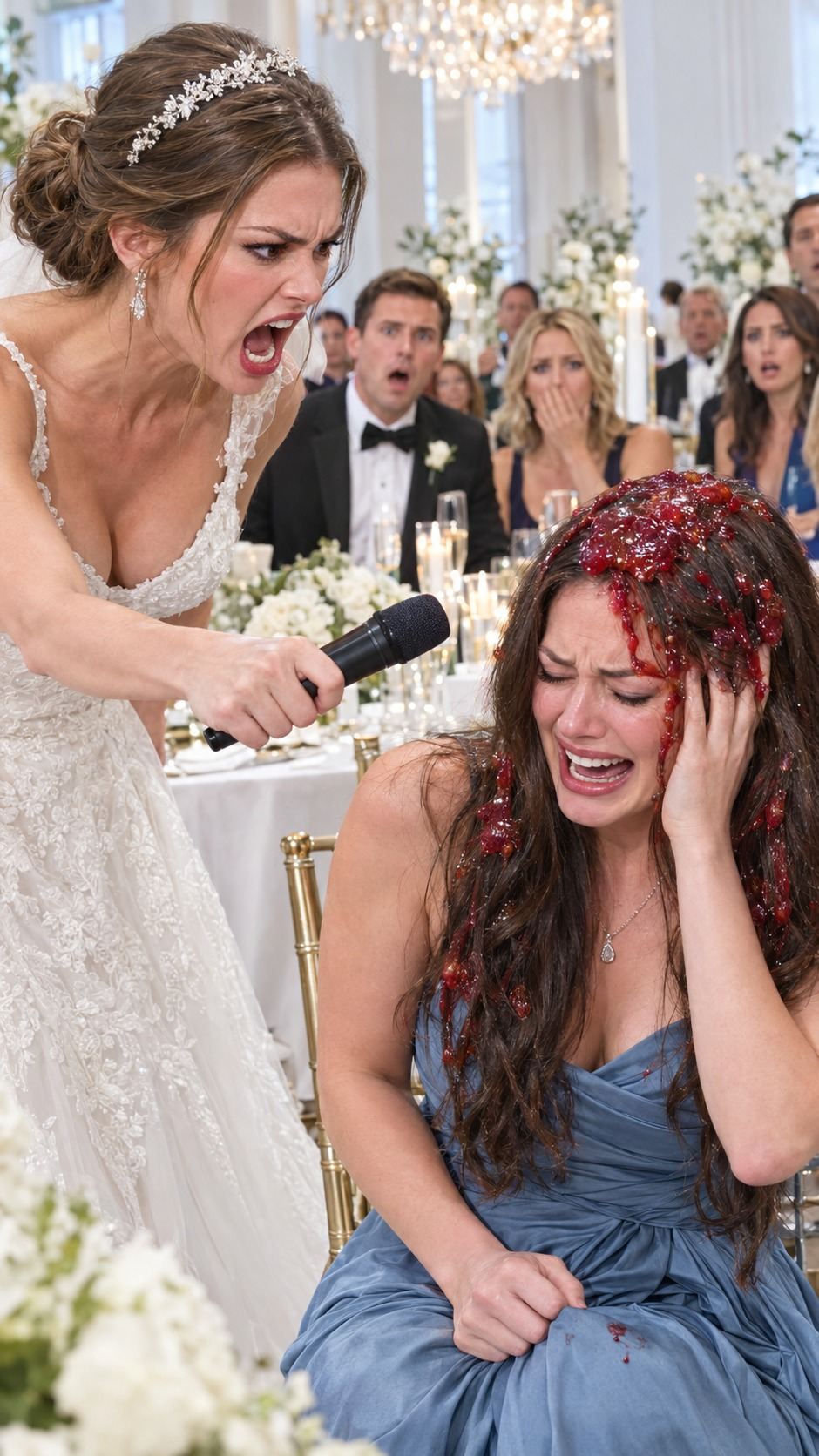
“Somebody help me!” a woman shouted as I stumbled away from the banquet table. “She’s bleeding!”
Dr. Hayes would later find a decades-old medical file bearing my name and a suspicious settlement code.
On the back of my childhood hospital record, someone had written four words in blue ink: DO NOT CONTACT THE FAMILY.
My family had spent twenty-one years making sure I never saw them.
And on the night of my sister’s wedding, they nearly succeeded again.
The microphone struck my temple before I understood that my sister had moved.
One second, I was sitting at the reception table, watching Victoria lift her champagne glass beneath the crystal chandeliers. The next, a hard metallic crack exploded beside my right ear, and the entire ballroom tilted sideways.
I grabbed the edge of the table.
The guests disappeared into a blur of white flowers, gold chairs, and startled faces. Somewhere, a glass shattered. My ears rang so loudly that I could barely hear my own breathing.
Victoria stood over me with the steel microphone in her hand.
Her champagne-gold wedding gown shimmered under the lights. Her copper-red hair was arranged in a perfect low bun, and the diamonds at her ears flashed as she turned toward the crowd.
For one strange second, she looked as surprised as everyone else.
Then I felt something warm slide down my forehead.
I lifted my fingers to my temple.
When I pulled my hand away, the fingertips were red.
I stared at them.
I had never seen so much of my own blood.
“Victoria,” I whispered.
She glanced at the microphone, then at me.
“Calm down. It slipped from my hand.”
The words were so absurd that I almost laughed. I hadn't even accused her of anything yet.
I tried to stand, but my knees seemed disconnected from the rest of my body. The ballroom swayed, and I reached for the chair to keep myself upright.
A woman gasped behind me.
Someone else muttered, “Oh, my God.”
My mother pushed through the guests.
For one brief moment, I thought she was coming to help me.
I had spent thirty-two years believing that, no matter how badly things went between us, my mother would always reach for me when I was hurt.
Instead, she seized the edge of Victoria's enormous skirt and pulled it away from my bloodied hand.
“Step back!” she shrieked. “Do not get your blood on her twelve-thousand-dollar gown!”
The ballroom went silent.
I looked at her.
My mother, Diane Whitmore, had spent months planning every detail of this wedding. She had personally approved the floral arrangements, the crystal centerpieces, and the champagne served to three hundred guests. She had argued with the event coordinator over the exact shade of gold on the invitations.
But I had never imagined that she would look at the blood running down my face and worry about the price of a dress.
“Mom,” I said, struggling to focus. “I'm hurt.”
“Then sit down and stop making a scene.”
Victoria lowered the microphone.
She didn't apologize.
She didn't ask whether I could see clearly.
She glanced toward the nearest photographer, whose camera remained raised.
“Please tell me you weren't recording that,” she said.
That was when something inside me went very still.
Not because I had stopped hurting. My head throbbed with every heartbeat, and the metallic taste of blood had begun to spread across my tongue.
I went still because my sister was more frightened of a photograph than she was of what she had done to me.
A man in a charcoal suit approached cautiously.
“Ma'am, should I call an ambulance?”
My mother turned on him.
“There's no need to create a spectacle. She probably caught the edge of the microphone. These things happen.”
I stared at her, trying to understand how she could say that while blood continued to run down my cheek.
The man hesitated.
Victoria seized the opportunity.
“Exactly. It was an accident.” She lifted her chin and addressed the surrounding guests. “Everyone, please. We don't need to ruin the evening over a little misunderstanding.”
A little misunderstanding.
I had seen the microphone coming toward me only at the last instant. There had been no warning, no accidental slip, no attempt to pull the heavy object away.
Victoria had swung it.
I knew what I had seen.
Yet as I looked around the ballroom, I noticed something worse than the shock on the guests' faces.
People were already looking away.
One woman picked up her champagne glass. A man whispered to his wife. The photographer lowered his camera without saying another word.
The celebration was beginning to reclaim the room, as if my injury were an inconvenient interruption rather than a reason to stop everything.
I pressed a folded napkin against my temple.
The white fabric turned red almost immediately.
“I'm going to the hospital,” I said.
My mother sighed.
“Don't be dramatic, Maren.”
I looked at her for another second.
Then I reached for my handbag.
My hands were trembling so badly that I dropped it. My phone slid across the marble floor and stopped beneath a chair. I bent to retrieve it, but the sudden movement sent a wave of dizziness through me.
A guest finally stepped forward and picked it up.
“Here,” she whispered. “You need to get that checked.”
Her name was Caroline, one of Victoria's college friends. I had met her twice before. She was practically a stranger, yet she was the only person in the ballroom who had shown me even a trace of kindness.
“Thank you,” I managed.
Caroline glanced toward Victoria.
“Maybe I should come with you.”
Before I could answer, my sister interrupted.
“Caroline, please don't encourage her. She's always been sensitive.”
Always been sensitive.
The phrase was familiar.
When I was twelve and Victoria broke my wrist by slamming a bedroom door against my arm, my mother had said I was exaggerating.
When I was seventeen and Victoria emptied my savings account to pay for a vacation, I was accused of being jealous.
When I was twenty-six and refused to lend her money for a business that never existed, my mother told relatives that I had become selfish.
Every injury had been minimized.
Every accusation had somehow become my fault.
But this time, blood was running down my face in front of hundreds of witnesses.
Surely, I thought, no one could rewrite what had happened.
I was wrong.
“I'm fine,” I told Caroline, although I could barely keep my eyes focused. “I'll get a car.”
She looked unconvinced.
I didn't blame her.
As I walked toward the ballroom doors, I could hear my mother telling someone that the evening would resume in a few minutes. Victoria's voice followed, bright and composed, thanking the guests for their patience.
Then the music started again.
I stopped with one hand on the door.
My sister was continuing her wedding reception while I was bleeding from the head.
I turned back once.
Victoria stood beneath the chandeliers, accepting an embrace from a guest. Her expensive gown was immaculate. My mother had arranged the train behind her so that not a single fold touched the floor.
My sister caught my eye across the room.
For a fraction of a second, the smile vanished from her face.
She looked directly at the blood on my hand.
Then she lifted her champagne glass.
I left.
The corridor outside the ballroom was quiet enough for me to hear my own footsteps.
I leaned against the wall and opened my rideshare application. The screen blurred, and I had to blink several times before I could enter the hospital's address.
My phone rang before I could confirm the ride.
Mom.
I answered because some foolish part of me still hoped she might have changed her mind.
“Are you really leaving?” she demanded.
“I'm going to the emergency room.”
“You're making Victoria's wedding all about you.”
I closed my eyes.
“Mom, she hit me in the head with a metal microphone.”
“She said it slipped.”
“You saw the blood.”
“And I saw you standing there upsetting everyone. You could have handled it privately.”
I pressed the napkin harder against my temple.
The pain was becoming sharper. I felt nauseated, and a strange pressure had begun to build behind my right eye.
“I need medical attention,” I said.
“Fine. Go, then. But don't call your sister asking for money if you decide to run up an enormous bill.”
For several seconds, I couldn't speak.
I wasn't asking for money. I wasn't asking for an apology. I wasn't even asking her to come with me.
I had wanted my mother to say that she was worried.
That was all.
Instead, she ended the call.
My rideshare arrived a minute later.
The driver took one look at the blood on my face and immediately asked whether I needed an ambulance. I told him I was conscious, could speak, and wanted to reach the emergency department as quickly as possible.
He drove carefully, occasionally checking the rearview mirror.
I sat with a clean towel pressed against my head and watched the wedding venue disappear behind us.
At a traffic light, I opened my messages.
There were photographs from the reception. Pictures of Victoria entering the ballroom. Pictures of the first dance. Pictures of my mother laughing beside the cake.
I found one image Caroline had sent earlier that evening.
In it, Victoria and I stood together beneath the floral arch.
She was smiling with her arm around my waist.
I was smiling, too.
We looked like sisters who loved each other.
I stared at the photograph until the screen dimmed.
Then I locked my phone.
For the first time in my life, I wondered whether my family had ever seen me as a person separate from the role they had assigned me.
Victoria was the daughter who deserved admiration.
I was the daughter who was expected to understand.
Victoria was allowed to make mistakes.
I was expected to forgive them.
And if I protested, I became the problem.
The car stopped outside the emergency department.
The driver helped me out and offered to accompany me inside, but I thanked him and insisted I could walk.
I made it through the sliding doors before my knees began to shake.
A nurse saw the blood and hurried toward me with a wheelchair.
“Ma'am, what happened?”
“My sister hit me,” I answered.
The words sounded strange.
Saying them aloud made the incident real in a way that the ballroom had somehow refused to allow.
The nurse guided me into the triage area.
“Did you lose consciousness?”
“I don't think so.”
“Do you feel nauseated? Any blurred vision?”
“Yes. Both.”
Her expression changed.
She called for another nurse and began checking my vital signs.
When she asked whether anyone had come with me, I looked toward the entrance.
“No,” I said. “I'm alone.”
The nurse didn't comment, but her hand rested briefly on my shoulder.
That small gesture nearly broke me.
Not the pain.
Not the blood.
Not even my mother's words.
It was the kindness of a stranger who had nothing to gain by showing it.
They moved me into an examination room and ordered a CT scan. A physician examined the wound while a nurse cleaned the blood from my hairline.
The bright lights made my head ache.
I answered the questions as carefully as I could. I told them about the microphone, the sudden impact, the dizziness, and the nausea.
I also told them I had no memory of a serious head injury as an adult.
The doctor didn't appear satisfied with that answer.
“Have you ever had surgery on your head?”
“No.”
“Any significant childhood injuries?”
I thought about it.
“When I was eight, I fell in the backyard. I tripped over a garden hose near the steps. My mother said I bumped my head, but it wasn't serious.”
“Did you go to the hospital?”
“No. She kept me home from school for three days.”
The doctor made a note.
“Did you have headaches afterward?”
“I don't remember.”
That was the truth. My childhood memories were uneven, full of ordinary moments and strange blank spaces. I remembered school, birthdays, the smell of my grandmother's kitchen, and Victoria stealing the best pieces of cake.
But there were certain periods I couldn't reconstruct no matter how hard I tried.
I had always assumed that was normal.
The nurse finished cleaning my wound and applied a temporary dressing.
“We're going to take good care of you,” she said.
I nodded.
For the first time that night, I allowed myself to believe someone.
The CT scan took only a few minutes. I lay still inside the machine, staring at the ceiling while the equipment hummed around me.
When they returned me to the examination room, I expected stitches, instructions, and perhaps a few hours of observation.
Instead, the nurse checked the dressing and told me the physician would be back shortly.
She left.
I was alone for less than five minutes.
Then the door opened.
Dr. Hayes entered holding a tablet. He was in his early fifties, with graying hair and a calm, precise manner that had reassured me earlier.
Now he looked different.
He pulled the door shut behind him and glanced at the tablet again.
“Ms. Whitmore,” he said, “I need you to listen carefully.”
I straightened against the pillows.
“Is something wrong?”
He didn't answer immediately.
Instead, he moved the tablet so I could see the scan.
A series of gray images appeared on the screen, showing the bones of my skull.
At first, I couldn't understand what I was looking at.
Then Dr. Hayes enlarged one section.
The bone near my right temple was visibly deformed. A jagged depression extended inward, surrounded by irregular areas that looked nothing like the smooth contours of the surrounding skull.
I stared at it.
“Is that from tonight?”
“No,” he said quietly.
He turned the tablet toward himself, examined the image again, and then looked directly at me.
“This is an old, severely depressed cranial fracture. The bone has healed in an abnormal position, and there is substantial calcification. Based on the imaging, the injury is decades old.”
My mouth went dry.
“Decades?”
“Yes.”
“But I never had a serious accident.”
Dr. Hayes pulled a chair closer to the bed.
“Maren, a fracture of this severity is not consistent with a minor fall from a garden step. The original injury would ordinarily have required urgent specialist evaluation and, depending on the associated damage, potentially major surgery.”
I shook my head.
“No. My mother said I hit my head on the steps. She said I was lucky it wasn't worse.”
He watched me carefully.
“Did anyone ever explain why you weren't taken to a hospital?”
“No.”
“Did you ever have unexplained headaches, seizures, or periods of confusion as a child?”
“I don't know.”
My voice sounded smaller than I wanted it to.
Dr. Hayes lowered the tablet.
“I've requested a more detailed review of the imaging and the available historical records. I don't want to jump to conclusions about the circumstances of an injury that happened so long ago.”
I clutched the blanket.
“What are you saying?”
“I'm saying that the story you were told does not match what I'm seeing.”
The room seemed to grow colder.
I thought of my mother's certainty. Victoria's smile. The years of being told I was dramatic, difficult, and too sensitive to understand what was best for me.
For the first time, those memories no longer felt like separate incidents.
They felt like pieces of something I had never been allowed to see.
Dr. Hayes glanced at his tablet again.
“There is one more thing,” he said.
He turned the screen toward me.
An old state medical archive had returned a preliminary record associated with my name and date of birth. The information was incomplete, but one billing field had been preserved.
It did not list a health insurance company.
Instead, a line of bold capital letters appeared across the screen:
RESTRICTED ESCROW / HOMEOWNERS LIABILITY CASUALTY SETTLEMENT.
I read the words twice.
Then a third time.
“What does that mean?”
Dr. Hayes's expression hardened.
“It suggests the original medical expenses may have been paid through a liability settlement rather than ordinary health insurance. I need to verify the source and the legal circumstances before I can tell you more.”
I felt suddenly cold despite the warm blanket.
“Who paid it?”
“That is what I'm trying to establish.”
He scrolled down.
A date appeared.
A facility number.
A reference to a sealed claim.
Then, beneath the billing entry, a field that should have contained the name of the responsible party appeared to have been deliberately restricted.
Dr. Hayes stopped scrolling.
His eyes narrowed.
“That's unusual.”
“What is?”
He didn't answer immediately.
Instead, he enlarged the document and examined a line near the bottom that had not appeared in the initial summary.
I watched his face change.
He looked at me, then back at the screen.
“Ms. Whitmore, I need you to tell me something before I go any further.”
My fingers tightened around the blanket.
“What?”
“Has your mother ever told you that your childhood medical records were lost, destroyed, or transferred to another hospital?”
I opened my mouth.
Before I could answer, his tablet chimed.
A new archive document had arrived.
Dr. Hayes read the first line.
Then he slowly turned the screen toward me.
At the top of the newly recovered file was my full name, followed by a date from twenty-one years earlier—and a red warning stamped across the page:
DO NOT CONTACT THE FAMILY.






Comments 0