I read the warning until the letters began to blur.
DO NOT CONTACT THE FAMILY.
The words seemed almost ordinary on the screen, but their meaning was unbearable.
Someone had known that I was a child in danger, or believed I might become one. Someone had written those words into an official medical record and ensured that the warning survived for more than two decades.
And someone had made certain that my family would never be contacted.
“Who wrote that?” I asked.
Dr. Hayes did not answer immediately.
He placed the tablet on the bedside table and pulled his chair closer. His expression was serious, but he seemed to be choosing his words with unusual care.
“The document is an archived administrative record. I can't yet establish who entered the restriction or why. We need the original file and the associated legal documents.”
“But you said my injury was severe.”
“Yes.”
“And this says someone paid a settlement.”
“That is what the preliminary billing record indicates.”
“Then somebody knew.”
He held my gaze.
“Someone knew about the original injury. Whether that person was responsible for it, tried to conceal it, or was involved in the settlement is something we cannot determine from this page alone.”
I looked back at the screen.
My full name appeared beneath a string of numbers. The date matched the year I had turned eight. There was also a reference to an emergency admission, followed by a sequence of codes I couldn't understand.
I tried to remember that year.
I remembered a yellow bicycle with a basket on the handlebars. I remembered a cake with eight candles, and Victoria laughing because I had gotten frosting on my nose.
I remembered running through our backyard.
Then there was a blank.
Not an ordinary gap in childhood memory, but a strange emptiness surrounded by fragments that seemed to belong to different days.
I remembered waking up in my bedroom with the curtains drawn.
I remembered my mother telling me not to move too quickly.
I remembered a headache so intense that the sunlight hurt my eyes.
And I remembered asking why I couldn't go to school.
“You had a little accident,” she had told me. “You fell near the garden steps. You need to rest.”
At the time, I had believed her.
Why wouldn't I?
She was my mother.
“Dr. Hayes,” I whispered, “what if the story I've been told my entire life isn't true?”
He leaned forward.
“Then you deserve the truth. But we are going to establish it through evidence, not assumptions.”
I nodded, although I wasn't sure I could absorb another word.
He explained that the fresh wound required stitches and that the severity of my symptoms meant I should remain under medical observation. He also wanted a specialist to review the old fracture and assess whether it had left any lasting complications.
I agreed to everything.
For the first time that evening, I wasn't thinking about my sister's wedding, the ruined reception, or my mother's anger.
I was thinking about a little girl who had been hurt badly enough to leave a permanent mark inside her skull.
A little girl who had been told that nothing serious had happened.
A little girl who had grown up believing that the people responsible for protecting her had always told her the truth.
I wondered whether she had cried.
I wondered whether anyone had held her hand.
And I wondered why, if the injury had been so severe, no one had ever shown me a medical record.
“Can I have a copy of that file?” I asked.
“Once the appropriate records are retrieved and verified, we can explain the process for obtaining the documents you're entitled to access.”
“I want to see everything.”
“That's understandable.”
“No.” I looked directly at him. “I don't think you understand. I want every record. Every scan. Every bill. Every name.”
Dr. Hayes studied me for a moment.
Then he nodded.
“I'll document that request.”
A nurse entered to prepare the wound for stitching. Dr. Hayes explained the procedure, and I answered her questions while trying not to look at the tablet.
The local anesthetic stung.
I gripped the edge of the bed as the doctor worked carefully around the injury. He told me when I might feel pressure and reminded me to speak up if the pain became too intense.
Everything about his manner was calm and methodical.
That made the contrast with the wedding even harder to bear.
At the ballroom, my mother had shouted about a dress.
Here, a stranger had taken the time to explain every movement before touching my wound.
When the stitches were finished, the nurse cleaned away the remaining blood and replaced the dressing.
She asked whether I needed someone to collect me.
I almost laughed.
My family had been surrounded by hundreds of people when I was injured, yet I had arrived at the hospital alone.
“I can arrange transportation later,” I said.
She gave me a sympathetic look.
“There's no rush. The doctor wants to review the historical findings with you before making a decision about discharge.”
She left the room.
I picked up my phone.
There were eleven missed calls from my mother and six messages from Victoria.
For a moment, hope stirred inside me.
Perhaps my sister had finally realized what she had done.
Perhaps my mother had become frightened when she understood how serious the injury was.
I opened Victoria's messages.
The first read:
You need to stop making this bigger than it was.
The second arrived two minutes later.
I barely touched you. Everyone saw that you were fine afterward.
The third was longer.
I have spent a year planning this wedding. Do you have any idea how much money and effort went into tonight? Please don't destroy my marriage before it even begins.
I read the last message twice.
There was no question about my condition.
No request for a photograph of the wound.
No apology.
She was worried about the consequences of my telling the truth.
My mother had sent a message, too.
Your sister is devastated. I hope you're satisfied.
I stared at those words until my eyes burned.
Then another message appeared.
This one was from an unknown number.
You need to stop asking about what happened when you were eight.
I stopped breathing for a second.
The message had arrived less than a minute earlier.
I checked the number. It wasn't saved in my contacts. There was no name or photograph attached to it.
I typed a reply.
Who is this?
The message showed as delivered.
No answer came.
I tried calling the number.
It rang once before going to voicemail.
I ended the call without leaving a message.
My hand was trembling again, but this time the tremor had nothing to do with the injury.
Someone knew I was asking questions.
Someone knew about the medical record.
And whoever had sent that message wanted me to stop.
I took a screenshot and saved it.
Then I forwarded it to my own email account.
It was a small action, almost insignificant, but it was the first thing I had done that night for the sole purpose of protecting myself.
I wasn't ready to accuse anyone.
I wasn't ready to decide what had happened twenty-one years earlier.
But I was no longer willing to let my family decide what I was allowed to know.
Dr. Hayes returned with another physician shortly before midnight.
The second doctor introduced herself as Dr. Patel, a neurologist who had reviewed the images. She explained that the old fracture was substantial and that the fresh injury needed to be considered alongside it.
They discussed the imaging in language I struggled to follow, occasionally pausing to explain a term.
The old depression was unmistakable.
It wasn't a shadow caused by the recent impact. It wasn't an artifact of the scan.
The skull had healed around an injury that had once been catastrophic.
“Could a fall cause this?” I asked.
Dr. Patel answered carefully.
“Some falls cause serious head injuries, particularly in children. But we cannot evaluate the original mechanism from this image alone. The severity and pattern raise questions that the historical records may help answer.”
I thought of the garden hose.
The small step.
My mother's insistence that I had merely bumped my head.
“Would I have needed surgery?”
“An injury of this severity would generally have required urgent specialist assessment,” she said. “Whether surgery was necessary would depend on the original condition, including the degree of depression and any associated brain injury.”
“Could someone have survived it without treatment?”
“It would depend on the circumstances. We cannot reconstruct that from the scan alone.”
Her caution was reasonable.
I knew that.
But every careful answer left another question behind.
Why had my mother kept me home from school?
Why had no one ever taken me for a follow-up examination?
Why had a liability settlement paid the expenses?
And why had someone restricted the records?
Dr. Hayes opened the archived document again.
“We have requested additional information from the records department,” he said. “The billing code points to a settlement account, but it does not identify the person who paid it. I don't want you to assume that it proves someone in your family caused the injury.”
I nodded.
“I understand.”
But I couldn't stop thinking about the wedding.
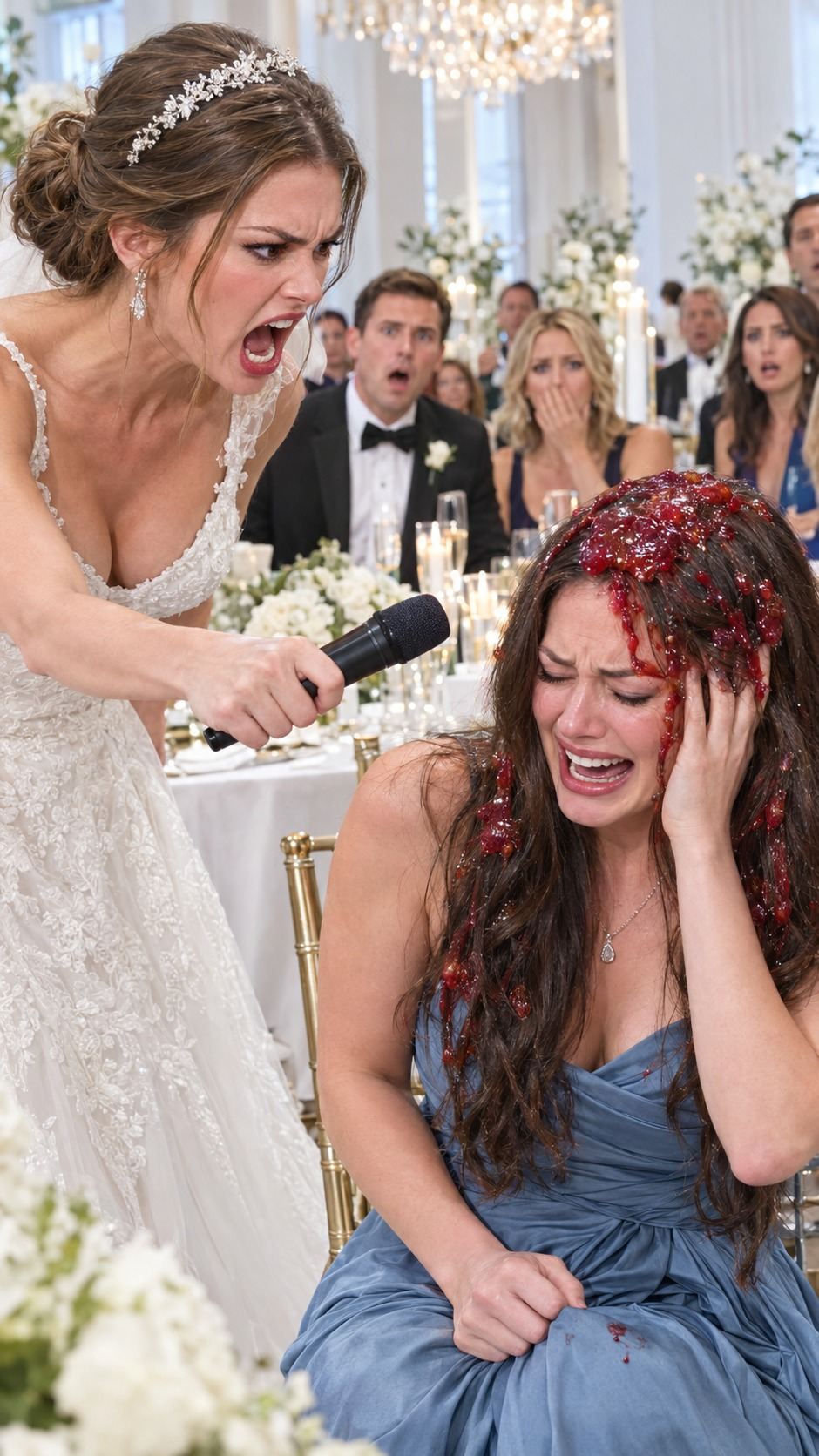
Victoria had struck me in front of three hundred witnesses, then called it an accident.
My mother had watched me bleed and worried about the dress.
Both of them had acted as if the truth mattered less than the appearance of the family.
It was possible that the childhood injury had been an accident, too.
It was also possible that the explanation I had been given was a lie.
I needed to know which.
Dr. Hayes explained that I would remain under observation while the team completed the necessary assessments. He also arranged for a social worker to speak with me about the suspicious messages and my concerns about the historical records.
When he finished, he asked whether I felt safe returning to my family home.
The question caught me off guard.
“Why wouldn't I?”
He didn't look away.
“Because you have described an assault by a family member, followed by messages pressuring you not to investigate a past injury. I want to understand whether you have somewhere safe to recover.”
I looked at my phone.
Another message had arrived.
This time, it was from my mother.
Come home tomorrow. We need to discuss what you are going to tell people about tonight.
I read it once.
Then I showed Dr. Hayes.
He didn't tell me what to do, and he didn't attempt to interpret her motives. He simply asked whether I had a friend or another trusted person I could contact.
I thought of Caroline.
I didn't have her number, but she had sent me the photograph earlier that evening. I opened the message thread and typed a brief note explaining that I was receiving treatment and needed someone to speak with.
She responded almost immediately.
I'm so sorry. I should have come with you. Are you safe right now?
My eyes filled with tears.
I hadn't cried at the wedding.
I hadn't cried in the car.
I hadn't cried when Dr. Hayes showed me the fracture.
But that simple question loosened something inside me.
I'm at the hospital, I wrote. The doctors found something on my scan. Something old.
Caroline called.
I answered, and for several seconds neither of us spoke.
Then she said, “Maren, I saw what happened. Victoria didn't drop that microphone. She swung it at you.”
I pressed my lips together.
“Thank you for saying that.”
“I don't know why everyone acted as if it was nothing.”
“Neither do I.”
“I should have done more.”
“You were the only person who tried to help.”
She went quiet.
Then she asked, “What did the doctors find?”
I hesitated.
I didn't know Caroline well enough to trust her with everything, but I was tired of holding the questions alone.
I told her about the old fracture.
I told her about the settlement code.
And I told her about the warning on the archived record.
When I finished, she didn't offer an easy explanation.
She didn't say my mother would never lie.
She didn't tell me to forgive Victoria because it was her wedding day.
She simply listened.
Finally, she said, “Save everything. Don't delete those messages. And don't let anyone convince you that you imagined what happened.”
I looked toward the tablet on the bedside table.
“I won't.”
After the call, I saved Caroline's number and placed my phone beside the bed.
For the first time in years, I felt that someone believed me without requiring me to prove that I deserved to be believed.
It wasn't enough to solve the mystery.
But it was enough to help me face it.
At 1:17 a.m., the hospital records department sent Dr. Hayes a preliminary response.
He returned to my room carrying a printed document.
“We've located an additional reference to the original admission,” he said. “It's not the complete medical file, but it may help us identify the next records to request.”
I sat upright.
“What does it say?”
He placed the paper on the table.
The document contained an admission date, a transfer reference, and the name of a facility that had since been reorganized.
Beneath those details was a field marked RESPONSIBLE PARTY.
The name had been partially redacted in the digital copy.
However, the remaining letters were visible.
D. W.
I stared at them.
“My mother is Diane Whitmore.”
Dr. Hayes nodded.
“I see the similarity. But initials alone are not enough to establish identity. We need the original documentation.”
I understood.
I did.
Yet my pulse had begun to race.
Diane Whitmore.
My mother.
The woman who had told me that I had fallen over a garden hose.
The woman who had refused to take me to the hospital.
The woman who had shouted about Victoria's gown while blood ran down my face.
I looked at the document again.
“Can we get the original?”
“We've submitted a request. It may take time.”
“How much time?”
“I can't promise an exact timeframe.”
I leaned back against the pillows.
The old injury had been hidden for twenty-one years. I couldn't expect the truth to appear simply because I had finally asked the right questions.
But I could wait.
I could request the records.
I could preserve the evidence.
And I could refuse to let anyone silence me again.
Dr. Hayes gathered the papers and prepared to leave.
His phone rang.
He checked the screen, answered, and listened without speaking.
At first, his expression remained neutral.
Then he looked at me.
“I'm sorry,” he said into the phone. “Could you repeat the name of the person requesting access?”
He listened again.
His face changed.
He ended the call slowly and turned toward my bed.
“The hospital records office just received a request for your archived file,” he said.
I felt a cold sensation move through my chest.
“From whom?”
Dr. Hayes glanced at the phone in his hand.
“The caller identified herself as a member of your family.”
Then he looked at the printed record on the bedside table.
“And she specifically asked whether you had already seen the settlement documents.”
End of Chapter 2.






Comments 0