My father slammed the forty-two dollars onto the trading post counter.
"She's yours. Take her before I change my mind."
Hollis Vain, the mountain trapper in the wheelchair, looked at the money without touching it.
Then he looked directly at me.
And he asked the one question my father had never bothered to ask.
"Does she know what she's agreeing to?"
I was twenty-seven years old, standing in a room full of men who had just watched my father sell his only daughter like a piece of livestock.
My name was Miriam Louise Oaks.
And according to the handwritten agreement lying between them, I was worth forty-two dollars.
Not forty-two dollars and a promise.
Not forty-two dollars and a future.
Just forty-two dollars.
My father, Edmund Oaks, had once been a respectable man. At least, that was what people in Cold Water Basin remembered. He had owned a small timber lease, kept a modest house, and possessed enough money to purchase seed, livestock, and supplies without borrowing from every businessman in three counties.
But respectable men did not spend their savings at saloon card tables.
And respectable men did not return home drunk, sell their furniture, and blame their daughters for the consequences.
By the time I turned twenty-seven, my father's gambling debts had swallowed almost everything.
The kitchen table was gone.
The good silver had disappeared.
The winter blankets had been pawned.
Even my mother's wedding ring had been exchanged for money he never managed to repay.
My mother had died when I was nineteen. She had left me one piece of advice.
Never let a desperate person convince you that your life belongs to them.
I remembered those words while my father signed the agreement.
The man standing opposite him was Dunore, a land speculator with a narrow face, expensive waistcoat, and an unpleasant habit of smiling whenever someone else was losing something.
He had brought the contract.
He had brought the money.
And he had brought the news that a mountain trapper named Hollis Arden Vain needed a wife.
Hollis lived beyond the timberline in the Bitterroot Mountains. Two winters earlier, a boulder had crushed his legs in a narrow canyon. A doctor had reportedly told him he would never walk again.
Since then, Hollis had refused to return to town.
He traded furs twice a year through intermediaries and kept to himself.
People said he was difficult, dangerous, and growing increasingly bitter.
People also said he had enough silver to purchase half the trading post.
Dunore explained that Hollis needed someone to cook, clean, maintain the household, and provide companionship.
My father needed money.
The arrangement was apparently simple.
I was the solution to both problems.
"You should consider yourself fortunate," my father told me.
I looked at him.
"Fortunate?"
"You're getting a roof over your head. Food. A husband."
"A husband I have never met."
"You're twenty-seven, Miriam. You should be grateful anyone wants you."
Dunore chuckled.
I did not.
Instead, I looked toward the man in the wheelchair.
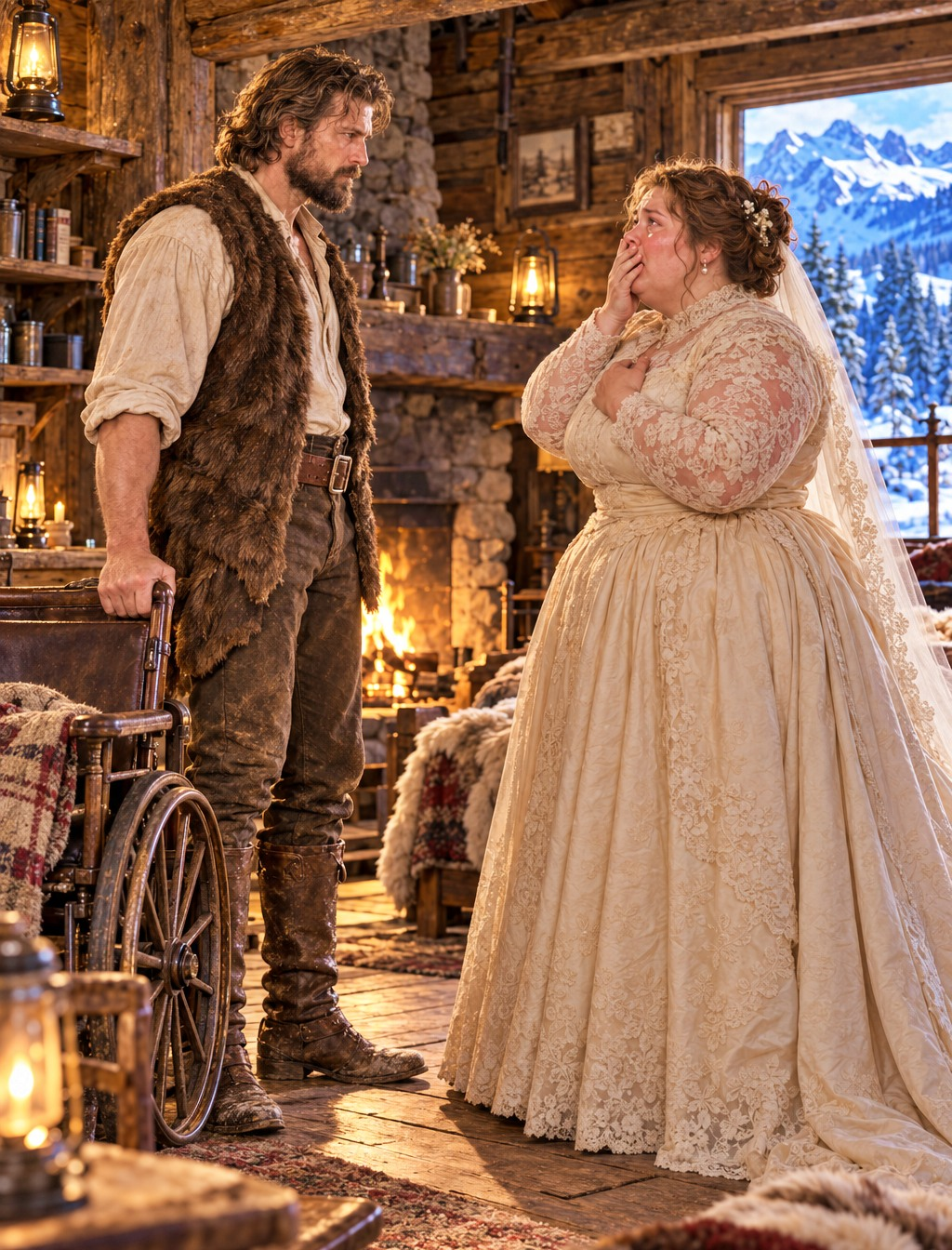
Hollis wore a brown fur vest over a weathered linen shirt. His dark hair reached the collar of his coat, and his thick beard concealed much of his expression.
He was broad across the shoulders, with powerful hands resting on the wooden arms of his chair.
A wool blanket covered his legs.
His eyes were pale gray.
And unlike my father, he did not seem particularly interested in the money.
"Does she know what she's agreeing to?" he repeated.
My father answered before I could.
"She knows enough."
Hollis continued watching me.
"That wasn't my question."
For the first time that afternoon, someone had spoken as though I were actually present.
I swallowed.
"I know that my father has sold me for forty-two dollars."
The room became quiet.
Dunore's smile disappeared.
My father grabbed my arm.
"Watch your mouth."
I pulled away.
Hollis studied my face for several seconds.
Then he reached for the contract.
"Bring her to my cabin tomorrow."
That was how my marriage was arranged.
No courtship.
No flowers.
No promise of affection.
Just a signature, a handful of silver, and a journey into the mountains.
The following morning, a buckboard arrived outside my father's house.
The driver introduced himself as Casper. He was a quiet man with weathered skin, a dark wool hat, and an expression that suggested he had already heard every unpleasant thing that could be said about the arrangement.
I carried one canvas bag.
Inside were two dresses, a pair of stockings, a comb, a small sewing kit, and my mother's old Bible.
My father stood on the porch.
He did not hug me.
He did not apologize.
He simply asked Casper whether the payment had been completed.
I climbed into the wagon without answering.
As we traveled away from Cold Water Basin, I watched the familiar buildings disappear behind the trees.
I expected to cry.
Instead, I felt something strange.
Relief.
For years, I had lived beneath a roof where every meal depended on my father's latest gamble and every conversation eventually became an argument about money.
Whatever waited for me in the mountains, at least it was somewhere else.
The journey took most of the day.
The road narrowed as we climbed higher. Pine branches stretched across the trail, and the wagon wheels rattled over exposed stones.
Casper spoke only twice.
The first time was to tell me to hold my bag when the road became steep.
The second time was when I asked whether Hollis truly could not walk.
"That's what the doctor said."
"Have you known him long?"
"Long enough."
"Is he cruel?"
Casper looked at the trail.
"He's not a man who likes questions."
That was not an answer.
I decided not to ask another.
By late afternoon, the trees began to thin.
A long, low cabin appeared in a clearing beneath a ridge of exposed granite. Smoke rose from its chimney, and several stacks of split firewood stood neatly beside the entrance.
There were animal traps hanging beneath the porch roof.
A wooden chopping block stood near the door.
Everything looked orderly.
More orderly than I had expected from a man supposedly incapable of leaving his wheelchair.
Before I could mention it, the cabin door opened.
Hollis sat inside.
A rifle rested across his knees.
Another leaned against the doorframe.
He watched the wagon approach without moving.
Casper stopped near the porch.
"Here you are," he said.
I climbed down.
Hollis's eyes followed me.
"Miriam Oaks?"
"Yes."
"Dunore sent a letter."
"I know. I wrote it for him."
His eyebrows moved slightly.
"You wrote it?"
"His handwriting was difficult to read. He dictated the terms. I put them on paper."
For the first time, I noticed something almost resembling amusement in his expression.
"You're welcome to bring your bag inside."
I looked toward the wagon.
"Will Casper carry it?"
"No. He doesn't come past the treeline."
I picked up my canvas bag.
Casper immediately turned the wagon around.
He did not wish me luck.
He did not even look back.
I watched until the sound of the wheels disappeared into the forest.
Then I faced my new husband.
Hollis moved his chair backward to make room.
"There's a preacher coming before sunset."
"I see."
"We'll be married tonight."
"I understand."
He watched me for another moment.
"Do you have any questions?"
I almost laughed.
I had hundreds.
Why did he need a wife?
Why did he live so far from town?
Why did he own two rifles?
And why did a man who supposedly could not walk keep his firewood stacked in such perfect rows?
But I chose the question that mattered most.
"Will I be safe here?"
His expression changed.
Not dramatically.
Just enough for me to notice.
"Yes."
"Can you promise that?"
"I can promise that no one under this roof will hurt you."
I looked at the rifle across his knees.
"Even you?"
His gray eyes held mine.
"Especially me."
I did not know what to make of that answer.
The preacher arrived shortly before dark.
His name was Reverend Couts, and he looked thoroughly miserable about having climbed three hours through the mountains.
He performed the ceremony beside the cast-iron stove.
Hollis remained in his wheelchair.
I stood beside him in the same cream-colored dress I had worn during the journey.
There were no flowers.
No guests.
No music.
Just the preacher, two strangers, and a lantern whose flame trembled whenever the wind pressed against the cabin walls.
When Reverend Couts asked whether I accepted Hollis as my husband, I hesitated.
Not because I expected love.
I had stopped expecting that a long time ago.
But because I understood that the words would change my life.
"I do," I finally answered.
Hollis spoke the same words.
The preacher completed the ceremony, accepted his payment, and departed before the mountain trail became too dangerous.
The door closed.
And I became Miriam Vain.
For several seconds, neither of us spoke.
Then Hollis nodded toward the kitchen.
"There's food in the pantry. The beans need heating."
I removed my gloves.
"I can do that."
He watched as I moved around the kitchen.
The cabin was surprisingly well stocked. There were sacks of flour, dried beans, smoked meat, jars of preserved vegetables, and enough coffee to last several months.
I found a pot, added water, and placed it over the stove.
Hollis remained near the window.
He did not ask me to hurry.
He did not complain.
He simply watched the darkness gathering beyond the glass.
When supper was ready, I placed two plates on the table.
He maneuvered his wheelchair toward it.
We ate quietly.
Afterward, I washed the dishes.
"Where do I sleep?" I asked.
"The bed is in the back."
"And you?"
"I'll take the chair."
I turned around.
"You cannot possibly sleep in that wheelchair every night."
"I've managed."
"That doesn't mean it's comfortable."
His jaw tightened.
"The bed is yours, Miriam. The matter isn't open."
I studied him.
Then I returned to the dishes.
I had learned that some arguments were better postponed until the person across from you was willing to have them.
Later, I entered the sleeping alcove and pulled the heavy blanket over myself.
The room smelled faintly of cedar, clean linen, and wood smoke.
I was exhausted, but sleep refused to come.
Through a narrow opening in the curtain, I could see Hollis beside the window.
His rifle rested across his lap.
The lantern illuminated the side of his face.
He was staring into the forest.
Not casually.
Not absentmindedly.
He looked like a man waiting for someone.
I watched him for several minutes.
Then I noticed something strange.
His wheelchair was positioned at an angle toward the window, but the blanket covering his legs had slipped slightly.
There was no sign of movement beneath it.
I closed my eyes.
Perhaps Casper had been right.
Perhaps Hollis was simply a lonely man who had grown accustomed to watching the mountains.
I was almost asleep when a sound reached me.
A soft wooden creak.
Then another.
I opened my eyes.
The curtain had moved.
A shadow crossed the narrow strip of light beneath it.
I sat up.
"Hollis?"
No answer.
I climbed out of bed and approached the curtain.
The wheelchair stood beside the window.
Empty.
The wool blanket had fallen onto the floor.
And from somewhere in the darkness beyond the curtain, I heard three unmistakable footsteps moving across the cabin.
Then Hollis spoke.
"Miriam, stay where you are."
But his voice was no longer coming from the wheelchair.
It was coming from directly behind me.
Comments 0