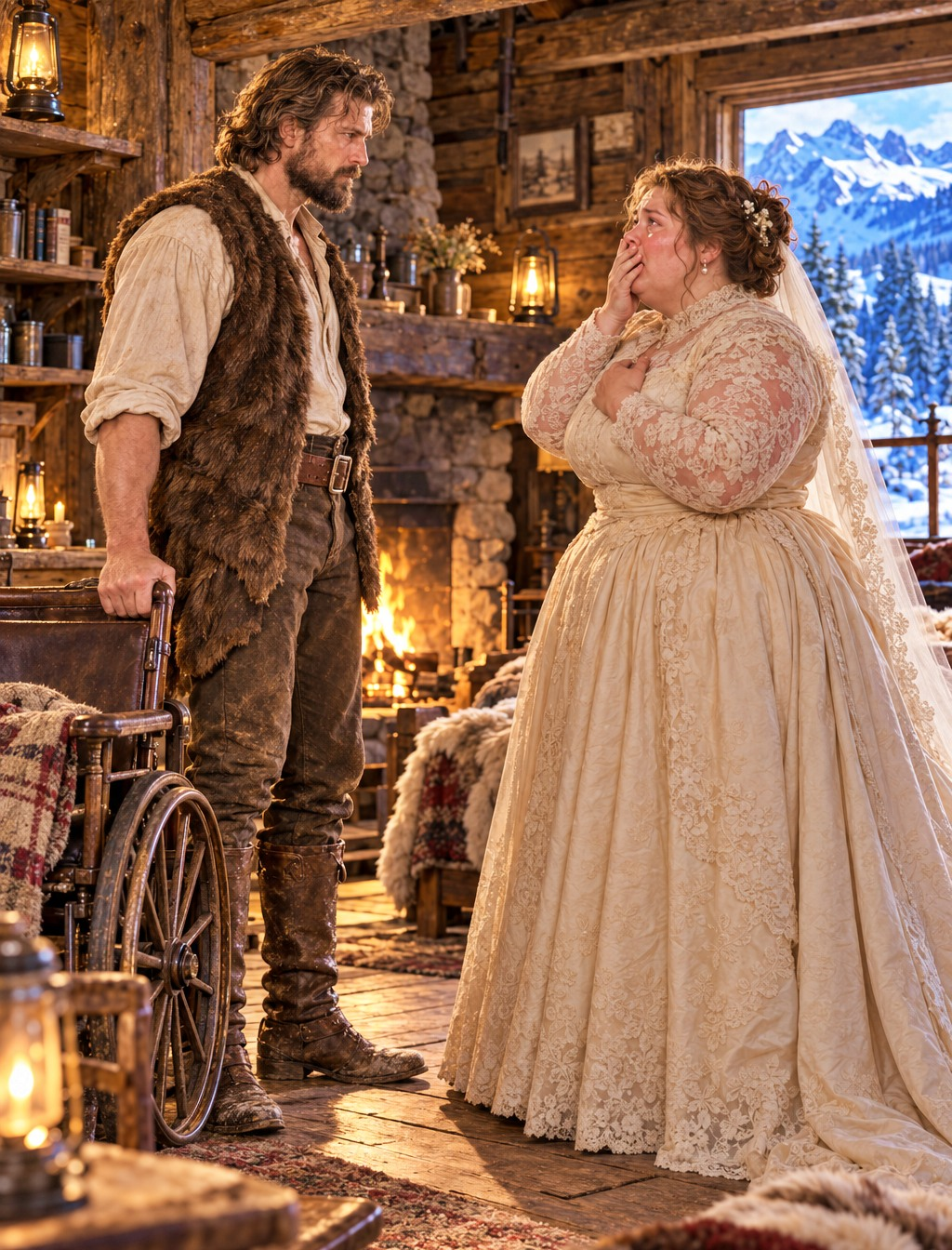
Rusk stared at Hollis as though he had seen a dead man.
My father backed into the wall.
The leather folder slipped from Rusk's fingers and struck the floor.
For several seconds, nobody spoke.
Then Rusk whispered a name.
"Arden."
Hollis's expression did not change.
"That's what my mother called me."
Rusk swallowed.
"I thought you were dead."
"Many people did."
My father looked between them.
"What is this?"
Hollis stepped away from the wheelchair.
His boots made two quiet sounds against the wooden floor.
Edmund stared at his legs.
"But the doctor said—"
"The doctor said what he was paid to say."
Rusk moved toward the door.
Hollis did not stop him.
Instead, he looked at the document on the table.
"Leave the letter."
Rusk shook his head.
"I don't think so."
"Then leave the folder."
"You're making a mistake."
Hollis gave a faint smile.
"I've made plenty. This isn't one of them."
Rusk grabbed the folder and rushed outside.
My father followed.
But before he crossed the threshold, he turned toward me.
"Miriam, come home."
I looked at him.
"You mean come help you sign away Mother's land?"
"I mean come away from this man."
I glanced at Hollis.
For the first time, I noticed that his expression had become almost protective.
My father pointed at him.
"You don't know what he did!"
Hollis remained silent.
Edmund continued.
"He ruined people. He destroyed lives. Ask him why he disappeared from town."
I stepped toward the door.
"Tell me what he did, Father."
My father looked at me.
Then he shook his head.
"Not here."
He left.
The horses disappeared into the trees.
I remained standing in the doorway until the sound of their movement faded.
Then I turned toward Hollis.
"Who are you?"
He looked at the wheelchair.
Then at me.
"My name is Hollis Arden Vain."
"That's not enough."
"No."
"Why did Rusk recognize you?"
He rubbed his jaw.
"Because we worked together once."
"Doing what?"
"Surveying land."
I frowned.
"You were a surveyor?"
"Among other things."
"Then why are you living as a trapper?"
He looked toward the window.
"Because I needed to disappear."
I folded my arms.
"From whom?"
He did not answer.
I walked toward the table and picked up the photograph from my mother's box.
The one showing her standing beside him.
"Tell me about this."
Hollis looked at it.
His expression softened.
"Your mother was brave."
"She was a good woman."
"Yes."
"What did you do together?"
He took the photograph from me.
"We worked on a land survey near the northern ridge. She was helping keep the accounts for a small group of families."
"Why?"
"Because the company was trying to take their property."
I sat down.
He continued.
"Your mother could read legal documents better than most men who worked in the territorial office. She noticed that the boundaries on several deeds had been altered."
"Who altered them?"
"Dunore's associates."
I looked at the photograph.
"And you helped her?"
"Yes."
"What happened?"
Hollis placed the photograph on the table.
"We found proof that the company had been using forged signatures to transfer land."
"Then why didn't you report them?"
"We did."
"And?"
He gave a humorless smile.
"The officials who received the reports were involved."
I felt sick.
"How many people knew?"
"Your mother. Me. A clerk named Rusk. Dunore. A few others."
"And my father?"
Hollis looked at me.
"Your father knew more than he admitted."
I closed my eyes.
I wanted to believe there was some misunderstanding.
That Edmund Oaks had simply been foolish.
That he had not deliberately helped anyone steal from my mother.
But I remembered the way he had avoided looking at me.
I remembered the money.
And I remembered his signature.
"Did he help them forge her name?"
"I don't know."
"Do you believe him?"
"No."
I appreciated the honesty.
I also hated it.
I stood and walked toward the window.
The mountains looked peaceful.
Snow covered the distant peaks, and the trees moved gently in the wind.
It was difficult to believe that so much ugliness could exist beneath such beautiful surroundings.
Behind me, Hollis opened a drawer.
He removed another photograph.
This one was older.
It showed a younger Hollis standing beside a woman with dark hair.
I recognized the woman immediately.
My mother.
But there was something different about the way she looked at him.
She was smiling.
Not politely.
Not for the camera.
She looked genuinely happy.
I turned.
"Was she in love with you?"
Hollis did not move.
For a long moment, I thought he would refuse to answer.
Then he shook his head.
"No."
"Are you sure?"
"Yes."
I studied the photograph.
"Then why does she look at you like that?"
He lowered his eyes.
"Because I was the first person who believed her when she said something was wrong."
I felt my chest tighten.
My mother had spent years living with a man who dismissed her opinions.
She had raised a daughter while trying to keep a household functioning with almost nothing.
Perhaps Hollis had simply listened.
Sometimes that was enough to make someone feel seen.
"Did she tell you about me?"
"Every time she came here."
"What did she say?"
He smiled faintly.
"That you were stubborn. That you hated bitter coffee. That you could add numbers faster than the men at the trading post. That you never forgot an insult."
Despite everything, I almost smiled.
"She was right."
"I know."
I sat beside the table.
"Why didn't you come to see me after she died?"
Hollis became quiet.
"Because I was being watched."
"By Dunore?"
"Yes."
"And you let me believe my mother had simply died from illness."
"I didn't know how to reach you without putting you in danger."
I looked down.
It was difficult to forgive a man for withholding information, even when his reasons sounded convincing.
But I was beginning to understand that the danger surrounding Hollis was real.
And my mother had known about it.
I reached into the wooden box and removed the letters.
There were six.
Each one was addressed to Hollis.
The dates spanned several months.
I opened the first.
The handwriting was delicate, slightly uneven.
My dearest Hollis,
If you receive this, it means I have not found another safe way to send the records. Edmund has become increasingly reckless. He believes Dunore can erase his debts, but he does not understand what those men are asking him to sign.
I stopped reading.
My father's name appeared again.
I continued.
They have asked about Miriam. I told them she knows nothing. Please make certain she remains away from the northern ridge until this matter is resolved.
I looked at Hollis.
He was watching me.
I turned the page.
There was another paragraph.
The original survey ledger is not in the cabin. I have hidden it somewhere no one would think to look. If I cannot retrieve it, you must find the second key.
I read the final sentence.
And I knew that I had found something important.
The second key is with the man who never leaves his chair.
I looked up.
Hollis's face had become completely still.
"Who is the man who never leaves his chair?" I asked.
He took the letter.
For the first time, he looked genuinely confused.
"I don't know."
I looked toward the wheelchair.
Then back at him.
"But someone does."
He read the sentence again.
Then he turned the paper over.
There was a small mark in the lower corner.
A drawing of a mountain.
Beneath it was a number.
17.
Hollis stared at it.
Then he walked to the window.
Outside, a single rider had appeared on the distant trail.
The man was moving slowly.
He stopped beside the woodpile and raised one hand.
Hollis immediately reached for his rifle.
"Who's that?" I whispered.
He didn't answer.
Instead, he moved the curtain aside.
The rider lifted his face.
And Hollis whispered a name I had never heard before.
"Caleb."
Then the man raised something in his hand.
A small silver key.
Comments 0