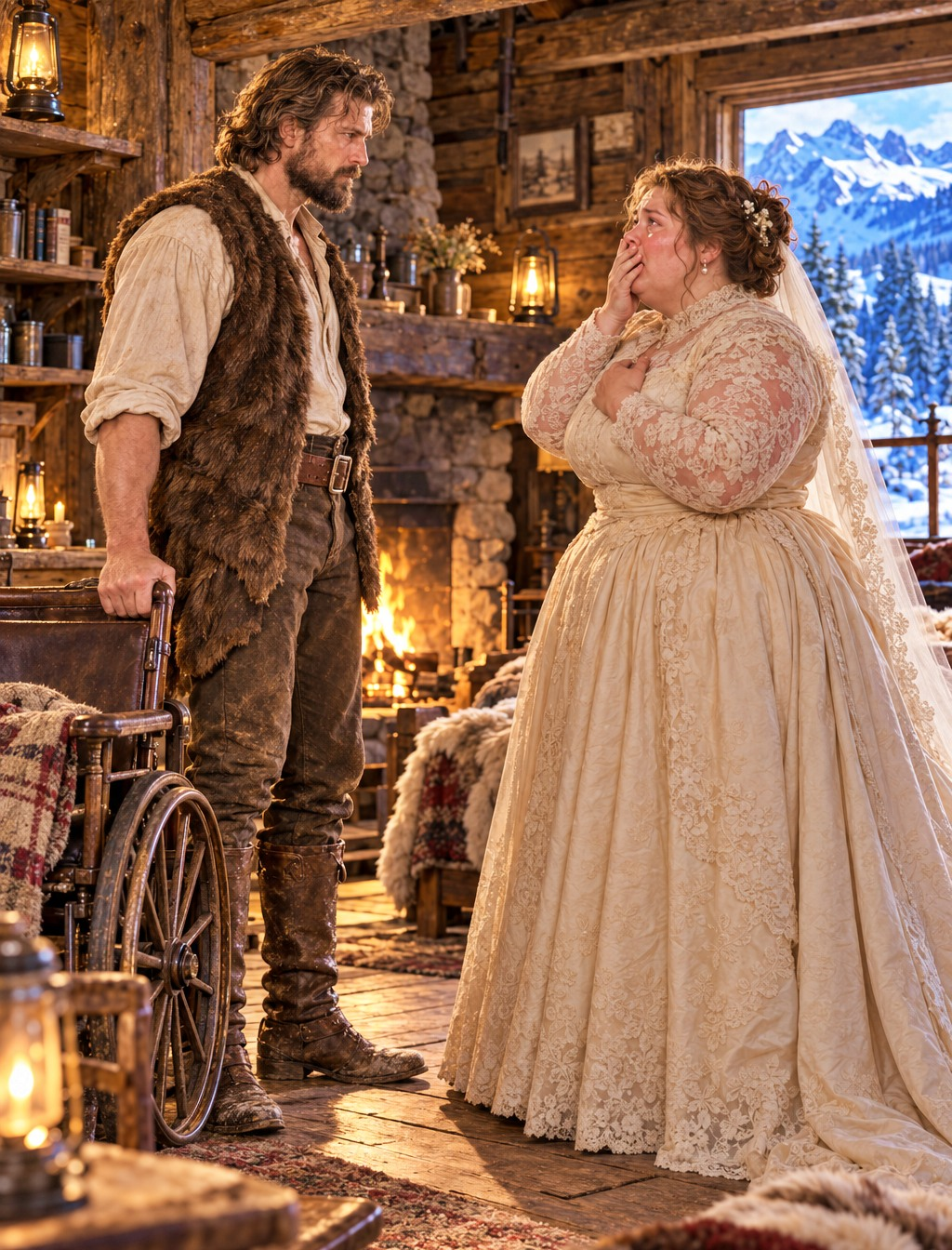
I froze.
Every instinct told me to turn around, but I couldn't make my body move.
Hollis stood behind me.
Not in his wheelchair.
Not leaning against the wall.
Standing.
I could hear his breathing, slow and controlled, while the wooden floor beneath his boots settled with a faint creak.
For several seconds, neither of us spoke.
Then I turned.
He was perhaps six feet away, his right hand resting against the edge of the kitchen table.
His legs were straight.
His shoulders were level.
There was no sign of the weakness I had expected to see in a man whose spine had supposedly been damaged beyond recovery.
I stared at him.
He stared back.
"You're standing," I whispered.
"Yes."
"You can walk."
"Apparently."
I glanced toward the empty wheelchair.
The blanket lay on the floor exactly where it had fallen.
I looked at his boots again.
Then at his face.
"How long?"
His expression remained unreadable.
"How long what?"
"How long have you been able to walk?"
He did not answer immediately.
Instead, he looked toward the window.
The darkness outside seemed to interest him more than the woman standing three feet away from him.
"Go back to bed, Miriam."
I almost laughed.
Not because anything was funny.
Because I had just discovered that my husband had lied about something enormous, and he was speaking as though I had interrupted him while he was reading.
"You're not going to explain?"
"No."
"Then perhaps I'll ask again."
His eyes returned to mine.
"How long have you been in my house?"
"Less than six hours."
"And how many of those hours have I spent treating you badly?"
I opened my mouth.
Then closed it.
He had not shouted.
He had not threatened me.
He had given me food, offered me the bed, and made no attempt to touch me.
That did not make the deception acceptable.
But it made the situation considerably more complicated.
"Why did you pretend to be crippled?" I asked.
His jaw tightened.
"Because people believe what they're told."
"That isn't an answer."
"It's the only one you're getting tonight."
He stepped toward the wheelchair and picked up the fallen blanket.
I watched his movements carefully.
He bent naturally.
No hesitation.
No visible discomfort.
He folded the blanket and placed it over the chair.
Then he returned to the window.
I noticed something else.
His rifle was no longer on his lap.
It was resting against the wall beside the window, within easy reach.
"You were watching something outside," I said.
He became still.
"Go to bed."
"Someone is out there."
"Not anymore."
My stomach tightened.
"What does that mean?"
He looked toward the forest again.
"Exactly what I said."
I wanted to demand an explanation, but something in his expression stopped me.
He was listening.
Not pretending.
Listening.
A minute passed.
Then another.
Finally, he turned away from the window.
"Lock the bedroom door."
I glanced toward the curtain.
"There is no lock."
"Then wedge the chair beneath the handle."
"Why?"
His eyes settled on mine.
"Because I asked you to."
It was the first time he had spoken with anything resembling authority.
I did not appreciate it.
But I moved the small wooden chair beside the bed anyway.
I did not sleep.
For the next hour, I listened to the cabin.
There were occasional sounds from the main room.
A drawer opening.
A metal object being placed on a table.
Boots moving across the floor.
Once, I heard the front door open.
Cold air entered the cabin.
Then it closed.
I eventually rose and approached the curtain again.
Hollis was sitting in his wheelchair.
His blanket covered his legs.
His hands rested on the wooden armrests.
Anyone looking through the window would have seen exactly what the trading post stories had described.
A disabled mountain trapper.
A lonely man who could not leave his chair.
But I had seen him standing.
I had heard him walk.
And I had watched him bend to retrieve the blanket.
There was no explanation I could invent that would make those things disappear.
At dawn, I woke to the smell of coffee.
I found Hollis beside the stove, already dressed.
He sat in his wheelchair, holding a tin cup.
"Morning," he said.
I looked at his legs.
The blanket was back in place.
"Morning."
"There are eggs in the pantry."
"Thank you."
I prepared breakfast.
While I worked, I noticed a small notebook on the table.
It was bound in dark leather and had a brass clasp.
I recognized the handwriting immediately.
The same narrow, precise lettering appeared on the contract Dunore had shown my father.
I looked at the notebook.
Then at Hollis.
"Is this yours?"
He followed my gaze.
"Yes."
"Can I look at it?"
"No."
I nodded.
"Fair enough."
He seemed surprised by my answer.
I placed breakfast on the table.
As he reached for his fork, I noticed a pale scar running along the inside of his right wrist.
It was narrow, uneven, and several inches long.
I had seen similar scars on men who worked with knives or suffered accidents involving broken glass.
But something about this one bothered me.
It looked deliberate.
"How did you hurt your wrist?"
He pulled his sleeve down.
"Long time ago."
I decided to stop asking questions.
For the moment.
After breakfast, I began inspecting the pantry.
The cabin was better organized than most homes I had seen.
Every jar had a label.
Every sack was tied and marked.
Even the firewood had been stacked by size.
Hollis might have been a man living alone in the mountains, but he was not careless.
Near the back wall, I found a wooden cabinet containing medical supplies.
Bandages.
Bottles of antiseptic.
A small pair of surgical scissors.
And a leather case containing several instruments I couldn't identify.
I was examining the case when Hollis spoke behind me.
"Leave that alone."
I turned.
He was still in his wheelchair.
His expression had become considerably colder.
"Is someone injured?"
"No."
"Then why do you need so many medical supplies?"
"Because I live three hours from the nearest doctor."
That was reasonable.
I closed the cabinet.
But as I turned away, I noticed a small piece of paper caught beneath one of the bottles.
Only a few words were visible.
PROPERTY OF THE TERRITORIAL MEDICAL OFFICE.
I had no idea why a mountain trapper would possess something belonging to a government medical office.
I decided not to mention it.
Around noon, Hollis asked me to bring a bundle of firewood inside.
I went out through the front door.
The air was sharp and clean.
Snow covered the higher ridges, although the clearing itself remained mostly bare.
I carried two pieces of wood inside.
Then I returned for more.
On my third trip, I noticed something beside the woodpile.
A footprint.
A man's bootprint.
It was fresh.
The impression was deep, and the heel had a distinctive broken edge.
I looked toward the forest.
There was no one there.
I returned to the cabin and told Hollis.
He listened without interrupting.
"Where?"
"Beside the woodpile."
"What direction was it facing?"
"Toward the cabin."
He put down his cup.
"Did you see anyone?"
"No."
He rolled toward the door.
I watched him reach for his rifle.
Then he stopped.
"Stay inside."
He moved outside.
I stood near the window and watched him cross the porch.
For several minutes, he examined the ground.
Then he followed the footprints toward the trees.
I expected him to stop after a few yards.
Instead, he continued farther into the clearing.
His movements were smooth.
Steady.
Confident.
And then I saw him do something that made my breath catch.
He stood up from the wheelchair.
He walked several steps toward a pine tree.
He bent down.
And picked up something from the snow.
I could barely see what it was.
He examined it for a moment before placing it inside his coat.
Then he looked directly toward the cabin window.
Toward me.
I stepped back.
A few seconds later, he returned.
He entered through the front door and sat down without saying anything.
"What did you find?" I asked.
"Nothing important."
"Then why did you bring it inside?"
His eyes narrowed.
"You're observant."
"I've had to be."
For the first time, he looked at me as though he were reconsidering something.
Not my appearance.
Not my usefulness as a housekeeper.
Something deeper.
"Your father told Dunore you were quiet," he said.
"My father tells people whatever makes them easier to sell."
Hollis looked down at his hands.
Then he laughed once.
It was a short, unexpected sound.
I had not heard him laugh before.
"You're going to be difficult, Miriam Oaks."
"I'm beginning to think that's an advantage."
His smile disappeared.
But the tension around his eyes eased slightly.
That evening, I prepared supper.
We ate at the same table.
For the first time, Hollis asked about my life.
Not about my cooking.
Not about the arrangement.
About me.
"Did you attend school?"
"For a while."
"How long?"
"Until my father couldn't afford it."
"Can you read accounts?"
"I can read, write, calculate expenses, and identify when someone is changing numbers."
He considered that.
"Useful skills."
"More useful than being sold for forty-two dollars."
His fork stopped.
I regretted the words almost immediately.
Not because they were untrue.
Because I had seen something change in his expression.
"I didn't pay your father because I wanted to own you," he said.
I looked at him.
"Then why did you?"
He was silent.
Finally, he reached into his shirt pocket and placed a folded document on the table.
It was the original contract.
I recognized my father's signature.
But beneath it was something I had not seen before.
A second handwritten clause.
I leaned closer.
It stated that Dunore had received forty-two dollars on behalf of Edmund Oaks, and that the amount represented full settlement of a specific outstanding obligation.
I read it twice.
Then I noticed the name written beside the obligation.
Hollis Arden Vain.
"What debt did my father owe you?"
Hollis folded the paper.
"Not yours to worry about."
"He sold me to settle it."
"I know."
"Then it concerns me."
His face became hard.
For a long moment, he said nothing.
Then he spoke.
"Your father didn't owe me forty-two dollars, Miriam."
I stared at him.
"Then who did he owe?"
Hollis looked toward the window.
"The man who came to my cabin before you arrived."
A chill moved through me.
"Who?"
Before he could answer, three hard knocks sounded against the front door.
Hollis immediately reached for his rifle.
And from outside, a familiar voice called his name.
It was Dunore.
Comments 0