Mr. Davies returned two days later.
This time, he brought Euan Mcloud.
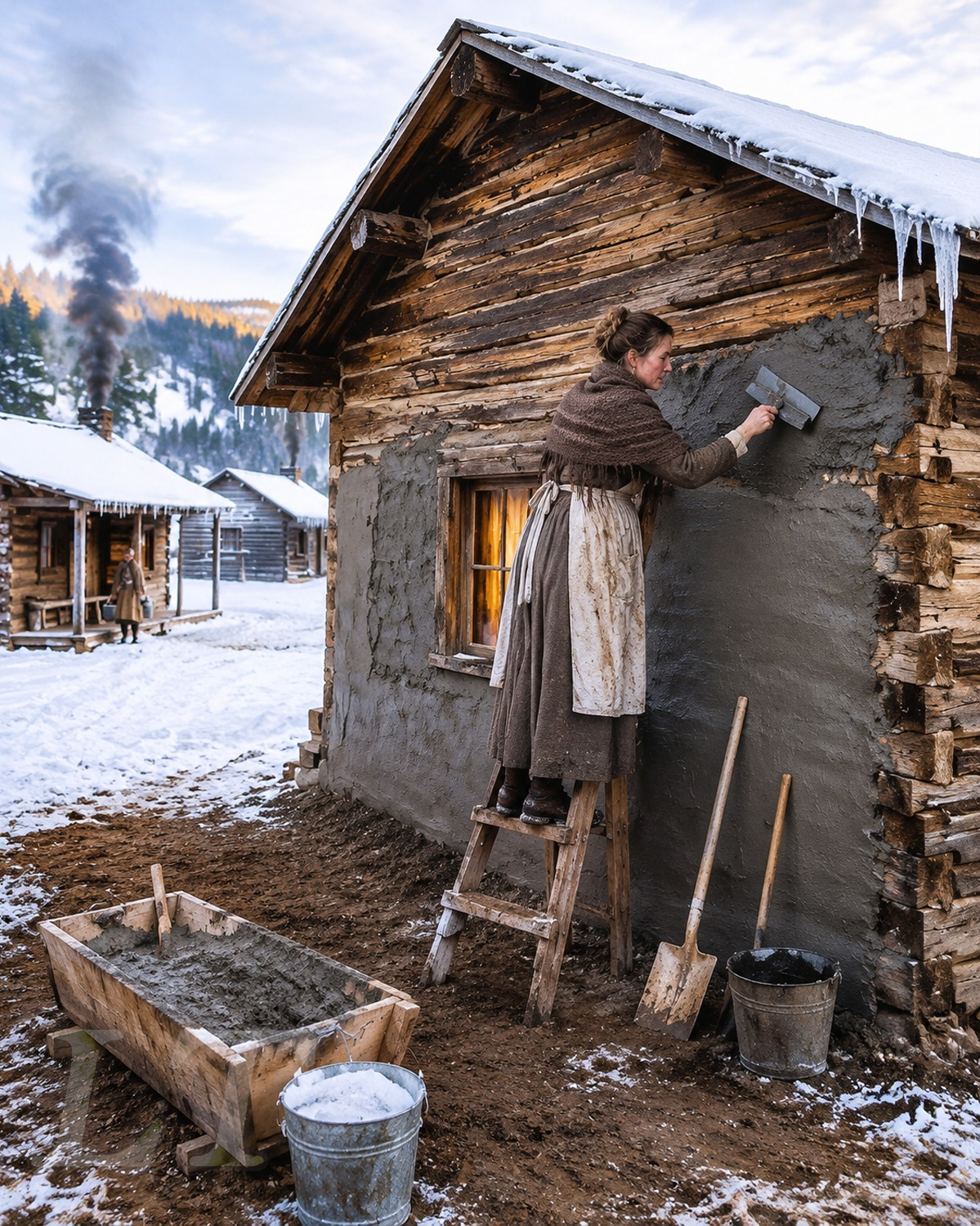
I was outside preparing another batch of plaster when their horses stopped beside the fence.
Carl was splitting wood near the cabin.
He looked up immediately.
"Good morning," he called.
Mr. Davies barely acknowledged him.
"I would like to inspect the walls again."
I put down my mixing paddle.
"Of course."
He entered the cabin and began examining the plaster.
Euan followed him.
I watched Euan's face carefully.
He was not laughing now.
He was studying the wall as though he wanted to find something that would prove him right.
Mr. Davies opened his ledger.
"Mrs. Vogle, I need to ask you several questions."
"Go ahead."
"What exactly is this material?"
I explained the ingredients.
"Clay, fine sand, sifted wood ash, and coarse horsehair."
"And you applied it directly over the logs?"
"Yes, along the interior surface."
"Without professional approval?"
"There was no local regulation specifically addressing this method."
He frowned.
"That doesn't mean you can experiment with a permanent structure."
Carl stepped forward.
"She's not damaging the cabin."
Mr. Davies raised his hand.
"I am speaking to your wife."
The words were quiet, but their effect was immediate.
Carl's expression hardened.
I touched his arm.
"Let him finish."
The agent examined the corners again.
"How long has this been drying?"
"Different sections have been drying for different periods."
"Have you measured the moisture content of the timber?"
I shook my head.
"Not with an instrument."
"Then you cannot guarantee that the material will not create a moisture problem."
"No," I said. "I cannot guarantee that."
Euan looked at me.
Perhaps he had expected a different answer.
Mr. Davies closed the ledger.
"Then I cannot endorse this construction method."
He turned toward the door.
"Should damage occur, the responsibility will rest with the owners."
Carl followed him outside.
"Are you saying we could lose our homestead?"
"I am saying you should understand the consequences of unauthorized alterations."
He climbed onto his horse.
Before leaving, he added something that stayed with me for days.
"People sometimes mistake confidence for knowledge, Mrs. Vogle."
I watched him ride away.
Euan remained behind.
For a moment, I thought he might say something useful.
Instead, he looked at the wall.
"You should have listened when I warned you."
I met his eyes.
"I heard you."
"Then why continue?"
"Because I still believe the work is worth doing carefully."
He shook his head.
"You're risking too much."
"Perhaps."
He seemed surprised again.
I continued.
"But I'm not going to stop simply because something is unfamiliar."
Euan looked toward the mountains.
Then he mounted his horse and followed the agent.
Carl stood silently beside me.
I could feel his anger.
Not at me.
At the humiliation.
"They spoke to you as though you were a child."
I picked up the trowel.
"They were worried about the structure."
"They were threatening our land."
I looked at him.
"Then we'll have to be even more careful."
He turned away.
For the rest of the afternoon, neither of us mentioned the inspection.
But the news spread quickly.
By Sunday, almost everyone in the valley knew that the land agent had questioned our construction.
At the general store, Silas Croft made sure the story reached every customer.
He stood near the stove with a cup of coffee.
"Apparently, the Ash Palace has become an official problem."
A few men laughed.
He continued.
"Now even the land agent has to investigate whether the woman is burying her own house in mud."
Someone asked whether Carl was going to tear down the plaster.
Silas shrugged.
"Perhaps he should. Unless he wants to live in a grave by spring."
The laughter grew louder.
Euan sat near the counter.
He did not join in.
But he did not defend me either.
That afternoon, Carl returned home unusually late.
He hung his coat beside the door.
I was preparing supper.
"How was the store?"
He avoided my eyes.
"Fine."
I knew it was not.
"What happened?"
He pulled out a chair.
"Silas said the land agent would refuse to recognize the cabin if anything went wrong."
I continued stirring the pot.
"That isn't exactly what Mr. Davies said."
"He also said people were beginning to question whether I had built this place properly."
I turned toward him.
"Carl—"
"I spent months cutting those logs."
"I know."
"Every single one."
"I know."
He lowered his voice.
"And now people are saying I let my wife destroy them."
I put down the spoon.
"Do you believe that?"
He looked at the floor.
"No."
But his answer came too slowly.
I sat beside him.
"Carl, I have never wanted to make you look foolish."
He rubbed his hands together.
"I know that too."
"Then why does their opinion matter so much?"
He looked toward the window.
"Because this cabin is all I have ever built that I truly believed would last."
I reached for his hand.
"And I am trying to make it last longer."
He said nothing.
I could hear the children playing in the other room.
After a while, Carl stood and walked toward the unfinished section of the roof.
He spent the rest of the evening repairing a loose board.
I knew he needed time.
I gave it to him.
But the next morning, I found something that frightened me.
A section of the plaster near the western corner had developed a hairline crack.
I examined it carefully.
The material had dried faster near the fireplace than in the colder section of the wall.
I removed the loose edge and checked the surface beneath it.
There was no obvious sign of rot.
But I could not be certain about the deeper timber.
I mixed a smaller batch and repaired the area.
Then I checked the other walls.
I found two more places that needed attention.
It was a reminder that my idea would not succeed simply because I believed in it.
Every detail mattered.
The mixture.
The thickness.
The drying conditions.
The way the logs moved as the weather changed.
I had to learn from every mistake.
That evening, I opened the old wooden box containing my father's notes.
The papers were worn.
Some had stains from years of handling.
I found a small drawing of a ceramic stove and a paragraph written in his familiar handwriting.
It described the importance of allowing materials to dry gradually.
I read it several times.
Then I noticed another sentence beneath the drawing.
"Never seal a weakness you do not understand."
I sat very still.
My father had not taught me to cover everything blindly.
He had taught me to understand what needed protection.
I closed the box.
The following day, I adjusted the way I worked.
I checked each section before applying more plaster.
I avoided covering any area that showed signs of persistent dampness.
I paid special attention to the joints and corners.
And I kept the unfinished outer surfaces exposed to the air as I worked through the final sections.
Carl noticed the change.
"You've slowed down."
"I have."
"Will we finish before the snow?"
"If the weather allows."
He looked at the wall.
Then he nodded.
We worked together that afternoon.
For the first time in weeks, I felt that we were moving forward without fighting each other.
But outside our cabin, the settlement was becoming increasingly anxious.
The first serious snowfall arrived earlier than expected.
It covered the mountain paths.
The temperature dropped.
Men hurried to finish their roofs.
Families stacked their remaining firewood.
And every morning, the smoke rising from the chimneys seemed thicker.
That night, I woke to a strange sound.
A sharp crack echoed through the valley.
It sounded like a tree splitting.
Then another.
Then another.
Carl sat up.
"What was that?"
I moved toward the window.
Outside, the sky was clear.
The moon illuminated the snow-covered trees.
Far in the distance, another explosive crack broke the silence.
Carl stood beside me.
Neither of us spoke.
The cold was arriving.
And it was arriving much sooner than anyone had prepared for.
The next morning, Euan came to our fence.
His face looked unusually serious.
He did not laugh at the wall.
He did not call our home the Ash Palace.
He simply looked at Carl and said:
"There's something you both need to know about the northern cabins."
Then he reached into his coat and pulled out a folded letter.
When Carl opened it, I saw his face change.
Because the letter contained the name of a family we knew.
And their cabin had already begun to freeze.






Comments 0