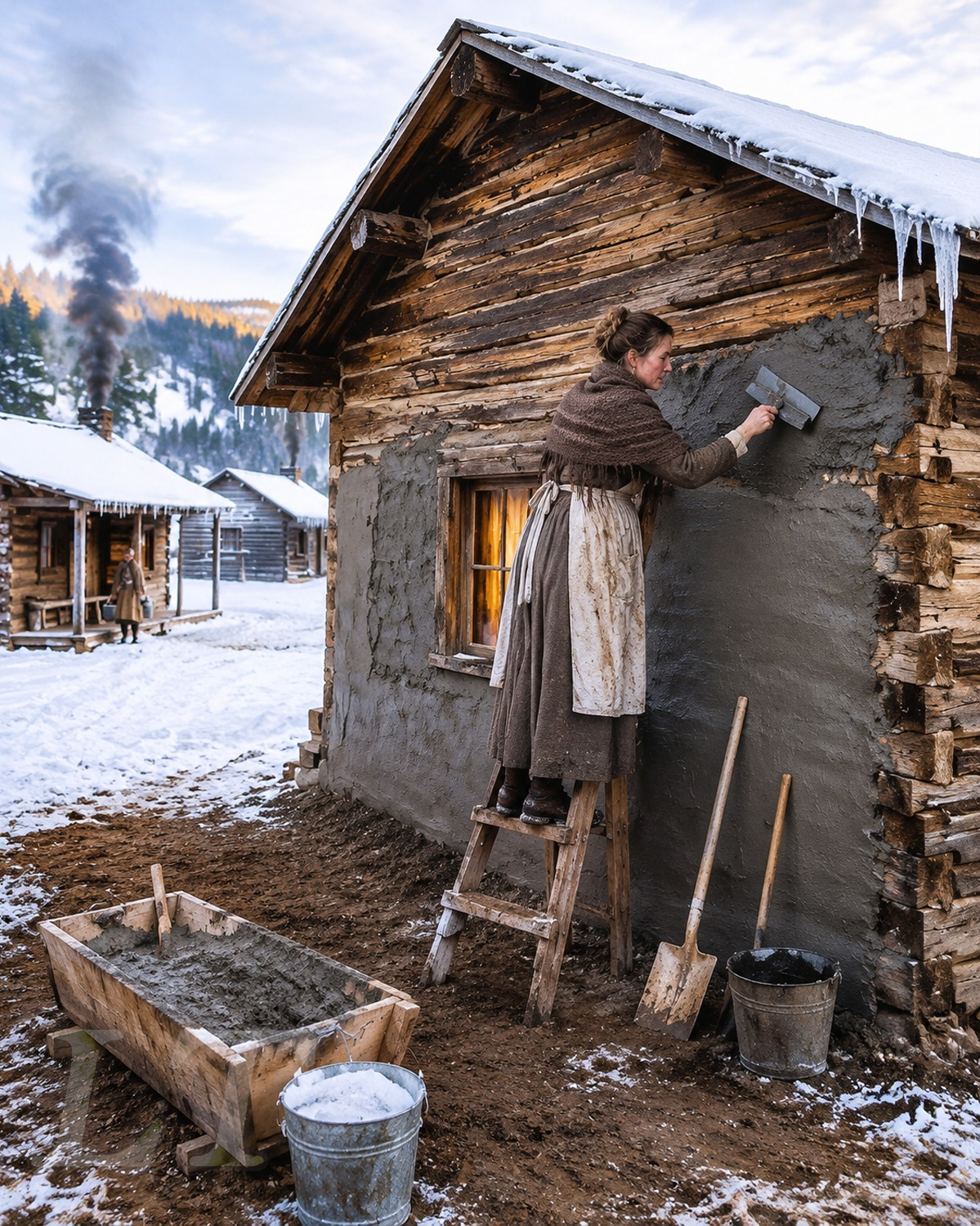
Spring arrived slowly in Clearwater Valley.
The snow began melting along the lower slopes.
Water returned to the creek.
The first birds appeared in the pine trees.
And for the first time in months, the settlement could move freely between homes.
The winter had been brutal.
Several families had suffered damage.
Some had lost sheds and livestock.
Others had spent weeks repairing roofs and chimneys.
But most of the settlement had survived.
And the Ash Palace remained standing.
Its gray walls were still intact.
The timber showed no obvious signs of serious deterioration.
The cabin had endured the cold, the snow, and the constant activity of people seeking shelter.
I continued checking the walls.
I did not stop simply because the winter had ended.
My father had taught me that materials required attention.
A good result did not mean the work was finished forever.
Every spring, the walls needed to be inspected.
Every year, the cabin needed maintenance.
But the results had given us something valuable.
Confidence.
Carl spent the first warm weeks repairing the fence.
He replaced several damaged boards and reinforced the gate.
He also built a better covered area for storing firewood.
Leisel helped me clean the cabin.
Jacob spent most of his time playing with Ash in the yard.
The puppy had become a healthy, energetic dog.
He followed the children everywhere.
Sometimes he slept beside the entrance, as though he still remembered the cold nights when we had first brought him inside.
One afternoon, Euan arrived.
He was carrying a large wooden trough.
Behind him were three other builders.
Silas came last.
He was carrying a sack of sifted ash.
I laughed when I saw them.
"Have you all come to build Ash Palaces?"
Euan smiled.
"Something like that."
He placed the trough beside mine.
"We've been discussing your mixture."
I nodded.
"Good."
He opened his notebook.
"We want to prepare several small test panels before applying anything to existing cabins."
I smiled.
"That's the right way to begin."
He showed me the measurements he had recorded.
He had also written down observations from the winter.
The thickness of the walls.
The condition of the timber.
The amount of firewood used.
The differences between the cabins.
He had become much more careful.
Silas stepped forward.
"I want to try it on the northern wall of my cabin."
I looked at him.
"Have you checked the timber?"
"Yes. Euan inspected it last week."
"Is it dry?"
"Yes."
"Then we can begin with a small section."
Silas nodded.
He looked uncomfortable.
"I know I have said this before, but I am sorry."
I smiled gently.
"You don't need to keep apologizing."
"I do."
He looked toward the children.
"Mary is alive because you opened your door."
I followed his gaze.
Mary was standing beside Leisel.
She looked much healthier.
Her cheeks had regained their color.
She was laughing as Ash chased a stick across the yard.
Silas continued.
"I used to think strength meant never admitting you were wrong."
He looked toward Euan.
"That winter taught me something different."
Euan nodded.
"It taught all of us."
We spent the afternoon preparing a small test mixture.
I showed the builders how I sifted the ash.
How I checked the clay.
How I judged the consistency.
I explained why the sand mattered and why the horsehair needed to be distributed evenly.
They asked questions.
I answered as carefully as I could.
When I did not know something, I said so.
I had no interest in pretending that my method was perfect.
I wanted people to understand what I had learned.
And I wanted them to avoid the mistakes I had made.
By summer, several families had begun experimenting with improved wall treatments under careful conditions.
Some used clay-based plaster.
Others focused on repairing the gaps in their traditional chinking.
Euan helped evaluate the work.
He became one of the strongest supporters of examining the whole structure rather than judging a cabin by the beauty of its exterior.
He often repeated something he had learned during that winter.
"A house is not strong simply because its logs look impressive. You must understand how every part works together."
People began asking him where he had learned that.
He always gave the same answer.
"From a German woman who was tired of feeling cold."
The general store eventually stopped calling our home the Ash Palace as a joke.
The name became a symbol of the winter.
Of the families who had gathered there.
Of the lessons the settlement had learned.
And of the woman who had refused to abandon an idea simply because everyone else found it strange.
One evening, Carl and I sat outside our cabin.
The sun was setting behind the mountains.
The children were playing near the fence.
Ash was lying in the grass.
Carl looked at the gray wall.
"Do you remember the first day you covered those logs?"
I smiled.
"Very clearly."
"I thought you were destroying my cabin."
I laughed.
"You told me the same thing three times."
He shook his head.
"I was an idiot."
"You were worried."
"Still."
He reached for my hand.
"I am glad you didn't listen."
I looked toward the mountains.
"I was frightened too."
He turned toward me.
"You never showed it."
"I didn't want the children to see how uncertain I was."
He squeezed my hand.
"Perhaps that was the bravest part."
I looked at him.
Then I looked at the cabin.
The gray plaster was no longer strange to me.
It was part of our home.
Part of the life we had built together.
A few weeks later, Euan organized a small gathering near the general store.
He invited several families.
He invited the builders.
He invited Mr. Davies.
And he asked me to speak.
I was nervous.
I had never imagined standing in front of the people who had once laughed at me.
But I agreed.
When the gathering began, Euan introduced me.
He spoke about the winter.
He described the cabins that had struggled.
He explained how the settlement had come together.
Then he turned toward me.
"Anelise Vogle understood something many of us overlooked. She recognized that keeping a home warm required more than simply building thick walls and feeding a large fire."
He paused.
"She also reminded us that knowledge can come from unexpected places."
The crowd became quiet.
I stepped forward.
I looked at the people gathered before me.
Some had mocked me.
Some had warned me.
Some had doubted me.
But many had also helped us survive.
I took a breath.
"I did not build the Ash Palace because I wanted to prove anyone wrong."
I looked toward Carl and the children.
"I built it because I was afraid of what would happen if we entered winter without fixing the problems I had noticed."
People listened.
"I was not certain the mixture would work. I made mistakes. I had to repair cracks and adjust the way I worked. And I was always aware that moisture could damage the timber if the walls were not allowed to dry properly."
I looked toward Euan.
"He was right to ask questions. I was right to keep investigating. Neither of us knew everything."
A few people smiled.
I continued.
"But when the cold arrived, we learned something more important than who had been right."
I looked at the families.
"We learned that a neighbor's safety matters more than our pride."
Nobody spoke.
I finished quietly.
"If we remember that, then perhaps the winter taught us something worth keeping."
For several seconds, there was silence.
Then Euan began applauding.
Carl joined him.
Thomas followed.
Soon, the entire gathering was clapping.
I looked toward Leisel.
She was smiling.
Jacob was waving both hands.
Mary stood beside her parents.
Silas nodded at me.
I felt my eyes become wet.
Not because I had finally received recognition.
But because I could see how much had changed.
The woman who had once been laughed at was no longer standing alone.
That evening, we returned home together.
Carl lit a small fire.
The children ate supper.
Ash settled beside the fireplace.
Outside, the air was cool, but the house remained comfortable.
I walked toward the wall and placed my palm against the gray plaster.
I remembered the first day.
The heavy buckets.
The rough wooden trough.
The criticism.
The laughter.
The fear.
I remembered wondering whether I had made a terrible mistake.
Then I remembered the desperate knocking on our door.
Euan carrying his freezing wife.
Silas carrying Mary.
Families arriving through the darkness.
People who had once laughed now asking for help.
I closed my eyes.
My father had once told me that warmth was not something a house could simply promise.
It had to be protected.
Now I understood that the lesson reached far beyond walls.
A family could be strong because its members protected one another.
A settlement could survive because its people shared what they had.
And a person could change the course of an entire community simply by refusing to abandon what she believed was worth trying.
Carl came up behind me.
"What are you thinking about?"
I turned.
"Father."
He smiled.
"I think he would have liked this place."
I looked around the room.
At the gray walls.
At the children.
At the warm light of the fireplace.
At the man who had stood beside me when I needed him most.
"Yes," I whispered. "I think he would have."
Outside, the wind moved through the pine trees.
But inside the Ash Palace, nobody was afraid of it anymore.
The following winter, the people of Clearwater Valley prepared differently.
They repaired their roofs.
They inspected their chimneys.
They sealed unnecessary drafts.
They learned to respect materials they had once dismissed.
Some adopted clay-based interior treatments.
Others improved their traditional construction methods.
Not every cabin became an Ash Palace.
And not every home needed the same solution.
But almost everyone remembered the winter when one woman's determination had helped bring an entire settlement together.
Years later, whenever newcomers asked about the gray cabin at the edge of Clearwater Valley, the old settlers told them the story.
They told them about the woman who collected fireplace ashes.
About the builder who called her foolish.
About the man who named her home the Ash Palace.
And about the terrible winter when the people who had laughed at her came knocking on her door.
But the part they remembered most was not the plaster.
It was what happened when she opened that door.
She did not ask who had mocked her.
She did not demand an apology.
She did not ask anyone to admit that she had been right.
She simply made room.
And in a valley where winter could take everything from a family, that kindness became the warmest thing anyone had ever built.






Comments 0