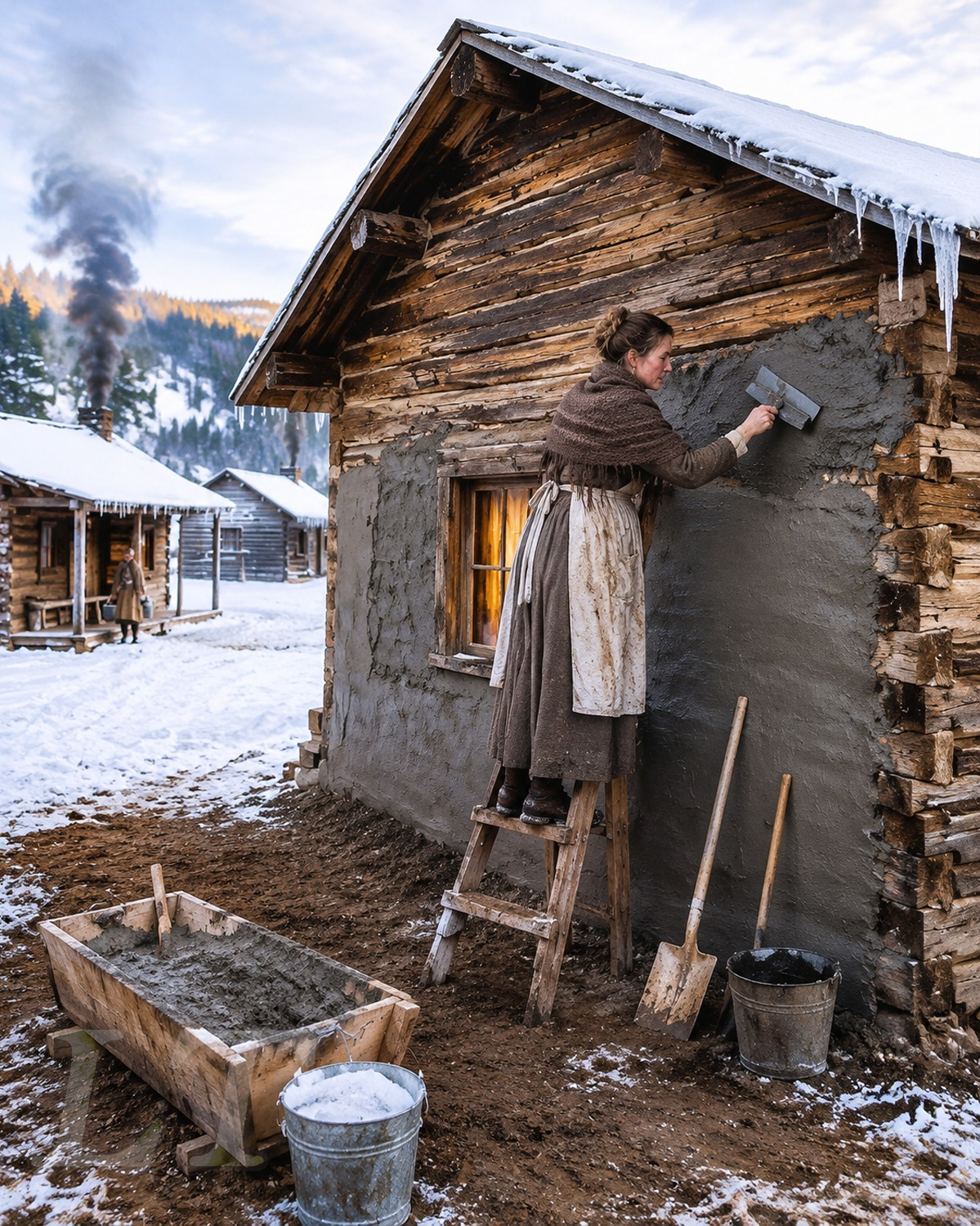
I pressed my trowel against the cabin wall as a man shouted behind me.
"Stop covering those beautiful logs!"
When Euan Mcloud, the most respected builder in Clearwater Valley, approached, he noticed the wooden trough filled with my strange gray mixture.
Three parts clay. Two parts sand. One part ash.
He stared at it.
Then he looked at me.
He had no idea what I had discovered.
I kept spreading the plaster.
My name was Anelise Vogle, and by the autumn of 1878, almost everyone in Clearwater Valley, Montana Territory, believed I had lost my mind.
I had married Carl Vogle six years earlier. We had two children, Leisel and Jacob, and a small homestead that had cost us nearly everything we owned.
Carl had built our cabin himself.
He had selected the pine trees, cut the logs, shaped their ends, and fitted each one into place. He had spent months working with an axe, a hand saw, and a collection of tools he treated with more affection than some men showed their horses.
Our cabin was his greatest accomplishment.
It had thick timber walls, a sturdy roof, a large stone fireplace, and a small window overlooking the valley.
Whenever visitors complimented the craftsmanship, Carl stood a little taller.
I was proud of him.
But I was also worried.
Because something was wrong with our beautiful cabin.
I had first noticed it during an unusually cold evening in October.
The fire was burning brightly, and the children were sitting near the hearth. Carl was repairing a leather strap at the table.
I was preparing supper when I noticed the flame of the small candle beside the window trembling.
At first, I assumed someone had opened the door.
But the door was closed.
I moved closer.
The flame leaned sideways.
I held my hand near the wooden wall and felt a narrow stream of cold air against my fingers.
I moved along the wall.
There it was again.
A little farther down, another stream.
Then another.
The cabin was losing warm air through places too small to see clearly.
That night, after everyone had gone to bed, I walked around the room with a candle.
I found tiny gaps between several logs.
Some were barely wider than a piece of thread.
Others were hidden beneath rough sections of old chinking.
They seemed insignificant.
But I remembered something my father had taught me when I was a child in southern Germany.
My father had been a ceramic stove builder. He spent his days working with clay, sand, and fire.
He understood materials in ways I had never seen anyone else understand them.
He had taught me how clay behaved when it dried, how sand helped prevent cracking, and how certain mixtures could withstand repeated changes in temperature.
But one lesson had stayed with me longer than all the others.
"Anelise," he once told me while repairing a large ceramic stove, "never underestimate a tiny opening. A little escaping heat can become a great loss when the cold refuses to leave."
I had been too young to understand him completely.
Now I understood.
The following morning, I told Carl what I had discovered.
He listened while eating his breakfast.
"You felt a draft?"
"Several."
"Where?"
I showed him.
He examined the gaps and pressed his fingers against the old chinking.
"That's normal," he said. "Every log cabin moves a little."
"I know."
"We'll repair the worst sections before the snow gets heavy."
I nodded.
But I was thinking about something else.
Repairing the visible gaps would not solve everything.
The cold seemed to find its way through places that looked perfectly sealed.
I needed something that could cover the entire interior surface and reduce the movement of air through the walls.
I remembered the mixtures my father used when working with traditional earthen materials.
And then I remembered the ash.
Wood ash was everywhere in Clearwater Valley.
Every household produced it.
Most people discarded it after cleaning their fireplaces.
Some spread it over their gardens.
Others threw it into pits behind their cabins.
I began collecting it.
At first, Carl thought I needed only a little.
Then he saw me returning with two buckets.
By the end of the third day, I had collected enough to fill a large wooden container.
He stood in the doorway watching me sift the fine gray powder.
"What exactly are you planning?"
"An experiment."
He looked at the buckets.
"With fireplace ashes?"
"And clay."
"Why?"
I placed a small quantity of river clay into the wooden trough.
"Because the clay will bind the mixture. The sand will help control shrinkage. The ash will become part of the material."
Carl rubbed his forehead.
"Anelise, we have enough work already."
"I know."
"The roof needs another inspection. The woodpile isn't finished. The children need warmer clothing."
"I know, Carl."
"Then why are you spending your mornings collecting ashes?"
I stopped mixing.
"Because I don't want our children waking up freezing in January."
He looked toward the fireplace.
"We have a good fire."
"And what happens when the fire goes out?"
He did not answer.
I returned to the trough.
Over the next several days, I collected river clay from a quiet bend in the Clearwater River.
I carried sacks of sand from the nearby bank.
I even visited the blacksmith and asked whether he had any coarse horsehair he could spare.
He laughed when I explained why I needed it.
"Planning to plaster a horse?"
I smiled politely.
"No. A cabin."
He shook his head but eventually gave me a bundle.
The mixture took time to prepare.
I sifted the ash carefully, removing pieces of charcoal and anything that had not burned completely.
Then I combined the ingredients in the trough.
The clay was thick and heavy.
The sand changed its texture.
The fine ash blended into the mixture, giving it a deep gray color.
Finally, I worked in the horsehair.
My father's lessons guided my hands, but I was not pretending that I knew everything.
I tested small amounts first.
I watched how they dried.
I checked whether they separated or cracked.
I adjusted the consistency until the plaster could be pressed against the wooden surface without immediately sliding downward.
Then I climbed onto a wooden ladder and began.
The first section was difficult.
The mixture clung to the trowel.
My arms grew tired.
A little plaster fell onto the ground.
But after several attempts, I found a rhythm.
I pressed the material into the gaps.
Then I spread another layer across the surrounding logs.
Slowly, the rough timber disappeared beneath a continuous gray surface.
I worked until the sun began sinking behind the mountains.
When I finally stepped down from the ladder, nearly half the wall had been covered.
I stood back and studied it.
It looked strange.
Almost unnatural.
Our beautiful pine logs had vanished.
But the wall was no longer full of visible openings.
I placed my hand against it.
The surface was cool and damp from the fresh mixture.
I knew it would need time to dry properly.
I also knew that covering timber required care. Moisture could become a serious problem if the structure could not dry.
I had thought about that.
I was not trying to trap water inside the logs.
I was trying to create a more continuous interior surface while allowing the cabin to dry outward.
Still, I could not guarantee the result.
And that uncertainty frightened me more than I wanted to admit.
The next morning, I returned to work.
That was when Euan Mcloud arrived.
He was approaching sixty, a broad-shouldered Scottish settler with thick hands and a weathered face.
He had helped build more cabins in Clearwater Valley than anyone else.
People trusted him.
When Euan said a roof was strong, people slept beneath it without worrying.
When he said a wall was badly constructed, its owner usually spent the following week repairing it.
He had built his reputation through decades of hard work.
And he was not accustomed to being challenged.
He stopped beside the ladder.
His eyes moved across the gray wall.
Then he looked at the trough.
"What on earth is this?"
I continued spreading the plaster.
"Clay, sand, ash, and horsehair."
He blinked.
"You're putting that on your cabin?"
"Yes."
"On the logs?"
"Yes."
He stepped closer.
"Who told you to do this?"
"Nobody."
His face tightened.
"Then who taught you?"
"My father."
Euan looked at the wall again.
"Your father wasn't building cabins in Montana."
"No. He built ceramic stoves in Germany."
That answer seemed to irritate him even more.
He pointed toward the timber.
"Do you understand what happens when you cover wood like this?"
"I understand the importance of allowing it to dry."
"Then you should know better."
I lowered the trowel.
He continued.
"Wood needs to breathe. You trap moisture inside those logs, and you'll have rot before spring."
"The walls can still dry outward."
"That's not how we build houses in Montana."
"No," I replied quietly. "It isn't."
His expression changed.
I could tell he expected an argument.
Instead, I picked up the trowel and continued working.
That made him angrier.
"Are you listening to me, woman?"
I stopped again.
"Yes."
"Then why are you continuing?"
I looked toward the small window.
Inside, I could see Leisel sitting at the table, helping Jacob with a wooden puzzle.
"Because I felt the wind coming through these walls."
Euan followed my gaze.
"Every cabin has drafts."
"Then perhaps every cabin has something worth improving."
He stared at me.
For a moment, neither of us spoke.
Finally, he shook his head.
"Come spring, don't say nobody warned you."
He turned and walked away.
I watched him disappear beyond the fence.
Then I returned to the wall.
I had barely completed another section when I heard laughter from the road.
Two men were standing beside a neighboring cabin.
One pointed toward our gray wall.
The other covered his mouth while laughing.
I recognized Silas Croft.
He owned a farm a short distance away and had a habit of turning other people's difficulties into entertainment.
"Look at that!" he called. "The woman is building a castle out of fireplace sweepings!"
His companion laughed.
I kept my eyes on the wall.
Silas raised his voice.
"Careful, Anelise! You might bury the whole cabin before the snow arrives!"
I heard another burst of laughter.
Then he gave my home a name.
"The Ash Palace!"
The words traveled farther than he could have imagined.
By the afternoon, two more settlers had repeated them.
By evening, even children were calling our cabin the Ash Palace.
When Leisel returned from carrying a bucket of water, she looked unusually quiet.
She was eight years old, with delicate features and a serious expression that often made her seem older.
She placed the bucket beside the trough.
"Mama?"
"Yes, sweetheart?"
"Why does everybody laugh at our house?"
I wiped my hands on an old cloth.
"Because they don't understand what we're doing."
"Did we do something bad?"
"No."
She looked at the gray wall.
"Then why do they say it's ugly?"
I knelt in front of her.
"Sometimes people laugh at things they have never seen before."
She studied my face.
"Will Papa be angry?"
I glanced toward the cabin.
Carl was inside repairing a harness.
"No, sweetheart."
But I was not entirely certain.
Leisel touched my sleeve.
"Will it keep us warm?"
I looked at the plaster.
Then at my daughter.
"I believe it will."
She nodded, picked up the empty bucket, and went inside.
I remained outside for several minutes.
The mountains were turning dark.
A cold wind was moving through the pines.
And for the first time, I wondered whether I had taken a risk that was too great.
Not because Euan had criticized me.
Not because Silas had laughed.
But because my children were depending on something I had never tested through a real Montana winter.
That night, Carl sat at the table sharpening his axe.
I was cleaning the trowel.
For a long time, he said nothing.
Then he finally spoke.
"Silas came by the general store today."
I continued wiping the metal.
"What did he say?"
"He called our cabin the Ash Palace."
"I heard."
Carl put down the sharpening stone.
"Everyone was laughing."
I looked at him.
"Does that bother you?"
He hesitated.
"It bothers me that they think I don't know how to build my own house."
I felt a knot tighten in my chest.
"Carl, I never said you built it badly."
"Then why are you covering every log?"
I placed the trowel on the table.
"Because I don't think the gaps are the only problem."
He looked at me.
I explained the candle flame, the drafts, and the way the warmth disappeared after the fire weakened.
He listened without interrupting.
When I finished, he leaned back.
"Perhaps we should have waited until spring."
I looked toward the bedroom.
The children were already asleep.
"We don't have until spring."
Outside, the wind struck the cabin.
The candle flame trembled.
Carl noticed it.
For a few seconds, neither of us spoke.
Then he slowly stood and walked toward the wall.
He placed his hand against the timber where I had not yet applied the plaster.
A narrow draft touched his fingers.
He moved to the newly covered section.
The air felt different.
He looked at me.
I did not say anything.
He returned to his chair.
"Finish the wall," he finally said.
I stared at him.
"Are you certain?"
He nodded.
"But if anything goes wrong, we stop and fix it."
"Of course."
He picked up his axe handle and examined the worn wood.
"Just promise me one thing."
"What?"
"Don't let those people convince you that you have to prove something to them."
I reached across the table and touched his hand.
"I'm not doing this for them."
He looked toward the bedroom.
"I know."
But neither of us could have imagined what the coming winter would bring.
Because while we were worrying about drafts, cracked plaster, and the opinions of our neighbors, the weather was preparing something far worse.
And the first warning arrived three days later.
A rider came through the settlement carrying a message from the northern trading post.
The temperature had already begun falling faster than expected.
And the man delivering the warning had one additional piece of information.
He said the coming winter might be the coldest Montana had experienced in years.
Then he handed Carl a folded notice.
There were only a few lines written inside.
But when Carl finished reading them, he looked at me with an expression I had never seen before.
The first severe cold front was coming early.
And we had less time than we thought.






Comments 0