The bundle was not a child.
It was a small black puppy.
Euan had found it beside the damaged Miller cabin while traveling back toward Clearwater Valley.
The animal was trembling.
Its fur was wet, and one of its paws was injured.
I brought it inside and wrapped it in an old blanket.
Euan stood beside the door, watching.
"The family is safe," he said. "They managed to reach their neighbor's place before the roof collapsed."
Carl exhaled.
"Thank God."
"But their cabin is finished."
I looked at Euan.
"Did they have enough firewood?"
"They had plenty. That wasn't the problem."
He looked around our room.
"The roof had already been weakened by the weight of the snow."
Carl nodded.
"Did you inspect the other cabins?"
"Some."
Euan removed his hat.
"People are frightened."
I gave him a cup of hot tea.
He accepted it.
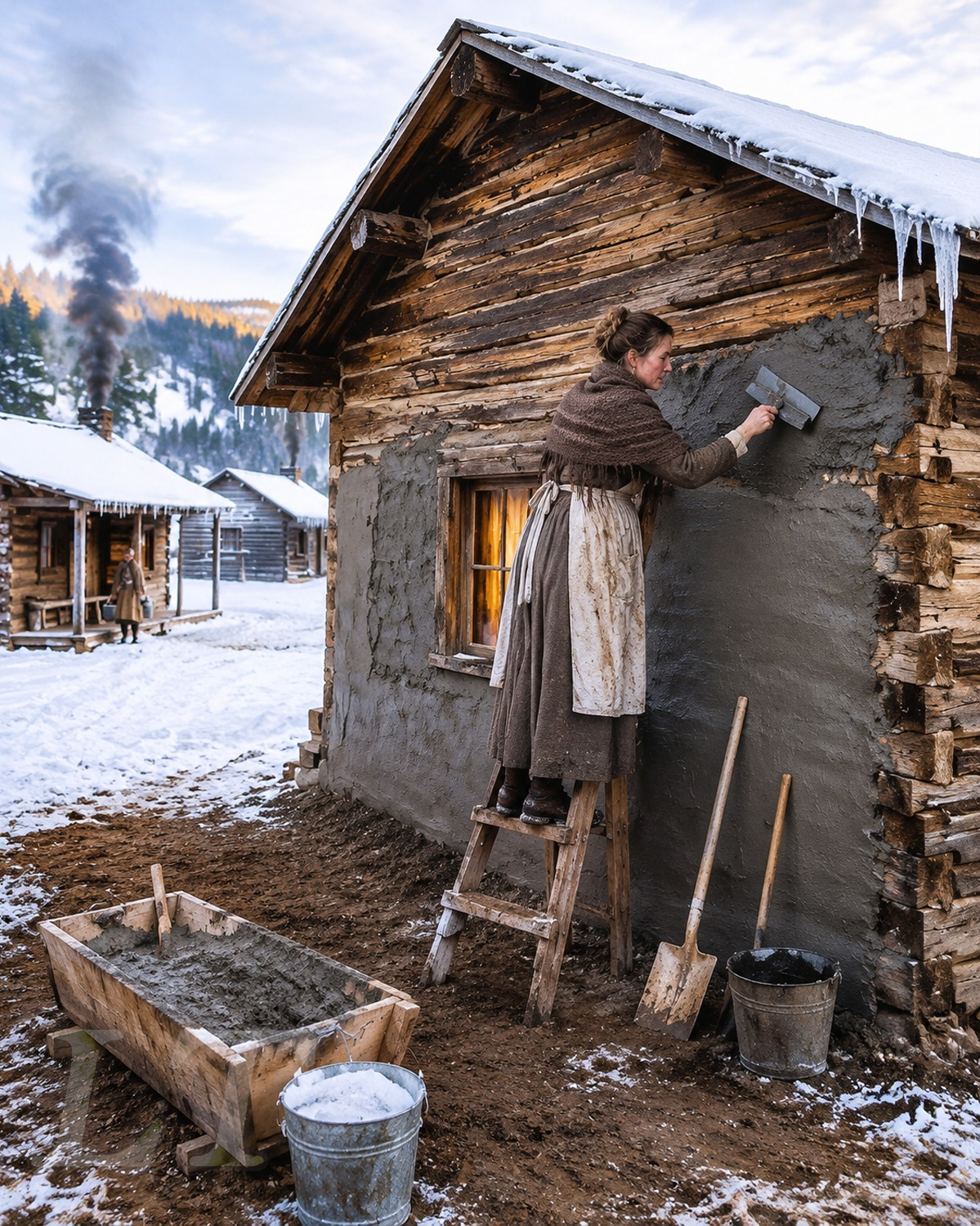
For a long time, he stared at the gray wall.
Then he asked:
"How did you know the cabin was losing so much heat?"
I explained again about the candle flame.
The tiny drafts.
The cold corners.
The way the warmth disappeared when the fire died down.
He listened without interrupting.
Finally, he said:
"I've spent forty years building houses."
I waited.
"And I have never paid enough attention to the air inside them."
I did not know what to say.
He looked at me.
"I was wrong to laugh at you."
Carl shifted beside the fireplace.
Euan continued.
"But I still worry about the timber."
"You should," I answered. "We need to make sure it can dry properly."
He nodded.
That answer seemed to satisfy him.
After he left, I carried the puppy closer to the hearth.
Leisel came running from the bedroom.
"Can we keep him?"
I smiled.
"We'll see whether he wants to stay."
Jacob knelt beside the blanket.
"He's cold."
"He's warming up now."
The children watched him until his breathing became calmer.
I looked at the gray walls.
Outside, the snow continued falling.
Inside, the fire was burning steadily.
The following days were difficult.
The first hard frost arrived.
Water froze in the buckets overnight.
The ground became so hard that the wooden fence posts seemed locked into the earth.
Carl had to break the ice around the well each morning.
I spent more time checking the cabin.
I watched for condensation.
I examined the plaster.
I inspected the window frames.
The work had to be maintained.
The gray surface was not a magical solution.
It was simply one part of a house that needed to function properly.
The fireplace still mattered.
The roof still mattered.
The doors and windows still mattered.
But the cabin felt different.
The air was quieter.
The candle flame remained steady.
And the corners that had once felt painfully cold no longer seemed as uncomfortable.
One evening, Carl brought a thermometer inside.
It was an old instrument he had purchased from a traveling merchant.
He placed it near the center of the room.
Then he placed another near the eastern wall.
We waited.
The readings were not identical, but the difference was smaller than we had expected.
Carl looked at me.
"That is encouraging."
I nodded.
"Very."
We repeated the observation over several evenings.
The results were not always the same.
The weather changed.
The amount of firewood changed.
The wind changed.
But the cabin remained comfortable enough for the children to sleep without wearing their outdoor coats.
That was what mattered to me.
Then December arrived.
The first snowstorm became a series of storms.
Roads disappeared.
The mountain passes closed.
The settlement became isolated.
Carl began storing additional firewood beneath a covered section near the entrance.
I checked our food supplies.
We had enough flour, dried beans, smoked meat, and potatoes to last several weeks.
Leisel helped me organize the pantry.
Jacob insisted on carrying small pieces of wood to the fireplace.
The puppy, whom the children named Ash, followed him everywhere.
For a while, life seemed almost peaceful.
But the temperature continued falling.
The first warning came from the forest.
A tree split with such force that the sound echoed across the valley.
Then another broke.
And another.
Euan later told us that several large pine trees had cracked overnight.
Silas Croft began burning more wood.
So did the families near the creek.
Smoke rose from every chimney.
Some households burned twice as much fuel as they had expected.
One evening, Thomas arrived with a worried expression.
He removed his gloves and sat near the fire.
"How are the children?"
"Fine."
He looked toward the walls.
"How warm is it?"
"Comfortable."
He nodded.
"People are talking again."
I sighed.
"What now?"
"Some say your cabin is staying warmer than theirs."
Carl looked up.
"Who says that?"
"Silas, mostly. But he's not laughing anymore."
I looked at Thomas.
"Is something wrong with his house?"
He nodded.
"His fireplace is burning constantly. He says the walls feel like ice."
I felt sorry for him.
Despite everything, I had never wanted our neighbors to suffer.
"Perhaps he should inspect the gaps."
"He has."
Thomas leaned forward.
"He's been stuffing old cloth into the worst places."
Carl looked at me.
Neither of us said anything.
Thomas stayed for supper.
Before leaving, he told us that the coming forecast was frightening.
A large mass of bitterly cold air was moving toward Montana.
The weather observer at the trading post had warned that temperatures could fall far below zero.
Then Thomas gave us a detail that made my stomach tighten.
The storm was expected to arrive just before Christmas.
After he left, Carl stood beside the window.
The sky was clear.
Stars shone above the mountains.
But the air was unusually still.
He turned toward me.
"Do you think the walls will hold?"
I looked at the plaster.
Then at the fireplace.
"I think we've done everything we can."
He nodded.
We went to bed early.
At midnight, I woke because the cabin seemed unusually quiet.
There was no wind.
No movement outside.
Even the fire had settled into a low orange glow.
I pulled on my shawl and stepped into the main room.
The thermometer stood near the wall.
Carl had left it there.
I looked at the reading.
Then I checked the candle.
Its flame was steady.
I returned to bed.
But I could not sleep.
Something about the silence felt wrong.
Just before dawn, a distant sound rolled across the mountains.
It was not thunder.
It was the sound of the forest breaking under the cold.
A moment later, Carl woke.
He looked at me.
Neither of us spoke.
Then the first blast of wind struck the cabin.
And the temperature began falling.
By noon, the trading post sent another rider through the settlement.
He carried a warning that changed everything.
The storm was no longer expected to last one or two days.
It could last an entire week.
And the temperature was predicted to fall toward thirty degrees below zero.






Comments 0