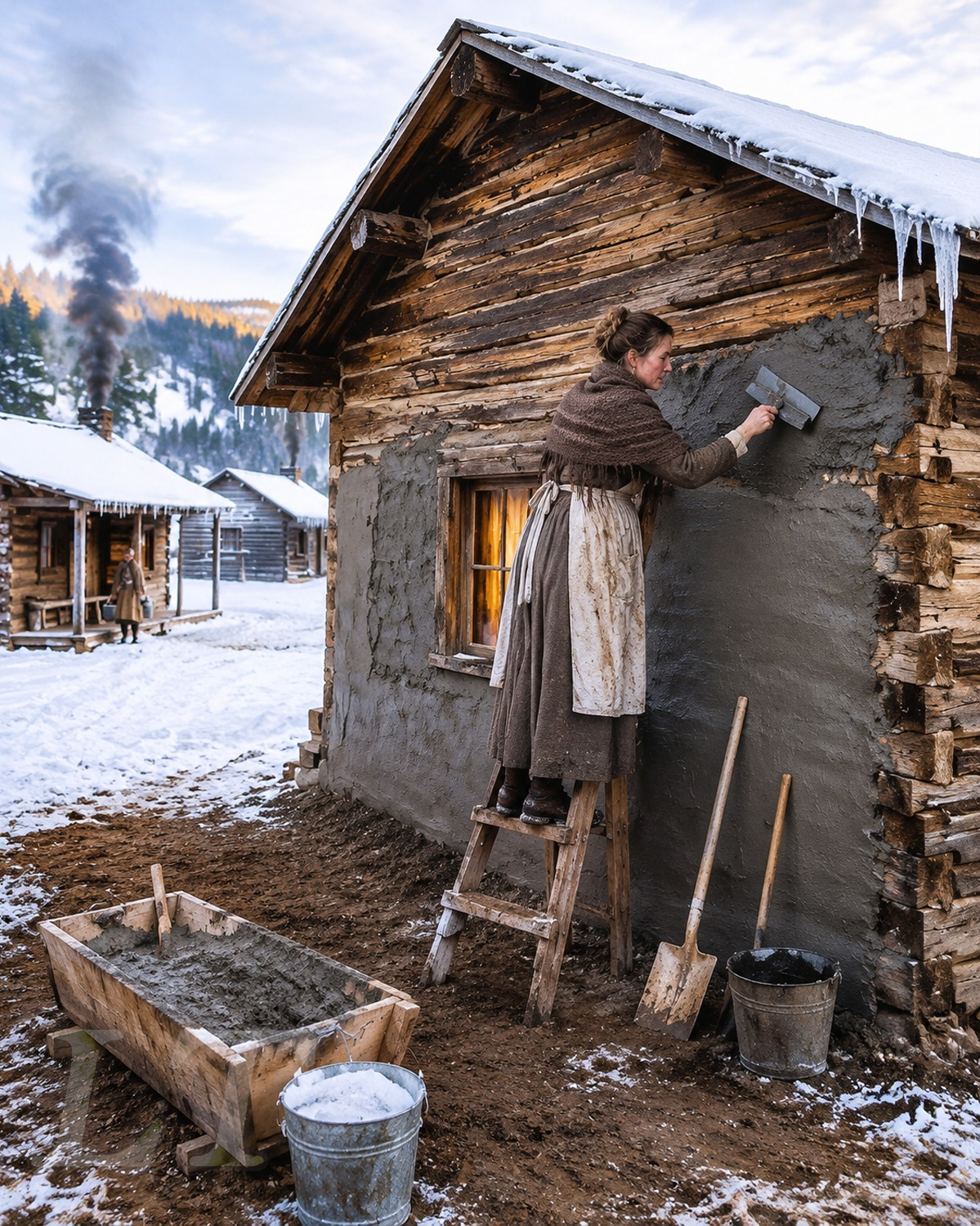
The first night of the great cold arrived without warning.
The wind began shortly after sunset.
It swept down from the mountains, crossed the frozen creek, and struck the cabins with such force that several families woke believing their roofs were coming apart.
Inside our home, Carl placed another log into the fireplace.
The flames rose.
Jacob sat beside Leisel, wrapped in a wool blanket.
Ash, the little black puppy, slept near their feet.
I checked the windows.
The wooden frames were holding.
The doors were shut.
And the walls remained quiet.
Carl looked at me.
"How do you feel?"
"Cold."
He laughed.
"At least you're honest."
I touched the plaster.
The surface was cool, but there was no obvious stream of air moving across it.
Outside, the wind screamed.
Inside, we could still speak without raising our voices.
That night, I woke several times.
Each time, I checked the fireplace and examined the room.
The fire was burning.
The children were sleeping.
The candle remained steady.
At dawn, Carl opened the door.
Snow had piled against the entrance.
He pushed his way through it and stepped outside.
I followed him.
The settlement looked almost unrecognizable.
The smaller cabins were buried beneath snow.
The trees bent beneath the weight.
The mountain peaks had disappeared behind a thick curtain of white.
Carl walked toward the woodpile.
Then he stopped.
He looked toward the neighboring houses.
"Anelise."
I turned.
Smoke was rising from Silas Croft's chimney.
It was much thicker than usual.
A second column rose from Euan's cabin.
Then a third.
Almost every household seemed to be burning an enormous fire.
Carl returned inside.
"They're using a lot of wood."
I looked through the window.
"How much do we have left?"
"Enough, if we're careful."
We were not wealthy settlers.
Our supplies had to last.
But I knew that wasting fuel was not an option.
That morning, I prepared a simple breakfast.
Oatmeal.
Dried apples.
A little honey.
The children ate at the table while Carl repaired a broken shovel handle.
Jacob looked toward the window.
"Is everybody else cold?"
I considered the question.
"Some people are having a difficult time."
"Can we help them?"
I looked at Carl.
He put down the handle.
"We'll help if we can."
The next two days were brutal.
The temperature continued falling.
The snow stopped briefly, but the wind remained fierce.
Carl measured the temperature each morning.
The numbers were lower than anything we had experienced since arriving in Montana.
On the third night, he placed the thermometer near the eastern wall.
Then he placed another near the fireplace.
We waited.
The difference was smaller than expected.
Carl looked at me.
"Your wall is doing something."
I did not answer immediately.
I wanted to believe him.
But I remembered my father's warning.
Never mistake one good result for a guarantee.
We needed more time.
That afternoon, Euan arrived.
He had walked through the snow from his cabin.
His beard was covered in frost.
His eyes looked tired.
He stepped inside and immediately stopped.
The children were reading.
The fireplace was burning moderately.
I was preparing bread.
Carl was repairing a strap.
Nobody was shivering.
Euan looked at the thermometer.
Then at the walls.
"How much wood have you burned today?"
Carl answered.
"Two modest loads since morning."
Euan looked confused.
"Only two?"
Carl nodded.
Euan removed his gloves.
He approached the wall and placed his hand against it.
Then he looked toward the fireplace.
"Mine is burning almost constantly."
I offered him tea.
He accepted.
For several minutes, he sat silently.
Then he said something that surprised both of us.
"I think I made a mistake."
Carl looked at him.
"About what?"
"About you two."
Euan stared into his cup.
"I spent years believing that a good cabin was simply a matter of strong timber and proper chinking."
He looked toward the gray surface.
"Perhaps I never thought enough about how the whole room worked."
I sat opposite him.
"You were right to worry about moisture."
He nodded.
"That concern hasn't disappeared."
"Neither has mine."
For a moment, we shared a small smile.
Euan stayed until late afternoon.
Before leaving, he asked whether he could return with a thermometer the following morning.
Carl agreed.
The next day, Euan came back.
He brought a second instrument.
We placed both thermometers in different parts of the room.
We recorded the readings.
Then we repeated the process several hours later.
The results were encouraging.
But what interested Euan most was not the exact temperature.
It was how little the room changed when the wind strengthened.
He stood near the wall for a long time.
Finally, he looked at me.
"Your father understood something I overlooked."
I smiled.
"He spent his entire life studying heat."
Euan nodded.
"Perhaps I should have spent more time studying it too."
That evening, the wind became stronger.
A neighboring chimney stopped producing smoke.
Carl noticed immediately.
"That's Silas's cabin."
I looked outside.
The chimney was dark.
Perhaps the fire had gone out.
Perhaps the family had run out of wood.
I could not know.
But I felt uneasy.
Carl put on his coat.
"I'm going to check."
I grabbed his sleeve.
"Wait until the wind weakens."
He looked at me.
"His children are out there."
I knew he was right.
He took a lantern and stepped into the snow.
I watched through the window until he disappeared.
He returned nearly an hour later.
His coat was covered in ice.
"What happened?"
"Silas's chimney is blocked with snow. He's trying to clear it."
"Is everyone safe?"
Carl nodded.
"For now."
He sat beside the fireplace.
Then he told me something that made me think about the days when Silas had laughed at our home.
Silas had been burning wood almost continuously.
But the heat was disappearing through gaps around his windows and between several logs.
His family had moved their beds closer to the fireplace.
Their youngest child was coughing.
Carl had helped him clear the chimney and repair one of the worst openings.
Silas had thanked him.
But he had not mentioned the Ash Palace.
I looked toward the gray walls.
We were no longer thinking about proving anything.
We were thinking about surviving.
And survival was becoming a matter of days rather than months.






Comments 0