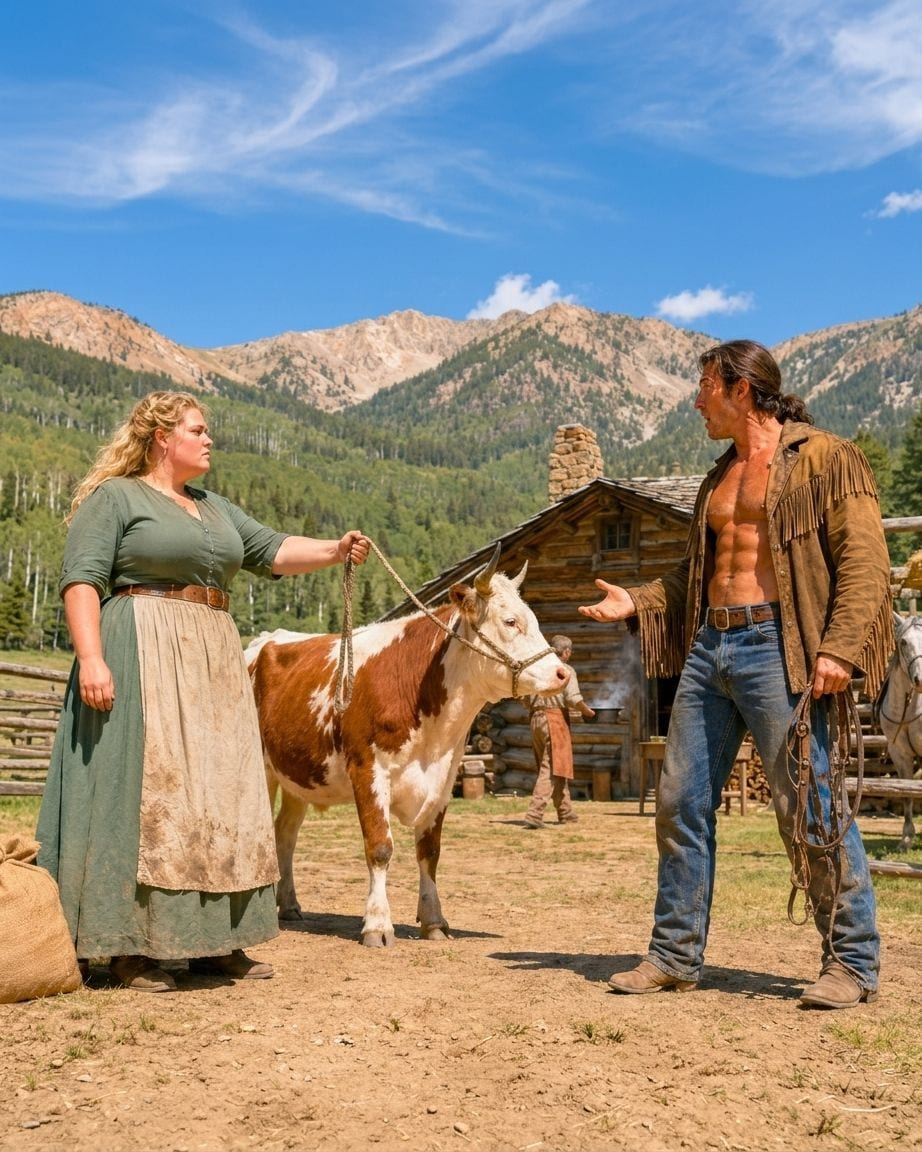
"That cow is stolen!" Martha Ogden shouted, gripping the creamery gate.
Milton Sloan stepped forward with the official bill of sale.
Beside the eleventh animal, someone had written three words in black ink: "No identifying marks."
Martha looked at the cow's split horn.
The document was a lie.
The creamery yard went quiet.
Not entirely quiet. There were still eleven cows shifting their weight against the fence, the rattle of a loose chain on the loading platform, and the distant mechanical thump of the butter churn inside the building. But the six men standing around the gate had stopped talking.
That was unusual.
Men in Twin Buttes rarely stopped talking when Martha Ogden opened her mouth. Usually, they talked louder.
Milton Sloan folded his hands over his gold watch chain.
"Miss Ogden," he said pleasantly, "you are making a very serious accusation."
Martha did not release the gate.
"I'm telling you the animal doesn't match the paper."
"Are you a lawyer?"
"No."
"A veterinarian?"
"No."
"Then perhaps you ought to confine yourself to making cheese."
A few of the men chuckled.
Martha felt the familiar heat crawling up her neck. She knew what came next. It had been coming all her life, ever since she was a schoolgirl who needed two desks pushed together and a teacher who called her a burden whenever she entered the classroom.
She had learned to recognize the precise moment when a conversation stopped being about what she knew and became about how she looked.
But this time, a living creature stood on the other side of the fence.
And the creature had a name.
"Duchess," Martha said.
The old red-and-white cow lifted her head.
Her crumpled left ear twitched.
Then she leaned against the fence with the same stubborn confidence she had shown every winter Martha had known her.
Martha swallowed.
"She's fifteen years old. Her right horn is split. Her left ear was damaged when she was a calf. Her left hindquarter has been blind for years. And she's been milked at the Latham place since before half the men standing here could grow whiskers."
Sloan's smile remained perfectly arranged.
"The bill of sale describes an eight-year-old red cow, sound in all quarters."
"Then the bill is wrong."
"Or your memory is."
Martha stared at him.
He had written the document himself.
Everybody knew Milton Sloan. He handled mortgages, foreclosures, land transfers, livestock notes, and more legal papers than any other man in three counties.
He wore imported waistcoats and carried a gold watch that cost more than Martha earned in a year.
When people spoke of him, they lowered their voices.
Not because they respected him.
Because nearly everybody owed him something.
Martha had never owed him a penny.
Until that morning, she had considered that a kind of freedom.
The creamery manager, Mr. Bell, stepped between them.
"Enough, Martha."
"But—"
"I said enough."
He glanced toward Sloan, then back at her.
"You have work to do."
Martha looked down the line of cattle.
Eleven animals had arrived behind a rider wearing a black oilcloth coat. The rider had presented the sale as a lawful foreclosure. The cooperative had purchased the cattle against an outstanding debt, and the animals were to be milked until buyers could be found.
Martha had examined every one.
Nine were strangers.
The tenth she remembered from a neighboring dairy.
The eleventh was Duchess.
And Duchess belonged to Jesse Latham.
Martha knew that because she had made butter and cheese from the animal's milk for years.
She knew the old cow's habits, her stubbornness, the peculiar way she refused to stand still until someone scratched behind her damaged ear.
She also remembered Jesse's mother.
Mrs. Latham had been a quiet woman with capable hands and a laugh that could fill a room.
Years ago, before she died, she had brought cream down from upper Elkhorn and taught Martha how to judge butterfat by its behavior in a shallow pan.
Martha had never forgotten her.
She had never imagined that the woman's favorite cow would end up behind a foreclosure gate.
"Go inside," Bell ordered.
Martha stepped away.
But she did not go far.
She stood beside the loading platform until Sloan had finished speaking to the men.
He moved among them with the comfortable authority of someone who expected every door to open before he reached it.
He never raised his voice.
He never needed to.
When he finally walked toward the office, Martha followed.
"Mr. Sloan."
He stopped.
"What now?"
"Who signed the original livestock description?"
"I did."
"And who verified the animal?"
"I did."
"Then you must have seen the split horn."
Something changed in his expression.
It lasted less than a second.
But Martha saw it.
His smile became narrower.
"You should be careful, Miss Ogden."
"About what?"
"About confusing stubbornness with intelligence."
He opened the office door.
"People who cannot afford mistakes should be especially cautious about making them."
The door closed between them.
Martha remained standing on the wooden steps.
She had eleven dollars coming in wages.
She rented a room behind the general store.
Her mother had left her three cheese knives, a recipe book, and a trade that had kept her alive for twenty-three years.
She had no husband, no children, no land, and no family willing to take her in.
The creamery was not merely her employment.
It was the only place in Twin Buttes where people needed what she knew.
And Milton Sloan had just reminded her how easily that could disappear.
By noon, the entire town knew she had challenged him.
By one o'clock, Flora Denby had added her own version.
Flora stood outside the general store in a plum-colored dress and informed three women that Martha had accused a respected businessman of stealing cattle because she wanted attention.
"Poor thing," Flora said, loudly enough for Martha to hear as she passed. "When a woman can't attract a husband, I suppose she has to find some other way to make herself noticed."
The women laughed.
Martha kept walking.
She had learned that turning around only gave people a better view of her hurt.
Inside the cheese room, she washed her hands and began cutting curd.
The blade moved through the pale white mass in clean, even strokes.
She had done this work since she was fifteen.
Her mother had died in November, when the first hard freeze sealed the creek banks. By December, Martha had been standing over a copper kettle because there was no one else to earn the rent.
She had learned to work through grief.
Then hunger.
Then humiliation.
She could work through almost anything.
But every time she closed her eyes that afternoon, she saw Duchess standing behind the fence.
At four o'clock, a horse approached the yard.
Martha heard the hooves before she saw the rider.
He was enormous.
Broad shoulders. Weathered face. Dark hair tied back. A brown fringed buckskin jacket hanging open over his sunburned chest.
He rode a gray horse and stopped at the gate.
"Jesse Latham," one of the workers muttered.
Martha put down her knife.
She watched through the window.
Jesse dismounted.
He spoke to Bell.
Martha could not hear the first words, but she saw Bell shake his head.
Jesse pointed toward the cattle.
Bell blocked the gate.
Then Jesse said something that carried clearly through the open window.
"She's fifteen. She was my mother's."
Bell crossed his arms.
"The sale is lawful."
"Her name is Duchess."
"Doesn't matter."
"She won't take to strange hands."
Bell said nothing.
Jesse looked past him.
For a moment, his eyes rested on the red-and-white cow.
Duchess lifted her head.
She gave a low, familiar call.
Martha felt something twist inside her chest.
Jesse did not shout.
He did not threaten.
He simply looked at the animal for a long moment, touched the brim of his hat, and returned to his horse.
The quietness of his departure was worse than anger.
On the store porch, Flora Denby laughed.
"Maybe that big woman could carry the cow home on her back!"
Several men joined her.
Jesse heard them.
Martha knew he heard them because his shoulders stiffened.
But he did not turn around.
He mounted and rode away.
Martha watched until the gray horse disappeared beyond the last buildings.
Then she closed the cheese room door.
She stood in the darkness with her hands trembling.
For years, she had told herself that cruelty was easier to survive when it was directed at her.
She could endure being called fat.
She could endure the jokes about her unmarried state.
She could endure being treated as though her body made her foolish.
But she could not endure watching a man lose the last living thing his mother had loved while everyone around her pretended the paperwork made it right.
That evening, Bell called her into the office.
Sloan was waiting.
The creamery board had gathered around the long table.
Martha remained standing.
Sloan gestured toward a chair.
"Please, Miss Ogden."
She did not sit.
He sighed.
"We have discussed your allegations."
"They aren't allegations. They're facts."
"Your interpretation of the facts."
He looked around the table.
"Gentlemen, we cannot operate a respectable cooperative if every employee is permitted to overturn lawful transactions based on personal sentiment."
Martha stepped forward.
"Look at the cow."
No one moved.
"Just look at her. Compare her to the description."
Sloan smiled.
"Miss Ogden, can you read?"
Martha stared at him.
The question struck harder than she expected.
He knew she could read.
She had read his document aloud that morning.
"Yes."
"Then surely you understand that an executed bill of sale carries more legal weight than your recollection."
"Not when the bill describes a different animal."
Sloan's smile disappeared.
For the first time, his voice became cold.
"You are calling a notary public a thief."
Martha looked at the men seated around the table.
Some avoided her eyes.
Others watched with the eager discomfort of people witnessing someone else destroy her own livelihood.
She could still retreat.
She could apologize.
She could tell Sloan she had misunderstood.
She could return to the cheese room tomorrow morning and pretend Duchess was simply another cow.
Instead, Martha said, "I'm calling the paper false."
Sloan turned toward the board.
"I believe that settles the matter."
The vote took ninety seconds.
The sale stood.
Martha Ogden was dismissed for insubordination.
Bell counted eleven silver dollars into her palm.
No written receipt.
No final wage statement.
Just silver.
Martha looked down at the coins.
Twenty-three years of work had ended in less time than it took to heat a kettle.
She placed the money inside her apron pocket.
Then she asked for her knives.
Bell nodded toward the cheese room.
"Collect your things before morning."
Martha left without another word.
She packed her three knives, her mother's recipe book, a spare dress, a comb, and a piece of bread into a grain sack.
She sat on the edge of her narrow bed until midnight.
At one o'clock, she stood.
At two, she lit a lantern.
At three, she walked toward the creamery.
The streets were empty.
A cold wind moved dust along the storefronts.
Martha entered the yard through the side gate.
Duchess stood beneath the lean-to, chewing slowly.
The old cow recognized her immediately.
Martha pressed her forehead against the animal's warm neck.
"I know," she whispered.
She stayed there until her breathing steadied.
Then she found the halter rope.
She fastened it carefully.
She lifted her grain sack.
And she walked toward the gate.
At the far end of the yard, a light appeared in the creamery office.
Martha froze.
Through the window, she saw Milton Sloan seated at the desk.
He had a large black ledger open before him.
He wrote something.
Then he stopped.
He looked directly toward the yard.
Martha pulled Duchess into the shadow of the loading platform.
Sloan closed the ledger.
He stood.
And then the office door began to open.






Comments 0