The office door swung outward.
Martha Ogden held her breath.
Behind her, Duchess shifted one heavy hoof against the frozen ground. The sound seemed enormous in the sleeping creamery yard.
Milton Sloan stepped onto the porch with a lantern in one hand and his black ledger tucked beneath the other arm.
Martha pressed herself against the loading platform. Her heart hammered so hard she could feel it in her throat.
If Sloan caught her with the cow, he would have her arrested.
If she left Duchess behind, the old animal would disappear into another man's herd, and Jesse Latham would never see her again.
Sloan lifted the lantern.
Its yellow light moved across the empty wagons, the stacked milk cans, and the muddy ground beside the gate.
Martha tightened her grip on the rope.
Duchess leaned against her.
"Easy, girl," Martha breathed.
Sloan stopped.
For one terrible moment, Martha thought he had heard her.
Then a voice came from the street.
"Mr. Sloan?"
It was the night watchman, Henry Pike.
Sloan turned sharply.
"What is it?"
"Telegraph office sent word. Something about the Denver bank."
Martha watched Sloan's expression change.
"At this hour?"
"Operator said it couldn't wait."
Sloan looked once more toward the cattle pens.
Then he closed the office door and walked toward the street.
Martha waited until their footsteps faded.
Only then did she move.
She led Duchess through the side gate, carefully lowering the iron latch so it would not strike the post.
The cow followed without resistance.
At the corner, Martha looked back.
The creamery windows were dark.
For twenty-three years, she had entered that building before sunrise and left after sunset. She had given it her strongest years, her mother's knowledge, and every ounce of patience she possessed.
Now she was walking away with eleven silver dollars, three cheese knives, a grain sack, and a cow that did not belong to her.
She had never felt so frightened.
She had never been so certain.
By the time the first pale light appeared over Twin Buttes, Martha had reached the northern road.
Her boots were already rubbing her heels.
She ignored them.
Duchess walked slowly, her old joints stiff in the morning cold.
Martha had known from the beginning that twenty-two miles would be difficult.
She had not understood how difficult until the town disappeared behind the hills.
The road climbed through dry pastureland and scattered pine trees. Deep wagon ruts held pockets of icy water. Loose stones rolled beneath her boots.
At the first steep rise, Martha stopped to catch her breath.
Duchess stopped beside her.
The cow turned her white face toward Martha and blinked.
"Don't look at me like that," Martha said.
Duchess chewed.
"I know I'm slow."
The cow gave a low, rumbling sound.
Martha almost smiled.
"Well, you're no spring chicken yourself."
She scratched behind the damaged ear.
Then they continued.
By eight o'clock, the sun had risen above the eastern ridge.
Martha's back hurt.
Her feet burned.
The grain sack seemed heavier with every mile.
She had packed only what she could carry, yet every possession felt like a reminder of how little remained of her life.
Her mother's recipe book rested at the bottom of the sack.
The cover was cracked brown leather, softened by decades of handling.
Inside were measurements written in her mother's careful handwriting, along with small observations about temperature, weather, and the temperament of milk.
Martha had read those pages so often she knew them by heart.
She had once imagined passing the book to a daughter.
That had been when she was young enough to believe a man might someday look at her and see something besides her size.
At seventeen, a farmhand named Daniel Mercer had asked her to the harvest dance.
She had spent two weeks sewing a blue ribbon onto her best dress.
When she arrived, Daniel's friends had laughed.
He had admitted it was a wager.
Martha had walked home alone.
She had never attended another dance.
At twenty-four, a widower with three children had begun visiting the creamery.
He praised her cooking, asked about her work, and once brought her a small bunch of wildflowers.
Then he explained that he needed someone strong enough to manage his household without wages.
He had not been proposing marriage.
He had been offering employment disguised as affection.
By thirty, Martha had stopped expecting invitations.
By thirty-eight, she had stopped imagining them.
She knew how to turn milk into something valuable.
She knew how to keep a sick calf alive through winter.
She knew how to recognize spoiled cream before anyone else smelled it.
But she had never learned how to make people believe she deserved tenderness.
The road turned west.
Martha adjusted the sack on her shoulder.
"Come along, Duchess."
The cow followed.
Near noon, they reached a shallow creek.
Martha knelt on the bank and drank from her cupped hands.
Then she let Duchess drink.
The cow lowered her head eagerly.
Martha watched the water ripple around the animal's muzzle.
Her thoughts returned to Jesse Latham.
She had seen him only a handful of times before the afternoon at the creamery.
He rarely came into Twin Buttes.
When he did, he purchased flour, salt, nails, and whatever supplies he could not produce on his own ranch.
People said he lived alone twenty-two miles up Elkhorn Creek.
People also said he had once been engaged.
Some claimed his intended bride had died.
Others insisted she had run away with a traveling salesman.
Martha had never asked.
She knew how quickly a person's private grief became public entertainment in a town like Twin Buttes.
What she remembered most clearly was the way Jesse had looked at her outside the creamery.
He had not laughed.
He had not glanced down at her body.
He had looked at her face as though she were simply another human being.
It was such a small thing.
She hated how much she remembered it.
At the creek, Duchess shifted her weight and nudged Martha's shoulder.
Martha caught herself before falling into the water.
"Good heavens!"
The cow blinked innocently.
Martha laughed.
The sound surprised her.
She could not remember the last time she had laughed while completely alone.
By afternoon, the road had become rougher.
The mountains rose higher ahead.
Patches of snow lingered beneath the trees.
Martha's boots began to fill with blood.
She stopped beside a fallen log and removed one.
The heel of her stocking was dark red.
She stared at it.
Then she looked toward the distant mountains.
There was no turning back.
She tore a strip from the lining of her spare dress and wrapped it around her heel.
She did the same with the other foot.
When she stood, pain shot through both legs.
For a moment, she feared she would fall.
Instead, she leaned against Duchess.
The cow stood patiently.
Martha pressed her forehead into the animal's warm side.
"Just a little farther."
She did not know whether she was speaking to the cow or herself.
They traveled another two miles before the light began to fade.
Martha found an abandoned hay shed near the road.
Its roof sagged, and one wall had collapsed, but enough remained to shelter them from the wind.
She led Duchess inside.
The old cow immediately began investigating the scattered hay.
Martha lowered herself onto a dry patch of ground.
Every muscle in her body protested.
She removed her boots and examined her feet.
Both heels were blistered.
Her toes were swollen.
Her knees ached.
She had brought bread, but her stomach felt too tight to accept it.
She ate anyway.
Then she reached into her sack and took out her mother's recipe book.
For several minutes, she simply held it.
A folded scrap of paper slipped from between the pages.
Martha recognized it immediately.
It was a note her mother had written shortly before dying.
The handwriting was weak.
Never let anyone convince you that the work of your hands is worth less because they do not admire the woman attached to them.
Martha read the words twice.
Then she closed the book.
Outside, the wind moved through the pines.
Duchess settled onto the ground with a long, satisfied sigh.
Martha wrapped the halter rope around her wrist.
She lay beside the cow.
And for the first time since leaving Twin Buttes, she cried.
Not loudly.
There was no one to hear her.
She cried for the job she had lost.
For the room she would never return to.
For the mother who had taught her everything except how to survive being unwanted.
And for the terrible possibility that Jesse Latham might take his cow, thank her politely, and close his gate.
When she finally slept, the rope remained wrapped around her wrist.
She woke before dawn.
Duchess was standing over her.
Martha opened one eye.
"You're a demanding old woman."
The cow snorted.
Martha sat up slowly.
Her body felt as though someone had beaten her with a fence rail.
She managed to stand.
Then she milked Duchess into a shallow hollow she had cleared beside the shed, letting the milk soak into the earth.
It hurt to waste it.
Milk was food.
Milk was money.
Milk was the substance from which Martha had built her entire life.
But she had no pail, no kettle, and no way to carry it.
She rubbed the cow's neck.
"I'm sorry, Duchess."
The animal seemed unconcerned.
They started walking.
The second day was worse.
The road climbed steadily toward the mountains.
Martha's breathing grew heavy.
Her feet throbbed.
Twice she had to stop because her vision blurred.
Once, a wagon approached from behind.
The driver was a narrow-faced man hauling fence posts.
He slowed when he saw her.
"Where you headed, ma'am?"
"Upper Elkhorn."
He looked at the cow.
"That's a long walk."
"I know."
He studied her swollen face and dusty clothing.
"You need a ride?"
Martha glanced at the wagon.
There was no room for Duchess.
"No, thank you."
The man shrugged.
"Suit yourself."
He drove on.
Martha watched the wagon disappear.
For a moment, she regretted refusing.
Then Duchess nudged her hand.
They continued together.
By late afternoon, the valley opened.
The road descended into a broad stretch of grassland bordered by aspen and pine.
Elkhorn Creek ran through the center, dark and cold beneath the spring sunlight.
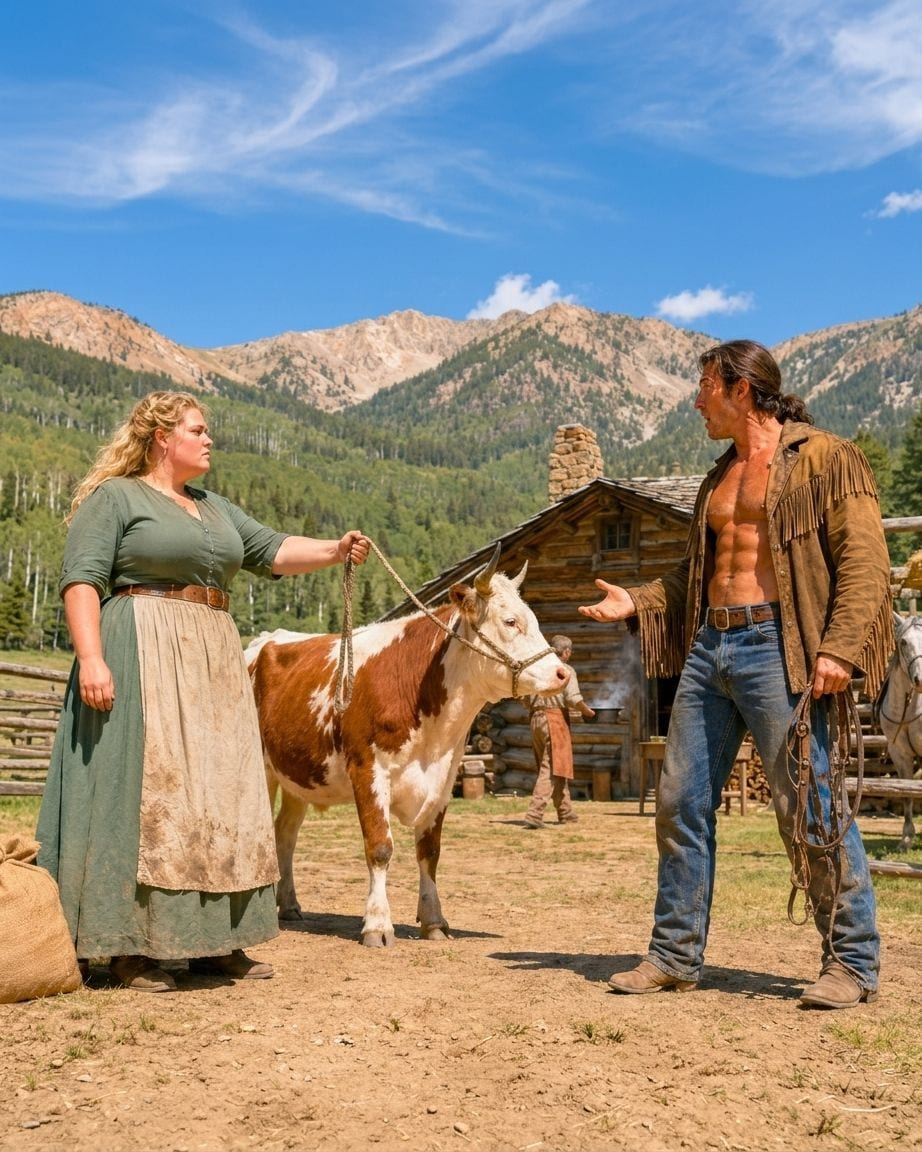
Beyond it stood a low log house with a stone chimney.
A barn occupied the eastern side of the property.
Split-rail fences enclosed several pastures.
Farther back, a small stone building stood beside a spring-fed channel.
Martha stopped.
She knew the place from Mrs. Latham's descriptions.
The woman had spoken of the mountains, the cold water, and the milk house she had built with her own hands.
Martha had imagined it many times.
Now it stood before her.
Jesse Latham's ranch.
Twenty-two miles from Twin Buttes.
Twenty-two miles from everything she had ever known.
Martha's mouth went dry.
She adjusted her apron.
She tried to smooth her hair.
The effort was hopeless.
Dust covered her dress.
Her face was sunburned.
Her boots were ruined.
She looked like a woman who had walked twenty-two miles behind an elderly cow.
Which, she supposed, was exactly what she was.
"Well," she whispered, "we've come this far."
Duchess gave a low moo.
Martha opened the outer gate.
They entered the yard.
A gray horse lifted its head from a nearby enclosure.
Chickens scattered from the path.
Somewhere inside the barn, a metal tool struck wood.
Martha stopped.
A man appeared in the barn doorway.
Jesse Latham.
He carried a bridle in one hand.
His dark hair was tied loosely behind his head.
His brown fringed jacket hung open over his broad chest.
He took two steps into the sunlight.
Then he saw Duchess.
He stopped dead.
The bridle slipped slightly in his hand.
For several seconds, he did not move.
Martha felt every mile of the journey pressing against her bones.
She had practiced what she would say.
She had repeated the words while climbing hills, crossing creeks, and lying awake in the hay shed.
Now she could barely remember them.
Jesse looked at the cow.
Then at Martha.
Then at the rope worn into her palm.
Martha forced herself to speak.
"I came to return your cow."
The words sounded small in the enormous valley.
Jesse stared at her.
Duchess recognized him.
She gave a long, deep call and pulled gently toward the pasture.
Jesse's face changed.
He stepped forward.
"Duchess?"
The old cow moved toward him.
Martha released a little rope.
Jesse reached out and touched the animal's forehead.
His hand remained there.
Martha watched his throat move.
For a moment, he looked like a boy who had found something he thought was gone forever.
Then he turned toward her.
"Where did you get her?"
"The creamery."
His eyes narrowed.
"They sold her."
"They had no right."
"How did you get her out?"
Martha hesitated.
"I opened the gate."
Jesse stared.
"You opened the gate?"
"Yes."
"And brought her here?"
"Yes."
"Alone?"
Martha nodded.
His gaze moved toward the road.
Then toward her boots.
Then toward the grain sack hanging from her shoulder.
"From Twin Buttes?"
"Yes."
He looked at her for a long time.
"That's twenty-two miles."
"I counted."
Something moved across his face.
Not amusement.
Not pity.
Something much harder for Martha to understand.
He looked at the rope burns on her palm.
Then he spoke quietly.
"What do you want for her?"
Martha blinked.
"Nothing."
"I can pay you."
"She's yours."
"You brought her all this way."
"She was never mine to sell."
Jesse reached toward his pocket.
Martha shook her head.
"Please don't."
He stopped.
She hated the tremor in her voice.
She hated that exhaustion had made her so close to tears.
But Jesse did not insist.
He simply took the halter rope from her hand.
His fingers brushed hers.
The contact was brief.
Gentle.
Martha looked down.
Jesse led Duchess toward the near pasture.
He opened the gate and let her inside.
The old cow moved immediately toward a patch of fresh grass.
Jesse stood watching her.
Then he closed the gate and returned.
Martha adjusted the grain sack on her shoulder.
"Well," she said, attempting a smile, "I suppose I'd better be going."
Jesse looked toward the road.
"Going where?"
"Back."
"To Twin Buttes?"
"Yes."
He glanced at her feet.
"Tonight?"
"I'll find somewhere to sleep."
"Where?"
Martha had no answer.
She looked away.
Jesse waited.
The silence stretched.
Finally, Martha said, "I'll manage."
He studied her face.
Then he reached for the grain sack.
Martha instinctively pulled it closer.
"It's all right. I can carry it."
"I know you can."
He took it gently from her hands.
"But you don't have to."
Martha stared at him.
No man had ever said those words to her.
Not in that tone.
Not without expecting something in return.
Jesse lifted the sack as though it weighed nothing.
Then he looked toward the house.
"Would you stay for supper?"
Martha froze.
She had prepared herself for suspicion.
For questions.
For the familiar downward glance.
She had not prepared herself for an invitation.
"Me?"
Jesse nodded.
"You."
Martha searched his expression.
There was no joke waiting behind his eyes.
No hidden audience.
No smirk.
Only a tired man standing in the sunlight with her belongings in his hand.
"I wouldn't want to impose," she whispered.
"You returned my mother's cow."
"That doesn't mean—"
"It means you ought to eat something before you fall over."
She looked down at her boots.
Jesse followed her gaze.
His expression tightened.
"Your feet are bleeding."
"It's nothing."
"Looks like something."
Martha tried to laugh.
The sound broke halfway out.
Jesse did not smile.
He simply turned toward the house.
"Come inside."
She hesitated.
He stopped at the porch.
For one terrible moment, Martha expected him to change his mind.
Instead, he looked back.
And said, "There's something you should know before you decide whether to stay."
Martha's stomach tightened.
Jesse set the grain sack on the porch.
His eyes moved toward the distant road.
Then he lowered his voice.
"Milton Sloan was here yesterday."
Martha went cold.
Jesse reached into his jacket.
He withdrew a folded paper bearing Sloan's unmistakable signature.
"I think you ought to see what he left."
He unfolded the paper.
Martha recognized the official seal.
Then she saw the name written beneath it.
Her own.






Comments 0