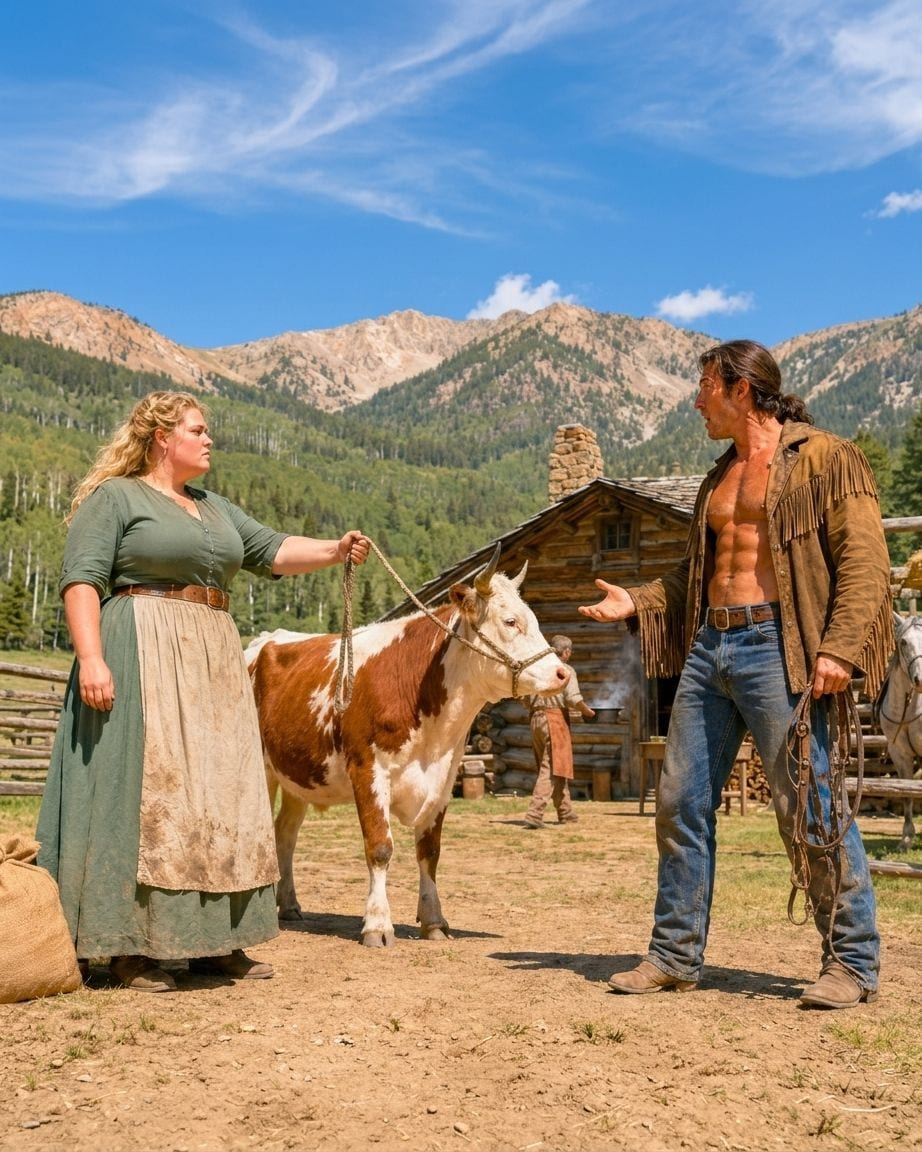
The rider pulled a revolver from beneath his black oilcloth coat.
Jesse Latham stepped into the doorway before Martha could move.
"Put that away."
The stranger stopped beside his horse.
He was a narrow-faced man with pale eyes, a crooked nose, and the stiff posture of someone who enjoyed making other people uncomfortable.
The revolver hung loosely in his right hand.
"Got business with the woman," he said.
"Then you can conduct it without waving a gun around."
The man looked Jesse up and down.
"You threatening an officer of the law?"
"Are you one?"
The question settled over the yard.
Martha stood just inside the milk house, her fingers gripping the edge of the stone doorway.
The stranger's eyes flicked toward her.
"Name's Curtis Vane. Special deputy working under authority of the Twin Buttes sheriff."
"Then show me your badge."
Vane hesitated.
Jesse noticed.
So did Martha.
Finally, Vane reached inside his coat with his left hand and produced a tarnished metal star.
Jesse did not move.
"Now put the gun away."
Vane's jaw tightened.
For a moment, Martha thought he might refuse.
Then he slid the revolver back into its holster.
"Got a warrant," he said. "Signed and witnessed."
He held up the folded document.
Jesse extended his hand.
Vane pulled it back.
"Not for you."
"You're standing on my property."
"And the woman standing behind you is wanted for stealing livestock."
Martha felt her stomach drop.
She had known this was possible.
She had imagined a sheriff arriving in Twin Buttes, asking questions, perhaps ordering her to return Duchess.
But she had not imagined a man coming all the way up Elkhorn Creek with a gun.
Or a warrant bearing her name.
She stepped forward.
"May I see it?"
Jesse turned.
"Martha—"
"It's all right."
Her voice sounded steadier than she felt.
She moved beside him.
Vane looked her over.
His gaze traveled from her face to her broad shoulders, then down to her waist.
A familiar expression appeared.
Martha knew it before he opened his mouth.
"Well," Vane said, "you're a bigger woman than Sloan described."
Jesse's face hardened.
"Watch yourself."
Vane smirked.
"Just making an observation."
"Make one about the warrant."
The smirk disappeared.
Vane handed Martha the paper.
She unfolded it carefully.
The document accused her of unlawfully removing livestock belonging to the Twin Buttes Cooperative Creamery.
The stated value of the animal was seventy-five dollars.
Martha stared at the number.
Seventy-five dollars.
More than six months of her wages.
The complaint was sworn before Milton Sloan.
But the arrest order itself was supposedly authorized by Sheriff Amos Bellamy.
Martha examined the signature.
Something troubled her.
She had seen Sheriff Bellamy's handwriting before.
He had once signed a certificate for a dairy inspection, and Martha had filed it in the creamery office.
His signature had been broad and uneven, with a peculiar downward stroke beneath the final letter.
This signature was neat.
Too neat.
She looked at Vane.
"When did the sheriff sign this?"
"Yesterday."
"Where?"
"Twin Buttes."
"Was he there?"
Vane frowned.
"What kind of question is that?"
"A simple one."
"Of course he was there."
Martha looked at Jesse.
"Sheriff Bellamy left for Denver three days ago."
Jesse's eyes narrowed.
"That's right."
Vane shifted his weight.
"He's back."
"Since when?" Jesse asked.
"Yesterday morning."
Jesse crossed his arms.
"Funny. I passed the stage driver coming up from Twin Buttes yesterday afternoon. He said Bellamy wouldn't be home until next week."
Vane's face reddened.
"Stage drivers don't know everything."
"No," Jesse said. "But they generally know who's riding their stage."
Martha looked again at the document.
Her pulse quickened.
She had challenged a false bill of sale.
Now someone had brought a questionable warrant.
Both documents had passed through Milton Sloan's hands.
And both depended on people accepting written words without examining the truth behind them.
Vane reached for the paper.
"Enough talking. You're coming with me."
Martha held it out of his reach.
"Not until I speak to the sheriff."
"You can speak to him in town."
"I won't go with you on a paper I have reason to believe is false."
Vane stepped forward.
Jesse moved between them.
"She's not going anywhere until I see a lawful order."
Vane's hand dropped toward his holster.
Jesse's voice became very quiet.
"Don't."
The stranger froze.
Jesse did not reach for a weapon.
He did not raise his fists.
He simply stood there, broad and immovable, with the calm certainty of a man who had spent his life handling dangerous animals and knew exactly when not to make a sudden movement.
Vane looked toward the barn.
Then toward the road.
Finally, he stepped back.
"You'll regret interfering, Latham."
"Maybe."
"Sloan owns the mortgage on this place."
"I know who holds my note."
"He can call it."
"He can try."
Vane gave a short, ugly laugh.
"You think this is about one old cow?"
Martha felt the words settle into her chest.
Jesse's expression did not change.
"What is it about?"
Vane smiled.
"You'll find out."
He snatched the warrant from Martha's hand.
Then he mounted his horse.
Before turning toward the road, he pointed at her.
"You're making a mistake, woman."
Martha looked straight at him.
"I've made plenty."
She paused.
"Returning that cow wasn't one of them."
Vane's face twisted.
He drove his heels into the horse and rode away.
Neither Martha nor Jesse spoke until the rider disappeared beyond the trees.
Then Martha sat down.
Not because she intended to.
Her knees simply stopped holding her.
Jesse caught her elbow before she struck the ground.
"Easy."
"I'm sorry."
"For what?"
"All of this."
He helped her onto a low wooden bench outside the milk house.
She pressed her hands together.
Her fingers were shaking.
"I should never have come."
Jesse crouched in front of her.
"Martha."
She kept looking at the ground.
"He knows about me. He knows about Duchess. And now he's threatening your ranch."
"Martha."
She finally looked up.
Jesse's expression was serious.
"You didn't create that mortgage."
"No."
"You didn't write that false bill of sale."
"No."
"And you didn't send a man up here waving a gun."
She shook her head.
"Then stop apologizing for what other people have done."
The words landed somewhere Martha had never allowed anyone to reach.
She looked away quickly.
Jesse stood.
"Come on."
"Where?"
"Inside. Your feet need tending."
"I can do it."
"I know."
He offered his hand.
"Let me help anyway."
Martha stared at it.
Then, slowly, she placed her hand in his.
His fingers closed around hers.
Warm.
Steady.
Without hesitation.
For a woman who had spent most of her life being avoided, that simple contact felt almost unbearable.
Jesse helped her stand.
They walked back toward the house.
At the porch, Martha glanced over her shoulder.
The road was empty.
But she could not shake the feeling that Curtis Vane had left something behind.
Not a physical object.
A warning.
And warnings from men like Milton Sloan were rarely empty.
Inside, Jesse filled a basin with warm water.
He brought clean cloth, soap, and a small tin of salve.
Martha sat on the bench beside the stove.
When she removed her boots, Jesse saw the damage.
His face tightened.
"Good Lord."
"It's not as bad as it looks."
"That's a terrible lie."
She almost smiled.
He knelt to examine the bandages she had wrapped around her heels.
Martha stiffened.
"Jesse, please. You don't have to—"
He looked up.
"Would you rather do it yourself?"
She hesitated.
The question surprised her.
He was not insisting.
He was asking.
"I can manage," she said quietly.
Jesse nodded.
He placed the basin within reach and moved to the other side of the room.
"I'll put coffee on."
Martha looked down at the water.
She had expected him to take offense.
Instead, he had respected her answer.
She washed her feet slowly.
The warm water stung.
The salve smelled of pine resin and herbs.
By the time she finished wrapping fresh cloth around her heels, Jesse had prepared coffee and cut two slices of his unfortunate bread.
He placed one beside her.
Martha picked it up.
The crust was hard enough to knock against the table.
She examined it solemnly.
Jesse watched her.
"Well?"
She took a bite.
Chewed.
Swallowed with difficulty.
Then said, "You could repair a wagon wheel with this."
Jesse stared.
For one second, Martha feared she had offended him.
Then he laughed.
A real laugh.
Deep and sudden.
It filled the little kitchen.
Martha began laughing too.
The sound escaped before she could stop it.
For a few moments, the warrant, the mortgage, and the man with the revolver seemed very far away.
Jesse shook his head.
"My mother used to say the same thing."
"About your bread?"
"About my cooking in general."
Martha smiled.
"She was a wise woman."
"She was."
His expression softened.
Then he looked toward the window.
The laughter faded.
Martha followed his gaze.
"You're worried."
Jesse did not deny it.
"Sloan's been trying to tighten his hold on this place for years."
"Why?"
"Because I owe him money."
"That's not the same thing."
He looked at her.
Martha continued.
"A mortgage gives a lender rights. It doesn't give him the right to invent debts or seize animals that aren't covered."
Jesse leaned against the counter.
"You know much about mortgages?"
"Enough to know that paper can be made to say things that aren't true."
He considered that.
Then he walked toward a small cabinet beside the fireplace.
He unlocked it and removed a leather folder.
Inside were several documents tied together with string.
He placed them on the table.
Martha stared at the papers.
"My father's original loan," Jesse said. "Renewed after he died. Then renewed again when the winter of '78 killed half the herd."
Martha untied the string.
She read slowly.
The mortgage covered livestock, equipment, and improvements attached to the property.
The principal amount was substantial.
But what caught her attention was a clause near the bottom.
All increase, issue, produce, and manufactured value derived from the mortgaged stock shall remain subject to the lien until full satisfaction of the debt.
Martha read it again.
"Jesse."
He looked up.
"This includes milk."
"I know."
"And butter."
"Yes."
"And cheese."
He nodded.
"Anything made from the cattle."
She looked toward the milk house.
A cold feeling spread through her.
For a few precious minutes that morning, she had imagined the copper kettle filled with fresh milk.
She had imagined rows of cheese aging on the slate shelves.
She had imagined working again.
Not for a manager who despised her.
Not for a board that could dismiss her in ninety seconds.
But somewhere her knowledge might matter.
Now she understood.
Anything she produced could become another asset Milton Sloan claimed.
She folded the document carefully.
"How much do you still owe?"
Jesse hesitated.
"Four hundred and sixty dollars."
Martha stared.
It was an enormous sum.
More money than she had ever possessed at one time.
"And the ranch?"
"Worth considerably more."
"Then why haven't you refinanced?"
"With whom?"
She understood.
Sloan handled nearly every livestock loan in the county.
The few independent lenders demanded terms that small ranchers could not meet.
Jesse sat opposite her.
"I've paid interest for eleven years."
"How much principal?"
"Not enough."
Martha examined the papers again.
Something about the numbers bothered her.
She had spent twenty-three years keeping production records.
Milk in.
Cheese out.
Butterfat lost.
Wages owed.
Accounts settled.
Numbers had always told her the truth when people would not.
She began adding the payments listed in the margins.
Jesse watched silently.
After several minutes, she looked up.
"These figures don't agree."
He leaned forward.
"What?"
"The balance. It doesn't follow from the payments."
"Are you sure?"
"Not yet."
She took a pencil from the table.
"Do you have the earlier receipts?"
Jesse nodded toward the cabinet.
"Most of them."
"May I see them?"
He brought the rest.
Martha spread the papers across the table.
The afternoon passed without either noticing.
Jesse fetched water.
Martha calculated.
He checked the cattle.
She continued.
At one point, he returned to find her standing beside the window, holding two receipts against the sunlight.
"What are you doing?"
"Looking at the ink."
"Why?"
"Because this figure was changed."
Jesse approached.
Martha pointed.
A payment of forty dollars had been written in dark brown ink.
But the balance carried forward on the next document treated it as fourteen.
The difference was twenty-six dollars.
"Could be a mistake," Jesse said.
"Yes."
She examined another receipt.
Then another.
"But there are too many mistakes."
Jesse's expression darkened.
Martha laid the papers down.
"Your father paid money that wasn't properly credited."
"How much?"
"I don't know yet."
She looked at the stack.
"But enough that someone should have noticed."
Jesse remained silent.
Martha understood why.
For eleven years, he had believed himself trapped beneath a debt that never seemed to shrink.
Now a woman who had arrived yesterday with bleeding feet was telling him the numbers might have been manipulated.
It was not the kind of truth a man accepted easily.
She expected him to dismiss her.
Instead, he pulled out the chair opposite her.
"Show me."
Martha looked at him.
"All of it?"
"All of it."
She began again.
By sunset, they had identified three discrepancies.
Not enough to prove fraud.
Not enough to challenge the mortgage.
But enough to make Martha certain that the papers deserved closer examination.
Jesse stared at the figures.
Then he looked toward the mantel.
"My father worked himself into the ground trying to pay that note."
Martha said nothing.
"He died believing he'd failed."
His voice was flat.
That made the pain inside it more difficult to hear.
Martha placed her pencil down.
"Jesse, I don't know what these numbers mean yet."
He nodded.
"But I know they aren't right."
He looked at her.
For a long moment, neither spoke.
Then he said, "You see things other people miss."
Martha felt her throat tighten.
She had heard many things said about herself.
Too large.
Too stubborn.
Too outspoken.
Too difficult.
But never that.
She looked down at the papers.
"It's only arithmetic."
"No," Jesse said quietly. "It isn't."
That night, Martha helped prepare supper.
She insisted on making the bread.
Jesse watched her knead the dough with practiced hands.
"You don't need a recipe?"
"Not for bread."
"Good. Mine appears to have declared war on the human jaw."
She laughed.
He smiled.
The kitchen filled with the smell of baking.
They ate at the same table.
This time, Martha did not hesitate when Jesse offered her another helping.
After supper, she washed the dishes while he dried them.
Neither mentioned that she had stayed another day.
Neither mentioned that she had no place to return to.
When Jesse carried his bedding toward the barn, Martha stopped him at the door.
"Thank you."
He looked back.
"For what?"
"For believing me."
His expression softened.
"Good night, Martha."
"Good night, Jesse."
She watched him cross the yard beneath the stars.
Then she climbed the stairs.
But she did not sleep.
The mortgage figures kept moving through her mind.
Forty dollars entered.
Fourteen credited.
A difference of twenty-six.
A payment recorded twice under different dates.
A livestock valuation that increased without explanation.
And the false description of Duchess.
One lie might be carelessness.
Two might be coincidence.
But Martha had spent her life recognizing patterns.
She knew when milk was about to turn.
She knew when a cheese would fail before the first crack appeared.
And she knew that the same hand had touched too many of these documents.
Shortly after midnight, she heard a horse.
Martha sat upright.
The sound came from beyond the pasture.
One horse.
Moving slowly.
Then stopping.
She went to the window.
The moon illuminated the ranch yard.
Duchess stood near the fence.
The barn was dark.
For several seconds, Martha saw nothing.
Then a shadow moved beside the milk house.
A man.
He wore a dark coat.
He crouched near the stone wall.
Martha pressed her hand against the window frame.
The figure moved toward the door.
He carried something long and narrow.
A tool.
Perhaps a pry bar.
Martha's heart began pounding.
She stepped away from the window and reached for her boots.
Before she could pull them on, a sharp metallic sound echoed across the yard.
The milk house lock had broken.
Martha hurried downstairs.
She reached the kitchen door.
Then stopped.
A second figure stood outside the barn.
This man held a lantern.
And in its yellow light, Martha recognized the face of Curtis Vane.
He was watching the house.
Waiting.
Martha backed away from the door.
Her eyes moved toward Jesse's shotgun hanging above the fireplace.
She had never fired a gun in her life.
Outside, Vane raised his lantern.
The signal was unmistakable.
From the direction of the milk house came the scrape of heavy wood being dragged across stone.
Martha realized they were not there for Duchess.
They were searching for something.
Something hidden inside the building Jesse's mother had left untouched for eleven years.
She turned toward the back door.
A floorboard creaked behind her.
Martha froze.
She had heard no one enter.
Slowly, she looked over her shoulder.
The kitchen doorway was occupied.
A tall figure stood in the darkness.
Then a familiar voice whispered her name.
"Martha."
It was Jesse.
He was barefoot, holding a shotgun.
His face was pale.
"Don't make a sound."
Martha opened her mouth.
Jesse shook his head.
Then he pointed toward the stairs.
"There's someone upstairs."
Martha stared at him.
She had just come down those stairs.
Jesse raised the shotgun slightly.
From above them came the slow, unmistakable sound of a bedroom door opening.
And then a man's voice spoke from the darkness.
"Miss Ogden, I believe you have something that belongs to Mr. Sloan."






Comments 0