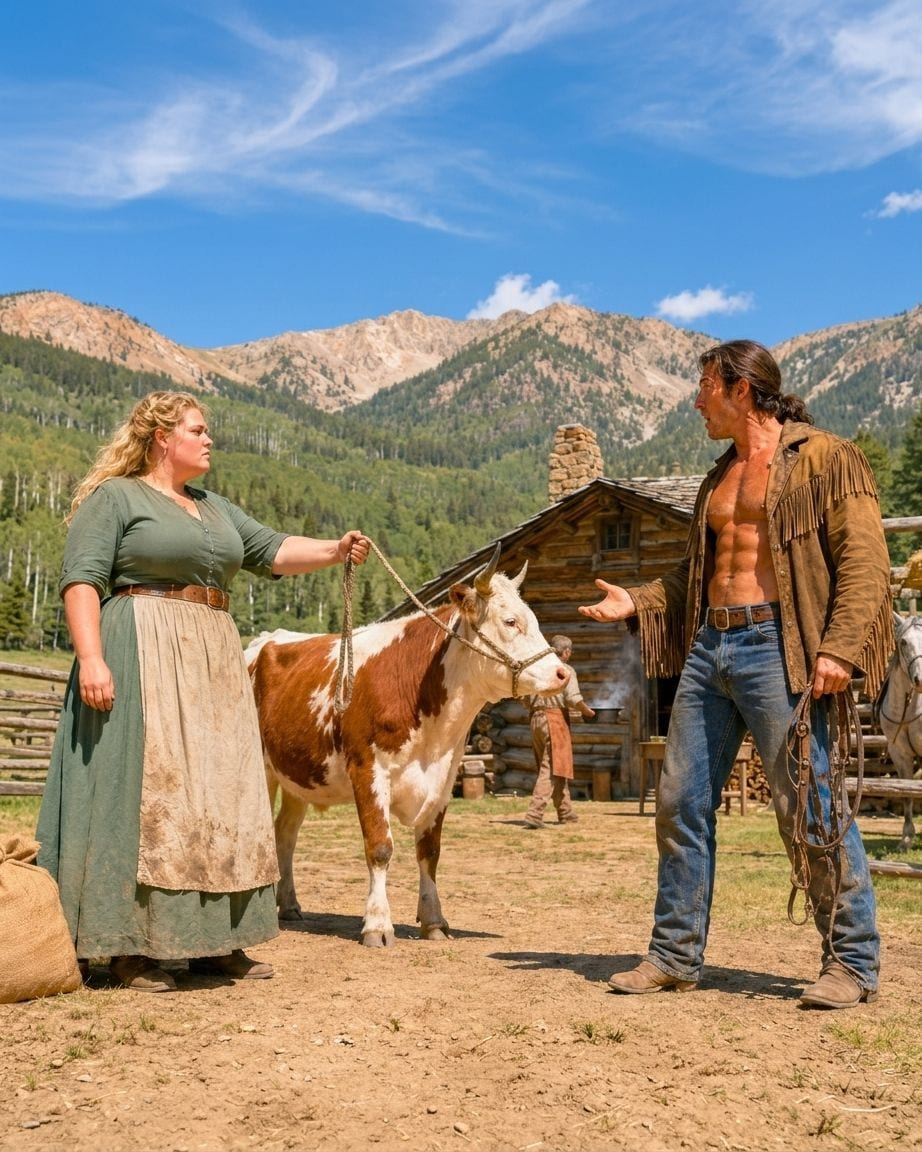
Martha Ogden stared at the four words written beneath her father's signature.
He is still alive.
The kitchen seemed to shrink around her.
For twenty-three years, she had believed her father lay beneath a weathered gravestone outside Twin Buttes. She had visited that grave with her mother every spring. She had pulled weeds from the earth, left flowers beside the stone, and whispered things she could never say to anyone living.
Now a stranger stood in Jesse Latham's kitchen with a letter suggesting that everything she knew about her father's death was a lie.
Martha looked up.
"Who wrote those words?"
Walter Reed hesitated.
"Milton Sloan."
"Then they're probably false."
Walter nodded slowly.
"Possibly."
"Possibly?"
He removed his spectacles and wiped them with a handkerchief.
"Miss Ogden, I didn't come here to ask you to believe Sloan. I came because I recognized your mother's name."
Jesse stepped closer to Martha.
"Explain."
Walter placed the letter on the table.
"I received this in Red Willow three days ago. Sloan's messenger said I was to deliver it if Martha Ogden returned a cow named Duchess to this ranch."
Martha frowned.
"How could he know I would do that?"
"He didn't know. He was preparing for the possibility."
Jesse's jaw tightened.
"Because she challenged the sale."
Walter nodded.
"Sloan expected you to act, Miss Ogden. He knew your mother had once helped my old friend Mrs. Latham keep records. Perhaps he suspected you'd inherited more than her recipes."
Martha looked down at the letter.
"And my father?"
Walter's expression grew troubled.
"That's the part I cannot explain."
"Did you know him?"
"Not well. I met Thomas Ogden twice."
Martha's breath caught.
Thomas.
She rarely heard her father's given name spoken aloud.
Her mother had always called him simply your father, as though saying his name might disturb something painful.
Walter continued.
"He worked as a clerk in Sloan's office. Quiet fellow. Excellent with figures. I remember that much."
"Was he dishonest?"
Walter looked genuinely startled.
"No."
Martha swallowed.
"Then why would Sloan claim he's alive?"
Walter folded his hands.
"Because Sloan wants something from you."
"What?"
"That," Walter said, "is what we must discover."
Jesse pulled out a chair.
"Sit down, Mr. Reed."
Walter lowered himself carefully onto the bench.
Martha noticed his hands.
They were broad and scarred, with thickened fingertips and a faint yellow stain beneath the nails.
Not the hands of a man who had spent his entire life behind a desk.
She looked at him more closely.
"Jesse said you handled estate accounts."
"I did."
"But you worked with Mrs. Latham?"
Walter smiled faintly.
"Long before I kept accounts, I made cheese."
Martha stared.
"Cheese?"
"Thirty years of it. My father had a dairy outside Red Willow. I learned to turn curd before I learned to shave."
For the first time that morning, Martha felt something besides fear.
"You knew Mrs. Latham's methods?"
"Some of them. She knew more than I did about hard cheeses."
Jesse looked between them.
"My mother used to mention a Walter who could tell when a cheese was ready just by knocking on it."
Walter chuckled.
"She said that because I had a terrible singing voice."
Martha almost smiled.
The old man's expression softened.
Then he noticed the papers spread across the table.
His smile vanished.
"Where did those come from?"
Jesse glanced at Martha.
"Under the milk house floor."
Walter went still.
"The iron box?"
"You knew about it?" Jesse demanded.
Walter looked toward the window.
"Your mother told me she'd hidden records somewhere safe. She never said exactly where."
"Men broke in last night and took most of them," Martha explained. "We recovered one sheet."
Walter reached for it.
His hands trembled as he read.
Then he whispered, "Eleanor was right."
Martha leaned forward.
"About what?"
"About Sloan."
He looked at Jesse.
"Your mother believed the mortgage had been paid before your father died. She asked me to examine the accounts, but by then Sloan controlled the original documents."
Jesse's expression darkened.
"And you did nothing?"
Walter accepted the accusation without protest.
"I did less than I should have."
The answer surprised Martha.
Most men she knew defended their mistakes before anyone finished naming them.
Walter simply looked ashamed.
"I had no proof," he continued. "And when your mother became ill, she asked me to wait."
"She died," Jesse said.
"Yes."
"And you kept waiting."
Walter lowered his head.
"Yes."
Silence settled over the kitchen.
Martha looked at Jesse.
His face was tight with grief.
She understood that his anger was not only for the money.
It was for the years.
Eleven years of believing his father had failed.
Eleven years of working beneath a debt that never seemed to shrink.
Eleven years of mourning a mother whose final efforts had been hidden from him.
Martha touched his sleeve.
He looked down at her.
She said quietly, "We have more now than she had."
Jesse held her gaze.
Then he nodded.
Walter reached into his satchel.
"I brought my old account books. If you have the receipts, we can reconstruct the balance."
Martha glanced at the damaged milk house through the window.
"And if the figures prove the debt was paid?"
"Then Sloan's claim can be challenged in court."
Jesse looked toward the pasture.
"And Duchess?"
"If the animal was never lawfully transferred, the creamery has no right to her."
Martha drew a slow breath.
For the first time, there was a path forward.
Not an easy one.
But a path.
Walter opened his ledger.
"Now, Miss Ogden, show me what you found."
They worked through the morning.
Martha arranged the receipts by date.
Walter checked the interest calculations.
Jesse brought every document he could find, including a bundle of letters his mother had kept in an old flour tin.
The kitchen table disappeared beneath paper.
At first, Walter worked cautiously.
Then his pencil began moving faster.
He stopped twice to recalculate.
Finally, he removed his spectacles.
"Well."
Martha looked up.
"What?"
"The balance Sloan claims is impossible."
Jesse leaned forward.
"Impossible?"
Walter pointed toward the figures.
"Even if we accept his interest rate, these payments should have reduced the debt considerably. Instead, the balance increases after several substantial payments."
Martha nodded.
"That's what I found."
Walter looked at her with new respect.
"You found this without the original account book?"
"With the receipts."
He smiled.
"Then you have a better head for figures than half the clerks I've trained."
Martha looked down quickly.
Praise still embarrassed her.
Jesse noticed.
He did not tease her.
He simply placed another sheet beside her hand.
"Here's one more."
Martha examined it.
Then frowned.
The date was wrong.
Not by a day.
By an entire year.
She compared it with the others.
"Jesse, when did your father die?"
"October of '78."
Martha pointed.
"This receipt is dated November of '79."
Walter leaned closer.
"So?"
"It carries his signature."
Jesse went still.
Walter took the paper.
He examined the writing.
Then the date.
His face changed.
"A payment signed by a dead man."
Martha looked toward Sloan's letter.
Her father's signature.
The claim that he was alive.
The forged warrant.
The false livestock sale.
She felt the pieces turning around one another.
Sloan had used signatures as weapons.
And signatures could be copied.
She picked up the letter again.
"Mr. Reed, how well did you know my father's handwriting?"
Walter considered.
"Well enough to recognize it, I think."
Martha placed the paper before him.
He studied the signature.
For a long time, he said nothing.
Then he opened his satchel and removed a small notebook.
He turned several pages.
Near the back was a folded memorandum.
Walter placed it beside the letter.
"Thomas wrote this for me twenty-four years ago."
Martha leaned closer.
The two signatures were similar.
But not identical.
The old memorandum carried a distinctive curl beneath the final letter.
The newer signature lacked it.
Martha pointed.
"There."
Walter nodded.
"I see it."
Jesse looked at both.
"So Sloan forged it."
"Perhaps," Walter said. "But there's another possibility."
Martha looked up.
"What?"
Walter hesitated.
"Your father may have changed the way he signed his name."
Martha stared.
"After he died?"
Walter did not answer.
The question hung between them.
At noon, Jesse insisted they stop working.
Martha had forgotten to eat.
Walter's hands were trembling from hunger.
Jesse warmed the leftover stew while Martha prepared fresh biscuits.
The old cheesemaker watched her work.
"You learned from your mother?"
"Everything I know."
"She was a remarkable woman."
Martha paused.
"You knew her well?"
Walter looked at the flour on her hands.
"Better than you might think."
Something in his tone made her look up.
But he turned away before she could ask another question.
During the meal, Walter told stories about Mrs. Latham.
How she once argued with a cattle buyer for forty minutes over the price of a sick calf.
How she built the milk house because she refused to let spring milk spoil.
How she could judge the quality of cream from the way it clung to a wooden spoon.
Jesse listened quietly.
Martha watched his face soften.
For a little while, the old man's stories returned his mother to the kitchen.
Not as a woman dying in bed.
But as someone laughing, working, arguing, and living.
Martha was grateful for that.
After the meal, Walter asked to see the milk house.
Jesse led them across the yard.
The broken door hung crookedly.
Stone dust covered the floor.
The slab Vane's men had lifted remained beside the spring channel.
Walter stood in the doorway for a long time.
"She built it well," he murmured.
Martha moved toward the copper kettle.
She ran her fingers along its rim.
Despite everything, the building still filled her with longing.
She imagined milk warming over a careful fire.
Curds gathering beneath her hands.
Fresh cheese resting on the shelves.
She imagined waking each morning with work that belonged to her.
Jesse noticed her expression.
"You still want to use it?"
Martha turned.
"After what happened?"
"Yes."
She hesitated.
"Very much."
"Then we should repair the door."
Walter looked between them.
A small smile appeared.
"That sounds sensible."
Martha shook her head.
"But the mortgage covers anything made from the cattle."
Walter nodded.
"It may. Until we establish whether the lien is valid."
"Then Sloan could take every cheese I make."
"Possibly."
Martha looked at the empty shelves.
For a moment, hope seemed foolish.
Then Walter spoke.
"There's a difference between making cheese and selling it."
She turned.
"What do you mean?"
"If we can document the milk, the labor, and the finished product separately, we may be able to establish an independent claim to the value of your work. It won't remove every risk, but it will give us records."
Martha considered.
"Records Sloan can't alter?"
"Records he doesn't control."
Jesse looked at her.
"Would you try?"
Martha stared at the kettle.
Then at the press.
Then at the man who had offered her supper when she had nowhere left to go.
"Yes," she whispered.
Jesse smiled.
Not broadly.
Not dramatically.
But enough to make her heart stumble.
"Then we'll start tomorrow."
Walter cleared his throat.
"I'll help."
Martha looked at him.
"With the cheese?"
"With the accounts. Though I may still remember how to turn a curd."
She laughed.
The sound echoed against the stone walls.
For one brief moment, the milk house felt alive again.
Then Walter noticed something.
He crouched beside the opening beneath the floor.
His expression changed.
"What is it?" Jesse asked.
Walter reached into the narrow space.
His fingers brushed the stone.
Then he withdrew a small piece of red thread.
Martha recognized it.
The same thread used to stitch the hidden pages into her mother's recipe book.
Walter stared at it.
"She used the old system."
Martha frowned.
"What system?"
Walter looked up.
"Your mother and Mrs. Latham used matching marks to identify duplicate records. Red thread meant the document had been copied and concealed."
Martha felt her pulse quicken.
"Then there may be more?"
Walter nodded.
"Possibly."
He examined the opening again.
Then stood.
"But if Sloan knows about the thread, he'll know where to look."
Jesse glanced toward the road.
"We need to keep the remaining papers safe."
Walter agreed.
"I'll take copies to Red Willow. There are people there who owe Sloan nothing."
Martha looked at him.
"Can you trust them?"
Walter's expression grew serious.
"More than I trust the county office."
They returned to the house.
By late afternoon, Martha had copied every document they possessed.
Her hand ached.
But she did not stop.
Walter sealed the copies inside his satchel.
Before leaving, he stood beside the kitchen table.
"Miss Ogden, there's something I should have told you this morning."
Martha looked up.
Walter glanced at Jesse.
Then back at her.
"I knew your mother was afraid of Sloan. But I didn't know why until after she died."
Martha's heart tightened.
"Why?"
Walter removed a folded newspaper clipping from his pocket.
It was yellowed and brittle.
The headline described the wagon accident that supposedly killed Thomas Ogden.
Martha recognized the date.
She had seen it engraved on her father's gravestone.
Walter placed the clipping before her.
"Read the last paragraph."
Martha leaned closer.
The article stated that a wagon had overturned on a mountain road.
The driver was presumed to be Thomas Ogden.
His coat and personal effects were recovered.
But the body had been badly damaged.
Identification had been made by the items found nearby.
Martha stared.
"Presumed?"
Walter nodded.
"No one who knew your father well ever saw his face."
Jesse leaned over her shoulder.
"Then who was buried?"
Walter looked troubled.
"That's the question."
Martha felt cold.
She remembered the funeral only in fragments.
A black dress.
Rain.
Her mother's hand gripping hers.
A wooden coffin.
She had been six.
She had never questioned what lay inside.
Walter folded the clipping carefully.
"I don't know whether Thomas survived. I don't know whether Sloan's letter is a lie. But I know the death was never properly established."
Martha looked toward the window.
The mountains rose beyond the pasture.
Somewhere beyond them, perhaps, was a man she had spent her life mourning.
She did not know whether to hope.
Hope had always been dangerous.
It made disappointment sharper.
Walter prepared to leave.
Jesse walked him to the wagon.
Martha remained in the kitchen, holding the clipping.
A few minutes later, Jesse returned.
He found her standing beside the mantel.
"Are you all right?"
She shook her head.
"I don't know."
He came closer.
Martha looked at him.
"What if he's alive?"
Jesse said nothing.
"What if he knew where I was all these years?"
Her voice broke.
"What if he chose not to come back?"
Jesse reached for her hand.
Martha let him take it.
"I don't know what happened to your father," he said quietly.
She looked down.
"But whatever happened, you deserved the truth."
Martha closed her eyes.
For a moment, she leaned toward him.
Jesse did not move away.
His hand remained around hers.
Warm.
Steady.
She could hear his breathing.
Feel the quiet strength of him standing beside her.
Then a horse whinnied outside.
Jesse looked toward the window.
A rider was approaching from the eastern road.
Not Walter.
Not the sheriff.
A woman.
She rode a dark bay horse and wore a long gray traveling coat.
A leather case was strapped behind her saddle.
She stopped at the gate.
Jesse stepped onto the porch.
Martha followed.
The woman dismounted.
She was perhaps forty, with sharp blue eyes and dark hair pinned beneath a plain hat.
She looked at Martha.
Then at Jesse.
"Which of you is Martha Ogden?"
Martha stepped forward.
"I am."
The woman removed her gloves.
"My name is Clara Whitcomb. I'm a physician from Denver."
Martha frowned.
"A physician?"
Clara nodded.
"I've been searching for you."
"Why?"
The woman hesitated.
Then reached into her coat.
She withdrew a small photograph.
Martha stared at it.
A man sat in a wooden chair.
His hair was gray.
His face was thin.
But his eyes—
Martha knew those eyes.
She had seen them in the faded portrait her mother kept beside her bed.
Her breath caught.
Clara watched her carefully.
"Do you recognize him?"
Martha could barely speak.
"My father."
Clara nodded.
"Thomas Ogden."
Jesse moved closer.
Martha gripped the porch rail.
"Where is he?"
Clara's expression changed.
"Before I tell you, you need to understand something."
Martha stared.
The physician looked toward the road.
Then lowered her voice.
"Thomas Ogden has been living under another name for twenty-three years."
Martha felt the world tilt.
"Why?"
Clara swallowed.
"Because someone made certain he could never safely return."
Martha's hands began trembling.
"Who?"
Clara looked at Jesse.
Then back at Martha.
She opened her leather case.
Inside was a sealed medical record.
Across the front was written a name.
Not Thomas Ogden.
Another name.
Martha leaned closer.
Clara broke the seal.
She unfolded the first page.
Then her face went pale.
She looked toward the eastern road.
A second rider had appeared on the ridge.
Clara snapped the case shut.
"Get inside," she whispered.
Jesse stepped forward.
"What is it?"
Clara's voice shook.
"I was followed."
The rider stopped at the top of the hill.
He raised one hand.
In it was a rifle.
Clara grabbed Martha's arm.
"Don't let him see the photograph."
Jesse reached for the shotgun beside the door.
But the rider had already lifted the rifle to his shoulder.
And the man he was aiming at was not Jesse.
It was Martha.






Comments 0