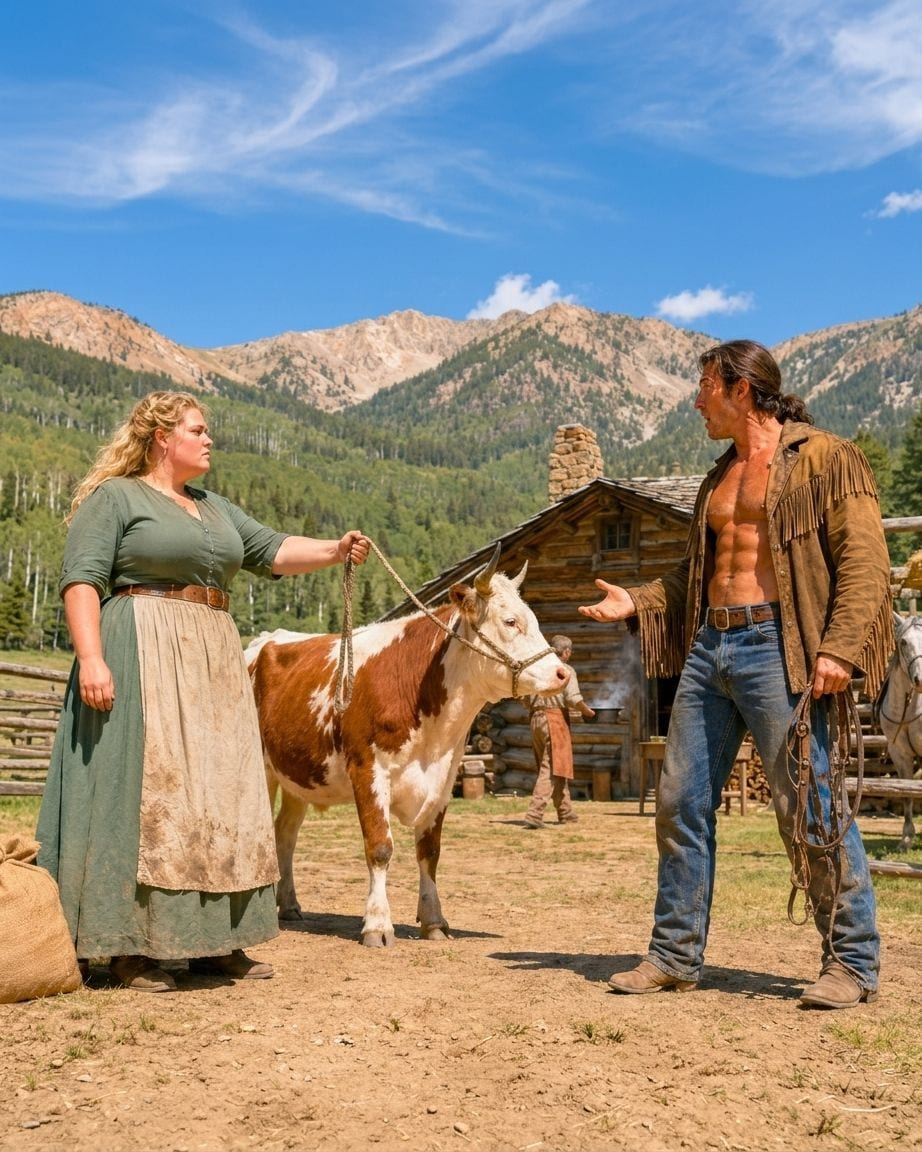
Martha Ogden stared at her name on the paper.
For a moment, she forgot about her bleeding feet.
She forgot about the twenty-two miles she had walked and the old cow grazing peacefully beyond the fence.
All she could see was the familiar handwriting of Milton Sloan.
MARTHA OGDEN.
The letters were written in thick black ink beneath an official seal.
Jesse Latham stood beside her on the porch, holding the document between two weathered fingers.
"How does he know I'm here?" Martha whispered.
Jesse looked at her.
"He doesn't."
"Then why is my name on that paper?"
"That's what I've been trying to figure out."
He turned the page toward her.
Martha leaned closer.
The document was a formal notice concerning livestock claimed under a chattel mortgage. It listed eleven animals transferred to the Twin Buttes Cooperative Creamery, including one described as an eight-year-old red cow, sound in all quarters.
At the bottom, beneath Sloan's signature, someone had added a sentence in smaller handwriting.
Any person interfering with the disposition of said property, including one Martha Ogden, shall be held personally responsible for losses arising from such interference.
Martha read it twice.
Then a third time.
Her stomach tightened.
"He knew."
Jesse frowned.
"Knew what?"
"That I would try to bring her back."
Jesse looked toward Duchess.
The old cow had found a patch of grass near the fence and was eating with the complete indifference of an animal unaware that powerful men were arguing over her existence.
"How could he know that?" Jesse asked.
Martha shook her head.
"I challenged him yesterday morning. I told the creamery board that the description was false. He had me dismissed."
Jesse's expression hardened.
"He fired you?"
"The board did."
"Because you recognized my cow?"
"Because I wouldn't stop saying she was yours."
For several seconds, Jesse said nothing.
Martha watched his face carefully.
She knew that look.
It was the moment when people began calculating how much trouble she might bring into their lives.
She had seen it in employers, landlords, neighbors, and the few men who had briefly considered courting her.
The calculation always ended the same way.
Martha reached for her grain sack.
"I should go."
Jesse did not move.
"Why?"
"Because Mr. Sloan is a powerful man, and I won't have him making trouble for you on my account."
Jesse folded the document.
"He's already making trouble for me."
"That doesn't mean you need more."
He studied her.
"Miss Ogden, did you steal that cow?"
Martha felt the question like a blow.
Her face burned.
"I took her from the creamery yard."
"That wasn't what I asked."
She looked up.
Jesse's eyes remained steady.
"Did you steal her?"
Martha swallowed.
"No."
"Then we're agreed."
He tucked the paper into his jacket.
Martha stared at him.
She had expected a lecture.
Perhaps a warning.
Perhaps an explanation of how foolish she had been.
Instead, he turned toward the door.
"Come inside before you fall down."
She hesitated.
"Mr. Latham—"
"Jesse."
"What?"
"My name is Jesse."
He opened the door.
"And supper doesn't improve while we stand outside discussing it."
Martha almost smiled.
Almost.
Then she followed him into the house.
The first thing she noticed was how clean everything was.
Not polished. Not decorated. Not arranged to impress visitors.
Clean.
The wooden floor had been scrubbed until the grain showed pale beneath the years of use. A cast-iron stove stood against one wall. A long table occupied the center of the room, with two chairs on one side and a narrow bench on the other.
A shelf held nearly forty books.
Martha noticed titles about livestock, medicine, agriculture, and history.
There were also several novels.
She had not expected novels.
A woman's photograph rested face down on the mantel.
Martha saw it but did not ask.
Beside the stove stood a loaf of bread that had risen unevenly and collapsed on one side.
Jesse noticed her looking at it.
"Before you say anything," he remarked, "I already know."
Martha blinked.
"Know what?"
"That bread's a disgrace."
She looked at the loaf.
Then at him.
A small laugh escaped her.
Jesse's mouth moved slightly.
It was not quite a smile.
But it was close.
He set her grain sack beside the table.
"Sit down."
"I can help."
"You've walked twenty-two miles."
"I've worked longer days than this."
"I believe you."
The answer stopped her.
There was no challenge in it.
No sarcasm.
He simply believed her.
Jesse pulled out a chair.
Martha looked at it.
The chair was narrow.
She had spent a lifetime judging furniture before sitting down.
At the creamery, she always chose the heavy bench near the stove because the office chairs were too small.
At church, she sat at the end of a pew so nobody would complain about the space she occupied.
At public dinners, she often stood until everyone else had found a seat.
Jesse followed her gaze.
Without saying anything, he moved the chair aside and pulled the long bench closer to the table.
Martha felt heat rise into her cheeks.
She waited for the explanation.
For the awkward joke.
For the little apology that somehow made the humiliation worse.
None came.
Jesse simply returned to the stove.
"Elk stew," he said. "Potatoes. Bread, if you're brave."
Martha sat carefully.
The bench held her comfortably.
She looked down at her hands.
They were trembling.
She told herself it was exhaustion.
Nothing more.
Jesse placed a bowl before her.
Steam rose from the dark broth.
The smell of meat, onions, and potatoes filled the room.
Martha had eaten nothing but stale bread since leaving Twin Buttes.
Her stomach tightened painfully.
"Go ahead," Jesse said.
She lifted her spoon.
The first mouthful nearly made her cry.
It was hot.
It was nourishing.
And someone else had prepared it for her.
She ate slowly at first, conscious of Jesse sitting across from her.
She had learned to eat carefully in front of strangers.
People watched large women eat.
They noticed second helpings.
They counted slices of bread.
They made remarks about appetite and self-control as though hunger were a moral failure.
Jesse ate his own supper without looking at her plate.
When her bowl was empty, he reached for the pot.
"More?"
Martha hesitated.
"No, thank you."
He glanced at her.
"There's plenty."
"I'm quite satisfied."
Her stomach betrayed her with a low growl.
Jesse looked down at the pot.
Then he quietly filled her bowl.
He did not comment.
Martha stared at the food.
She had been offered charity before.
She had been given leftovers.
She had been told to be grateful for scraps.
This was different.
Jesse had simply noticed that she was hungry.
And fed her.
For a long while, neither spoke.
The silence was surprisingly comfortable.
Outside, the last sunlight faded from the mountains.
The house grew warm around the stove.
Finally, Jesse set down his spoon.
"Tell me about the creamery."
Martha stiffened.
"What about it?"
"The sale."
She looked toward the window.
"Eleven cows came in. Sloan called it a foreclosure. The manager said the cooperative had purchased them against a debt."
"Whose debt?"
"He wouldn't say."
Jesse leaned back.
"Mine, apparently."
Martha looked at him.
"You owe Mr. Sloan money?"
"Most ranchers around here do."
"How much?"
Jesse hesitated.
Then he answered.
"Enough."
Martha understood the reluctance.
Debt was a private wound.
In Twin Buttes, people spoke of another person's mortgage with the same pleasure they took in discussing a scandal.
She did not press him.
Instead, she said, "The description was wrong."
"I know."
"Not just the age. The horn. The quarter. Everything."
Jesse nodded slowly.
"My mother raised that cow from a calf."
Martha looked at him.
"She used to bring her cream to the cooperative."
"Before she got sick."
"Yes."
Jesse's gaze moved toward the mantel.
Martha followed it.
The photograph lay face down.
He noticed.
For a moment, his expression closed.
Then he said quietly, "She died eleven years ago."
"I'm sorry."
He nodded.
"She built the milk house."
Martha's eyes lifted.
"The stone building by the creek?"
"That's the one."
"Your mother used to talk about it."
Jesse looked surprised.
"You knew her?"
"She taught me how to test cream without instruments."
Something softened in his face.
"That sounds like her."
Martha smiled faintly.
"She said a person who couldn't understand milk had no business trying to make cheese."
Jesse gave a low laugh.
It was a brief sound.
But it changed his entire face.
Martha looked away before he noticed her watching.
They spoke for another hour.
Not about anything important.
The winter snowfall.
The price of flour.
The difficulty of keeping calves healthy during a cold spring.
Martha discovered that Jesse had nineteen cows, four recently freshened.
He discovered that she had made cheese for twenty-three years.
When she mentioned the number, he stared at her.
"Twenty-three?"
"Since I was fifteen."
"And they dismissed you in ninety seconds?"
Martha looked down.
"About that."
Jesse's jaw tightened.
He did not speak for a moment.
Then he said, "They were fools."
Martha raised her eyes.
Nobody had ever described the creamery board that way in her presence.
She did not know what to say.
So she said nothing.
After supper, she insisted on washing the dishes.
Jesse protested once.
She protested twice.
He surrendered.
Martha stood at the basin, working warm water over the plates.
It felt good to do something familiar.
Her body hurt terribly, but her hands knew the rhythm.
Jesse dried the dishes beside her.
Their shoulders nearly touched.
Martha became painfully aware of his size.
He was taller than any man she had ever known.
Broad enough to fill a doorway.
Yet he moved around her with a quiet consideration that made the small kitchen feel spacious.
When she finished, he pointed toward a narrow staircase.
"There's a room upstairs."
Martha turned.
"For whom?"
"You."
She stared.
"I can't stay."
"Why not?"
"Because it wouldn't be proper."
Jesse considered this.
Then he nodded toward the barn.
"I can sleep out there."
Martha blinked.
"You would sleep in the barn?"
"There's a cot."
"But this is your house."
"And you're my guest."
She looked at him.
He seemed genuinely puzzled by her objection.
"Mr. Latham—"
"Jesse."
"Jesse, I don't want to inconvenience you."
He folded the dish towel.
"Miss Ogden, you've already walked twenty-two miles to return something that belonged to my family. I think I can manage a night in my own barn."
Martha lowered her eyes.
She was dangerously close to crying again.
She hated it.
She had spent years teaching herself not to cry in front of other people.
Tears invited pity.
Pity invited questions.
Questions invited humiliation.
But Jesse simply picked up a lantern.
"There's clean bedding upstairs. Wash water in the pitcher. I'll bring more wood before morning."
He moved toward the door.
Martha stopped him.
"Why?"
He turned.
"Why what?"
"Why are you being so kind to me?"
Jesse looked genuinely surprised.
"Shouldn't I be?"
The question struck her harder than any insult could have.
Martha opened her mouth.
No answer came.
Jesse waited.
Then he said softly, "You look tired, Martha."
It was the first time he had used her given name.
She felt it somewhere deep inside her chest.
"Get some sleep."
He stepped outside.
The door closed gently behind him.
Martha remained standing in the kitchen.
For several minutes, she did not move.
Then she climbed the stairs.
The bedroom was small but comfortable.
A narrow bed stood beneath a window overlooking the pasture.
A folded quilt rested at its foot.
There was a washstand, a wooden chair, and a small shelf.
Nothing fancy.
Nothing unnecessary.
Martha placed her grain sack on the floor.
She removed her boots.
The stockings had dried against the broken skin.
Pulling them free brought tears to her eyes.
She washed her feet carefully, wrapped them in clean strips of cloth, and sat on the bed.
Outside, she could see a lantern moving toward the barn.
Jesse.
He was carrying his bedding.
Martha watched until the light disappeared inside.
Then she lay down.
The mattress was softer than anything she had slept on in years.
She closed her eyes.
But sleep did not come immediately.
Instead, she thought about the paper.
Her name.
Sloan's signature.
The warning.
She remembered the way Sloan had looked at her through the creamery office window.
He had known she might interfere.
Perhaps he had expected it.
Perhaps the document was intended to frighten her into silence.
But why send it to Jesse before she arrived?
She turned onto her side.
The question would not leave her.
At last, exhaustion overcame it.
She slept deeply.
When she woke, the room was still dark.
For a moment, she did not know where she was.
Then she heard a sound from downstairs.
Wood being placed into the stove.
A kettle shifting.
Someone moving quietly through the kitchen.
Martha sat up.
She looked toward the window.
The first gray light of morning was just beginning to touch the mountains.
She dressed carefully.
Her feet still hurt, but the swelling had eased.
When she descended the stairs, Jesse was standing beside the stove.
He had already lit the fire.
A pot of coffee warmed on the iron surface.
He looked up.
"Morning."
Martha stopped on the bottom step.
"How long have you been awake?"
"Since four."
"Why?"
"Cows don't care what time people want breakfast."
He poured coffee into a cup.
Then he handed it to her.
Martha accepted it with both hands.
The warmth seeped into her fingers.
"Thank you."
Jesse nodded.
"I'll be outside."
He picked up his hat.
Martha watched him move toward the door.
Then she remembered something.
"Jesse?"
He stopped.
"Yes?"
"Could I see the milk house?"
He looked at her.
For the first time that morning, something uncertain crossed his face.
"The milk house?"
"Your mother's."
He glanced toward the creek.
"Nobody's used it in eleven years."
"Would you mind?"
Jesse studied her for a moment.
Then he nodded.
"Finish your coffee."
Ten minutes later, they crossed the yard together.
The morning air was cold.
Duchess stood near the fence, watching them with sleepy eyes.
Martha stopped to scratch behind the cow's damaged ear.
Jesse waited.
Then he led her toward the small stone building beside the creek.
The walls were thick.
The roof was slate.
A narrow channel carried spring water beneath the foundation.
Martha noticed the craftsmanship immediately.
Mrs. Latham had built this place to last.
Jesse stopped at the door.
He took a heavy iron key from his pocket.
The lock resisted.
He turned it again.
Finally, it opened.
The door creaked inward.
Martha stepped inside.
And stopped breathing.
Slate shelves lined the walls.
A copper kettle stood beneath a broad chimney.
Wooden cheese hoops were stacked carefully on a workbench.
An old press occupied the far corner.
A narrow channel carried cold spring water through the stone floor.
Dust covered everything.
But beneath the dust, Martha saw something extraordinary.
A complete cheesemaking operation.
Not a poor farmer's improvised kitchen.
Not a collection of broken tools.
A proper milk house.
Designed by someone who had understood the craft.
Martha walked slowly toward the copper kettle.
She touched its rim.
Then the press.
Then the smooth stone shelves.
Her hands began to tremble.
"Your mother built all this?"
Jesse nodded.
"She made cheese for most of upper Elkhorn."
Martha turned toward him.
"And after she died?"
"Nobody knew how to use it."
"You didn't learn?"
He shook his head.
"She said it was women's work. Figured she'd teach me someday."
His voice grew quieter.
"Someday never came."
Martha looked around the room.
"How many cows did you say you had?"
"Nineteen."
"How many fresh?"
"Four."
"And the milk?"
Jesse looked embarrassed.
"Mostly goes to the pigs."
Martha stared at him.
"All of it?"
"Most."
She pressed one hand against her mouth.
Four fresh cows.
A spring-cooled milk house.
A copper kettle large enough to process a day's milk.
Cheese hoops.
A press.
Everything she needed.
Everything she had spent her life learning to use.
For the first time since leaving Twin Buttes, Martha felt something stronger than fear.
Possibility.
She moved toward the press and brushed dust from its wooden frame.
"Does this still work?"
"I suppose."
"Has anyone checked the screws?"
"No."
"The spring channel?"
"Runs year-round."
"The kettle?"
"Doesn't leak."
Martha looked at him.
Her eyes were shining.
"Jesse, do you understand what you have here?"
He glanced around.
"A building full of things I don't know how to use."
She almost laughed.
"No."
She touched the copper kettle again.
"You have a dairy."
Jesse looked at her for a long moment.
Then he said something that made her heart stumble.
"Then perhaps it's time somebody used it."
Martha stared.
She did not dare ask whether he meant her.
Before she could speak, a sharp metallic sound came from outside.
Both turned toward the door.
A horse was approaching at speed.
Jesse's expression changed.
He moved toward the window.
Martha followed.
Down the ranch road, a rider in a black oilcloth coat was coming toward the house.
The same coat worn by the man who had delivered the eleven cattle to the creamery.
Jesse stepped away from the window.
"Stay here."
Martha's stomach dropped.
The rider reached the yard.
He dismounted.
Then he pulled a folded document from inside his coat.
Across the front, in large black letters, Martha could read two words.
ARREST WARRANT.
The man looked directly toward the milk house.
He raised his voice.
"Martha Ogden!"
Jesse moved toward the door.
But the rider was already reaching beneath his coat.
And what he drew out was not another piece of paper.






Comments 0